 Busirank Team
Introduction
You check your Google Business Profile, and there it is—a scathing one-star review from someone you’ve never heard of. The details don’t match your business. The name isn’t in your customer records. The timing feels suspicious. You’re almost certain it’s fake.
Now what?
For many business owners, this is where frustration sets in. You know the review is fake, but you don’t know how to get it removed. You’ve heard horror stories about Google ignoring reports. You worry the review will drag down your rating and scare away customers. And you feel powerless to stop it.
Here’s the truth: Google does remove fake reviews—but only if you report them correctly. The process isn’t complicated, but it does require the right approach, solid evidence, and patience. Businesses that follow the proper steps succeed far more often than those that give up after one attempt.
In this comprehensive guide, we’ll walk you through exactly how to report fake Google review content. We’ll cover how to confirm a review is fake, how to report it through Google’s system, what evidence to include, what to do if Google rejects your report, and how to prevent future attacks. By the end, you’ll have a clear, actionable playbook for protecting your reputation.
What Counts as a Fake Google Review?
Before you report a review, it’s important to confirm it actually violates Google’s policies. Not every negative review is fake. Some are legitimate complaints from real customers. Reporting genuine feedback won’t get it removed—and it could make you look like you’re trying to hide valid criticism.
According to Google’s review policies, a review can be reported and removed if it:
- Contains spam or fake content: The review was posted by someone who was never a customer or was created by a bot.
- Is off-topic: The review discusses something unrelated to your business or your industry.
- Contains restricted content: Hate speech, harassment, or offensive language.
- Contains illegal content: Anything that violates the law.
- Includes personal information: Names, phone numbers, addresses, or other private details.
- Involves a conflict of interest: Reviews from competitors, former employees, or people with a vested interest in harming your business.
- Is impersonation: Someone pretending to be a customer they’re not.
- Is promotional: Reviews that advertise another business or include links. If a review violates any of these policies, it’s eligible for removal.
How to Confirm a Review Is Fake
Before you report, gather evidence. Here’s how to confirm a review is fake.
Check Your Customer Records
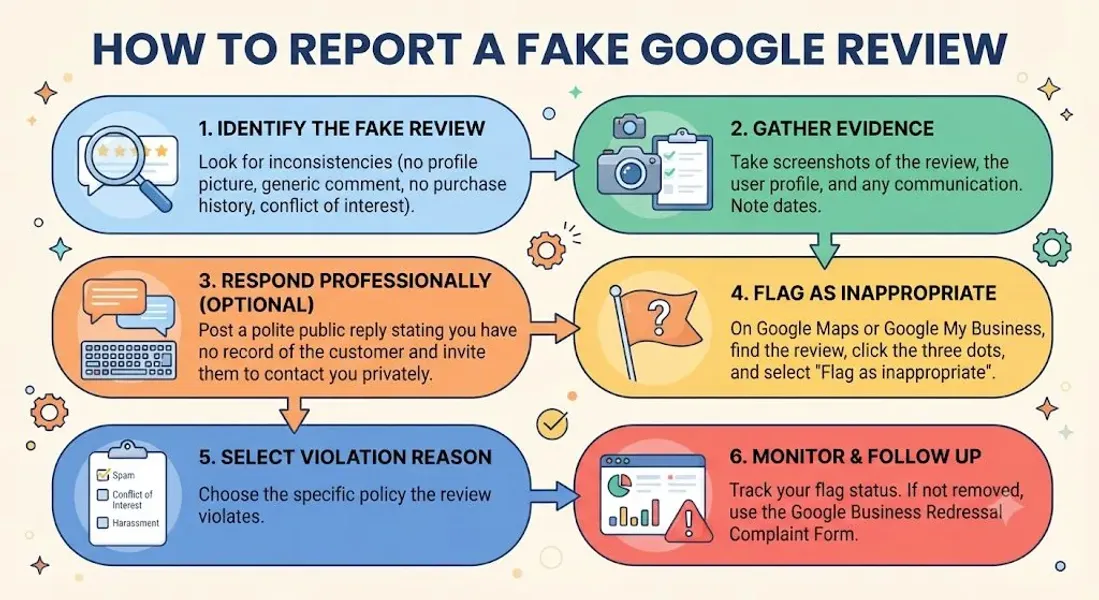
Search your database, appointment system, email, or point-of-sale records for the reviewer’s name. If you can’t find them anywhere, that’s a red flag.
Examine the Reviewer’s Profile
Click on the reviewer’s name to view their Google profile. Look for:
- Number of reviews: Accounts with only one review—yours—are suspicious.
- Review history: A pattern of negative reviews for local businesses suggests a serial fake reviewer.
- Profile completeness: Fake accounts often have no photo, no bio, and no other activity.
- Timing: When was the account created? If it’s brand new, that’s a red flag.
Analyze the Review Content
Fake reviews often have telltale signs:
- Vague complaints: “Terrible service” without specifics.
- Exaggerated language: Overly dramatic or emotional claims.
- Inaccurate details: Mentions products, services, or experiences your business doesn’t offer.
- Incoherent text: Gibberish, repetitive phrases, or irrelevant content.
- Promotional mentions: References to competitors or links to other sites.
Check the Timing
When was the review posted? If it appeared right after a dispute with a customer, a former employee, or a competitor’s opening, that’s suspicious. Multiple negative reviews posted within hours suggest a coordinated attack.
Look for Patterns
Has the same reviewer left fake reviews on other businesses? Have other local businesses in your area experienced similar attacks? Patterns suggest a coordinated effort.
Document Everything
Take screenshots of:
- The review
- The reviewer’s profile
- Any evidence the reviewer isn’t a customer
- Any pattern of fake reviews across multiple businesses You’ll need this documentation for your report.
How to Report a Fake Google Review: Step-by-Step
Once you’ve confirmed a review is fake, here’s how to report it.
Step 1: Sign In to Your Google Business Profile
Go to google.com/business and sign in with the Google account associated with your business.
Step 2: Navigate to Your Reviews
Find the review you want to report. You can access reviews from your dashboard or directly from your Google Maps listing.
Step 3: Click the Three-Dot Menu
Next to the review, click the three dots (or three horizontal lines, depending on your device). This opens a menu of options.
Step 4: Select “Report Review”
Choose “Report review” from the menu. This opens a reporting form.
Step 5: Choose the Reason for Reporting
Google will ask why you’re reporting the review. Select the most appropriate reason:
- Spam or fake content
- Off-topic
- Restricted content
- Illegal content
- Personal information
- Conflict of interest
- Impersonation
- Promotional content Choose the reason that best describes the violation.
Step 6: Provide Additional Details
If Google asks for more information, provide it. Be clear and concise. Explain why the review violates Google’s policies. Include any evidence you have.
Step 7: Submit Your Report
Click “Submit” to send your report to Google. You’ll receive a confirmation that your report was received.
Step 8: Wait for Google’s Response
Google reviews reports and may remove the review if it violates policies. This can take a few days to a few weeks.
Step 9: Check Your Email
Google will notify you by email about the outcome of your report. Check your inbox (and spam folder) for updates.
Step 10: Follow Up If Needed
If the review isn’t removed, you can escalate through Google Business Profile support. Be persistent but polite.
Reporting a Fake Review on Mobile
If you’re using the Google Maps app, here’s how to report a fake review.
Step 1: Open Google Maps
Launch the Google Maps app on your phone.
Step 2: Find Your Business
Search for your business and tap on your listing.
Step 3: Go to Reviews
Scroll down to the reviews section and find the review you want to report.
Step 4: Tap the Three-Dot Menu
Tap the three dots next to the review.
Step 5: Select “Report Review”
Choose “Report review” from the menu.
Step 6: Choose a Reason
Select the reason for reporting and submit.
What Evidence Should You Include?
Google reviews reports based on the information you provide. The more evidence you include, the better your chances of removal.
Proof the Reviewer Isn’t a Customer
- Screenshots of your customer database showing no record of the reviewer
- Appointment logs
- Point-of-sale records
- Email correspondence showing no contact
Proof the Review Is Fake
- Screenshots of the reviewer’s profile showing suspicious activity
- Evidence of a pattern of fake reviews
- Documentation of a dispute with the reviewer
- Evidence of a coordinated attack
Proof the Review Violates Policies
- Screenshots of offensive language
- Evidence of promotional content
- Documentation of personal information shared
- Evidence of impersonation
A Clear Explanation
Write a brief, factual explanation of why the review violates Google’s policies. Avoid emotional language. Stick to the facts.
What to Do If Google Rejects Your Report
Sometimes Google rejects reports, even when the review is clearly fake. Here’s what to do.
Re-Report With More Evidence
If your first report was rejected, try again with additional evidence. Sometimes a more detailed report succeeds where a brief one fails.
Escalate Through Google Support
Contact Google Business Profile support directly. Explain the situation and provide your evidence. Be persistent but polite.
Respond Professionally to the Review
If the review stays up, respond professionally. Don’t argue or accuse the reviewer of lying. Instead, acknowledge the feedback, clarify any factual errors, and offer to resolve the issue offline.
Example: “We take all feedback seriously, but we don’t have a record of your visit. If this is a mistake, please contact us at [email/phone] so we can look into it. We’re committed to providing excellent service to all our customers.”
Bury It With Positive Reviews
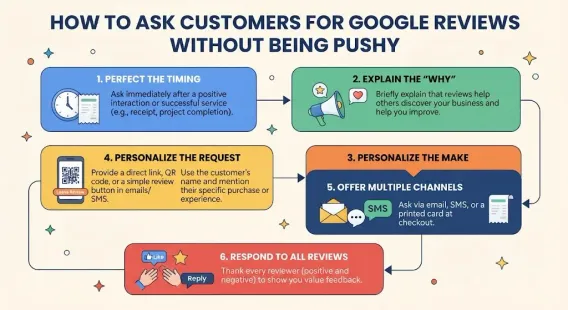
The best defense against fake reviews is a steady stream of genuine positive reviews. Ask satisfied customers to leave reviews regularly. Over time, positive reviews will dilute the impact of the fake one.
For more, see our guide on ask for Google reviews.
Report the Reviewer
If the reviewer has left fake reviews on other businesses, report their profile to Google. This can result in their account being removed.
Consider Legal Action
In extreme cases, you may have legal options. If a fake review contains defamatory statements, you may be able to pursue legal action against the reviewer. Consult with an attorney.
Monitor and Document
Keep monitoring your profile for additional fake reviews. Document everything. If the attacks continue, you can escalate to Google and potentially pursue legal action.
Common Mistakes to Avoid When Reporting Fake Reviews
Avoid these mistakes to improve your chances of removal.
Reporting Legitimate Negative Reviews
Not every negative review is fake. If a real customer left a negative review, reporting it won’t get it removed—and it could hurt your credibility with Google.
Providing Insufficient Evidence
Google needs proof. Screenshots, customer records, and clear explanations all help. Don’t just say “This review is fake”—show why.
Being Emotional or Aggressive
Emotional reports are less effective. Stick to the facts and be professional.
Giving Up After One Attempt
If your first report is rejected, try again. Persistence pays off.
Not Responding to the Review
If the review stays up, respond professionally. Ignoring it makes you look like you don’t care.
Buying Fake Positive Reviews to Compensate
Buying fake reviews violates Google’s policies and can result in penalties or suspension. Earn reviews honestly.
Not Monitoring Your Profile
Fake reviews can appear at any time. Monitor your profile regularly so you can catch and report them quickly.
How to Prevent Fake Google Reviews
You can’t prevent every fake review, but you can reduce your risk.
Claim and Verify Your Profile
An unclaimed or unverified profile is more vulnerable to attacks. Claim and verify your profile to maintain control.
Build a Strong Review Profile
The more genuine positive reviews you have, the less impact a fake negative review will have.
Monitor Your Profile Regularly
Check your reviews daily or weekly. The sooner you catch a fake review, the sooner you can report it.
Respond to All Reviews
Responding to reviews shows engagement and makes your business look more trustworthy.
Don’t Buy Fake Reviews
Buying fake positive reviews violates Google’s guidelines and can result in penalties or suspension.
Train Your Team
Make sure your team knows not to leave fake reviews, ask for incentives, or engage in review manipulation.
Keep Customer Records
Maintain accurate customer records so you can verify whether a reviewer is a real customer.
Document Interactions
If you have a dispute with a customer, document it. This can help if they later leave a fake review.
Build a Positive Reputation
A strong reputation makes your business a less attractive target.
How Fake Reviews Impact Your Local SEO
Fake reviews can hurt your local SEO in several ways.
Lower Star Rating
A lower rating can reduce click-through rates and conversions, which can indirectly affect your ranking.
Reduced Prominence
Google considers reviews as a prominence signal. Fake negative reviews can reduce your prominence.
Damage to Local Pack Rankings
Businesses with lower ratings and fewer positive reviews are less likely to appear in the local pack.
Loss of Trust
Even if a review is fake, some customers will believe it. Loss of trust can lead to fewer calls, visits, and sales.
Time and Energy
Reporting fake reviews takes time and energy you could spend on more productive activities.
Conclusion
Fake Google reviews are frustrating, but they’re not unbeatable. With the right approach, you can report them, get them removed, and protect your reputation.
The key is to confirm the review is fake, gather solid evidence, report it through Google’s system, and follow up if needed. If the review stays up, respond professionally, bury it with positive reviews, and consider escalation. Monitor your profile regularly, document everything, and never give up.
Remember: your reputation is one of your most valuable assets. Protect it.
Call to Action
Dealing with fake Google reviews? Let our local SEO experts help. We’ll help you identify fake reviews, report them to Google, and build a review strategy that protects your reputation and improves your local rankings.
Contact Us Today for a Free Local SEO Audit!
FAQs
Q1: How do I report a fake Google review? A: Sign in to your Google Business Profile, find the review, click the three-dot menu, select “Report review,” choose a reason, and submit. You can also report from the Google Maps app.
Q2: How long does it take for Google to remove a fake review? A: It varies. Some reviews are removed within days; others take weeks. If the review isn’t removed, you can escalate through Google support.
Q3: What evidence should I include when reporting a fake review? A: Include screenshots of the review, the reviewer’s profile, proof the reviewer isn’t a customer, and any evidence of a pattern or coordinated attack.
Q4: What if Google won’t remove the fake review? A: Respond professionally, bury it with positive reviews, report the reviewer, and consider legal action if the review is defamatory.
Q5: Can I sue someone for leaving a fake review? A: In some cases, yes—especially if the review contains defamatory statements. Consult with an attorney to explore your options.
Q6: How can I prevent fake reviews? A: Claim your profile, build a strong review profile, monitor regularly, respond to all reviews, and never buy fake reviews.
Q7: Should I respond to fake reviews? A: Yes, if they remain online. Respond professionally, clarify any factual errors, and offer to resolve the issue offline. Don’t argue or accuse.
Q8: How do fake reviews impact local SEO? A: Fake reviews can lower your rating, reduce prominence, and hurt your local pack rankings. For more, see our guide on customer reviews local SEO.
Q9: What should I do if my business is not showing on Google Maps? A: Check for verification issues, suspensions, incorrect information, or ranking problems. See our guide on business not showing on Google Maps.
Q10: What should I do if my Google Business Profile is suspended? A: If your profile is Google Business Profile suspended, review Google’s guidelines, fix any violations, and submit an appeal. Our guide on suspended profiles covers this in depth.
Q11: How do I fix incorrect information on my Google Business Profile? A: If your profile shows incorrect information, you can edit it directly from your dashboard. For persistent issues, see our guide on how to fix Google Business Profile errors.
Internal Links
-
What Is Google Business Profile and How Does It Work? A Complete Guide
-
Google Business Profile vs Google Maps: What’s the Difference?
-
Google Business Profile Verification: Complete Step-by-Step Guide
-
How to Write the Perfect Google Business Profile Description
-
Google Business Profile Photos: Best Practices for Local SEO
-
Google Business Profile Services: How to Add and Optimize Them
-
Google Business Profile Attributes: What Are They and Why Do They Matter?
-
Google Business Profile Suspended? Common Causes and What to Do
-
How to Improve Your Google Maps Visibility Without Paid Ads## External Links
-
Google’s Guidelines for Representing Your Business on Google
Keep reading
Grow Your Google Maps Ranking on Autopilot
Stop spending hours every week manually replying to customer reviews and writing Google posts. Busirank automates your Google Business Profile to boost your local SEO rankings and turn searchers into paying clients.

 Busirank Team