 Busirank Team
Introduction
Every local business owner knows that reviews matter. A five-star rating looks better than a three-star rating. Positive reviews make customers feel confident. Negative reviews can scare them away. But what many business owners don’t realize is that reviews do far more than influence customer decisions—they directly influence how visible your business is in local search results.
Google uses reviews as a major ranking signal for local search. When someone searches for a business like yours, Google considers the quantity, quality, and freshness of your reviews when deciding which businesses to show in the local pack, Google Maps, and even regular search results. In short: better reviews mean better visibility. And better visibility means more customers.
This connection between reviews and local search visibility is what we call customer reviews local SEO. It’s the idea that your review profile isn’t just a reputation asset—it’s a ranking asset. It’s one of the most powerful tools you have for improving your position in local search.
In this comprehensive guide, we’ll explain exactly how customer reviews influence local search visibility. We’ll cover the ranking factors involved, the psychology behind reviews, how negative and fake reviews affect you, and what you can do to build a review profile that drives both trust and rankings. By the end, you’ll understand why reviews are one of the most important investments you can make in your local SEO strategy.
What Are Customer Reviews and Why Do They Matter?
Customer reviews are evaluations left by people who have interacted with your business. They typically include a star rating (one to five) and often a written comment. On Google, reviews appear on your Google Business Profile and can be seen by anyone searching for your business or for services you offer.
Reviews matter for two main reasons:
-
They influence customer decisions. Studies consistently show that the vast majority of consumers read online reviews before choosing a local business. Positive reviews build trust and make people more likely to choose you. Negative reviews can drive them away.
-
They influence search rankings. Google uses reviews as a ranking signal. Businesses with more positive reviews, higher ratings, and a steady flow of new reviews tend to rank higher in local search results. This is the core of customer reviews local SEO—your reviews help determine how visible you are.
Because reviews impact both trust and rankings, they’re a double win. They attract customers directly by making your business look good, and they attract customers indirectly by improving your visibility.
How Customer Reviews Influence Local Search Visibility
Google’s local ranking algorithm considers three primary factors: relevance, distance, and prominence. Reviews play a major role in prominence—and they can also influence relevance. Here’s how.
Reviews as a Prominence Signal
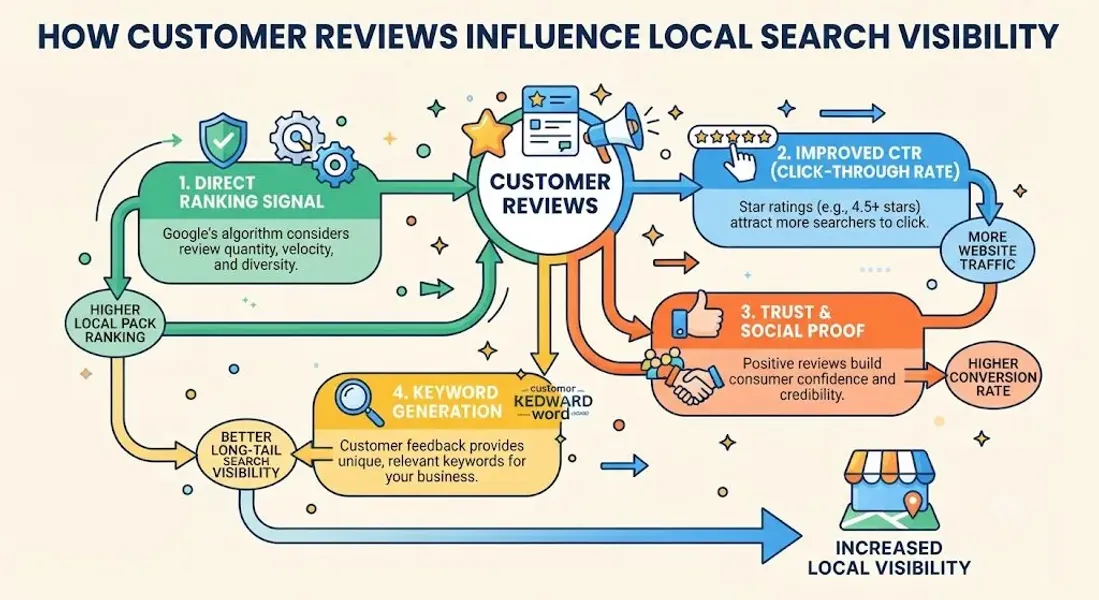
Prominence is about how well-known and well-regarded your business is. Google wants to show users the best local businesses, and reviews are one of the strongest indicators of quality. When your business has many positive reviews, Google interprets that as a sign of prominence and is more likely to show your listing in local results.
Reviews as a Relevance Signal
Reviews also contribute to relevance. When customers mention specific services, products, or locations in their reviews, Google picks up on those keywords. If your reviews mention “emergency plumbing,” “vegan options,” or “downtown Austin,” those terms help Google understand what your business offers and where it’s located. This can improve your ranking for those specific searches.
Reviews and Click-Through Rate
Even if your ranking position is the same, reviews affect how many people click on your listing. A business with a 4.8-star rating and 200 reviews will get more clicks than a business with a 3.9-star rating and 20 reviews. Google notices when users click on your listing, and higher click-through rates can indirectly improve your ranking over time.
Reviews and the Local Pack
The local pack—the block of three map results at the top of Google—is heavily influenced by reviews. Businesses in the local pack typically have strong review profiles. If you’re not in the local pack, improving your reviews is one of the most effective ways to get there. For more on the local pack, see our guide on local pack SEO.
Reviews and Google Maps
Google Maps rankings are also driven by reviews. When someone searches on Maps, Google shows businesses with strong review signals. If your business isn’t showing on Maps, reviews may be part of the problem. See our guide on business not showing on Google Maps for more.
Key Review Signals That Impact Local SEO
Not all reviews are equal. Google looks at several specific signals when evaluating your review profile.
Review Quantity
The total number of reviews matters. Generally, more reviews signal more prominence. A business with 500 reviews is likely to outrank one with 50, all else being equal. Quantity also provides more data for Google to analyze.
Review Quality
The star rating matters. A business with a 4.8-star average is more attractive than one with a 4.0-star average. Google wants to show high-quality businesses, so higher ratings tend to rank better.
Review Velocity
Velocity refers to how frequently you receive new reviews. A steady stream of reviews over time is better than a burst of reviews followed by months of silence. Velocity signals that your business is active and consistently delivering good experiences.
Review Keywords
The words customers use in their reviews matter. If reviewers mention specific services, products, or locations, those keywords help Google understand your business. Encourage customers to be specific in their reviews—mentioning what they bought, what service they received, or where they are located.
Review Responses
Responding to reviews—both positive and negative—is a ranking signal. It shows Google that you’re engaged and that you care about customer feedback. For more on this, see our guide on respond to negative Google reviews.
Review Diversity
Reviews from a variety of customers—different names, different locations, different experiences—signal that your business is widely trusted. Diversity also reduces the risk of Google flagging your reviews as fake.
The Psychology of Reviews: How They Influence Customer Decisions
Beyond rankings, reviews influence whether customers choose you. Understanding the psychology helps you build a better review strategy.
Social Proof
People trust the opinions of others. When they see that many customers have had a positive experience with your business, they feel more confident choosing you. This is called social proof, and it’s one of the most powerful forces in marketing.
The Power of Recency
Recent reviews carry more weight than old ones. A review from last week feels more relevant than one from two years ago. This is why review velocity matters—not just for SEO but for customer trust.
The Negativity Bias
Negative reviews have a disproportionate impact on customer perception. A single one-star review can overshadow dozens of five-star reviews if it’s not handled well. Responding to negative reviews professionally can mitigate the damage.
The Goldilocks Zone
Research suggests that a perfect 5.0 rating can sometimes seem too good to be true. A rating between 4.2 and 4.7 often feels more authentic. Don’t obsess over perfection—focus on consistency and responsiveness.
Review Content Matters
Customers read review content, not just star ratings. Reviews that mention specific details—like “the staff was friendly,” “the food was fresh,” or “they fixed my leak in an hour”—are more convincing than generic praise.
How Reviews Impact Different Local Search Results
Reviews influence visibility across multiple Google platforms. Here’s how.
Google Business Profile
Your Google Business Profile displays your reviews prominently. They appear when someone views your listing on Search or Maps. A strong review profile makes your listing more attractive and can improve your local ranking.
Local Pack
The local pack is the three-pack of map results that appears for local searches. Reviews are a major ranking factor for the local pack. Businesses with more and better reviews are more likely to appear.
Google Maps
Google Maps rankings are driven by proximity, relevance, and prominence—and reviews are a key part of prominence. If you’re not showing on Maps, reviews are one of the first things to optimize.
Organic Search Results
Reviews can also influence organic search results. Google may show star ratings and review counts in search snippets, which can improve click-through rates and indirectly boost rankings.
Voice Search
Voice assistants like Google Assistant often rely on reviews when recommending local businesses. A strong review profile increases your chances of being recommended.
The Role of Review Responses in Local SEO
Responding to reviews is not just good customer service—it’s a ranking signal. Google has confirmed that responding to reviews can improve your local ranking.
Responding to Positive Reviews
Thank customers for their feedback. Personalize your response and mention specific details from their review when possible. This shows you’re engaged and appreciative.
Responding to Negative Reviews
Negative reviews are an opportunity. Respond professionally, apologize for the experience, and offer to make things right. Don’t argue or get defensive. A thoughtful response can turn a negative review into a positive signal. For a detailed guide, see our article on respond to negative Google reviews.
Response Time
Respond promptly—ideally within 24-48 hours. Timely responses show Google and customers that you’re active and attentive.
Response Keywords
Your responses can also include keywords. If a customer mentions a specific service, you can reference it in your response. This reinforces your relevance for that service.
Negative Reviews: Impact and Management
Negative reviews are inevitable. How you handle them determines whether they hurt you or help you.
The Impact of Negative Reviews
Negative reviews can reduce your star rating, scare away customers, and hurt your local ranking. A single negative review can have a noticeable impact, especially for businesses with few reviews.
How to Manage Negative Reviews
- Respond professionally and promptly.
- Apologize for the experience without being defensive.
- Offer to resolve the issue offline.
- Learn from the feedback and improve your business.
- Encourage satisfied customers to leave reviews to balance out the negative one.
When to Remove Negative Reviews
You can report reviews that violate Google’s policies (spam, fake, offensive, etc.). For more, see our guide on fake Google reviews and how to report fake Google review.
Fake Reviews: Risks and How They Affect Visibility
Fake reviews—both positive and negative—are a growing problem. They can hurt your business in several ways.
Positive Fake Reviews
Buying fake positive reviews violates Google’s guidelines. If detected, Google may remove the reviews, suspend your profile, or penalize your ranking. For more on suspension, see our guide on Google Business Profile suspended.
Negative Fake Reviews
Competitors or bad actors may leave fake negative reviews to damage your reputation. These can lower your rating and hurt your ranking. You can report them to Google for removal.
How Fake Reviews Affect Local SEO
Fake reviews undermine trust. If Google suspects your reviews are inauthentic, it may discount them or penalize your profile. The best defense is a steady stream of genuine reviews from real customers.
How to Build a Review Generation Strategy
Building a strong review profile doesn’t happen by accident. You need a strategy.
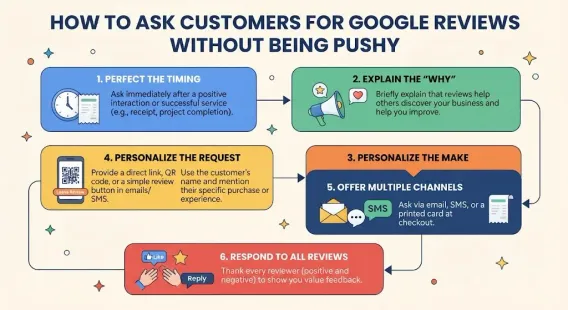
Ask at the Right Time
Ask for reviews immediately after a positive interaction. That’s when customers are most likely to say yes.
Make It Easy
Send a direct link to your Google review page. The fewer steps, the better. For more tips, see our guide on ask for Google reviews.
Use Multiple Channels
Ask via email, text, receipts, in-person requests, and signage. Different customers prefer different methods.
Train Your Team
If you have employees, train them to ask for reviews consistently.
Respond to Every Review
Respond to all reviews—positive and negative. This shows engagement and encourages more reviews.
Never Buy Reviews
Buying reviews violates Google’s guidelines and can get your profile suspended. Earn reviews the honest way.
Measuring the Impact of Reviews on Local SEO
To know if your review strategy is working, track these metrics.
Review Count and Rating
Track how many reviews you have and your average rating over time.
Review Velocity
Monitor how many new reviews you receive each month.
Local Rankings
Use local SEO tools to track your position in the local pack and Google Maps.
Google Business Profile Insights
Check Google Business Profile insights for views, calls, direction requests, and website clicks.
Website Traffic
Use Google Analytics to see how much traffic comes from local searches and Maps.
Conversion Rates
Track how many calls, direction requests, or website visits turn into actual customers.
Common Mistakes Businesses Make With Reviews
Avoid these mistakes to protect your review profile and local SEO.
Ignoring Reviews
Failing to respond to reviews—especially negative ones—hurts trust and rankings.
Buying Fake Reviews
This violates Google’s guidelines and can get your profile suspended.
Keyword Stuffing in Review Responses
Don’t stuff keywords into your responses. Be natural and helpful.
Only Asking for Reviews Once
Review generation should be ongoing. Build it into your customer journey.
Not Responding to Negative Reviews
Negative reviews left unanswered look bad to customers and Google. Respond professionally.
Focusing Only on Quantity
A hundred fake reviews are worthless. Focus on genuine reviews from real customers.
Not Tracking Results
If you’re not tracking your review metrics, you don’t know what’s working.
Conclusion
Customer reviews are one of the most powerful forces in local search. They influence customer decisions, build trust, and directly impact your ranking in Google Maps, the local pack, and organic search results. The connection between reviews and visibility is what we call customer reviews local SEO—and it’s one of the most important aspects of any local marketing strategy.
The key is to build a steady stream of genuine reviews, respond to all of them professionally, and use them to improve your business. Avoid fake reviews and never buy them. Track your progress and adjust your strategy as needed.
Remember: reviews aren’t just about reputation. They’re about visibility. The more positive reviews you have, the more likely you are to appear in local search results—and the more customers you’ll attract.
Call to Action
Want to improve your local search visibility through reviews but don’t know where to start? Let our local SEO experts help. We’ll build a review generation strategy, manage your responses, and optimize your profile to attract more customers.
Contact Us Today for a Free Local SEO Audit!
FAQs
Q1: How do customer reviews influence local SEO? A: Reviews influence local SEO by acting as a prominence signal. Google uses review quantity, quality, velocity, keywords, and responses to determine local rankings.
Q2: How many reviews do I need to rank in local search? A: There’s no fixed number. What matters is having more positive reviews than your competitors, with a steady flow of new reviews over time.
Q3: Do review responses affect local SEO? A: Yes. Google has confirmed that responding to reviews can improve your local ranking. Respond to all reviews—positive and negative.
Q4: Can fake reviews hurt my local SEO? A: Yes. Fake reviews violate Google’s guidelines and can result in removal, suspension, or ranking penalties. Always earn reviews honestly.
Q5: How often should I get new reviews? A: Aim for a steady stream—a few new reviews per month is better than a burst followed by silence. Velocity matters.
Q6: What should I do if I get a negative review? A: Respond professionally, apologize, and offer to resolve the issue offline. For a detailed guide, see our article on respond to negative Google reviews.
Q7: How do I ask customers for reviews? A: Ask immediately after a positive interaction, make it easy with a direct link, and use multiple channels. For more tips, see our guide on ask for Google reviews.
Q8: How do reviews impact the local pack? A: Reviews are a major ranking factor for the local pack. Businesses with strong review profiles are more likely to appear in the top three results. For more, see our guide on local pack SEO.
Q9: What should I do if my business is not showing on Google Maps? A: Check for verification issues, suspensions, incorrect information, or ranking problems. See our guide on business not showing on Google Maps for a complete diagnostic checklist.
Q10: What should I do if my Google Business Profile is suspended? A: If your profile is Google Business Profile suspended, review Google’s guidelines, fix any violations, and submit an appeal. Our guide on suspended profiles covers this in depth.
Q11: How do I fix incorrect information on my Google Business Profile? A: If your profile shows incorrect information, you can edit it directly from your dashboard. For persistent issues, see our guide on how to fix Google Business Profile errors.
Internal Links
-
What Is Google Business Profile and How Does It Work? A Complete Guide
-
Google Business Profile vs Google Maps: What’s the Difference?
-
Google Business Profile Verification: Complete Step-by-Step Guide
-
How to Write the Perfect Google Business Profile Description
-
Google Business Profile Photos: Best Practices for Local SEO
-
Google Business Profile Services: How to Add and Optimize Them
-
Google Business Profile Attributes: What Are They and Why Do They Matter?
-
Google Business Profile Suspended? Common Causes and What to Do
-
How to Improve Your Google Maps Visibility Without Paid Ads## External Links
-
Google’s Guidelines for Representing Your Business on Google
Keep reading
Grow Your Google Maps Ranking on Autopilot
Stop spending hours every week manually replying to customer reviews and writing Google posts. Busirank automates your Google Business Profile to boost your local SEO rankings and turn searchers into paying clients.

 Busirank Team