 Busirank Team
Introduction
You’ve invested time and money into local SEO. You’ve optimized your Google Business Profile, built citations, collected reviews, and posted regularly. Your rankings have improved, and your profile looks great. But when your boss, your partner, or your accountant asks the simple question—“Is this actually working?”—can you answer it with confidence?
For many business owners and marketers, the answer is uncomfortable. They know local SEO matters. They’ve seen anecdotal evidence of its impact. But they can’t point to a clear, measurable return on investment. They can’t say how many customers came from local search last month, or which activities drove the most value.
This is the gap that separates businesses that invest confidently in local SEO from those that abandon it after a few months because they “can’t tell if it’s working.”
The truth is that local SEO is highly measurable—if you know what to track and how to track it. Unlike traditional advertising, where attribution can be fuzzy, local SEO generates a trail of data points: rankings, profile views, calls, direction requests, website clicks, review growth, and ultimately, leads and revenue. When you connect those dots, you can build a clear picture of performance and ROI.
In this comprehensive guide, we’ll walk you through exactly how to measure local SEO performance. We’ll cover the metrics that matter most, the tools you need, how to set benchmarks, how to build a monthly reporting framework, and how to translate data into action. By the end, you’ll have a complete measurement system that proves the value of your local SEO efforts—and shows you where to improve.
Why Measuring Local SEO Performance Matters
Before we dive into metrics and tools, let’s establish why measurement is so important.
It Proves ROI
Local SEO requires investment—whether it’s your time, your team’s time, or an agency’s fees. Measurement lets you calculate the return on that investment. If you can show that local SEO generated 50 qualified leads worth $25,000 in a quarter, the investment is justified.
It Guides Decision-Making
Without data, you’re guessing. Should you invest more in review generation or citation building? Should you focus on Google Maps visibility or website content? Measurement answers these questions.
It Identifies Problems Early
If rankings drop, calls decline, or reviews stall, measurement alerts you before small issues become big ones.
It Sets Realistic Expectations
Local SEO takes time. Measurement helps you track progress against realistic benchmarks, so you don’t abandon a strategy prematurely.
It Justifies Budget
When you can show the impact of local SEO, you can confidently request more budget—or defend your existing allocation.
It Improves Accountability
Whether you’re managing local SEO yourself or working with an agency, measurement creates accountability. Everyone knows what success looks like.
For more on the individual metrics, see our guide on Google Business Profile insights.
The Core Pillars of Local SEO Performance
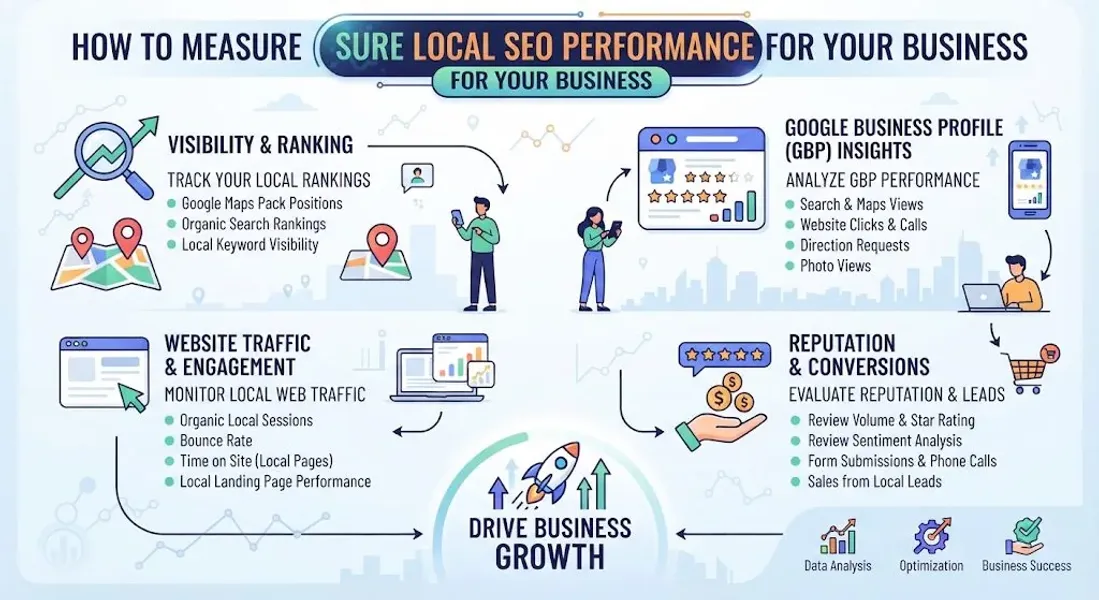
Local SEO performance can be measured across several pillars. Each represents a different stage of the customer journey.
Pillar 1: Visibility
Are you appearing in local search results? This includes rankings in the local pack, Google Maps, and organic search.
Key metrics: Local pack rankings, Maps rankings, impressions, profile views.
Pillar 2: Engagement
Are customers interacting with your listing? This includes calls, direction requests, website clicks, and messages.
Key metrics: Calls, direction requests, website clicks, post views, photo views.
Pillar 3: Reputation
What do customers think of your business? This includes review volume, rating, and sentiment.
Key metrics: Review count, average rating, review velocity, response rate.
Pillar 4: Conversions
Are customers taking the actions that matter to your business? This includes form submissions, bookings, purchases, and phone calls.
Key metrics: Conversion rate, cost per lead, revenue attributed to local search.
Pillar 5: Competitive Position
How do you compare to competitors in your area?
Key metrics: Share of local pack, ranking gaps, review gaps, citation gaps.
Measuring across all five pillars gives you a complete picture of local SEO performance.
Key Metrics for Measuring Local SEO Performance
Here are the specific metrics you should track, organized by category.
Visibility Metrics
Local Pack Rankings Where you appear in the three-pack of map results for target keywords. Track your position for each keyword in each location.
Google Maps Rankings Where you appear in Google Maps results. This often correlates with local pack rankings.
Organic Rankings Where your website appears in traditional organic search results for local keywords.
Impressions How many times your listing appeared in search results. Found in Google Business Profile insights.
Profile Views How many times your profile was viewed. Broken into Search views and Maps views.
Share of Local Voice The percentage of searches where your business appears in the local pack. A key competitive metric.
Engagement Metrics
Calls How many times customers tapped “Call” from your profile. A high-intent action.
Direction Requests How many times customers requested directions. Signals intent to visit.
Website Clicks How many times customers clicked through to your website.
Messages How many conversations started through messaging.
Bookings How many appointments or reservations were made through your profile.
Post Views and Clicks How many people viewed and engaged with your Google Posts.
Photo Views How many times your photos were viewed.
Reputation Metrics
Review Count Total number of reviews on Google and other platforms.
Average Rating Your star rating across platforms.
Review Velocity How many new reviews you receive per month. Consistency matters.
Review Response Rate The percentage of reviews you respond to. Aim for 100%.
Sentiment The overall tone of reviews—positive, negative, or neutral. For more, see our guide on customer reviews local SEO.
Conversion Metrics
Conversion Rate The percentage of profile visitors who take a desired action (call, click, book).
Cost Per Lead If you’re investing in local SEO, calculate the cost per lead generated.
Revenue Attributed to Local Search The total revenue from customers who found you through local search.
Customer Acquisition Cost The total local SEO investment divided by the number of new customers acquired.
Competitive Metrics
Share of Local Pack How often your business appears in the local pack compared to competitors.
Ranking Gaps Keywords where competitors outrank you.
Review Gaps How your review count and rating compare to competitors.
Citation Gaps Directories where competitors are listed but you aren’t.
For more on specific metrics, see our guide on how to track Google Business Profile calls.
Tools for Measuring Local SEO Performance
You’ll need a mix of free and paid tools to measure local SEO effectively.
Google Tools (Free)
Google Business Profile Insights Your primary source for profile views, calls, direction requests, website clicks, and search queries. Essential for every local business.
Google Analytics 4 Tracks website traffic and conversions. Use UTM parameters to attribute traffic from your Google Business Profile. For more, see our guide on Google Business Profile calls.
Google Search Console Shows how your website performs in Google Search, including queries, impressions, and clicks.
Google Tag Manager Helps deploy tracking tags without editing website code.
Google Trends Shows search interest over time for keywords and locations.
Local SEO Tools (Paid)
BrightLocal Comprehensive local SEO platform. Offers rank tracking, citation audits, review management, and reporting.
Local Falcon Specializes in grid-based local rank tracking. Shows how you rank across a geographic area.
Whitespark Popular for citation building and local rank tracking.
Moz Local Citation management and local listing distribution.
SEMrush All-in-one SEO platform with local SEO features, including rank tracking and competitor analysis.
Ahrefs Strong for keyword research, backlink analysis, and rank tracking.
Yext Manages business listings across many platforms from one dashboard.
Review Management Tools
Birdeye Review monitoring, response management, and analytics.
Podium Review generation and messaging platform.
ReviewTrackers Review monitoring and sentiment analysis.
GatherUp Review generation and management.
Call Tracking Tools
CallRail Call tracking with attribution and recording.
CallTrackingMetrics Advanced call tracking for larger businesses.
WhatConverts Combines call, form, and chat tracking.
Reporting Tools
Google Looker Studio (formerly Data Studio) Free. Build custom dashboards combining data from multiple sources.
BrightLocal Reporting Automated local SEO reports for clients and stakeholders.
AgencyAnalytics Marketing reporting platform with local SEO integrations.
How to Set Benchmarks and Goals
Measurement means nothing without benchmarks. Here’s how to set them.
Step 1: Establish Your Baseline
Before you start optimizing, record your current performance. Document:
- Current local pack rankings for target keywords
- Google Business Profile views, calls, and clicks
- Review count, rating, and velocity
- Website traffic from local sources
- Conversion rates This baseline becomes your reference point.
Step 2: Research Competitors
Look at the top-ranking competitors in your area. What are their review counts? Their rankings? Their engagement levels? This tells you what “good” looks like in your market.
Step 3: Set Realistic Goals
Set goals that are ambitious but achievable. For example:
- Increase local pack rankings from position 5 to position 3 within 90 days
- Grow review count from 50 to 100 within 6 months
- Increase calls from profile from 20 to 40 per month within 6 months
Step 4: Break Goals Into Milestones
Large goals can feel overwhelming. Break them into monthly or quarterly milestones so you can track progress.
Step 5: Revisit Goals Quarterly
As you gather data, you’ll learn what’s realistic. Adjust your goals accordingly.
Building a Monthly Local SEO Report
A monthly report keeps you accountable and provides a clear picture of progress. Here’s what to include.
Section 1: Executive Summary
A brief overview of the month’s performance. Highlight wins, challenges, and key takeaways.
Section 2: Visibility Metrics
- Local pack rankings for target keywords
- Maps rankings
- Organic rankings
- Profile views (Search vs. Maps)
- Search queries driving views
Section 3: Engagement Metrics
- Calls
- Direction requests
- Website clicks
- Messages
- Bookings
- Post performance
Section 4: Reputation Metrics
- New reviews
- Average rating
- Review response rate
- Sentiment trends
Section 5: Conversion Metrics
- Conversion rate
- Leads generated
- Revenue attributed to local search
Section 6: Competitive Analysis
- Share of local pack
- Ranking gaps
- Review gaps
Section 7: Actions Taken
- What optimizations were made this month
- What content was published
Section 8: Next Steps
- Priorities for next month
- Tests to run
- Improvements to make For a detailed framework, see our guide on local SEO report.
How to Attribute Local SEO to Revenue
The ultimate measure of local SEO performance is revenue. Here’s how to connect the dots.
Step 1: Track Calls and Clicks
Use Google Business Profile insights, UTM tagging, and call tracking to capture all actions from your profile. For more, see our guide on how to track Google Business Profile calls.
Step 2: Track Conversions
Set up conversion events in Google Analytics for form submissions, bookings, and purchases. If you use a CRM, track leads from local search.
Step 3: Assign Values
Assign a dollar value to each conversion. If your average customer is worth $500, then each lead is worth $500 (or a portion of that, depending on your conversion rate).
Step 4: Calculate ROI
ROI = (Revenue from local SEO − Cost of local SEO) ÷ Cost of local SEO × 100
If you generated $10,000 in revenue from local SEO and spent $2,000, your ROI is 400%.
Step 5: Track Over Time
Calculate ROI monthly or quarterly to see trends. Is it improving? Declining? Adjust your strategy accordingly.
Attribution Challenges
Perfect attribution is difficult. Customers often interact with multiple touchpoints before converting. Some practical approaches:
- Ask customers how they found you (and log the responses)
- Use call tracking numbers for attribution
- Track UTM parameters on all links
- Use CRM data to connect leads to sources For more on attribution, see our guide on local SEO performance.
Best Practices for Measuring Local SEO Performance
Follow these best practices to measure effectively.
Track Consistently
Set a recurring schedule for tracking. Monthly reviews are the minimum. Weekly reviews help you spot trends faster.
Use Multiple Data Sources
No single tool tells the whole story. Combine Google insights, Google Analytics, rank trackers, and review tools for a complete picture.
Compare Periods
Look at month-over-month and year-over-year changes. This helps separate seasonal fluctuations from real trends.
Focus on Actions, Not Just Views
Views are a vanity metric. Calls, bookings, and revenue are what matter.
Segment Data
Break down data by location, device, and source. Mobile performance often differs significantly from desktop.
Track Competitors
Knowing where you stand relative to competitors is just as important as knowing your own numbers.
Document Everything
Keep records of your baselines, goals, and results. This helps you learn over time.
Act on Insights
Measurement without action is pointless. Use your data to make decisions.
Common Mistakes to Avoid
Avoid these mistakes when measuring local SEO.
Only Tracking Rankings
Rankings matter, but they’re not the whole story. Track engagement and conversions too.
Ignoring Google Business Profile Insights
Your profile insights are the most direct measure of local SEO performance. Don’t neglect them.
Not Setting Benchmarks
Without a baseline, you can’t tell whether you’re improving. Establish benchmarks before you start.
Using Vanity Metrics
Profile views are nice, but calls and revenue are what matter. Focus on metrics that drive business results.
Failing to Attribute Revenue
If you can’t connect local SEO to revenue, you can’t prove ROI. Set up tracking from the start.
Reporting Inconsistently
Sporadic reporting makes it hard to spot trends. Report monthly.
Overcomplicating Reports
A simple, clear report is better than a complex one nobody reads. Focus on the metrics that matter.
Not Acting on Data
If you’re not using your data to make decisions, you’re wasting time collecting it.
For more on reporting, see our guide on local SEO report.
Conclusion
Measuring local SEO performance is the difference between guessing and knowing. It’s how you prove ROI, guide decisions, and continuously improve. The metrics in this guide—visibility, engagement, reputation, conversions, and competitive position—form a complete framework for tracking your success.
The process is straightforward: establish baselines, set benchmarks, track consistently with the right tools, build monthly reports, and attribute results to revenue. Then act on what you learn.
You don’t need expensive tools or a dedicated analytics team. Google’s free tools plus a modest investment in rank tracking and call tracking will give you everything you need. What matters is consistency—tracking the same metrics month after month so you can see real trends.
Start measuring this month. Your local SEO strategy will be stronger for it.
Call to Action
Want to know exactly how your local SEO is performing? Let our local SEO experts help. We’ll set up your tracking, build custom reports, and show you the ROI of your local marketing efforts.
Contact Us Today for a Free Local SEO Audit!
FAQs
Q1: What is local SEO performance? A: Local SEO performance is the measurement of how well your business appears and engages customers in local search results. It includes metrics like rankings, calls, website clicks, reviews, and revenue.
Q2: How do I measure local SEO performance? A: Use a combination of Google Business Profile insights, Google Analytics, rank tracking tools, and review management platforms. Track visibility, engagement, reputation, and conversion metrics.
Q3: What’s the most important local SEO metric? A: It depends on your business. For brick-and-mortar businesses, calls and direction requests are critical. For service businesses, calls and website clicks matter most. For all businesses, revenue attributed to local search is the ultimate metric.
Q4: How often should I measure local SEO performance? A: At least monthly. For competitive markets, weekly tracking helps you spot trends faster.
Q5: What tools do I need to measure local SEO? A: At minimum, you need Google Business Profile insights and Google Analytics (both free). For more advanced tracking, add a rank tracker (BrightLocal, Local Falcon), a call tracking tool (CallRail), and a review management platform.
Q6: How do I prove ROI from local SEO? A: Track calls, clicks, and conversions from local search. Assign a dollar value to each conversion. Calculate ROI as (Revenue − Cost) ÷ Cost × 100.
Q7: What’s the difference between local SEO performance and general SEO performance? A: Local SEO performance focuses on local search results—Google Maps, the local pack, and location-based queries. General SEO focuses on broader organic rankings.
Q8: How do I set benchmarks for local SEO? A: Establish your baseline by recording current rankings, engagement, and reviews. Then research competitors to see what “good” looks like in your market.
Q9: How do I create a local SEO report? A: Include visibility, engagement, reputation, conversion, and competitive metrics. Add an executive summary and next steps. For a framework, see our guide on local SEO report.
Q10: How do I track calls from my Google Business Profile? A: Use Google’s built-in call tracking in your insights dashboard. For deeper attribution, use a call tracking number. For more, see our guide on Google Business Profile calls.
Q11: What should I do if my Google Business Profile is suspended? A: If your profile is Google Business Profile suspended, review Google’s guidelines, fix any violations, and submit an appeal. Our guide on suspended profiles covers this in depth.
Q12: What should I do if my business is not showing on Google Maps? A: Check for verification issues, suspensions, incorrect information, or ranking problems. See our guide on business not showing on Google Maps.
Q13: How do I fix incorrect information on my Google Business Profile? A: If your profile shows incorrect information, you can edit it directly from your dashboard. For persistent issues, see our guide on how to fix Google Business Profile errors.
Internal Links
-
What Is Google Business Profile and How Does It Work? A Complete Guide
-
Google Business Profile vs Google Maps: What’s the Difference?
-
Google Business Profile Verification: Complete Step-by-Step Guide
-
How to Write the Perfect Google Business Profile Description
-
Google Business Profile Photos: Best Practices for Local SEO
-
Google Business Profile Services: How to Add and Optimize Them
-
Google Business Profile Attributes: What Are They and Why Do They Matter?
-
Google Business Profile Suspended? Common Causes and What to Do## External Links
Keep reading
Grow Your Google Maps Ranking on Autopilot
Stop spending hours every week manually replying to customer reviews and writing Google posts. Busirank automates your Google Business Profile to boost your local SEO rankings and turn searchers into paying clients.

 Busirank Team