 Busirank Team
Introduction
Every local search starts with a keyword. When someone types “plumber near me,” “best coffee shop in Austin,” or “emergency dentist open now” into Google, those words determine which businesses appear. If your business isn’t optimized for the keywords your customers are actually searching, you’re invisible—no matter how good your products or services are.
Here’s what makes local keyword research different from general SEO: local searches are driven by intent, proximity, and immediacy. Someone searching for “Italian restaurant” might be browsing. Someone searching for “Italian restaurant near me open now” is ready to eat—and they’re going to choose from the businesses that appear in those results.
The businesses that understand this difference and optimize for it consistently win. They appear in the local pack, they get the calls, and they get the customers. The ones that don’t—or that target the wrong keywords—struggle to gain visibility.
But here’s the challenge: local keyword research isn’t just about finding high-volume terms. It’s about understanding the specific language your local customers use, the geographic modifiers they include, and the intent behind their searches. It’s about finding the sweet spot between search volume, competition, and relevance to your business.
In this comprehensive guide, we’ll walk you through exactly how to do local keyword research. We’ll explain what local keywords are, why they matter, the different types you need to target, and a step-by-step process for finding the right keywords for your business. We’ll also share tools, best practices, and common mistakes to avoid. By the end, you’ll have a clear roadmap for attracting more local customers through smarter keyword targeting.
What Are Local Keywords?
Local keywords are search terms that include geographic intent—either explicitly or implicitly. They’re the phrases people use when looking for products or services in a specific location.
Explicit vs. Implicit Local Keywords
Explicit local keywords include a location modifier. Examples:
-
“Plumber in Austin”
-
“Best pizza Chicago”
-
“Dentist near me”
-
“Coffee shop downtown Seattle” Implicit local keywords don’t include a location but are understood to have local intent based on the searcher’s context. Examples:
-
“Plumber near me” (Google uses the searcher’s location)
-
“Restaurants open now” (Google assumes local intent)
-
“Emergency dentist” (Google prioritizes nearby results)
Why Local Keywords Matter
Local keywords matter because they connect you with customers who are ready to take action. Someone searching for a local service is usually further along in the buying journey than someone doing general research. They need a solution now, and they’re looking for businesses in their area.
When you optimize for local keywords, you:
- Appear in local search results and the local pack
- Attract high-intent traffic
- Compete with other local businesses rather than national chains
- Drive more calls, visits, and sales
Why Local Keyword Research Matters for SEO
Local keyword research is the foundation of any successful local SEO strategy. Here’s why.
It Connects You With Ready-to-Buy Customers
Local keywords capture high-intent searches. People searching for “emergency plumber near me” need help now. By targeting these keywords, you position your business to capture that demand.
It Improves Your Local Pack Rankings
The local pack is the block of three map-based results that appears for local searches. Ranking in the local pack requires optimizing for local keywords—both on your Google Business Profile and your website.
It Helps You Compete With Larger Competitors
National brands often dominate broad keywords. But local keywords level the playing field. A small local bakery can outrank a national chain for “best cupcakes in Portland” if it optimizes properly.
It Supports Your Google Business Profile
Your Google Business Profile benefits from local keyword optimization. Your description, services, products, and posts all contain keywords that help Google understand your relevance.
It Drives Website Traffic
Local keywords on your website—especially on location-specific landing pages—can drive significant organic traffic from people searching in your area.
It Informs Your Content Strategy
Understanding what local keywords your customers use helps you create content that answers their questions and addresses their needs.
Types of Local Keywords
Not all local keywords are the same. Here are the main types you should target.
”Near Me” Keywords
These are searches that include “near me” or similar phrases. Examples:
- “Plumber near me”
- “Restaurants near me”
- “Dentist near me open now” Google uses the searcher’s location to deliver results. These keywords have exploded in popularity because they’re easy to type and reflect immediate intent.
Location-Based Keywords
These include a specific city, neighborhood, or region. Examples:
- “Plumber in Austin”
- “Best pizza in Brooklyn”
- “Dentist Chicago Loop” These keywords are valuable because they’re explicit about location and often have less competition than broader terms.
Service + Location Keywords
These combine a specific service with a location. Examples:
- “Emergency plumbing repair Austin”
- “Cosmetic dentistry Beverly Hills”
- “Wedding photography Napa Valley” These are highly targeted and often convert well.
”Open Now” and Time-Based Keywords
These include urgency or time modifiers. Examples:
- “Restaurants open now”
- “24-hour plumber near me”
- “Dentist open Saturday” These keywords capture customers with immediate needs.
Brand + Location Keywords
These include your business name plus a location. Examples:
- “Smith Plumbing Austin”
- “Joe’s Coffee Seattle” These are important for customers searching for you specifically. Your Google Business Profile should rank for these.
Question-Based Local Keywords
These are questions people ask about local services. Examples:
- “Where can I find a good dentist near me?”
- “What’s the best Italian restaurant in Chicago?”
- “How much does a plumber cost in Austin?” These keywords are valuable for content marketing and FAQs.
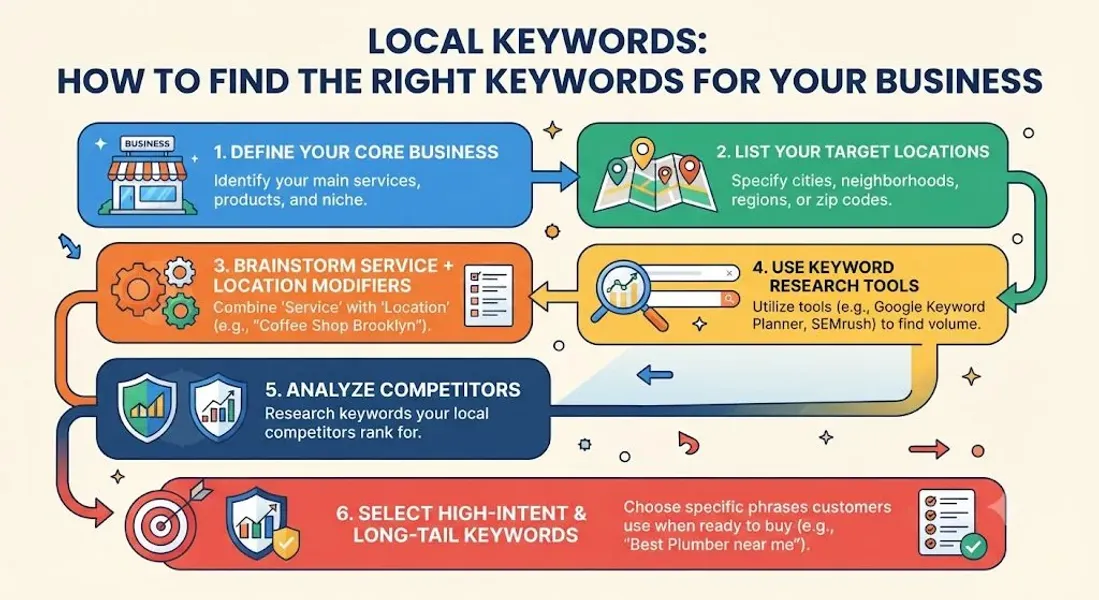
How to Find the Right Local Keywords: Step-by-Step
Now let’s get into the process. Here’s how to do local keyword research for your business.
Step 1: Start With Your Services and Products
Make a list of everything you offer. If you’re a plumber, this might include:
-
Drain cleaning
-
Water heater installation
-
Emergency plumbing repair
-
Bathroom remodeling If you’re a restaurant, this might include:
-
Brunch
-
Private dining
-
Catering
-
Vegan options This list becomes the foundation of your keyword research.
Step 2: Brainstorm Location Modifiers
List all the locations relevant to your business:
- Your city
- Neighborhoods you serve
- Suburbs
- Nearby towns
- Landmarks or districts Example: If you’re in Austin, your locations might include Downtown Austin, South Congress, East Austin, Round Rock, and Cedar Park.
Step 3: Combine Services With Locations
Combine your service list with your location list to create keyword variations:
- “Drain cleaning Austin”
- “Emergency plumber Downtown Austin”
- “Water heater installation Round Rock” These are your core local keywords.
Step 4: Use Google Autocomplete
Start typing your keywords into Google and see what autocomplete suggests. This reveals what real people are searching for.
Example: Type “plumber near” and Google might suggest:
- “plumber near me”
- “plumber near me open now”
- “plumber near me free estimate” These suggestions are gold for keyword research.
Step 5: Check “People Also Ask” and Related Searches
When you search for a keyword, Google shows “People Also Ask” questions and “Related Searches” at the bottom of the page. These reveal additional keywords and questions your customers are searching for.
Step 6: Use Keyword Research Tools
Tools can help you find keyword variations, search volume, and competition. Popular options include:
- Google Keyword Planner (free)
- Ubersuggest
- SEMrush
- Ahrefs
- Moz Keyword Explorer
- BrightLocal (local-specific)
Step 7: Analyze Competitor Keywords
Look at your top competitors’ websites and Google Business Profiles. What keywords are they targeting? Tools like SEMrush and Ahrefs can show you what keywords your competitors rank for.
Step 8: Check Google Business Profile Insights
Your Google Business Profile insights show you what search queries triggered your listing. This is invaluable data—it tells you exactly what people are searching when they find you.
Step 9: Prioritize Your Keywords
Not all keywords are equal. Prioritize based on:
- Relevance: How well does the keyword match your business?
- Search volume: How many people search for it?
- Competition: How hard is it to rank?
- Intent: How close is the searcher to taking action? Focus on keywords with high relevance and intent, even if search volume is lower.
Step 10: Map Keywords to Pages
Assign each keyword to a specific page on your website:
- Homepage: Primary keywords
- Service pages: Service + location keywords
- Location pages: Location-specific keywords
- Blog posts: Question-based and informational keywords
Tools for Local Keyword Research
Here are the best tools for finding local keywords.
Google Keyword Planner
Free with a Google Ads account, Keyword Planner shows search volume, competition, and keyword suggestions. You can filter by location to get local data.
Google Autocomplete and Related Searches
These free features reveal what people actually search for. They’re invaluable for finding long-tail local keywords.
Google Business Profile Insights
Your Google Business Profile insights show the exact search queries that triggered your listing. This is first-party data you can’t get anywhere else.
Ubersuggest
Ubersuggest offers keyword suggestions, search volume, and competition data. It has a free tier and is easy to use.
SEMrush
SEMrush is a comprehensive SEO tool with robust keyword research features, including local keyword tracking and competitor analysis.
Ahrefs
Ahrefs offers keyword research, competitor analysis, and rank tracking. Its “Keywords Explorer” is particularly powerful.
Moz Keyword Explorer
Moz’s keyword tool provides search volume, difficulty, and organic click-through rates.
BrightLocal
BrightLocal is built specifically for local SEO. It offers local keyword rank tracking, citation audits, and review management.
Best Practices for Local Keyword Research
Follow these best practices to get the most from your keyword research.
Focus on Intent, Not Just Volume
A keyword with low search volume but high intent is often more valuable than a high-volume keyword with low intent. “Emergency plumber Austin” may have lower volume than “plumbing services,” but it converts far better.
Target Long-Tail Keywords
Long-tail keywords are longer, more specific phrases. They have less competition and higher conversion rates. Examples: “best vegan brunch downtown Austin” instead of “brunch Austin.”
Include “Near Me” Keywords
Near me keywords are among the most valuable for local SEO. Optimize your Google Business Profile and website for these terms.
Optimize for Google Maps Keywords
Google Maps keywords are the terms people use when searching on Google Maps. These often include “near me,” “open now,” and specific service terms.
Create Location-Specific Pages
If you serve multiple areas, create a dedicated page for each location. This allows you to target location-specific keywords without diluting your main pages.
Use Keywords Naturally
Don’t stuff keywords into your content. Use them naturally in your descriptions, headings, and body text. Google penalizes keyword stuffing.
Monitor and Adjust
Keyword trends change over time. Monitor your rankings and adjust your strategy based on what’s working.
Common Local Keyword Research Mistakes to Avoid
Avoid these mistakes to get better results from your keyword research.
Targeting Only High-Volume Keywords
High-volume keywords are often highly competitive. Targeting only these terms means you’ll struggle to rank. Balance high-volume and long-tail keywords.
Ignoring “Near Me” Keywords
Near me keywords are essential for local SEO. Don’t neglect them.
Not Using Location Modifiers
If you’re not including location modifiers in your keywords, you’re missing out on local search traffic.
Forgetting About Google Business Profile
Your Google Business Profile is a key asset for local keyword optimization. Use your description, services, and posts to target relevant keywords.
Keyword Stuffing
Stuffing keywords into your content looks spammy and can hurt your rankings. Use keywords naturally.
Not Tracking Results
If you’re not tracking your rankings, you don’t know what’s working. Use tools to monitor your progress.
Ignoring Competitor Keywords
Your competitors’ keywords can reveal opportunities you’ve missed. Analyze their strategies.
Neglecting Local Citations
Local citations support your keyword rankings by reinforcing your NAP information and geographic relevance.
How Local Keywords Impact Your Local SEO
Local keywords are the foundation of your local SEO strategy. Here’s how they help.
Improved Local Pack Rankings
Optimizing for local keywords improves your chances of appearing in the local pack.
Better Google Maps Visibility
Local keywords help Google understand your relevance for specific searches, improving your Google Maps visibility.
More Website Traffic
Location-specific pages and content targeting local keywords drive organic traffic from your area.
Higher Conversion Rates
Local keywords capture high-intent traffic. People searching for local services are ready to buy.
Stronger Google Business Profile
Your profile benefits from keyword optimization. Your description, services, and posts all contribute to your relevance.
Competitive Advantage
If your competitors aren’t optimizing for local keywords, you gain an edge in local search results.
Conclusion
Local keyword research is the foundation of a successful local SEO strategy. It connects your business with customers who are actively searching for what you offer in your area. By understanding the different types of local keywords—near me keywords, location-based keywords, service + location keywords, and more—you can create a targeted strategy that drives real results.
The process is straightforward: start with your services, add location modifiers, use tools to find variations, and prioritize based on relevance and intent. Optimize your website, Google Business Profile, and content for these keywords. Monitor your rankings and adjust as needed.
Remember: local keyword research isn’t a one-time task. Search trends change, competitors adapt, and your business evolves. Stay consistent, track your progress, and keep refining your strategy.
Call to Action
Want to attract more local customers but don’t know which keywords to target? Let our local SEO experts help. We’ll conduct comprehensive local keyword research, identify the best opportunities for your business, and create a strategy that drives real results.
Contact Us Today for a Free Local SEO Audit!
FAQs
Q1: What are local keywords? A: Local keywords are search terms that include geographic intent—either explicitly (like “plumber in Austin”) or implicitly (like “plumber near me”). They connect you with customers searching for services in your area.
Q2: How do I find local keywords for my business? A: Start with your services and location, use Google Autocomplete and Related Searches, leverage keyword research tools like Google Keyword Planner or Ubersuggest, and check your Google Business Profile insights.
Q3: What are “near me” keywords, and why do they matter? A: Near me keywords are searches that include “near me” or similar phrases. They’re valuable because they capture high-intent local traffic. For more, see our guide on near me keywords.
Q4: How many local keywords should I target? A: There’s no fixed number. Focus on keywords that are relevant to your business and have decent search volume and intent. Start with your core services and expand from there.
Q5: What’s the difference between local keywords and general keywords? A: Local keywords include geographic intent—either explicit location modifiers or implicit local intent. General keywords don’t target a specific location.
Q6: How often should I update my local keyword strategy? A: Review your keyword strategy quarterly. Search trends change, and new opportunities emerge. Monitor your rankings and adjust as needed.
Q7: Can I rank for local keywords without a website? A: You can rank in Google Maps and the local pack with an optimized Google Business Profile, but a website strengthens your local SEO and allows you to target more keywords.
Q8: How do local keywords help with local pack SEO? A: Local keywords are a key ranking factor for the local pack. They help Google understand your relevance for specific searches. For more, see our guide on local pack SEO.
Q9: What are Google Maps keywords? A: Google Maps keywords are the terms people use when searching on Google Maps. They often include “near me,” “open now,” and specific service terms. For more, see our guide on Google Maps keywords.
Q10: What should I do if my Google Business Profile is suspended? A: If your profile is Google Business Profile suspended, review Google’s guidelines, fix any violations, and submit an appeal. Our guide on suspended profiles covers this in depth.
Internal Links
-
What Is Google Business Profile and How Does It Work? A Complete Guide
-
Google Business Profile vs Google Maps: What’s the Difference?
-
Google Business Profile Verification: Complete Step-by-Step Guide
-
How to Write the Perfect Google Business Profile Description
-
Google Business Profile Photos: Best Practices for Local SEO
-
Google Business Profile Services: How to Add and Optimize Them
-
Google Business Profile Attributes: What Are They and Why Do They Matter?## External Links
Keep reading
Grow Your Google Maps Ranking on Autopilot
Stop spending hours every week manually replying to customer reviews and writing Google posts. Busirank automates your Google Business Profile to boost your local SEO rankings and turn searchers into paying clients.

 Busirank Team