 Busirank Team
Introduction
If you run a local business, you’ve probably heard the term “citations” thrown around in SEO conversations. Maybe an agency mentioned it in a proposal. Maybe you read about it in a blog post. Or maybe you’re just trying to figure out why your competitors seem to show up everywhere online while your business barely registers.
Here’s the truth: local citations are one of the most powerful yet misunderstood tools in local SEO. They’re not glamorous. They don’t produce instant results. But they’re the foundation upon which your entire local search presence is built.
Think of citations as digital references—mentions of your business name, address, and phone number across the internet. Every time your business appears on a directory, a review site, a chamber of commerce page, or a local news article, that’s a citation. Google uses these mentions to verify that your business is real, legitimate, and located where you say it is.
When done right, citations boost your visibility in Google Maps and the local pack. When done wrong—or not at all—they can hold your business back, no matter how good your website or reviews are.
In this comprehensive guide, we’ll explain exactly what local citations are, why they matter for local SEO, the different types you need to know about, and how to build them step by step. We’ll also cover the most common mistakes and share tips for auditing and maintaining your citations over time. By the end, you’ll have a complete understanding of this essential local SEO building block.
What Are Local Citations?
A local citation is any online mention of your business’s Name, Address, and Phone number—often abbreviated as NAP. Citations can appear on a wide variety of websites, including:
- Business directories (Yelp, Yellow Pages, etc.)
- Review sites (Google, TripAdvisor, etc.)
- Social media platforms (Facebook, LinkedIn, etc.)
- Chamber of commerce websites
- Local newspaper and blog articles
- Industry-specific directories
- Government and licensing databases
- Mapping services (Bing Places, Apple Maps) Citations don’t always need to include all three NAP elements to count, but the most valuable ones do. They also don’t need to include a link to your website—though linked citations are generally more valuable for SEO.
Citations vs. Backlinks
It’s important to distinguish between citations and backlinks, as the two are often confused.
A citation is a mention of your NAP information. It may or may not include a link to your website.
A backlink is a hyperlink from another website to yours. It may or may not include NAP information.
A single mention on another website can be both a citation and a backlink. For example, a local newspaper article that mentions your business name, address, and phone number and links to your website is both a citation and a backlink.
Structured vs. Unstructured Citations
Citations come in two main forms.
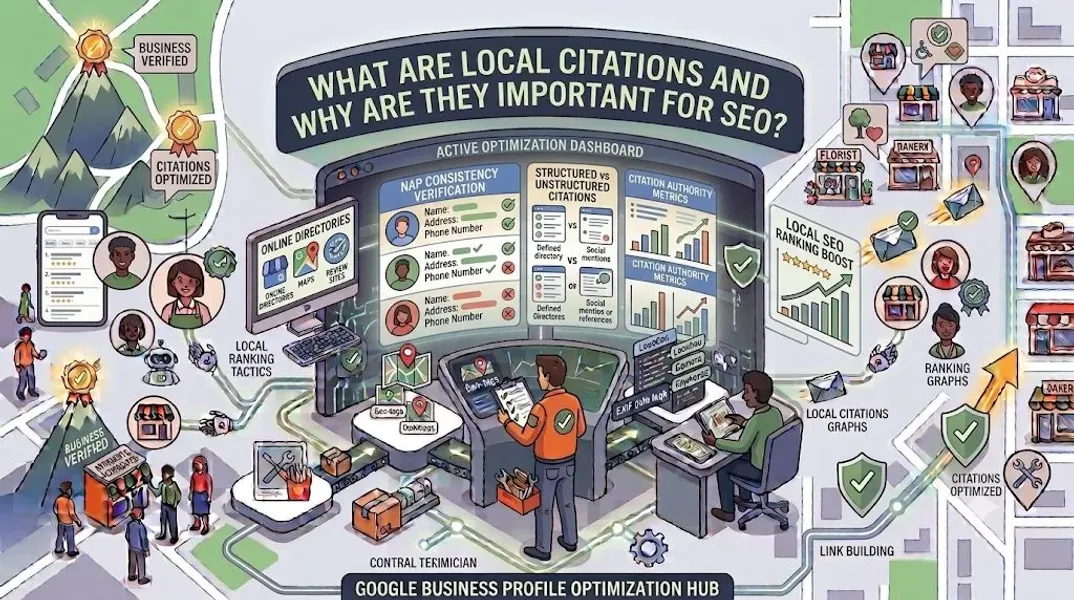
Structured citations appear on business directories and review platforms where your NAP information is displayed in a standardized format. Examples include Yelp, Yellow Pages, and Google Business Profile.
Unstructured citations appear in less structured contexts, such as news articles, blog posts, or social media mentions. These are mentions of your business within a body of text rather than in a dedicated listing format.
Both types matter for local SEO, though structured citations are typically easier to build at scale.
Why Local Citations Matter for SEO
Citations are a foundational element of local SEO. Here’s why they matter so much.
They Help Google Verify Your Business
Google uses citations to confirm that your business is legitimate and that your information is accurate. When Google sees consistent NAP information across many reputable websites, it gains confidence in your listing. This confidence translates to higher rankings.
They Improve Your Prominence
Prominence is one of the three pillars of local search ranking (along with relevance and distance). Citations build prominence by increasing the number of places your business appears online. The more citations you have—especially on authoritative sites—the more prominent your business appears to Google.
They Support NAP Consistency
NAP consistency is a critical ranking factor for local SEO. When your name, address, and phone number are identical across all your citations, Google trusts your information more. Inconsistent citations confuse Google and can hurt your rankings.
They Drive Direct Traffic
Citations don’t just help with SEO—they also drive direct traffic. People use directories to find local businesses. If your business is listed on Yelp, TripAdvisor, or a niche directory, customers may find you there and contact you directly.
They Build Trust With Customers
Seeing your business listed on reputable directories and review sites builds trust with potential customers. It signals that your business is established and legitimate.
They Support Local Pack Rankings
Local pack SEO depends heavily on citations. Businesses with strong, consistent citation profiles are more likely to appear in the top three local results.
They Help With Discovery
Different customers use different platforms to find businesses. Some use Google. Some use Yelp. Some use industry-specific directories. By building citations across many platforms, you increase your chances of being discovered.
Types of Local Citations
Not all citations are created equal. Understanding the different types helps you prioritize your efforts.
Core Citations
These are the most important citations for any local business. They include:
- Google Business Profile: The single most important citation
- Bing Places: Microsoft’s equivalent to Google Business Profile
- Apple Maps: Critical for iPhone users
- Facebook: A major platform for local business discovery
- Yelp: A leading review and discovery platform Every local business should have complete, verified listings on these platforms.
General Directories
These are broad directories that list businesses across many industries. Examples include:
- Yellow Pages
- Yellowbook
- Superpages
- Foursquare
- MapQuest
- Hotfrog
- Cylex These directories are valuable for building citation volume and consistency.
Industry-Specific Directories
These directories cater to specific industries. Examples include:
- Restaurants: OpenTable, TripAdvisor, Zomato
- Healthcare: Healthgrades, Vitals, WebMD
- Legal: Avvo, Justia, FindLaw
- Real Estate: Zillow, Realtor.com
- Home Services: Angi, HomeAdvisor, Thumbtack Industry-specific citations are often more valuable than general directories because they’re more relevant to your business.
Local Citations
These are citations on websites specific to your city or region. Examples include:
- Local chamber of commerce
- Local newspapers
- Local blogs
- Community organizations
- Local event calendars Local citations are particularly valuable because they reinforce your geographic relevance.
Unstructured Citations
These are mentions of your business in articles, blog posts, or social media. They’re less formal than directory listings but still contribute to your citation profile.
How to Build Local Citations: Step-by-Step
Building citations is a systematic process. Here’s how to do it right.
Step 1: Audit Your Existing Citations
Before you build new citations, find out what already exists. Search for your business name and NAP information on Google. Check major directories to see if you’re already listed and whether your information is accurate.
Use tools like Moz Local, BrightLocal, or Whitespark to audit your citations at scale.
Step 2: Fix Inconsistent Citations
If you find citations with incorrect or outdated information, fix them. Claim your listings and update your NAP information. Consistency is critical.
Step 3: Claim Core Citations
Start with the most important platforms:
- Google Business Profile
- Bing Places
- Apple Maps
- Yelp Complete every field and verify your listings.
Step 4: Build General Directory Citations
Create listings on general directories like Yellow Pages, Superpages, and Foursquare. Use consistent NAP information across all of them.
Step 5: Target Industry-Specific Directories
Identify the top directories for your industry and create listings. These are often more valuable than general directories.
Step 6: Build Local Citations
Reach out to your local chamber of commerce, newspapers, blogs, and community organizations. Ask to be listed or featured. Sponsor local events to earn mentions.
Step 7: Earn Unstructured Citations
Pitch stories to local media. Write guest posts for local blogs. Participate in community events that generate press coverage. These mentions build your citation profile and your reputation.
Step 8: Monitor and Maintain
Citations aren’t a one-time task. Monitor your listings regularly, fix inconsistencies, and add new citations over time.
Best Practices for Local Citation Building
Follow these best practices to maximize the impact of your citations.
Maintain NAP Consistency
Your Name, Address, and Phone number must be identical everywhere. Even small differences—like “St.” vs. “Street”—can cause problems. Choose one format and stick with it.
Use Your Real Business Name
Don’t keyword-stuff your business name in citations. Use your real-world business name exactly as it appears on your storefront and legal documents.
Prioritize Quality Over Quantity
A few high-authority citations are worth more than dozens of low-quality ones. Focus on reputable directories and relevant platforms.
Build Citations Gradually
Sudden bursts of citation building can look suspicious to Google. Build citations steadily over time.
Include Complete Information
Fill out every field on every directory. The more complete your listings, the more valuable they are.
Add Descriptions and Categories
Use relevant keywords in your business descriptions and choose the most accurate categories. This improves your relevance for local searches.
Monitor for Duplicates
Duplicate listings can confuse Google and hurt your rankings. Check for duplicates and merge or remove them.
Respond to Reviews on Citation Sites
Some citation sites allow reviews. Respond to them professionally, just as you would on Google.
Common Local Citation Mistakes to Avoid
Avoid these mistakes to protect your citation profile.
Inconsistent NAP Information
Inconsistent citations confuse Google and reduce trust. Ensure your NAP is identical everywhere.
Keyword Stuffing Your Business Name
Adding keywords to your business name in citations violates Google’s guidelines and can hurt your rankings.
Building Citations on Spammy Directories
Low-quality directories can hurt your reputation. Focus on reputable platforms.
Ignoring Duplicate Listings
Duplicates dilute your citation profile. Find and fix them.
Neglecting to Update Citations
If your address, phone number, or hours change, update your citations. Outdated information hurts trust and rankings.
Building Too Many Citations Too Fast
Sudden bursts of activity can trigger Google’s spam filters. Build gradually.
Forgetting to Verify Listings
Unverified listings are less valuable. Complete the verification process for each directory.
Not Monitoring Your Citations
Citations require ongoing maintenance. Monitor them regularly and fix issues promptly.
How to Audit Your Local Citations
Regular audits help you maintain a healthy citation profile. Here’s how to do it.
Step 1: Search for Your Business
Search for your business name and NAP information on Google. Review the results for accuracy.
Step 2: Use Citation Audit Tools
Tools like Moz Local, BrightLocal, and Whitespark can scan your citations across dozens of directories and identify inconsistencies.
Step 3: Check Major Directories
Manually check the most important directories to ensure your listings are accurate and complete.
Step 4: Identify Duplicates
Look for duplicate listings and take steps to merge or remove them.
Step 5: Fix Inconsistencies
Update any citations with incorrect or outdated information.
Step 6: Document Your Progress
Keep a record of your citations, including URLs, login credentials, and the date you last updated them.
Step 7: Schedule Regular Audits
Audit your citations at least quarterly. For businesses in competitive markets, monthly audits may be warranted.
How Citations Impact Your Local SEO
Citations play a supporting role in your overall local SEO strategy. Here’s how they contribute.
Improved Local Pack Rankings
Citations are a key ranking factor for local pack SEO. Businesses with strong citation profiles are more likely to appear in the top three local results.
Better Google Maps Visibility
Citations help Google verify your business location, improving your visibility on Google Maps.
Enhanced Trust Signals
Consistent citations across reputable platforms build trust with Google and with customers.
Support for NAP Consistency
Citations reinforce your NAP information, which is a critical ranking factor.
Increased Discoverability
Citations on multiple platforms increase your chances of being found by customers using different search methods.
Competitive Advantage
If your competitors have weak citation profiles, a strong profile gives you an edge in local search results.
Conclusion
Local citations are a foundational element of local SEO. They help Google verify your business, build your prominence, and improve your rankings in Google Maps and the local pack. They also drive direct traffic and build trust with customers.
Building citations takes time and effort, but the results are worth it. Start with core citations (Google, Bing, Apple, Facebook, Yelp), then expand to general directories, industry-specific platforms, and local sources. Maintain NAP consistency across all of them, and audit your citations regularly to catch and fix issues.
Remember: citations aren’t a one-time task. They require ongoing maintenance. But when done right, they become a powerful asset that supports your entire local SEO strategy.
Call to Action
Not sure where to start with local citations? Let our local SEO experts help. We’ll audit your existing citations, fix inconsistencies, and build new ones on the platforms that matter most for your business.
Contact Us Today for a Free Local SEO Audit!
FAQs
Q1: What are local citations? A: Local citations are online mentions of your business’s Name, Address, and Phone number (NAP). They appear on directories, review sites, social media, and other platforms.
Q2: Why are local citations important for SEO? A: Citations help Google verify your business, build your prominence, and improve your local search rankings. They also drive direct traffic and build customer trust.
Q3: How many citations does my business need? A: There’s no fixed number. Focus on building citations on the most relevant and authoritative platforms for your industry and location. Quality matters more than quantity.
Q4: What is NAP consistency, and why does it matter? A: NAP consistency means your Name, Address, and Phone number are identical across all online platforms. Consistent NAP information helps Google trust your business and improves your rankings.
Q5: How often should I audit my citations? A: Audit your citations at least quarterly. In competitive markets, monthly audits may be warranted.
Q6: Can I build citations myself, or should I hire a professional? A: You can build citations yourself, but it’s time-consuming. Many businesses hire professionals to handle citation building and maintenance.
Q7: What’s the difference between a citation and a backlink? A: A citation is a mention of your NAP information. A backlink is a hyperlink to your website. A single mention can be both.
Q8: How do citations help with local pack SEO? A: Citations are a key ranking factor for the local pack. They help Google verify your business and build your prominence, improving your chances of appearing in the top three results. For more, see our guide on local pack SEO.
Q9: What should I do if my Google Business Profile is suspended? A: If your profile is Google Business Profile suspended, review Google’s guidelines, fix any violations, and submit an appeal. Our guide on suspended profiles covers this in depth.
Q10: How do I fix incorrect information on my Google Business Profile? A: If your profile shows incorrect information, you can edit it directly from your dashboard. For persistent issues, see our guide on how to fix Google Business Profile errors.
Internal Links
-
What Is Google Business Profile and How Does It Work? A Complete Guide
-
Google Business Profile vs Google Maps: What’s the Difference?
-
Google Business Profile Verification: Complete Step-by-Step Guide
-
How to Write the Perfect Google Business Profile Description## External Links
-
Google’s Guidelines for Representing Your Business on Google
Keep reading
Grow Your Google Maps Ranking on Autopilot
Stop spending hours every week manually replying to customer reviews and writing Google posts. Busirank automates your Google Business Profile to boost your local SEO rankings and turn searchers into paying clients.

 Busirank Team