 Busirank Team
Introduction
Most SEO advice is written for websites that don’t exist yet — brand-new sites with no history, no customers, and no revenue to protect. That advice assumes you can afford to experiment, pivot, and start over.
Growing businesses can’t operate that way. You have customers to serve, cash flow to protect, and a team with limited time. Your SEO strategy has to fit inside those constraints — not fight them.
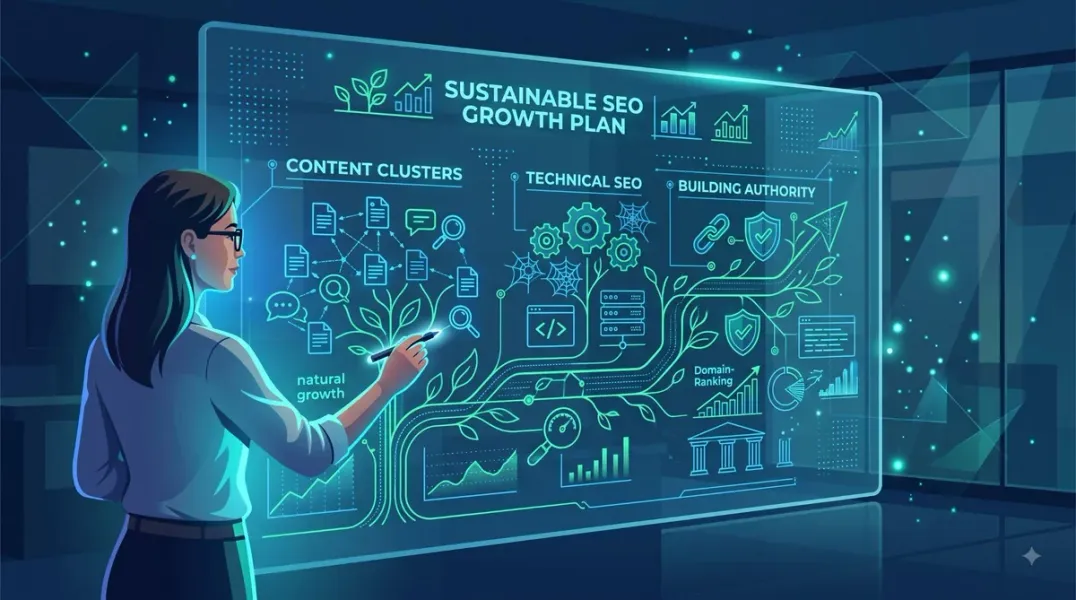
Sustainable SEO is different from aggressive SEO. It’s built to compound over years, not spike for a quarter. It prioritizes durable assets over short-term tricks. And it’s designed to survive algorithm updates, team changes, and budget cycles.
This guide lays out the full framework: goal-setting, prioritization, content systems, technical foundations, measurement, and how to scale without breaking what’s working.
What Makes an SEO Strategy Sustainable?
Sustainable SEO has five defining characteristics:
| Characteristic | What It Means |
|---|---|
| Compounding | Each asset builds on the last — content clusters, internal links, brand authority |
| Resilient | Survives algorithm updates because it’s built on genuine value |
| Resourced | Fits your actual budget, team, and time constraints |
| Measurable | Tied to business outcomes, not vanity metrics |
| Adaptable | Can shift as search changes (AI Overviews, new SERP features) |
The opposite of sustainable SEO: Chasing every algorithm update, publishing thin content at volume, buying links, and rebuilding your strategy every quarter.
Step 1: Define What SEO Success Means for Your Business
Before tactics, define outcomes. SEO isn’t the goal — revenue is.
Set Goals at Three Levels
Business goals (what leadership cares about):
- Leads per month
- Revenue from organic
- Customer acquisition cost
- Market share in target geography
Marketing goals (what SEO contributes to):
- Organic sessions
- Keyword rankings for priority terms
- Conversion rate from organic
- Content assets published
SEO goals (what the team executes):
- Indexation rate
- Core Web Vitals passing
- Internal link coverage
- Topical authority in target clusters
Choose Metrics That Actually Matter
| ❌ Vanity Metric | ✅ Business Metric |
|---|---|
| Total keywords ranking | Keywords ranking in top 3 for commercial intent |
| Total sessions | Sessions that convert |
| Domain authority score | Referring domains from relevant, authoritative sites |
| Pages published | Pages generating traffic and conversions |
| Social shares | Leads attributed to organic |
Related: See our guide on SEO competitor analysis for benchmarking against competitors.
Step 2: Build Your Keyword and Topic Strategy
Sustainable SEO starts with owning topics, not chasing keywords.
The Three-Layer Approach
Layer 1: Core commercial keywords
- Your highest-value service or product terms
- High intent, often competitive
- Supported by service pages and location pages
Layer 2: Topical authority clusters
- Informational content that builds expertise
- Pillar pages plus supporting articles
- Attracts top-of-funnel traffic and builds trust
Related: See content clusters SEO.
Layer 3: Long-tail and emerging queries
- Specific, low-competition queries
- Often seasonal or trend-driven
- Captured through new content or refreshed pages
Build a Keyword Map
Assign one primary keyword per page. Track:
- URL
- Primary keyword
- Secondary keywords
- Search intent
- Content type
- Priority
This prevents cannibalization and keeps content aligned with strategy.
Related: See keyword cannibalization.
Step 3: Prioritize Channels and Tactics
You can’t do everything. Sustainable SEO means choosing the few tactics that compound.
The Priority Framework
| Priority | Tactic | Why |
|---|---|---|
| 1 | Technical foundation | Nothing works if Google can’t crawl and index your site |
| 2 | Service and location pages | Highest commercial value |
| 3 | Topical authority clusters | Compounding organic growth |
| 4 | Internal linking | Amplifies everything else |
| 5 | Backlink acquisition | Builds authority over time |
| 6 | Content refresh | Recovers and maintains existing traffic |
| 7 | Local SEO | Essential for location-based businesses |
Related: See technical SEO checklist and SEO-friendly service pages.
What to Deprioritize
- Chasing every trending topic
- Publishing daily for the sake of frequency
- Building content for keywords with no business relevance
- Investing in channels you can’t sustain
Step 4: Build Content Systems, Not One-Off Posts
Sustainable content comes from systems, not bursts of effort.
The Content Operating System
- Planning cadence
- Quarterly: plan clusters and priorities
- Monthly: assign and schedule
- Weekly: publish, optimize, and monitor
- Production workflow
- Research and brief
- Writing and editing
- SEO optimization (titles, schema, internal links)
- Review and publish
- Promotion and internal linking
- Content types to maintain
- Pillar pages (updated every 6 months)
- Cluster articles (updated every 12 months)
- Service pages (updated every 6–12 months)
- Location pages (reviewed annually)
- Case studies (added as projects complete)
- Governance
- One person owns the content calendar
- A style guide ensures consistency
- An SEO checklist governs every publish
Related: See refresh old content SEO.
Step 5: Strengthen Technical Foundations
Technical SEO isn’t a one-time project. It’s ongoing maintenance.
Essential Technical Priorities
| Area | What to Maintain |
|---|---|
| Crawlability | Robots.txt, sitemap, internal links |
| Indexation | Search Console monitoring, fixing excluded pages |
| Core Web Vitals | Speed, responsiveness, stability |
| Mobile experience | Responsive design, tap targets, mobile CTAs |
| Security | HTTPS, no mixed content |
| Structured data | Valid schema for priority page types |
| URL structure | Consistent, descriptive, redirects maintained |
Related: See Core Web Vitals for small business, mobile-first SEO, and SEO-friendly URL structures.
Step 6: Build Authority Over Time
Backlinks and brand signals compound. Sustainable link building means earning links through value, not shortcuts.
Sustainable Link Building Tactics
- Original research and data — create assets others cite
- Local PR — press coverage for milestones, launches, community involvement
- Industry publications — contributed articles or expert commentary
- Partnerships — co-marketing with complementary businesses
- Guest content — on genuinely relevant, reputable sites
- Broken link building — replace dead links in relevant content
What to Avoid
- Paid links from low-quality directories
- Link exchanges at scale
- Private blog networks
- Automated outreach spam
Related: See E-E-A-T SEO for how authority and trust work together.
Step 7: Build Local Authority (For Location-Based Businesses)
Local SEO is often the highest-ROI channel for service businesses.
Local Priorities
| Tactic | Frequency |
|---|---|
| Google Business Profile optimization | Ongoing |
| Review acquisition | Weekly |
| Local citations and NAP consistency | Quarterly audit |
| Local content (city pages, local guides) | Quarterly |
| Local link building (chambers, sponsorships) | Ongoing |
Related: See topical authority for local business websites.
Step 8: Measure, Learn, and Iterate
Sustainable SEO requires honest measurement.
Monthly Review
- Organic sessions and conversions
- Keyword rankings for priority terms
- Indexation and crawl stats
- Core Web Vitals
- Content published vs. planned
Quarterly Review
- ROI by channel and content type
- Top-performing and underperforming pages
- Cluster coverage and gaps
- Backlink growth
- Competitor movement
Annual Review
- Strategy health check
- Budget and resource allocation
- Major opportunities and risks
- Team capacity and skills
Related: See Google Search Console SEO for practical measurement workflows.
Step 9: Scale Without Breaking What Works
As your business grows, SEO needs to scale without becoming fragile.
Scaling Principles
| Principle | Practice |
|---|---|
| Systemize | Document workflows so anyone can execute |
| Prioritize | Double down on what’s working — don’t spread thin |
| Specialize | Hire or outsource for skills you don’t have |
| Consolidate | Merge overlapping content, prune underperformers |
| Automate | Use tools for reporting, monitoring, and alerts |
| Protect | Never sacrifice technical health for growth speed |
When to Add Resources
- Content volume exceeds capacity → hire a writer or agency
- Technical debt accumulates → bring in a developer
- Link building stalls → dedicate outreach resources
- Reporting becomes manual → invest in tools
Common Sustainable SEO Mistakes
- Chasing algorithm updates — reacting to every change instead of building durable value
- Publishing without a plan — content volume without strategy
- Neglecting technical SEO — letting errors accumulate
- Ignoring content refresh — letting old pages decay
- Buying links — short-term gains, long-term risk
- Measuring vanity metrics — rankings without conversions
- No internal ownership — SEO becomes everyone’s side project
- Over-relying on one channel — vulnerable to algorithm shifts
How Sustainable SEO Connects to Other Strategies
| Strategy | Connection |
|---|---|
| Topical authority | The foundation of compounding SEO |
| Content clusters SEO | The structure for sustainable content |
| Internal linking SEO | Amplifies every page you publish |
| E-E-A-T SEO | Builds the trust that survives updates |
| Technical SEO checklist | Keeps foundations healthy |
| Refresh old content SEO | Maintains existing traffic |
| SEO competitor analysis | Keeps strategy aligned with the market |
A Simple 12-Month SEO Roadmap for Growing Businesses
| Quarter | Focus |
|---|---|
| Q1 | Technical audit, keyword map, service page optimization |
| Q2 | Launch first content cluster, build internal linking |
| Q3 | Launch second cluster, begin link building outreach |
| Q4 | Refresh underperforming content, expand clusters, review ROI |
Repeat annually with increasingly ambitious targets.
Conclusion
Sustainable SEO isn’t about doing more. It’s about doing the right things consistently — building assets that compound, systems that scale, and foundations that survive change.
Define what success means for your business. Prioritize the few tactics that move the needle. Build content systems, not one-off posts. Maintain technical health. Earn authority over time. Measure honestly. Scale carefully.
Do this for 12–24 months, and you’ll build something most competitors can’t replicate: a durable organic growth engine.
SEO isn’t a sprint or a hack. It’s a discipline. The businesses that treat it that way win.
Call to Action
Ready to build an SEO strategy that actually fits your business?
BusiRank works with growing businesses to build sustainable SEO roadmaps — grounded in your goals, resources, and market. We deliver strategy, execution plans, and ongoing guidance.
👉 Book a Free SEO Strategy Session
FAQs
1. What is sustainable SEO?
Sustainable SEO is an approach that builds compounding, resilient organic growth over years — rather than chasing short-term rankings through tactics that break under algorithm updates or budget changes.
2. How is sustainable SEO different from aggressive SEO?
Aggressive SEO prioritizes quick wins through tactics like bulk content, link buying, or keyword stuffing. Sustainable SEO prioritizes durable assets: topical authority, technical health, and genuine trust signals.
3. How long does it take to see results from a sustainable SEO strategy?
Expect 3–6 months for early traction, 6–12 months for meaningful growth, and 12–24 months for compounding results. Sustainable SEO is slower to start but more resilient long-term.
4. How much should a growing business invest in SEO?
It depends on your market and goals. Many growing businesses allocate 10–20% of marketing budget to SEO, with more during growth phases. The key is consistency — not bursts of spending.
5. Should I hire in-house or use an agency?
In-house works well if you have the skills and time. Agencies provide expertise and scale faster. Many growing businesses use a hybrid: in-house strategy with agency execution.
6. What metrics should I track for sustainable SEO?
Focus on business outcomes: organic leads, revenue from organic, conversion rate, and cost per acquisition. Support these with SEO metrics like rankings for commercial keywords, indexation rate, and content performance.
7. How do I scale SEO without losing quality?
Systemize workflows, document processes, specialize roles, and use tools for monitoring. Never sacrifice technical health or content quality for volume.
8. What’s the biggest mistake growing businesses make with SEO?
Chasing short-term wins without building durable foundations. Sustainable SEO requires patience, consistency, and a long-term view — but the results compound and last.
Internal & External Links
Internal Links
- topical authority for local business websites
- content clusters SEO
- internal linking SEO
- technical SEO checklist
- E-E-A-T SEO
- refresh old content SEO
- SEO competitor analysis
- SEO-friendly service pages
- Google Search Console SEO
- Book a Free SEO Strategy Session
External Sources
| Source | Purpose |
|---|---|
| Google Search Central – Search Essentials | Foundational guidance |
| Google Search Central – Creating Helpful Content | Content quality standards |
| Moz – The Beginner’s Guide to SEO | Comprehensive SEO education |
| Ahrefs – SEO Strategy Guide | Practical frameworks |
| Search Engine Journal – Sustainable SEO | Industry perspective |
Grow Your Google Maps Ranking on Autopilot
Stop spending hours every week manually replying to customer reviews and writing Google posts. Busirank automates your Google Business Profile to boost your local SEO rankings and turn searchers into paying clients.

 Busirank Team
