 Busirank Team
Introduction
If you’ve been publishing content for months but still can’t outrank bigger competitors, the problem usually isn’t your keywords or your on-page SEO — it’s that Google doesn’t yet see your website as an authority on your topic.
For local businesses, this is especially frustrating. You know your trade better than anyone in your city, yet a national directory or a thin competitor page keeps beating you in search results.
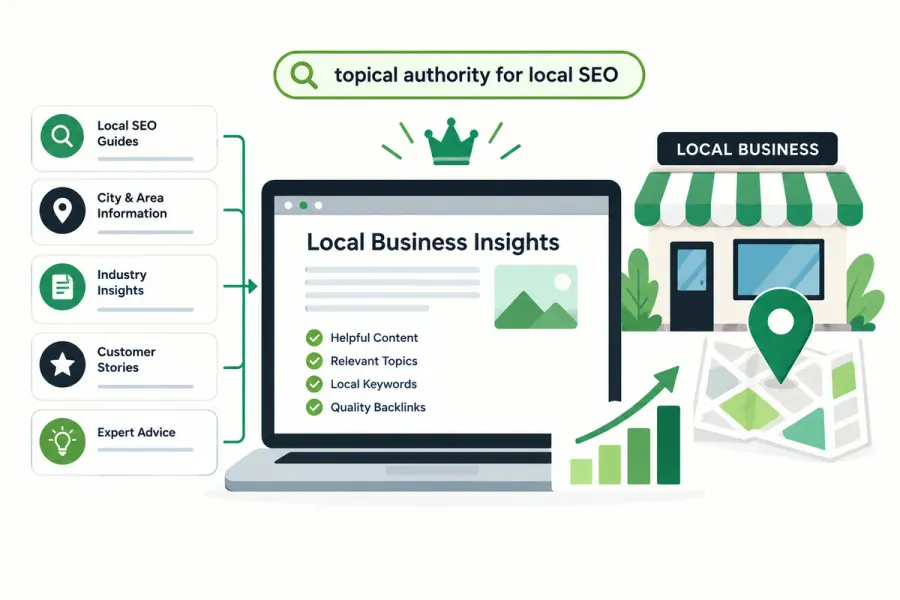
That’s where topical authority for local SEO comes in. When you build topical authority, you’re not just targeting keywords — you’re proving to Google that your site is the most complete, trustworthy resource on a specific subject in a specific place.
In this guide, you’ll learn exactly what topical authority is, why it matters more than ever for local rankings, and a step-by-step process to build it for your business website.
What Is Topical Authority?
Topical authority is the level of trust and credibility a website has built around a specific subject. Instead of publishing random posts on unrelated topics, an authoritative site covers one topic deeply and thoroughly.
Google’s algorithms — particularly since the Helpful Content and E-E-A-T updates — reward sites that demonstrate depth, expertise, and consistency on a subject rather than shallow coverage of many.
For a local business, topical authority has two layers:
- Subject authority — you’re an expert on what you do (e.g., plumbing, accounting, dental care).
- Local authority — you’re the expert for a specific geographic area (e.g., plumbing in Pune, accounting in Austin).
The strongest local sites combine both.
Why Topical Authority Matters for Local SEO
1. It builds trust signals Google can measure
Google can’t “know” you’re an expert. It infers expertise from patterns: how comprehensively you cover a topic, how your pages link to each other, and how others reference your content.
2. It helps you rank for long-tail local queries
Someone searching “emergency plumber in Bandra with 24-hour service” is a high-intent, local, specific query. Topical authority lets you rank for hundreds of these long-tail variations instead of fighting for one broad head term.
3. It reduces dependence on individual keywords
When your site is authoritative, new pages rank faster — because Google already trusts your domain on the topic.
4. It strengthens your local pack performance
While the local pack (map results) depends heavily on your Google Business Profile, organic authority supports the overall trust of your brand in that area.
The Pillars of Topical Authority for a Local Business
Think of topical authority as a structure built on four pillars:
| Pillar | What It Means |
|---|---|
| Depth | Covering a topic in full, not just surface-level posts |
| Relevance | Staying on-topic (no random unrelated content) |
| Structure | Linking related content together logically |
| Trust | Signals of real expertise and local presence |
Step-by-Step: How to Build Topical Authority
Step 1: Define Your Core Topic
Start narrow. A local business can’t be authoritative on “marketing” — but it can be authoritative on “local SEO for small service businesses in [city].”
Write your core topic in one sentence:
“We are the authority on [service] for [audience] in [location].”
Step 2: Map Your Topic Into Subtopics
Break your core topic into clusters. For a local plumber, that might be:
- Emergency plumbing
- Pipe repair and replacement
- Water heater installation
- Drain cleaning
- Bathroom remodeling plumbing
- Seasonal plumbing maintenance
Each subtopic becomes a content cluster with one main page (pillar) and several supporting articles.
Step 3: Build Pillar Pages
A pillar page is a comprehensive guide covering a broad subtopic. It should:
- Be 2,000–4,000 words for competitive topics
- Link out to every supporting article in the cluster
- Include local references (areas served, local regulations, local case studies)
Example pillar: “The Complete Guide to Emergency Plumbing in [City]“
Step 4: Create Supporting Cluster Content
Each supporting article targets a specific long-tail keyword and links back to the pillar.
Examples:
- “How Much Does an Emergency Plumber Cost in [City]?”
- “Signs You Have a Hidden Water Leak”
- “What to Do When Your Water Heater Breaks at Night”
Step 5: Interlink Everything Strategically
Internal linking is the backbone of topical authority. Every cluster article should:
- Link up to the pillar page
- Link across to 2–3 related cluster articles
- Use descriptive anchor text (not “click here”)
Note: This connects directly to our guide on internal linking SEO — the two strategies work together.
Step 6: Add Local Signals to Every Page
Local relevance amplifies topical authority. Include:
- City and neighborhood names naturally in content
- Local landmarks, regulations, or weather-related context
- Service area pages linked from relevant content
- Local testimonials and case studies
- NAP (Name, Address, Phone) consistency
Step 7: Strengthen E-E-A-T Signals
Topical authority and E-E-A-T reinforce each other. Add:
- Author bios with real credentials
- Citations to authoritative sources
- Original photos of your work or team
- Reviews and customer stories
- Clear business information and contact details
Step 8: Update and Expand Over Time
Authority compounds. Every 3–6 months:
- Refresh outdated statistics and examples
- Add new subtopics as you discover search demand
- Merge thin, overlapping posts into stronger ones
- Add internal links to new cluster pages
Common Mistakes That Kill Topical Authority
- Publishing off-topic content — a plumber blogging about cryptocurrency dilutes authority
- Writing thin, 300-word posts — depth signals expertise
- Ignoring internal linking — orphan pages don’t contribute to authority
- Keyword stuffing without real value — Google rewards helpfulness, not repetition
- No local context — generic content won’t win local rankings
- Abandoning the strategy after 3 months — authority takes time to build
How Long Does It Take to Build Topical Authority?
Realistically, expect 6–12 months of consistent publishing and interlinking before you see significant movement, depending on:
- Your competition in the local market
- Existing domain strength
- Publishing frequency and content quality
- Technical SEO health of your site
The good news: once established, topical authority is one of the most durable SEO advantages a local business can have.
Conclusion
Topical authority for local SEO isn’t a hack — it’s a long-term strategy that rewards consistency, depth, and genuine expertise. By defining a narrow core topic, building pillar pages, supporting them with cluster content, and interlinking everything with strong local signals, you give Google exactly what it needs to trust your site.
The businesses that win local search in the coming years won’t be the ones chasing every keyword — they’ll be the ones who own their topic completely.
Start small. Pick one subtopic. Build the cluster. Then expand.
Call to Action
Ready to see where your local website stands?
Run a free SEO audit with BusiRank to uncover your topical gaps, internal linking issues, and technical problems holding your rankings back. Or contact our team to build a custom topical authority roadmap for your business.
FAQs
1. What is topical authority in simple terms?
Topical authority is how much Google trusts your website as an expert on a specific subject. The more thoroughly and consistently you cover a topic, the more authority you build.
2. How is topical authority different from domain authority?
Domain authority measures overall website strength across all topics. Topical authority is specific to one subject area — a site can have low domain authority but high topical authority in a niche.
3. How many articles do I need to build topical authority?
There’s no fixed number. A focused cluster of 10–15 well-structured, interlinked articles on one subtopic is often enough to see early results. Quality and structure matter more than volume.
4. Does topical authority help local rankings specifically?
Yes. When combined with local signals (city references, service area pages, local citations), topical authority strengthens your ability to rank for local and “near me” searches.
5. Can a small business compete with large directories?
Absolutely — in local niches, a focused small business site with strong topical authority often outranks large directories because it offers deeper, more locally relevant content.
6. How often should I update my content to maintain authority?
Review and refresh your core pillar and cluster content every 3–6 months, or whenever industry facts, local regulations, or search trends change.
Internal & External Links
Internal Links
- internal linking SEO
- content clusters SEO
- E-E-A-T SEO
- technical SEO checklist
- SEO service pages
- free SEO audit
- contact our team
External Sources
| Source | Purpose |
|---|---|
| Google Search Central – Helpful Content | Official guidance on people-first content |
| Google Quality Rater Guidelines (PDF) | Defines E-E-A-T and expertise signals |
| Moz – Topic Authority Guide | Industry explanation of topical authority |
| Ahrefs – Topical Authority Study | Data-backed research on how authority impacts rankings |
| Google Business Profile Help | Local presence and profile optimization |
Grow Your Google Maps Ranking on Autopilot
Stop spending hours every week manually replying to customer reviews and writing Google posts. Busirank automates your Google Business Profile to boost your local SEO rankings and turn searchers into paying clients.

 Busirank Team
