 Busirank Team
Introduction
Google doesn’t rank the best business in your market. It ranks the one that looks most trustworthy online .
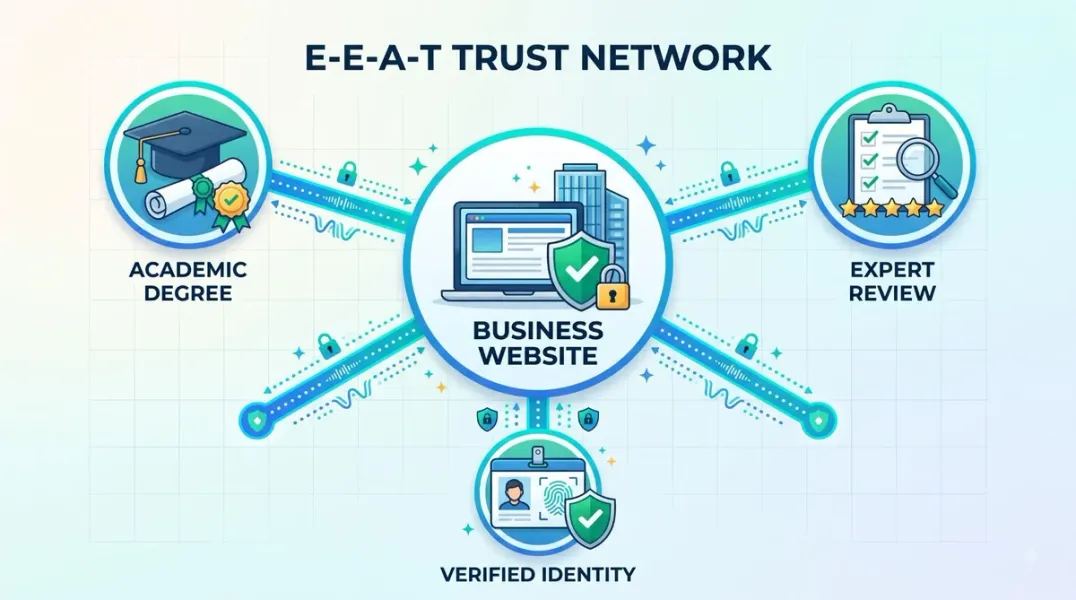
That’s the uncomfortable truth behind E-E-A-T. A competitor with inferior work but stronger online credibility signals will outrank you — because Google can’t evaluate your craftsmanship directly. It relies on signals that indicate whether you’re a real, credible, accountable business.
E-E-A-T stands for Experience, Expertise, Authoritativeness, and Trustworthiness. It comes from Google’s Search Quality Rater Guidelines, a document most recently updated in September 2025 . These guidelines train the human evaluators who assess search result quality — and while E-E-A-T isn’t a direct ranking factor, Google uses a mix of signals that identify content with strong E-E-A-T .
For small businesses, this is actually good news. Every quality E-E-A-T describes can be demonstrated without a big budget. You can’t out-publish a national brand, but you can easily out-prove one .
What Is E-E-A-T?
E-E-A-T is a framework from Google’s Search Quality Rater Guidelines. It stands for:
| Component | Definition |
|---|---|
| Experience | First-hand, real-world involvement with the topic |
| Expertise | Knowledge, skill, or qualifications to speak credibly |
| Authoritativeness | Recognition by others as a go-to source |
| Trustworthiness | Accuracy, honesty, safety, and reliability |
Google’s guidelines state: “Trust is the most important member of the E-E-A-T family because untrustworthy pages have low E-E-A-T no matter how Experienced, Expert, or Authoritative they may seem” .
The other three components exist to support trust. They are inputs to one judgment, not four separate scores .
Is E-E-A-T a Ranking Factor?
Google’s official answer: “While E-E-A-T itself isn’t a specific ranking factor, using a mix of factors that can identify content with good E-E-A-T is useful” .
In practice, Google’s systems look for signals that indicate strong E-E-A-T — and it gives even more weight to these signals for topics that could affect someone’s health, financial stability, or safety. These are called YMYL (Your Money or Your Life) topics .
For small businesses, E-E-A-T matters because it determines whether Google trusts you enough to show your content — especially in competitive or sensitive niches.
Why E-E-A-T Matters More Than Ever
1. AI search is changing the game
Google’s AI Overviews and AI-powered search results are pulling answers directly into search results. To be cited by AI systems, you need to demonstrate clear expertise and trustworthiness .
2. Local competitors are catching up
Your competitors are investing in their online presence. A competitor with more reviews, better content, and stronger credentials will outrank you — even if your work is better .
3. Trust signals influence buyers
Reviews, credentials, and transparent business information influence purchasing decisions. E-E-A-T isn’t just for Google — it’s for your customers.
4. Google’s systems are always evaluating
Continuous core updates mean content improvements can lift rankings without waiting for the next major update. Helpful-content evaluation is always-on .
How to Build E-E-A-T: Practical Steps for Small Businesses
1. Demonstrate Experience
Experience is your biggest advantage as a small business. A national brand can publish generic content about your industry. You can publish case studies from jobs you completed last month, with photos and specific details that competitors can’t replicate .
What to do:
- Add a “Case Studies” or “Our Work” page with before-and-after details
- Document real projects with photos and specific outcomes
- Share the reasoning behind decisions you made — not just the final result
- Use original photos, screenshots, and data
Why it works: First-hand experience signals are almost impossible for a competitor or AI content farm to fake .
2. Demonstrate Expertise
Expertise is about whether you or your content creators have the knowledge and qualifications to make credible claims .
What to do:
- Add author bios with real credentials — “licensed HVAC technician with 12 years of experience” is stronger than a blank byline
- Link author profiles to LinkedIn or professional association listings
- Ensure content depth and accuracy that a generalist couldn’t fake
- Include specific technical details, process explanations, and real specs
Example: A page about HVAC maintenance is more credible when the author bio includes relevant certifications and experience .
3. Build Authoritativeness
Authoritativeness is granted externally. Google measures it through recognition, references, and validation that exist outside your own website .
What to do:
- Earn backlinks from reputable, relevant websites — not generic directories
- Get mentioned in local news coverage, industry publications, or podcasts
- Secure local citations with consistent NAP (Name, Address, Phone) data
- Contribute guest posts to respected publications
- Speak at industry events or local business groups
For local businesses specifically: Authority includes completeness of your Google Business Profile, quality of reviews, mentions in local coverage, and citations in business directories with consistent information .
4. Establish Trustworthiness
Trust is the foundation everything else sits on. Without it, experience, expertise, and authority don’t carry much weight .
What to do:
- Include clear contact information with a physical address, phone, and email
- Publish privacy policy, terms of service, and transparent pricing information
- Ensure HTTPS security and fast, mobile-friendly performance
- Respond professionally to all reviews — positive and negative
- Cite primary sources and link to supporting evidence
- Fix factual errors openly and update content proactively
For YMYL topics (health, finance, legal, safety), trust requirements are dramatically higher. Content affecting someone’s wellbeing or financial security faces the highest scrutiny .
E-E-A-T Quick Wins for This Week
Based on Google’s own self-assessment questions, here are five actions you can take immediately :
- Add an author bio block to every blog post and service page. Include name, credentials, and a link to a full author page.
- Create one case study from a recent project. Include real photos, specific details, and the reasoning behind your decisions.
- Update your About page with your company history, team profiles with credentials, and physical location information.
- Audit your contact information. Ensure your address, phone, and email are visible and consistent everywhere.
- Ask for one review from a recent customer. Review velocity matters more than total count .
Common E-E-A-T Mistakes Small Businesses Make
- Anonymous content — “Admin” bylines damage E-E-A-T signals
- Stock photos for team members — Google’s systems can identify stock imagery
- Generic About pages — mission statements without specific details waste valuable trust-building space
- No reviews or ignored reviews — review velocity and professional responses matter
- Thin, unoriginal content — AI-generated content without unique value is penalized
- Missing trust signals — no physical address, no privacy policy, no transparent pricing
- Chasing volume over value — publishing lots of content on many topics dilutes expertise
How E-E-A-T Connects to Other SEO Strategies
| Strategy | Connection |
|---|---|
| Topical authority | E-E-A-T is the foundation of authority building |
| Content clusters SEO | Depth demonstrates expertise |
| Search intent SEO | Matching intent supports trust |
| Technical SEO checklist | HTTPS, speed, and mobile are trust signals |
| Internal linking SEO | Links reinforce topical relationships |
| Refresh old content SEO | Updates signal active maintenance |
| Programmatic SEO | Low-value scale destroys E-E-A-T |
How to Measure E-E-A-T Progress
Track these indicators over time:
- Rankings for target keywords — especially in competitive niches
- AI Overview citations — are you being referenced by Google’s AI?
- Review velocity — new reviews per month
- Backlink quality — referring domains from relevant, authoritative sites
- Brand mentions — unlinked mentions in local media or industry publications
- Engagement metrics — time on page, pages per session
- Conversions — leads and sales from organic traffic
Conclusion
E-E-A-T isn’t a checklist you complete once. It’s an ongoing digital posture — how you present yourself, prove your expertise, and build trust across every point where your business appears online .
For small businesses, the path to strong E-E-A-T is actually clearer than for large brands. You have genuine first-hand experience, real customer relationships, and local credibility that competitors can’t fabricate.
Start with the quick wins. Add author bios. Create one case study. Update your About page. Ask for reviews. Then build from there.
Google wants to reward businesses that deserve trust. Give it the signals to recognize yours.
Call to Action
Not sure how your website scores on E-E-A-T?
BusiRank audits your site for experience, expertise, authority, and trust signals — then gives you a prioritized action plan to close the gaps and build the credibility Google rewards.
👉 Get Your Free E-E-A-T Audit
FAQs
1. What is E-E-A-T in simple terms?
E-E-A-T stands for Experience, Expertise, Authoritativeness, and Trustworthiness. It’s a framework from Google’s Search Quality Rater Guidelines used to evaluate whether content demonstrates credibility and deserves to rank.
2. Is E-E-A-T a ranking factor?
No, Google says E-E-A-T itself isn’t a specific ranking factor. However, Google’s systems use signals that identify content with good E-E-A-T, and it gives more weight to these signals for sensitive topics .
3. Why is trust the most important E-E-A-T component?
Google’s guidelines state that trust is the most important member because untrustworthy pages have low E-E-A-T regardless of how experienced, expert, or authoritative they seem. The other three components exist to support trust .
4. How can small businesses demonstrate E-E-A-T without a big budget?
Small businesses have an advantage: first-hand experience, real case studies, local relationships, and genuine customer reviews. These are signals a content farm or large brand can’t easily replicate .
5. How long does it take to build E-E-A-T?
E-E-A-T compounds over time. Quick wins like author bios and case studies can show impact within months. Building strong authority and trust typically takes 6–12 months of consistent effort.
6. Does AI-generated content hurt E-E-A-T?
Not inherently. Google rewards high-quality content however it’s produced. Low-quality AI content with little originality or added value is penalized — regardless of how it was created .
7. What are YMYL topics and why do they matter for E-E-A-T?
YMYL stands for “Your Money or Your Life” — topics like health, finance, legal, and safety that could impact someone’s wellbeing. These topics face the highest E-E-A-T scrutiny .
8. How do reviews affect E-E-A-T for local businesses?
Reviews on your Google Business Profile directly influence local E-E-A-T signals. Review velocity (new reviews over time), quality, and professional responses to all reviews matter more than total count .
Internal & External Links
Internal Links
- topical authority for local business websites
- content clusters SEO
- search intent SEO
- technical SEO checklist
- internal linking SEO
- refresh old content SEO
- Get Your Free E-E-A-T Audit
External Sources
| Source | Purpose |
|---|---|
| Google Search Central – Creating Helpful Content | Official E-E-A-T guidance |
| Google Search Quality Rater Guidelines (PDF) | Full E-E-A-T definitions |
| Google Search Central – Helpful Content | People-first content framework |
| Moz – E-E-A-T Guide | Industry explanation and timeline |
| Search Engine Journal – E-E-A-T | Practical implementation guidance |
Grow Your Google Maps Ranking on Autopilot
Stop spending hours every week manually replying to customer reviews and writing Google posts. Busirank automates your Google Business Profile to boost your local SEO rankings and turn searchers into paying clients.

 Busirank Team
