 Busirank Team
Introduction
You’ve optimized your Google Business Profile. Your citations are clean. Your review velocity is steady. Yet you’re still stuck just outside the Local Pack for your most valuable keywords.
This is the plateau that most local businesses hit. On-page factors are dialed in, but something is missing: local trust signals—the kind that tell Google your business is a genuine, recognized part of its community .
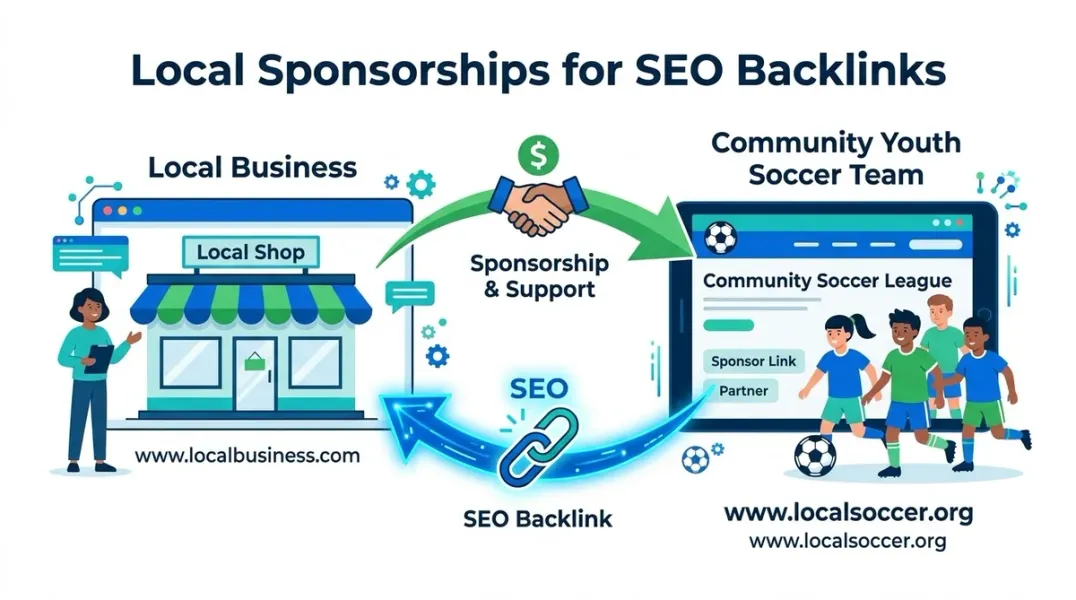
Local sponsorships are one of the most reliable sources of those signals. When you sponsor a youth sports team, a charity run, or a community festival, the organization often lists you on its website with a link back to your business. That link isn’t from a random directory or a paid link farm. It’s from a real community organization, on a page that real people visit, carrying geographic relevance that no generic backlink can replicate .
But here’s the catch: most businesses sponsor things and never ask for the link. They pay the fee, get their logo on a banner or a jersey, and assume that’s the end of it. The organization’s website gets updated with a sponsor page that either lists them without a link, or misses them entirely.
This guide shows you how to fix that. You’ll learn how to identify sponsorship opportunities, structure agreements for maximum SEO impact, and turn community goodwill into a systematic local link building asset.
Not all backlinks are created equal. For local search, the geographic relevance of the linking site matters more than its raw domain authority . A link from your city’s chamber of commerce or a local youth sports league signals something a link from a national publication never can: that your business is a genuine, recognized part of its community.
The Data on Sponsorship Links
Local sponsorship links often come from .org, .edu, or city government domains—sources that carry inherent trust signals . These aren’t paid placements or manipulated link patterns. They’re editorial acknowledgments of your support, published on websites that Google already recognizes as legitimate local entities.
One local SEO practitioner reported that a single charity run sponsorship generated three to four quality links from one investment: the organization’s sponsor page, local news coverage, and partner cross-promotion . Another noted that local businesses can gain 15-20 quality backlinks from a single event sponsorship when the event generates news coverage, participant blog posts, and community social media mentions .
Why Google Treats Them Differently
Google’s algorithms are sophisticated at detecting artificial link patterns. But sponsorship links look exactly like what they are: genuine business relationships within a community . There’s no manufactured anchor text scheme. No sudden spike of unrelated links. Just a local business supporting a local organization, acknowledged on the organization’s website.
Whitespark’s 2026 Local Search Ranking Factors report confirmed that quality and authority of inbound links remains one of the top local organic ranking factors, with emphasis firmly on local relevance, not volume .
How to Find Sponsorship Opportunities
You don’t need a massive research budget to find local sponsorship opportunities. Many are hiding in plain sight.
The Google Search Method
The simplest approach: search Google for inurl:sponsors [your city] . This reveals pages on local websites that list sponsors—youth sports clubs, charity events, school fundraisers, community festivals.
You can also try:
- [your city] event sponsorship opportunities
- [your city] nonprofit partners
- [your city] charity run sponsors
Start With What You Already Support
Before spending another dollar, list every local group you already sponsor or support . Sporting clubs, school fundraisers, charity days, business awards, town events. You may already be supporting organizations that would happily add a link if asked.
A café that donates coffee to a monthly netball fundraiser. A mechanic who sponsors the local rodeo. Both can request a proper sponsor listing without it feeling awkward .
Use AI to Expand Your List
ChatGPT’s agent mode can research sponsorship opportunities in your area. Tell it about your business, your service area, and the types of organizations you’d consider sponsoring. Ask it to prioritize by relevance to your business and look for local nonprofits, events, sports leagues, neighborhood associations, schools, faith-based organizations, and community groups .
Where to Look Beyond Sports
Sponsorship opportunities extend beyond youth sports:
| Category | Examples |
|---|---|
| Education | School P&C fundraiser pages, scholarship programs, library events |
| Civic | Council event calendars, town festivals, show societies |
| Business | Chamber of commerce events, business awards, networking groups |
| Charity | 5K runs, auctions, food drives, awareness campaigns |
| Arts | Local theatre, music festivals, art walks |
Localsearch’s Australian guide notes that regional opportunities include AFL, rugby league, netball, cricket, and surf clubs, along with council event calendars and regional chamber member directories .
Evaluating Sponsorship Opportunities
Not every sponsorship is worth pursuing. Before committing, evaluate each opportunity against these criteria :
1. Does the Organization Have a Real Website?
A dormant site with no traffic and a domain authority under 10 won’t move the needle. Look for organizations that maintain an active, regularly updated website.
2. Does the Sponsorship Include Digital Acknowledgment?
A logo on a banner earns you nothing online. You need a listing on their website with your business name, description, and a clickable link.
Check their current sponsor page before committing. If they list sponsors with logos and links, that’s a good sign. If they don’t have a sponsor page yet, ask if they’d create one.
3. Does the Audience Fit Your Business?
A pediatric dental practice sponsoring a youth soccer league makes sense. The same practice sponsoring a craft beer festival does not . Geographic and audience relevance matter.
4. Will the Event Generate Media Coverage?
Sponsorships that attract local press earn you a second layer of backlinks from news outlets covering the event. Ask the organizer if they expect media coverage .
Structuring Agreements for Maximum SEO Impact
The sponsorship agreement is where most businesses leave SEO value on the table. A logo on a banner earns you nothing. A dofollow link on the sponsor page earns you a high-quality local backlink .
What to Request in Every Agreement
When negotiating a sponsorship, ask for:
- A dofollow backlink from the sponsor page pointing to a relevant internal page (not just your homepage—a service or location page if applicable)
- Your business name, a brief description, and your URL on event promotional materials and digital newsletters
- A mention in any press releases or blog posts about the event
- Permission to write a guest post or testimonial on their website
The Anchor Text Matters
Request that the link uses descriptive anchor text tied to your services, such as “our local digital marketing partner” or “[City] residential electricians,” rather than a bare URL or “click here.” This helps search engines understand what your page is about .
A Simple Outreach Template
For organizations you already sponsor, the ask is straightforward :
“Hi [Name], thanks for all the work you’re doing for [organization]. We’re glad to support you again this season. Could you add the details below to your sponsor page when you get a chance? A clickable website link would be appreciated. Happy to send a different logo size if needed. Cheers, [Your Name]”
Then provide:
- Business name: [Exact match to your GBP]
- Website: [URL]
- Description: [Short, clean blurb they can paste]
- Contact number: [Your business number]
- Logo: [Clean PNG file attached]
Make it copy-and-paste easy for the volunteer or staff member managing the site .
Creating Content Around Your Sponsorships
Every sponsorship should generate at least two pieces of content on your own website :
- A pre-event announcement introducing your involvement and linking to the event page
- A post-event recap sharing highlights, photos, and outcomes
Both create crawlable, keyword-rich pages that reinforce your local relevance.
Go further by publishing:
- A case study showing how your sponsorship generated community impact
- Social media posts tagging the organization (which often leads to reciprocal shares and mentions)
- A year-end roundup blog post covering all sponsorships and partnerships
The result is a flywheel: the sponsorship earns a backlink. Your content about the sponsorship earns social shares and additional links. The organization shares your content, driving referral traffic. That traffic generates branded searches that reinforce your local authority .
Measuring Sponsorship SEO ROI
A sponsorship strategy that can’t be measured is a strategy that gets cut. Track these metrics for every sponsorship-driven link :
| Metric | What to Track |
|---|---|
| Backlink acquired | URL, anchor text, dofollow status |
| Domain authority | Of the linking site |
| Referral traffic | Visits from the sponsor page |
| Branded search lift | ”[Your business name] near me” queries after the event |
| Ranking movement | Positions for target keywords before/after |
A Note on Realistic Expectations
One large-scale test of local sponsorship links for a national wireless provider found no clear, attributable lift after six months . But the test had significant limitations: the markets weren’t similar enough for clean comparison, the target pages had very few links to begin with, and the scale was insufficient to move the needle in competitive national markets .
For a local business competing in a local market, the dynamics are different. A sponsorship link from a local youth sports league or charity run introduces a hyperlocal signal that most local competitors aren’t using. The test’s inconclusive result doesn’t mean sponsorships don’t work—it means they’re hard to isolate in large-scale, multi-market tests .
Conclusion
Local sponsorships are one of the few link building tactics where doing the right thing for your community also does the right thing for your SEO. You’re not buying links or manipulating algorithms. You’re supporting organizations that matter to your neighbors, and those organizations are acknowledging your support on their websites.
The key steps are simple:
- Identify opportunities using Google search operators, your existing community involvement, and AI research
- Evaluate each opportunity for website quality, digital acknowledgment, and audience fit
- Ask for the link in the sponsorship agreement—dofollow, with descriptive anchor text
- Make it easy for volunteers to add your listing
- Create content around every sponsorship to amplify the signal
- Measure the results to refine your strategy over time
A few hundred dollars of sponsorship spend regularly outperforms outreach budgets ten times its size . The businesses that master this approach don’t just build links—they build a local authority that competitors can’t replicate.
Call to Action
Ready to turn your community involvement into SEO results?
We’ve created a Local Sponsorship SEO Toolkit with outreach templates, a sponsorship evaluation checklist, and a tracking sheet to measure your link building ROI.
👉 Download the Toolkit and start earning backlinks that actually matter.
👉 Or run a free local SEO audit to see how your current backlink profile compares to competitors.
FAQs
1. Are sponsorship links considered paid link schemes by Google?
No. Sponsoring genuine community organizations is a standard business practice. Google recognizes legitimate local sponsorships as natural community engagement, not link manipulation .
2. How much do local sponsorships typically cost?
Local youth sports teams and community 5Ks typically offer sponsorship packages ranging from $250 to $1,500 annually, delivering ROI in both customer referrals and local SEO value .
3. How many backlinks can I get from one sponsorship?
A single sponsorship can generate 3-4 quality links from the organization’s sponsor page, local news coverage, and partner cross-promotion . Larger events with media coverage can generate significantly more .
4. Should the sponsor link point to my homepage or a service page?
For general sponsorships, linking to your homepage strengthens overall domain authority. For specific partnerships (like a sports team if you’re a physiotherapist), linking to a relevant service page passes direct topical relevance .
5. What if the organization doesn’t have a sponsor page?
Ask if they’d consider creating one. Many organizations are happy to add sponsor listings—they just haven’t thought to do it. Make the ask easy by providing your details ready to paste .
6. How do I find sponsorship opportunities in my area?
Search Google for inurl:sponsors [your city]. Also check your local chamber of commerce, council event calendars, and organizations you already support .
7. Can I ask for a dofollow link?
Yes. When negotiating the sponsorship, specify that you’d like a dofollow backlink on the sponsor page. Most organizations are happy to accommodate—they may not know the difference unless you ask .
8. How long does it take to see SEO results from sponsorship links?
For competitive queries, measurable ranking impact from new links typically takes 4-12 weeks . Sponsorship links compound over time as you build more relationships.
9. What if I can’t afford to sponsor larger events?
Start small. A single youth sports team sponsorship typically costs $100 to $500 per season. That one sponsorship often earns a backlink, community goodwill, and word-of-mouth referrals .
10. Do local sponsorship links still work for SEO in 2026?
Yes. Whitespark’s 2026 Local Search Ranking Factors report confirmed that quality local backlinks remain a top ranking factor. With AI search adding another layer, authentic local footprints are more valuable than ever .
Internal & External Links
Internal Links
- Local Link Building Strategies for Small Businesses With Small Budgets
- How to Build Local Backlinks Without Buying Links
- How Community Partnerships Can Strengthen Your Local SEO Strategy
- Local Citation Building vs Link Building: What’s the Difference?
- Industry-Specific Citations: How to Find the Best Directories for Your Business
External Sources
Grow Your Google Maps Ranking on Autopilot
Stop spending hours every week manually replying to customer reviews and writing Google posts. Busirank automates your Google Business Profile to boost your local SEO rankings and turn searchers into paying clients.

 Busirank Team
