 Busirank Team
Introduction
If you run a small local business, you’ve probably heard that backlinks matter for local SEO. You’ve also probably seen the price tags attached to professional link building services—retainers of $1,500 to $5,000 per month, per-link costs of $200 to $800, and “authority packages” that promise the world for prices that make your eyes water.
Here’s the truth: you don’t need a massive budget to build local links that actually move the needle.
In fact, some of the most powerful local link building strategies cost nothing more than time, relationship-building, and a willingness to be a genuine part of your community. A link from your local chamber of commerce, a neighborhood blog, or a vendor partner often carries more weight for local SEO than a generic link from a distant, high-authority site .
The key is understanding what makes local links valuable—geographic relevance, authenticity, and relationship depth—and then pursuing the opportunities that already exist within your business ecosystem.
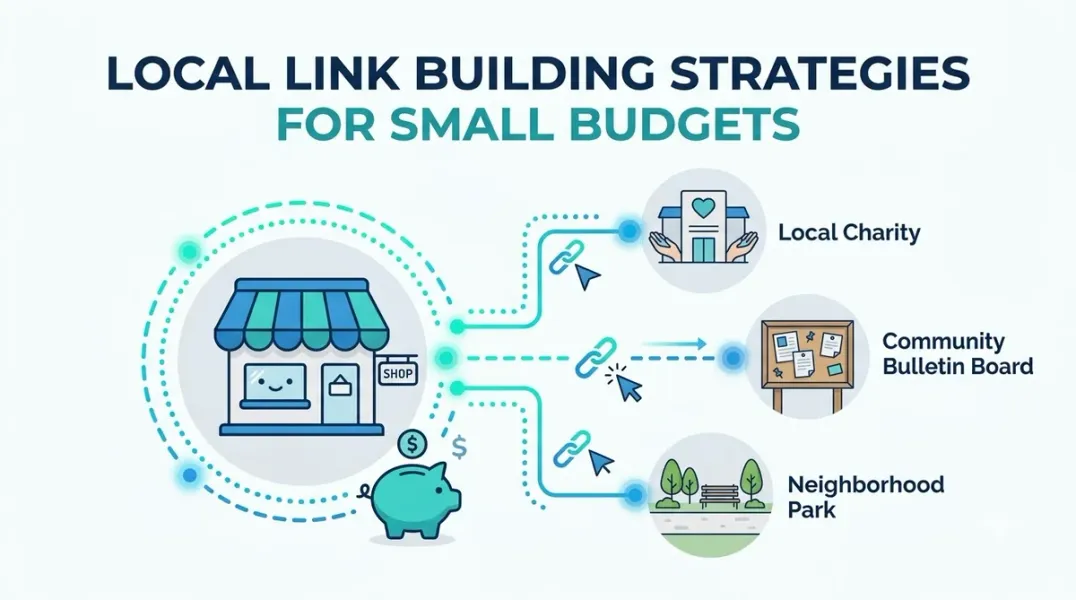
In this guide, you’ll learn 10 local link building strategies designed specifically for small businesses with small budgets. These aren’t theoretical tactics. They’re practical, proven approaches that leverage what you already have: your relationships, your community, and your reputation.
Before diving into tactics, let’s establish why local links deserve your attention—and why small budgets aren’t the disadvantage you might think.
The Quality Over Quantity Shift
Google’s link evaluation has evolved dramatically. In 2020, more links generally meant higher rankings. In 2026, quality and relevance outweigh volume . A small business building 5-15 high-quality local links per month is doing well—and those genuine links will impact rankings more than 300 low-quality directory and forum links .
Local Links Carry Geographic Relevance
For local SEO, the geographic relevance of the linking site matters more than its raw domain authority . A link from your city’s chamber of commerce or a neighborhood blog signals something a link from a national publication never can: that your business is a genuine, recognized part of its community .
Small Businesses Have Natural Advantages
Large national brands can’t easily build relationships with local journalists, sponsor neighborhood events, or partner with the bakery down the street. You can. These relationship-driven links are harder for competitors to replicate and often carry more weight for local rankings.
The Realistic Budget
A small business can build a strong local link profile for under $500 per month by focusing on relationship-based tactics. The most expensive strategies in this guide—sponsorships—typically cost $100 to $1,000 and come with additional benefits like brand visibility and community goodwill .
Strategy 1: Unlinked Brand Mentions (The Easiest Win)
Someone already mentioned your business online but forgot to link to your website. This is the easiest local link opportunity because the person already likes you—they just didn’t think to add a link .
How to Find Them
Use tools to monitor mentions of your business name:
- Google Alerts – Free, sends email notifications when your business is mentioned
- Ahrefs – Search for brand mentions without links
- Mention.com – Track mentions across the web
- Semrush Brand Monitoring – Monitor unlinked mentions
The Outreach
The conversion rate is insanely high because they’ve already voluntarily mentioned you .
Template:
“Hi [Name], thanks so much for mentioning [Your Business] in your article about [topic]! I noticed the mention didn’t include a link. If you’re able to add one, it would help readers find us more easily. Here’s the URL: [link]. Thanks again!”
Keep it short. Be grateful. Don’t demand.
Why It Works
This isn’t asking for a favor from a stranger. It’s a simple, reasonable request to someone who already thinks your business is worth mentioning. Most people are happy to add a link when asked politely .
Strategy 2: Vendor Partner Links (The Underrated Tactic)
This one is pure genius for local businesses, and almost nobody does it .
The Concept
If your business sources products or services from local vendors, ask those vendors to add a “Proud Supplier Of [Your Business]” badge with a link on their website .
Examples:
- A restaurant sources bread from a local bakery → ask the bakery to add a supplier badge
- An ice cream shop sources from a local dairy → ask the dairy for a supplier listing
- A contractor buys materials from a local supplier → ask for a “trusted customer” listing
Why It Works
The vendor benefits from the social proof—they get to show they supply a reputable local business. You get a highly relevant local link from a genuine business relationship. It’s a win-win .
How to Execute
The ask is simple: “We’re proud to source from you. Would you be open to adding a small ‘Proud Supplier Of’ badge with a link on your website? We’d be happy to do the same for you.”
Vendors who understand SEO will immediately see the value. Those who don’t will often agree anyway because it’s a reasonable request from a good customer.
Strategy 3: Local Business Partnerships and Cross-Referrals
Think of your local business ecosystem as a web of referral relationships. A plumber and an electrician serve the same homeowners. A wedding photographer, venue, and florist all work the same events .
The Non-Spammy Approach
Create a “Trusted Local Partners” page on your website listing businesses you genuinely recommend and work with. Invite those partners to do the same .
Why it’s not a link exchange: You’re not trading links for SEO purposes. You’re creating a genuine resource that helps your customers while promoting businesses you actually trust. Google’s algorithms are sophisticated enough to recognize the difference .
Examples of Natural Partnerships
- HVAC company + insulation contractor
- Wedding photographer + venue + florist
- Chiropractor + massage therapist + gym
- Dentist + orthodontist + pediatrician
- Real estate agent + mortgage broker + home inspector
The Outreach
“Hi [Partner], I’ve created a page on my website recommending trusted local businesses I work with, and I’d love to include you. Would you be open to doing something similar on your site? Here’s my information if so.”
Most complementary businesses are happy to participate. It’s free promotion for both of you, and it helps your shared customers.
Strategy 4: Local Sponsorships (Small Investment, Big Returns)
Sponsoring local events and organizations is one of the easiest ways to earn legitimate local links—when the organization actually lists sponsors on its website .
What to Sponsor on a Small Budget
-
Youth sports teams
-
School fundraisers (PTA/PTO)
-
Community festivals
-
Charity events (5K runs, auctions)
The ROI
One sponsorship can generate 3-4 quality links from a single investment: the organization’s sponsor page, local news coverage, social media mentions, and partner cross-promotion .
How to Maximize Sponsorship Links
Before committing, ask if sponsorship includes a website listing with a link. Not all do. If they don’t, ask if they’d consider adding sponsor links. Many organizations are happy to—they just haven’t thought to do it.
Use search operators to find opportunities: inurl:sponsors [your city] will surface sponsorship pages in your area .
Strategy 5: Community Involvement (Relationships That Produce Links)
Local chambers of commerce, business associations, and community organizations often have member directories with links. Joining these organizations provides both links and networking opportunities .
What to Join
-
Chamber of Commerce
-
Industry-specific local associations – Varies; directory listing plus member benefits
-
Business improvement districts – Often free or low-cost for local businesses
-
Neighborhood business alliances – Low-cost; directory listings and community events
The Dual Benefit
These memberships function as both citations and links. Your NAP information appears in a structured, verifiable directory—which helps with local SEO and AI search visibility—and the listing often includes a link to your website .
Beyond the Directory
Chamber memberships lead to additional opportunities: co-sponsored events, joint press mentions, and cross-promotion with other members. Each one adds another consistent NAP touchpoint and another potential link .
Strategy 6: Reverse “Top 10” Lists (Get Added to Existing Listicles)
Find existing “best of” lists in your target city. If you’re not included, reach out and pitch to get added .
Where to Look
- Local news “best of” features
- City magazine lists (e.g., “Best Restaurants in [City]”)
- Blog roundups of local businesses
- “Top [industry] in [city]” articles
The Approach
Don’t go straight for the ask. Start a conversation with the author: “I noticed your list of best [industry] in [city]. I’m curious—what criteria did you use?”
Once you’re on their radar, you can mention that your business might be a good fit. Offer something valuable if appropriate (free consultation, discount for their readers) .
Why it works: List owners often update content for freshness. Adding a new business is a small change with value for their readers .
Strategy 7: Local Press Coverage Through Story Pitching
Local journalists are constantly looking for stories. Your business can be that story—and you don’t need a PR agency to pitch it .
What Makes a Good Local Story
- Charity partnerships – “Local business partners with shelter to provide free [service]”
- Customer milestones – “Local business celebrates 1,000th customer with giveaway”
- “Local hero” features – Employees or customers doing something remarkable
- Business milestones – Anniversaries, expansions, new hires
- Data-driven stories – “Local wait times for [service] are the longest in the region”
The Data-Backed Pitch (The “Tabloid Technique”)
Local newspapers love to compare how their area stacks up against others . Pull local data on a newsworthy topic related to your industry and pitch it.
Examples:
- “Our city ranks 37th in the state for [relevant metric]”
- “Residents here pay [X] more in [category] than the national average”
One campaign about UK driving test wait times earned links from 58 referring domains, mostly local newspapers .
The Pitch
Keep it simple: “Hi [Journalist], I put together data showing how [City] compares to other areas on [topic]. Thought it might be interesting for your readers. Happy to share the full dataset if useful.”
Strategy 8: Expert Roundups (Chain Reaction Links)
Find 20-30 local thought leaders. Ask them one burning question about your industry. Publish the roundup, then reach back out asking them to share .
Why It Works
When you feature someone in a roundup, they’re likely to share it with their audience. Their audience includes other local businesses, journalists, and potential customers. This triggers a chain reaction—their shares lead to more visibility, more links, and local media picking up quotes .
How to Execute
- Identify 20-30 local experts – Business owners, community leaders, academics
- Ask one focused question – “What’s the biggest mistake local businesses make with [topic]?”
- Compile their answers into a comprehensive roundup post
- Notify participants – “You’re featured! Here’s the post—feel free to share with your network”
The links come naturally as participants share, and the roundup itself becomes a linkable resource.
Strategy 9: Goodwill Link Building (Donate Your Expertise)
Doing good things for your community is one of the most powerful link building tactics because it’s genuine—not transactional .
The Concept
Instead of inventing artificial reasons for websites to link to you, do something that actually gives another organization a reason to mention you .
Examples for Local Service Businesses
- Donate free work to a nonprofit – A roofer donated a free roof through a local Habitat for Humanity chapter. The charity posted about it with a link. A local news station picked it up. One act of goodwill built more authority than six months of buying links .
- Provide pro bono services – Offer your expertise to a local school, church, or community organization
- Donate products – If you sell physical goods, donate to local fundraisers or shelters
- Sponsor a family in need – Local media often covers heartwarming stories
The Key Step Most Businesses Miss
Ask for the link. Most contractors sponsor a team, get a photo caption with their name in plain text, and never think to ask for a link. It’s a two-minute email—and it’s the entire value .
Template: “Hi [Organization], I’m so glad we could support [cause/event]. Would you mind adding a link to our website on your sponsor page? It helps people learn more about what we do. Here’s the URL: [link]. Thanks again for the great work you do!”
Strategy 10: Local Resource Page Links (Create Something Linkable)
Create something that other local websites want to reference .
Examples of Linkable Local Resources
- An ultimate guide to local attractions
- A comprehensive list of all non-profits in your area
- A searchable map of local walking trails
- A guide to free family activities in your city
- A directory of local farmers’ markets
Why It Works
These resources are inherently valuable. Other websites—local blogs, community organizations, even news sites—link to them because they add value to their own readers . The links come naturally over time as people discover and reference the resource.
How to Execute
- Identify a gap in local information. What do people in your city constantly search for but can’t easily find?
- Create a high-quality, regularly updated resource on your website
- Promote it to local organizations and individuals who might link to it
Measuring Local Link Building Success Without a Budget
Don’t just count links. Measure quality .
Metrics That Matter
- Relevance: Is the linking site connected to your industry, community, or city?
- Trust: Is it a real organization with a real audience?
- Context: Is your business described in a sentence, not just dumped in a list?
- Traffic: Does the link send qualified visitors?
- Relationship depth: How many of your links come from sources you’ve built ongoing relationships with?
A Simple Rule
If you’d be proud to show the link to a customer, it’s probably a good one.
Conclusion
You don’t need a massive budget to build local links that actually move the needle for your local SEO.
The strategies in this guide share a common thread: they all involve being a real part of your community. Sponsoring a youth sports team. Partnering with a complementary business. Getting featured in the local paper. Creating a resource that helps your neighbors. Donating your expertise to a cause you care about.
These links can’t be bought. But they can be earned. And they’re worth more than anything you could purchase.
The realistic expectation: A small business building 5-15 high-quality local links per month is doing well . Those links compound over time. Six months of consistent local link building can transform your local search visibility.
Start with the easiest tactics. Claim your unlinked brand mentions. Ask your vendors for partner links. Join the chamber of commerce. Sponsor something small. Then build from there.
Call to Action
Ready to build local links without breaking the bank?
We’ve created a Local Link Building Starter Kit with outreach templates, a sponsorship tracker, and a checklist of the easiest tactics to implement first.
👉 Download the Starter Kit and start building your local link profile today.
👉 Or run a free backlink audit to see where you stand compared to competitors.
FAQs
1. How many local backlinks do I need for local SEO?
Quality matters more than quantity. A small business building 5-15 high-quality local links per month is doing well. Five genuine links from relevant local sources outperform 50 low-quality directory links .
2. What’s the easiest local link building tactic?
Unlinked brand mentions. If someone already mentioned your business, a simple polite email asking them to add a link often works—and the conversion rate is very high .
3. Can I build local links for free?
Yes. Unlinked brand mentions, vendor partner links, local business partnerships, community involvement, and goodwill link building all cost little or nothing beyond your time and relationship-building .
4. Are sponsorships worth the money for links?
Yes, if the sponsorship includes a website listing with a link. One sponsorship can generate 3-4 quality links from the organization’s sponsor page, local news coverage, and partner cross-promotion .
5. How do I find unlinked brand mentions?
Use Google Alerts (free), Ahrefs, Mention.com, or Semrush Brand Monitoring to track mentions of your business name without links .
6. What’s a vendor partner link and how do I get one?
Ask your vendors to add a “Proud Supplier Of [Your Business]” badge with a link on their website. It’s a genuine business relationship, the link is natural, and vendors are often happy to reciprocate .
7. How do I get added to local “best of” lists?
Start a conversation with the list author. Ask about their criteria, then mention your business might be a good fit. Offer something valuable if appropriate. Most list owners update content for freshness .
8. Can I get local press coverage without a PR agency?
Yes. Pitch human interest stories (charity partnerships, milestones) or data-driven stories comparing your city to others. Local papers love comparative data about their area .
9. What’s goodwill link building?
It’s doing something genuinely helpful for your community—donating expertise, sponsoring a cause, providing free services—and then asking for a link. The key step most businesses miss is simply asking .
10. How long does it take to see results from local link building?
For competitive queries, measurable ranking impact from new links typically takes 4-12 weeks. Links compound over time, so consistency matters more than speed .
Internal & External Links
Internal Links
- Local Citation Building vs Link Building: What’s the Difference?
- How Local Sponsorships Can Earn Valuable SEO Backlinks
- How Community Partnerships Can Strengthen Your Local SEO Strategy
- How to Build Local Backlinks Without Buying Links
- Industry-Specific Citations: How to Find the Best Directories for Your Business
External Sources
Grow Your Google Maps Ranking on Autopilot
Stop spending hours every week manually replying to customer reviews and writing Google posts. Busirank automates your Google Business Profile to boost your local SEO rankings and turn searchers into paying clients.

 Busirank Team
