 Busirank Team
Introduction
You’ve optimized your Google Business Profile. Your citations are clean. Your review velocity is steady. Yet competitors with fewer reviews and less polished websites still outrank you in the Local Pack.
What are they doing that you’re not?
The answer often isn’t another technical tweak or a new keyword strategy. It’s something more fundamental: they’re embedded in their community in ways Google can see and measure .
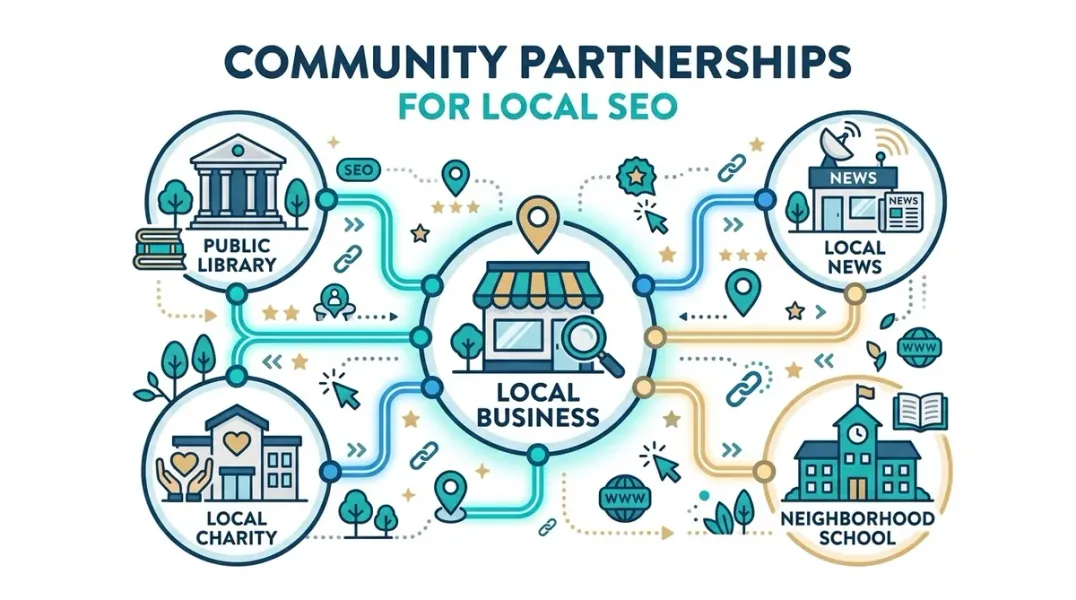
Local search has evolved beyond on-page optimization and citation building. Google now evaluates your business through the lens of entity relationships—how you’re connected to the landmarks, organizations, events, and other businesses that define your area . A business that sponsors the local Little League, partners with the neighborhood café, and gets mentioned in the town newspaper isn’t just building goodwill. It’s building entity authority—the kind of local trust signals that competitors can’t easily replicate.
In this guide, you’ll learn how community partnerships strengthen your local SEO strategy, what types of partnerships deliver the strongest signals, and how to turn your real-world involvement into measurable local search visibility.
Google’s local algorithm evaluates three primary factors: relevance, proximity, and prominence . Community partnerships directly strengthen prominence—the measure of how well-known and trusted your business is.
But they do something else, too. They create entity relationships that Google uses to understand your business’s place in the local ecosystem.
The Entity Connection
Search engines now look at entities that define everyday community life—schools, parks, events, and organizations. Businesses tied to those entities rise in visibility because Google values the connection . This is what entity-based SEO does: it positions you as a trusted part of the neighborhood.
A 2025 McKinsey study found that 47% of consumers consider “locally owned” important when making purchase decisions—clear proof that local signals influence both behavior and search rankings .
What Google Sees When You Partner
When you partner with a local organization, several things happen:
- Citations multiply: Your NAP appears on partner websites, event pages, and sponsor listings
- Backlinks grow: Partners link to your website, creating locally relevant link signals
- Branded searches increase: Community visibility drives people to search for your business by name
- Engagement signals strengthen: More people click, call, and request directions from your GBP
The combined effect is a local footprint that Google recognizes as authentic and authoritative.
The Types of Partnerships That Deliver SEO Value
Not all partnerships are created equal. Some generate strong local signals. Others are just friendly relationships with no measurable SEO impact.
Here are the partnership types that deliver the strongest local SEO value.
1. Complementary Business Partnerships
Think of your local business ecosystem as a web of referral relationships. A plumber and an electrician serve the same homeowners. A wedding photographer, venue, and florist all work the same events .
How it works: Create a “Trusted Local Partners” page on your website listing businesses you genuinely recommend. Invite those partners to do the same .
SEO impact: Reciprocal links from locally relevant, topically connected businesses. Google’s algorithm is sophisticated enough to identify when one local business has linked to another—and those links carry more weight than generic directory listings .
Example: A local tax lawyer partners with a bookkeeping service to create a monthly tax tips newsletter. Both firms contribute content, both link to each other’s service pages, and both gain authority from the association .
2. Vendor Partner Links
This is one of the most underrated local link building tactics .
How it works: If your business sources products or services from local vendors, ask those vendors to add a “Proud Supplier Of [Your Business]” badge with a link on their website.
Examples:
- A restaurant sources bread from a local bakery → ask for a supplier badge
- An ice cream shop sources from a local dairy → ask for a supplier listing
- A contractor buys materials from a local supplier → ask for a trusted customer listing
SEO impact: The vendor benefits from the social proof—they get to show they supply a reputable local business. You get a highly relevant local link from a genuine business relationship. It’s a win-win .
3. Event Sponsorships
Sponsoring local events creates multiple link opportunities from a single investment.
How it works: Sponsor a youth sports team, community festival, charity run, or school fundraiser. Ensure the sponsorship includes a website listing with a link .
SEO impact: One sponsorship can generate 3-4 quality links from the organization’s sponsor page, local news coverage, and partner cross-promotion. Links from .org and .edu domains are particularly valuable for local relevance .
The key step most businesses miss: Ask for the link. Many organizations are happy to add sponsor links—they just haven’t thought to do it .
4. Local Organization Memberships
Joining local chambers of commerce, business associations, and community organizations provides both links and networking opportunities .
What to join:
- Chamber of Commerce – member directory listing with link
- Industry-specific local associations – directory listing plus member benefits
- Business improvement districts – often free or low-cost for local businesses
- Neighborhood business alliances – directory listings and community events
SEO impact: These memberships function as both citations and links. Your NAP appears in a structured, verifiable directory—which helps with local SEO and AI search visibility—and the listing often includes a link to your website .
5. Content Collaboration Partnerships
Collaborating with local, like-minded businesses demonstrates your expertise and your partner’s expertise—and then showcases it on each other’s platforms .
How it works: Guest blog posts, joint webinars, offline events, or social media takeovers. All of these enhance your reputation as a trusted local information contributor.
SEO impact: Content sharing may result in the creation of valuable local backlinks and citations. Even social signals—likes, shares, and validation from partners—extend your content’s potential audience, where it can be read, liked, and shared again .
How to Turn Partnerships into SEO Assets
A partnership that isn’t documented online doesn’t help your SEO. Here’s how to capture the value.
Step 1: Document the Partnership on Your Website
Create a dedicated page for each partnership or a “Community Partners” page that lists all your collaborations.
What to include:
- Partner name and description
- What the partnership involves
- A quote from your partner about the collaboration
- A photo of the teams together
- A clear call to action
SEO benefit: This creates a crawlable, keyword-rich page that reinforces your local relevance. Google sees consistent names, addresses, and cross-mentions between two known entities in the same city, making you look more established .
Step 2: Ask for Reciprocal Links
Request that your partner links to your dedicated partnership page from their website—and link to their main site from yours .
Anchor text matters: Request descriptive anchor text tied to your services, such as “our local digital marketing partner” or “[City] residential electricians,” rather than a bare URL .
Step 3: Co-Post on Google Business Profile
Collaborate with your partner on a Google Post that highlights the partnership. Tag them if possible, and encourage them to share the post with their audience .
Why it works: GBP posts are a ranking signal, and co-posting extends your reach to your partner’s audience. When Google sees cross-mentions between two local entities, your combined authority strengthens .
Step 4: Ask for Reviews That Mention the Partnership
Request that your partner leave a Google review that names your business, the service provided, and the area you serve .
Why it works: Reviews that mention specific services and neighborhoods strengthen the keyword content in your review profile—a growing ranking factor .
Step 5: Share the Story Online
Document your partnerships through content: blog posts, social media updates, and GBP posts. Every piece of content creates another opportunity for links, mentions, and visibility .
Measuring the SEO Impact of Community Partnerships
Partnership SEO isn’t guesswork. Track these metrics to measure impact :
| Metric | What It Measures |
|---|---|
| Branded searches | How many people search for your business by name |
| GBP actions | Calls, website clicks, direction requests from your profile |
| Review mentions | Reviews that name services, neighborhoods, or partners |
| Local links | New backlinks from clubs, schools, media, and partner sites |
| Map pack visibility | Rankings for service + neighborhood queries |
| Referral traffic | Visits from partner sites and local blogs |
When these metrics rise together, your local footprint is strengthening—not just your rankings, but your overall presence .
A Practical Example: The Fitness Food Partnership
Here’s a real-world scenario that illustrates how partnership SEO works .
The partnership: A local fitness studio partners with a healthy café to offer a stay-fit meal deal to gym members.
What happens next:
- The café links to the gym’s website from its “Partners” page
- The gym links to the café’s menu from its “Member Benefits” page
- Both businesses co-post about the deal on Google Business Profile
- Members leave reviews mentioning both businesses and the neighborhood
- A local food blog covers the collaboration, generating additional links
The SEO result: Both businesses strengthen their local entity signals. Google sees consistent cross-mentions between two known entities in the same city. Branded searches increase. Map pack visibility improves for service + neighborhood queries .
Conclusion
Community partnerships are one of the few local SEO tactics where doing the right thing for your community also does the right thing for your rankings.
The businesses that win local search aren’t always the ones with the biggest budgets or the most sophisticated technical SEO. They’re the ones that are genuinely embedded in their community—the ones that sponsor the Little League team, partner with the neighborhood café, and get mentioned in the local paper.
Google recognizes those relationships because they’re real. The entity connections, citations, backlinks, and engagement signals that flow from community involvement are difficult to fake and impossible to replicate through shortcuts.
Start small. Partner with one complementary business. Sponsor one local event. Join the chamber of commerce. Document each partnership on your website. Ask for the link. Share the story.
Each connection adds to your entity’s SEO presence and builds brand reputation . Over time, those connections compound into a local authority that competitors can’t match.
Call to Action
Ready to turn community involvement into local SEO results?
We’ve created a Community Partnership SEO Toolkit with templates for partnership pages, outreach scripts, and a tracking sheet to measure your local signals.
👉 Download the Toolkit and start building partnerships that matter.
👉 Or run a free local SEO audit to see how your entity signals compare to competitors.
FAQs
1. What are community partnerships in local SEO?
Community partnerships are collaborations with local organizations, complementary businesses, and community groups that create local signals Google recognizes—citations, backlinks, entity relationships, and brand mentions .
2. How do partnerships improve local search rankings?
Partnerships strengthen prominence (one of Google’s three local ranking factors) and create entity relationships that Google uses to understand your business’s place in the local ecosystem .
3. What types of partnerships deliver the strongest SEO value?
Complementary business partnerships, vendor partner links, event sponsorships, local organization memberships, and content collaborations all deliver strong local signals .
4. Do I need to document partnerships on my website?
Yes. A partnership that isn’t documented online doesn’t help your SEO. Create dedicated pages for partnerships with descriptions, quotes, photos, and reciprocal links .
5. How do I ask a partner for a link?
Be direct and make it easy. “We’re proud to partner with you. Would you be open to adding a link to our partnership page on your website? Here’s the URL.” Most partners are happy to reciprocate .
6. What’s a vendor partner link?
A vendor partner link is when a supplier adds a “Proud Supplier Of [Your Business]” badge with a link on their website. It’s a genuine business relationship that creates a relevant local link .
7. How do sponsorships create SEO value?
Sponsorships generate links from the organization’s sponsor page, local news coverage, and partner cross-promotion. One sponsorship can generate 3-4 quality links .
8. How long does it take to see SEO results from partnerships?
For competitive queries, measurable ranking impact from new links typically takes 4-12 weeks. Entity signals compound over time as you build more relationships .
9. Can I measure the SEO impact of partnerships?
Yes. Track branded searches, GBP actions, review mentions, local links, map pack visibility, and referral traffic. When these rise together, your local footprint is strengthening .
10. What’s the easiest partnership to start with?
Complementary business partnerships. Identify a business that serves the same customers you do (but doesn’t compete), propose a cross-promotion, and document it on both websites .
Internal & External Links
Internal Links
- How Local Sponsorships Can Earn Valuable SEO Backlinks
- Local Link Building Strategies for Small Businesses With Small Budgets
- How to Build Local Backlinks Without Buying Links
- Local Citation Building vs Link Building: What’s the Difference?
- Industry-Specific Citations: How to Find the Best Directories for Your Business
External Sources
Grow Your Google Maps Ranking on Autopilot
Stop spending hours every week manually replying to customer reviews and writing Google posts. Busirank automates your Google Business Profile to boost your local SEO rankings and turn searchers into paying clients.

 Busirank Team
