 Busirank Team
Introduction
You know local backlinks matter. They’re one of the strongest signals you can send to Google that your business is a trusted, relevant part of its community. A link from your city’s chamber of commerce or a local news outlet carries more weight for local SEO than dozens of generic directory listings.
But here’s where many business owners get tempted: they see competitors with strong backlink profiles and wonder if they should just buy links. Agencies pitch “link packages.” Fiverr gigs offer “100 local backlinks for $50.” It’s fast. It’s easy. And it’s a trap.
Google’s spam policies are explicit: buying or selling links to manipulate rankings is prohibited . The consequences range from losing the ranking benefit of those links to full manual penalties that can erase months of progress . And unlike some SEO mistakes, link spam penalties may not be recoverable—once Google’s systems discount your spammy links, the ranking benefit is gone permanently .
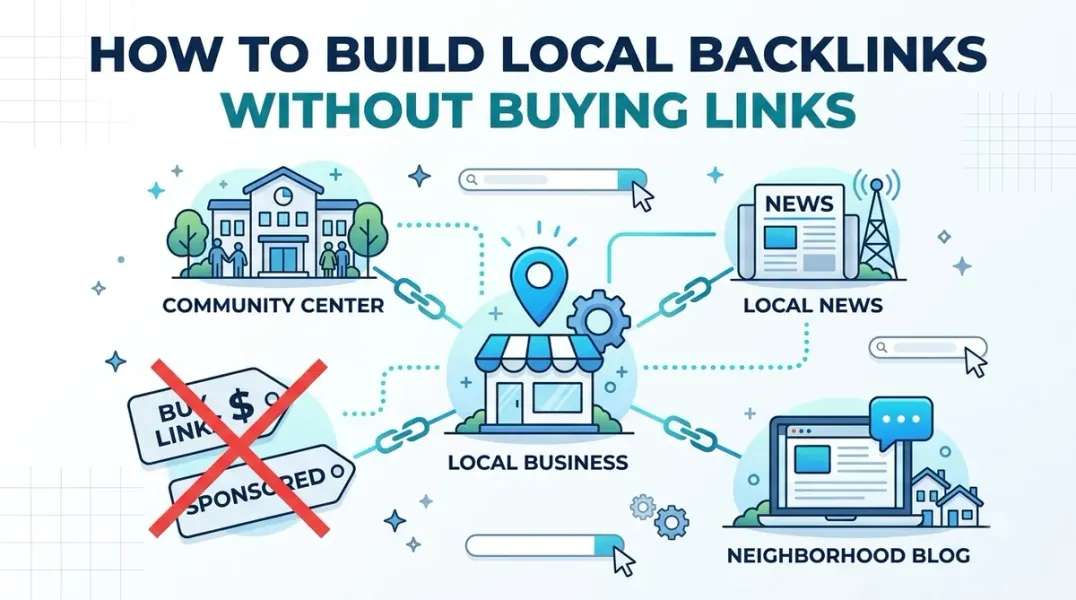
The good news: you don’t need to buy links. Local businesses have access to relationship-driven link opportunities that national brands can only dream of. Sponsorships, community partnerships, local press coverage, vendor relationships—these are the links that matter, and they’re earned through genuine participation in your community, not through transactions.
In this guide, you’ll learn 12 proven tactics for building local backlinks without buying links, why each one works, and how to execute them efficiently.
Before we get into tactics, let’s be clear about the risk.
Google’s Policy Is Unambiguous
Google’s spam policies define link spam as “links intended to manipulate rankings in Google Search results” and specifically list “buying or selling links for ranking purposes” as a violation . This includes:
- Buying links or link posts for money
- Exchanging goods or services for links
- Sending someone a product in exchange for them writing about it and including a link
The Penalty Is Permanent (For Those Links)
When Google detects link spam, it doesn’t just demote the spammy links. It removes the ranking benefit those links generated. And unlike some algorithmic adjustments, that benefit cannot be recovered by fixing the links later .
Local Businesses Are Easier to Audit
Large national sites have millions of links, making it harder for Google to identify paid placements. A local business with 50 backlinks and 30 of them coming from “guest post farms” is a much easier target.
The Real Cost
A local business that gets a manual action for link spam can lose all local visibility—not just organic rankings. Google Business Profile rankings, Local Pack presence, and map visibility can all be affected. For a business relying on local customers, that’s an existential threat.
The alternative: Build links the same way you build your business—through relationships, reputation, and genuine community participation.
Tactic 1: Sponsor Local Events and Organizations
Sponsorships are one of the easiest ways to earn legitimate local links—when the organization actually lists sponsors on its website .
Why It Works
Sponsorships create genuine relationships. You’re supporting something your community values. The link is a natural acknowledgment of that support, not a transaction. And sponsorships often come with other benefits: brand visibility, word-of-mouth, and access to new audiences.
What to Sponsor
- Youth sports teams and leagues – Local parents notice sponsors
- Community festivals and fairs – High visibility, often covered by local press
- School fundraisers (PTA/PTO) – Deep community roots
- Charity events (5Ks, auctions, drives) – Aligns your brand with a cause
- Local arts and cultural programs – Positions you as a community supporter
How to Make It Count
Before committing, ask if sponsorship includes a website listing with a link . Not all sponsorships do. If they don’t, ask if they’d consider adding sponsor links to their site. Many organizations are happy to—they just haven’t thought to do it.
Provide a short, clean description of your business (1-2 sentences) and ensure your business name matches your Google Business Profile exactly .
Tactic 2: Get Featured in Local Media
Local journalists are constantly looking for stories. Your business can be that story.
The “Tabloid Technique” for Local Press
Local newspapers love to compare how their area stacks up against others . This is a pattern you can exploit ethically.
How it works:
- Find a newsworthy topic related to your industry (evergreen topics like taxes, traffic, or seasonal issues work well)
- Pull local data about that topic—how your city compares to others
- Send the data to local journalists with a simple pitch
Examples that work:
- “Our city ranks 37th in the state for [relevant metric]”
- “Residents here pay [X] more in [category] than the national average”
- “Local wait times for [service] are the longest in the region”
Local journalists will cover comparative data about their area almost every time . One campaign about UK driving test wait times earned links from 58 referring domains, mostly local newspapers .
Where to Find Data
- Government databases (Data.gov, UK Data Service, Eurostat)
- CDC for health data
- FBI Crime Data Explorer
- Pew Research Center for demographic trends
The Pitch
Keep it simple. “Hi [Journalist], I put together data showing how [City] compares to other areas on [topic]. Thought it might be interesting for your readers. Happy to share the full dataset if useful.”
Tactic 3: Partner With Complementary Local Businesses
Think of your local business ecosystem as a web of referral relationships. A plumber and an electrician serve the same homeowners. A wedding photographer, venue, and florist all work the same events.
The Non-Spammy Approach
Create a local resources page on your site (e.g., “Trusted Local Partners in [City]”) and invite partners to do the same . This isn’t a link exchange—it’s genuine mutual promotion of businesses you actually work with and trust.
Examples of natural partnerships:
- HVAC company + insulation contractor
- Wedding photographer + venue + florist
- Chiropractor + massage therapist + gym
- Dentist + orthodontist + pediatrician
Vendor Partner Links (The Underrated Tactic)
This one is pure genius for local businesses: Ask your vendors to add a “Proud supplier of [Your Business]” badge with a link .
A restaurant that sources bread from a local bakery asks the bakery to add a supplier badge. An ice cream shop sources from the corner dairy. The vendor benefits from the social proof. You get a relevant local link .
Why it works: It’s a genuine business relationship, the link is natural, and vendors are often happy to reciprocate because it benefits them too.
Tactic 4: Create a Definitive Local Resource
Create something that other local websites want to reference .
Examples of Linkable Local Resources
- An ultimate guide to local attractions
- A comprehensive list of all non-profits in your area
- A searchable map of local walking trails
- A guide to free family activities in your city
- A directory of local farmers’ markets
Why It Works
These resources are inherently valuable. Other websites—local blogs, community organizations, even news sites—link to them because they add value to their own readers . The links come naturally over time as people discover and reference the resource.
How to Execute
- Identify a gap in local information. What do people in your city constantly search for but can’t easily find?
- Create a high-quality, regularly updated resource on your website
- Promote it to local organizations and individuals who might link to it
Tactic 5: Get Listed on Local Government or Council Websites
Being listed as a local service provider or partner on a city, county, or borough council website is extremely high-value .
Why It’s Valuable
Government domains (.gov) carry massive authority. A link from a council website is one of the strongest local signals you can earn. It’s also highly relevant—if the city lists you as a vetted vendor, that’s a powerful endorsement.
How to Get Listed
This depends on your business type. Look for:
- Programs that partner with local businesses
- Opportunities to be listed as a vetted vendor for certain services (e.g., approved contractors)
- Local business registries or directories hosted by the council
Note: This is usually challenging and depends on your business type. Not every business will qualify. But for those that do, the payoff is significant.
Tactic 6: Offer a Local Scholarship or Grant Program
Offering a scholarship to a local high school student or a small business grant to a local startup attracts links from educational institutions and news sites .
Why It Works
Scholarships and grants are newsworthy. Schools announce recipients. Local news covers the story. Educational institutions (.edu) and news sites link to your program page as a resource for students .
How to Execute
- Establish clear criteria and a simple application process
- Promote the program through local schools, community centers, and news outlets
- Announce recipients publicly—this generates additional coverage and links
Tactic 7: Turn Unlinked Brand Mentions Into Links
Did someone mention your business but forget to link? That’s an easy win .
How to Find Them
Use tools like:
- Google Alerts – Set up alerts for your business name
- Ahrefs – Search for brand mentions without links
- Mention.com – Monitor brand mentions across the web
- Semrush Brand Monitoring – Track unlinked mentions
The Outreach
The conversion rate is insanely high because they already like you—they mentioned you voluntarily .
Template:
“Hi [Name], thanks so much for mentioning [Your Business] in your article about [topic]! I noticed the mention didn’t include a link. If you’re able to add one, it would help readers find us more easily. Here’s the URL: [link]. Thanks again!”
Keep it short. Be grateful. Don’t demand.
Tactic 8: Reverse “Top 10” Lists and Listicles
Find existing “best of” lists in your target city. If you’re not included, reach out and pitch to get added .
Where to Look
- Local news “best of” features
- City magazine lists
- Blog roundups of local businesses
- “Top [industry] in [city]” articles
The Pitch
Don’t go straight for the ask. Start a conversation with the author: “I noticed your list of best [industry] in [city]. I’m curious—what criteria did you use?” .
Once you’re on their radar, you can mention that your business might be a good fit. Offer something valuable if appropriate (free consultation, discount for their readers) .
Why it works: List owners often update content for freshness. Adding a new business is a small change with value for their readers .
Tactic 9: Become a Source for Journalists (HARO/Connectively)
Journalists constantly need expert quotes for their articles. When they quote you, they usually link to your site .
How It Works
Services like Help a Reporter Out (HARO) (now Connectively) connect journalists with experts. You receive queries, respond with quotes, and if selected, you get a link .
How to Check If It’s Working for Competitors
- Enter a competitor’s domain into Ahrefs Site Explorer
- Go to the Backlinks report
- Look for quotes in the “Anchor and target URL” column
If you see a name attributed to quotes across multiple sites, that competitor is actively using this tactic .
Tips for Success
- Respond quickly—journalists work on deadlines
- Provide clear, quotable insights
- Focus on expertise, not promotion
- Align with publications relevant to your industry
Tactic 10: Local Press Coverage Through Story Pitching
Beyond data-driven pitches, you can pitch human interest stories to local media .
What Makes a Good Local Story
- Charity partnerships – “Local business partners with shelter to provide free [service]”
- Customer milestones – “Local business celebrates 1,000th customer with giveaway”
- “Local hero” features – Employees or customers doing something remarkable
- Business milestones – Anniversaries, expansions, new hires
The Pitch
Local news covers what their audience cares about. Frame your story in terms of community impact, not business promotion .
Tactic 11: Host a Local Event
Hosting an event generates significant local media coverage, social buzz, and links from event partners, attendees, and news sites .
Examples
- A workshop or class related to your industry
- A community gathering (customer appreciation day, open house)
- A fundraiser for a local cause
- A networking event for local professionals
Why It Works
Events create multiple link opportunities:
- The venue might link to you
- Partners and sponsors link
- Local news covers the event
- Attendees write blog posts or social media content
How to Execute
This is a substantial undertaking, but the PR and link-building opportunities are immense. Partner with local organizations, secure venues, and promote heavily .
Tactic 12: Be a Genuine Community Member (Reddit and Local Forums)
Reddit and local forums are not for direct link building, but they can lead to visibility, mentions, and indirect links .
The Strategy
- Find your local subreddits – r/[yourcity], r/[yourcity]food, r/[yourcity]events
- Lurk and learn – Understand the culture. Most subreddits have strict rules against self-promotion
- Contribute genuinely – Answer questions, share helpful tips, be a local expert
- Look for opportunities – If someone directly asks for a recommendation for your service, you can mention your business with a brief, helpful description
Why It Matters for Links
While Reddit itself is often nofollow, Reddit threads rank in Google. A helpful comment recommending your business can send real traffic and branded searches. And sometimes, bloggers and journalists source stories from Reddit—leading to editorial links .
Measuring Local Link Building Success
Don’t just count links. Measure quality.
Metrics That Matter
- Relevance: Is the linking site connected to your industry, community, or city?
- Trust: Is it a real organization with a real audience?
- Context: Is your business described in a sentence, not just dumped in a list?
- Traffic: Does the link send qualified visitors?
- Relationship depth: How many of your links come from sources you’ve built ongoing relationships with?
A Simple Rule
If you’d be proud to show the link to a customer, it’s probably a good one .
Conclusion
Buying links is a shortcut that leads to a dead end. It violates Google’s policies, risks permanent penalties, and—most importantly—doesn’t build the kind of local authority that actually drives business.
The alternative isn’t harder. It’s just different. It’s relationship-based. It’s community-oriented. It’s earned through genuine participation in the place where you do business.
The 12 tactics in this guide share a common thread: they all involve being a real part of your community. Sponsoring a youth sports team. Getting featured in the local paper. Partnering with complementary businesses. Creating a resource that helps your neighbors.
These links can’t be bought. But they can be earned. And they’re worth more than anything you could purchase.
Call to Action
Ready to build local backlinks the right way?
We’ve created a Local Link Building Playbook with templates for outreach, sponsorship asks, and press pitches—plus a tracking sheet to measure your progress.
👉 Download the Playbook and start earning links that actually move the needle.
👉 Or run a free backlink audit to see where you stand compared to competitors.
FAQs
1. Is buying links ever okay?
No. Google’s spam policies explicitly prohibit buying or selling links for ranking purposes. The ranking benefit of spammy links can be permanently lost .
2. What happens if Google detects paid links?
Your site may rank lower or not appear in results at all. For link spam updates specifically, any ranking benefit generated by those links is lost and cannot be recovered .
3. How long does it take to build local backlinks naturally?
Sponsorships and partnerships can generate links within weeks. Digital PR campaigns and resource-based links may take months to compound. Consistency matters more than speed.
4. What’s the easiest local link building tactic?
Unlinked brand mentions. If someone already mentioned you, a simple polite email asking them to add a link often works .
5. How many local backlinks do I need?
Quality matters more than quantity. One link from a local newspaper or government site can outperform 50 generic directory links .
6. Can I ask a business to link to me if I link to them?
Occasional partner links happen naturally, but “you link to me and I’ll link to you” campaigns create unnatural patterns and can backfire .
7. What’s the “tabloid technique” for local links?
It’s a digital PR tactic where you pull local data on a newsworthy topic and pitch it to local journalists. Local papers love comparative data about their area .
8. How do I find unlinked brand mentions?
Use Google Alerts, Ahrefs, Mention.com, or Semrush Brand Monitoring to track mentions of your business name .
9. Are guest posts still a valid link building tactic?
Yes, if done ethically. Guest posts that provide genuine value and use proper disclosure (rel=“sponsored” if paid) are acceptable. Avoid “guest post farms” that exist solely to sell links .
10. What if I can’t get local press coverage?
Start smaller. Sponsor a local event. Partner with a complementary business. Create a linkable local resource. Build relationships before pitching bigger opportunities.
Internal & External Links
Internal Links
- Local Citation Building vs Link Building: What’s the Difference?
- Local Link Building Strategies for Small Businesses With Small Budgets
- How Local Sponsorships Can Earn Valuable SEO Backlinks
- How Community Partnerships Can Strengthen Your Local SEO Strategy
- Industry-Specific Citations: How to Find the Best Directories for Your Business
External Sources
- Google Search Central – Spam Policies for Google Web Search
- Ahrefs – The Tabloid Technique: How to Easily Land Local Links With Digital PR
- Moz – Essential Local Link Building Tactics
- Search Engine Land – Natural Backlink Profiles: What They Are & Why They Matter
- Google Search Central – Qualify Outbound Links
Grow Your Google Maps Ranking on Autopilot
Stop spending hours every week manually replying to customer reviews and writing Google posts. Busirank automates your Google Business Profile to boost your local SEO rankings and turn searchers into paying clients.

 Busirank Team
