 Busirank Team
Introduction
You’ve claimed your Google Business Profile. You’re listed on Yelp, Bing Places, and Apple Maps. You’ve done the “big three” and a handful of other major directories.
So why aren’t you seeing the local visibility you expected?
The answer may be that you’re missing the citations that matter most for your specific industry.
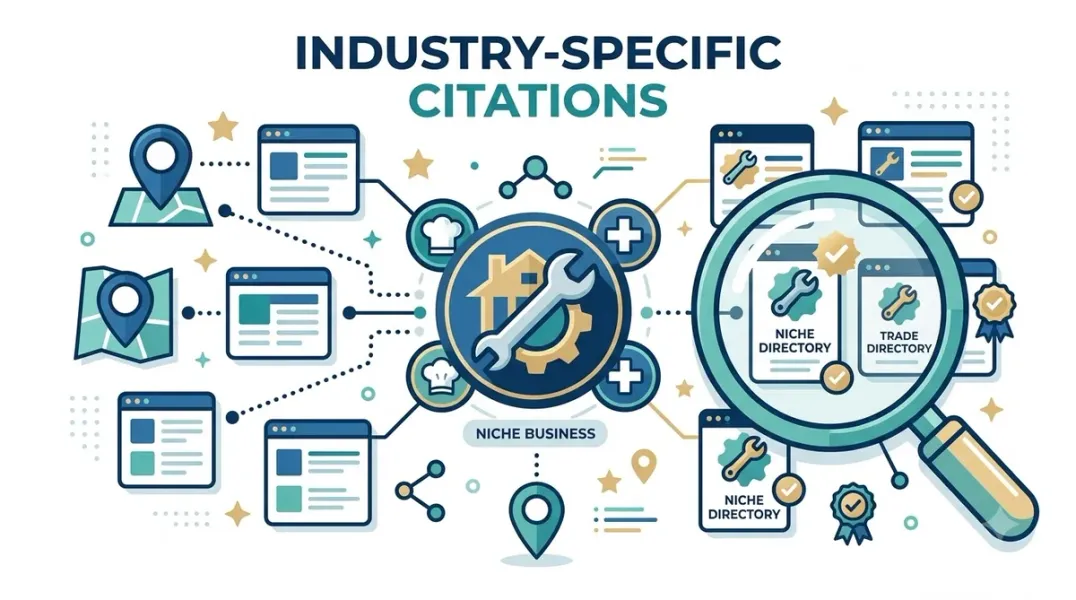
Industry-specific citations are directory listings on platforms that cater to your particular business category—healthcare, legal, hospitality, home services, and dozens more. Unlike generic directories like Yelp or Yellow Pages, these niche platforms attract users who are already searching for exactly what you offer. A citation on Avvo means more to a law firm than a listing on a general business directory. A profile on Healthgrades carries more weight for a doctor than a Yelp listing.
These citations do more than just provide backlinks. They signal relevance to Google, connect you with high-intent local customers, and often rank prominently in search results for industry-specific queries.
In this guide, you’ll learn what industry-specific citations are, why they matter for local SEO, how to find the best directories for your business type, and how to build them efficiently.
A citation is any online mention of your business’s Name, Address, and Phone number (NAP) . Citations can appear on:
- General directories (Yelp, Yellow Pages, Bing Places)
- Social platforms (Facebook, Instagram)
- Industry-specific directories (Avvo for lawyers, Healthgrades for doctors, TripAdvisor for hotels)
- Local directories (chamber of commerce, city business associations)
- Review sites (Google, Trustpilot, industry-specific review platforms)
Industry-specific citations are listings on directories that serve a particular vertical. They’re not general-purpose platforms. They exist to help consumers find businesses in a specific category.
Examples:
| Industry | Industry-Specific Directories |
|---|---|
| Legal | Avvo, FindLaw, Justia, Lawyers.com |
| Healthcare | Healthgrades, Vitals, WebMD, Zocdoc |
| Restaurants | TripAdvisor, OpenTable, Zomato |
| Hotels | TripAdvisor, Booking.com, Expedia |
| Home Services | Angi, HomeAdvisor, Thumbtack |
| Real Estate | Zillow, Realtor.com, Trulia |
| Automotive | Carfax, RepairPal, AutoMD |
| Beauty & Wellness | StyleSeat, Booksy, Mindbody |
Why Industry-Specific Citations Matter for Local SEO
Citations are a confirmed local search ranking factor. According to Whitespark’s Local Search Ranking Factors, citations account for roughly 8-11% of Map Pack rankings . But not all citations are created equal.
1. Relevance Signal to Google
Google uses citations to verify that your business is legitimate, located where you say it is, and relevant to the searches users are performing. An industry-specific citation tells Google: “This business is not just a generic entity—it’s a recognized provider in this specific category.”
A law firm listed on Avvo, FindLaw, and Justia sends a stronger relevance signal than one listed only on Yelp. A restaurant on OpenTable and TripAdvisor signals something different than one on a generic directory.
2. High-Intent Traffic
Industry-specific directories attract users who are already looking for what you offer. Someone browsing Healthgrades is searching for a doctor. Someone on Avvo needs a lawyer. Someone on TripAdvisor is planning a meal or a stay.
These users convert at higher rates than those browsing general directories. A citation on a niche platform isn’t just a backlink—it’s a lead source.
3. Trust and Authority
Many industry-specific directories have strict verification processes. Avvo verifies attorney credentials. Healthgrades verifies medical licenses. Being listed on these platforms signals credibility to both consumers and Google.
4. Competitive Advantage
If your competitors aren’t listed on industry-specific directories, you gain a visibility advantage. If they are, you need to match them to stay competitive.
How to Find the Best Industry-Specific Directories
Finding the right directories for your industry requires a systematic approach. Here’s how to do it.
Step 1: Identify Your Industry Category
Start by defining your business category as precisely as possible. “Healthcare” is too broad. “Dentist” or “Cosmetic Dentist” is more useful. “Home services” is broad. “Emergency plumber” is specific.
Your primary Google Business Profile category is a good starting point. Use that as your search term.
Step 2: Search for Directories
Search Google for:
- “[Your industry] directory”
- “[Your industry] business listings”
- “best [your industry] directories”
- “[Your industry] review sites”
For example:
- “dentist directory”
- “best lawyer directories”
- “restaurant review sites”
- “plumber business listings”
Step 3: Check Competitor Citations
One of the most effective ways to find industry-specific citations is to see where your competitors are listed.
Manual method: Search for your competitor’s business name plus “directory” or “listing.” Look at the results.
Tool method: Use tools like Whitespark’s Local Citation Finder, BrightLocal’s Citation Tracker, or Moz Local to see where competitors have citations. These tools identify directories where your competitors appear but you don’t.
Whitespark’s Local Citation Finder is specifically designed for this purpose. You enter your business information and your competitors’ information, and the tool shows you which directories they’re listed on .
Step 4: Evaluate Directory Quality
Not all directories are worth your time. Evaluate each potential citation source based on:
| Factor | What to Look For |
|---|---|
| Domain Authority | Higher DA = more valuable backlink |
| Traffic | Does the directory attract real users? |
| Relevance | Is it specific to your industry? |
| Verification process | Does it verify business legitimacy? |
| Cost | Free, freemium, or paid? |
| User experience | Is it easy to navigate and search? |
| Google indexing | Is the directory indexed by Google? |
Red flags: Directories that accept any business without verification, have no traffic, or exist solely to sell backlinks are not worth your time.
Step 5: Prioritize
You can’t be everywhere. Prioritize directories based on:
- Relevance: Directories most specific to your industry
- Authority: Directories with the highest domain authority
- Competitor presence: Directories where competitors are listed
- Cost: Start with free listings, then consider paid options
- Effort: Some directories require verification, credentials, or payment
Top Industry-Specific Directories by Sector
Here’s a starting point for the most important industry-specific directories across major sectors.
Legal
- Avvo: Attorney profiles with ratings, reviews, and disciplinary history
- FindLaw: Comprehensive lawyer directory with practice area filters
- Justia: Free legal directory with attorney profiles and legal resources
- Lawyers.com: Martindale-Hubbell directory with peer ratings
- Martindale-Hubbell: Established legal directory with AV Preeminent ratings
Healthcare
- Healthgrades: Doctor and hospital profiles with patient reviews
- Vitals: Doctor ratings, reviews, and appointment booking
- WebMD Care: Doctor directory integrated with WebMD content
- Zocdoc: Appointment booking platform with verified reviews
- RateMDs: Patient reviews of doctors and dentists
Restaurants & Hospitality
- TripAdvisor: Global review platform for restaurants, hotels, and attractions
- OpenTable: Restaurant reservation platform with reviews
- Zomato: Restaurant discovery and review platform
- Yelp: General platform but heavily used for restaurants
- The Infatuation: Restaurant reviews and guides
Home Services
- Angi (formerly Angie’s List): Home service professional directory with reviews
- HomeAdvisor: Connects homeowners with service professionals
- Thumbtack: Marketplace for local services
- Porch: Home improvement and repair professional directory
- Houzz: Home remodeling and design professional directory
Real Estate
- Zillow: Property listings and agent profiles
- Realtor.com: Official site of the National Association of Realtors
- Trulia: Property search and agent directory
- Redfin: Real estate brokerage with agent profiles
Automotive
- Carfax: Vehicle history reports with service shop directory
- RepairPal: Auto repair shop directory with fair price estimates
- AutoMD: Auto repair directory and diagnostic tools
- NAPA AutoCare: Network of independent repair shops
Beauty & Wellness
- StyleSeat: Booking platform for beauty professionals
- Booksy: Appointment booking for beauty and wellness
- Mindbody: Wellness and fitness class booking
- Vagaro: Salon and spa management with directory
How to Build Industry-Specific Citations Efficiently
Building citations one by one is time-consuming. Here’s how to do it efficiently.
1. Prepare Your Business Information
Before you start, gather:
- Business name (exactly as it appears on your GBP)
- Address (consistent formatting)
- Phone number (local, not toll-free if possible)
- Website URL
- Business description (short and long versions)
- Hours of operation
- Categories (primary and secondary)
- Logo and photos
- Payment methods accepted
- License or certification numbers (if required)
Consistency is critical. Your NAP must match exactly across all citations.
2. Use a Citation Building Service
For efficiency, consider using a citation building service. Options include:
- Whitespark: Manual citation building with vetted directories
- BrightLocal: Citation Tracker and citation building services
- Moz Local: Automated citation distribution to major directories
- Yext: Enterprise-level citation management
- Semrush Listing Management: Automated citation distribution
These services handle the submission process, ensuring consistency and saving hours of manual work.
3. DIY Citation Building
If you’re building citations manually, create a spreadsheet to track:
| Directory | URL | Status | Login | Notes |
|---|---|---|---|---|
| Avvo | avvo.com | Submitted | [email] | Awaiting verification |
| Healthgrades | healthgrades.com | Live | [email] | Complete |
Work through directories one at a time. Complete each listing fully before moving to the next.
4. Claim and Verify
Many industry-specific directories require verification. This may involve:
- Phone verification
- Email verification
- Document upload (license, certification)
- Manual review
Complete the verification process promptly. Unverified listings may not appear in search results.
5. Monitor and Maintain
Citations aren’t set-and-forget. Business information changes. Directories update their platforms. Monitor your citations quarterly to ensure:
- NAP is still accurate
- Hours are current
- Photos are up to date
- Reviews are being responded to (if applicable)
Common Mistakes to Avoid
1. Inconsistent NAP
Inconsistent NAP is the most common citation mistake. “Suite 100” vs. “Ste. 100” vs. “#100” creates confusion for Google. Choose one format and use it everywhere.
2. Duplicate Listings
Creating multiple listings for the same business on the same directory splits your authority and confuses Google. Claim and merge duplicates.
3. Neglecting Industry-Specific Directories
Generic directories are important, but industry-specific directories often provide more value for local SEO and lead generation. Don’t neglect them.
4. Paying for Low-Quality Directories
Some directories exist solely to sell backlinks. They have no traffic, no authority, and no value. Avoid them.
5. Ignoring Reviews
Many industry-specific directories include review functionality. If you’re listed, monitor and respond to reviews just as you would on Google.
Conclusion
Industry-specific citations are an essential component of a comprehensive local SEO strategy. They provide:
- Relevance signals to Google
- High-intent traffic from users already searching for your services
- Trust and authority through verification processes
- Competitive advantage over businesses that ignore them
Finding the best directories for your industry requires research—searching for directories, checking competitor citations, and evaluating quality. Building them requires consistency, verification, and ongoing maintenance.
The businesses that invest in industry-specific citations see compounding returns: higher rankings, more qualified leads, and stronger brand authority in their niche.
Call to Action
Ready to build citations that actually drive local visibility?
We’ve created an Industry Citation Checklist with the top directories for 20+ industries, plus a tracking template to manage your submissions.
👉 Download the Checklist and start building your industry-specific citations today.
👉 Or run a free citation audit to see where you’re listed—and where you’re not.
FAQs
1. What are industry-specific citations?
Industry-specific citations are business listings on directories that serve a particular vertical—like Avvo for lawyers, Healthgrades for doctors, or TripAdvisor for restaurants. They’re distinct from general directories like Yelp or Yellow Pages.
2. Why do industry-specific citations matter for local SEO?
They send relevance signals to Google, attract high-intent local traffic, build trust through verification processes, and provide a competitive advantage over businesses that ignore them.
3. How do I find the best directories for my industry?
Search for “[your industry] directory,” check where competitors are listed using tools like Whitespark’s Local Citation Finder, and evaluate directories based on domain authority, traffic, and relevance.
4. What’s the most important thing to get right with citations?
NAP consistency. Your business name, address, and phone number must match exactly across all citations. Inconsistent NAP confuses Google and dilutes your authority.
5. Should I pay for industry-specific citations?
Some paid directories are worth it (high authority, real traffic). Others are not. Start with free listings, evaluate results, and invest in paid options strategically.
6. How many citations do I need?
There’s no magic number. Focus on the most relevant, highest-authority directories for your industry. Quality matters more than quantity.
7. How often should I update my citations?
Monitor citations quarterly. Update whenever your NAP, hours, or business information changes.
8. Can I use a service to build citations for me?
Yes. Whitespark, BrightLocal, Moz Local, and Yext all offer citation building services. DIY is possible but time-consuming.
9. What if I find duplicate listings?
Claim and merge duplicates. Most directories have a process for reporting and consolidating duplicate listings.
10. Do industry-specific citations replace Google Business Profile?
No. Your Google Business Profile is the foundation. Industry-specific citations supplement and strengthen your local presence.
Internal & External Links
Internal Links
- Local Citations Explained: Which Business Directories Actually Matter?
- How to Audit Local Citations and Find Inconsistent Business Information
- Local Citation Building vs Link Building: What’s the Difference?
- How to Find Your Competitors in the Google Local Pack
- Local SEO Competitor Analysis: 15 Things to Compare Before You Optimize
External Sources
Grow Your Google Maps Ranking on Autopilot
Stop spending hours every week manually replying to customer reviews and writing Google posts. Busirank automates your Google Business Profile to boost your local SEO rankings and turn searchers into paying clients.

 Busirank Team
