 Busirank Team
Introduction
In local SEO, two terms get thrown around constantly: citation building and link building. They sound similar. They’re often mentioned in the same breath. Some business owners assume they’re the same thing.
They’re not.
Understanding the difference matters because citations and links serve distinct roles in Google’s local ranking algorithm. Citations verify that your business exists and operates where you say it does. Links signal authority and trustworthiness. Both contribute to local visibility—but they do so through different mechanisms, and they require different strategies.
The confusion is understandable. A citation on Yelp often includes a link to your website. A backlink from a local news article might also mention your business name and address. The overlap exists. But the intent, the implementation, and the impact are fundamentally different.
In this guide, we’ll break down exactly what citations and links are, how they differ, why Google treats them separately, and how to build a strategy that leverages both for maximum local search visibility.
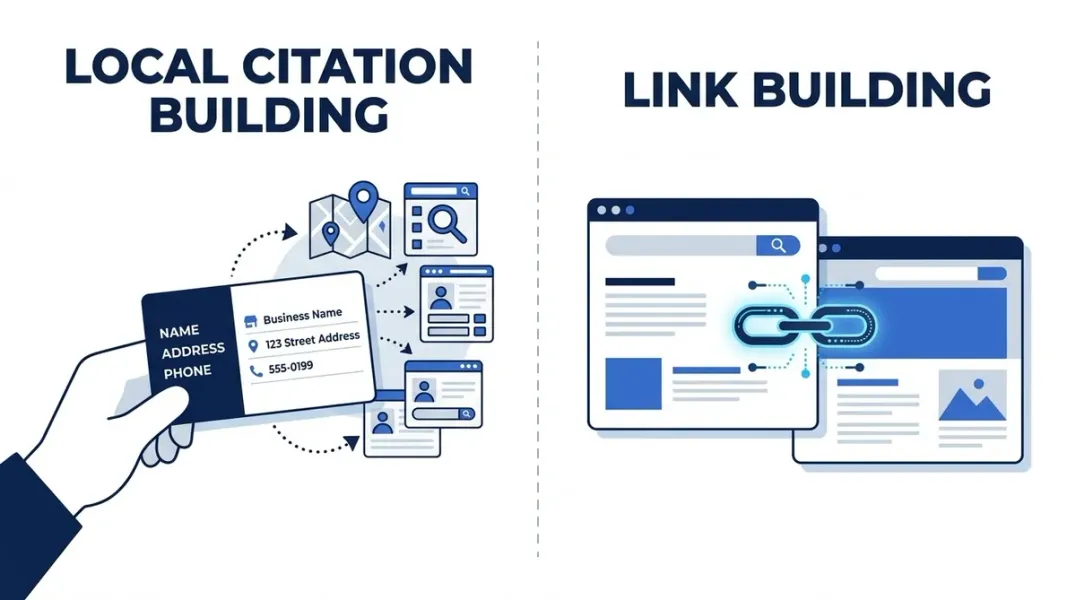
A citation is any online mention of your business’s Name, Address, and Phone number (NAP) . That’s it. A citation doesn’t need to include a link to your website. It just needs to reference your business information accurately.
Types of Citations
Structured Citations appear on business directories, mapping platforms, and review sites. The information is organized in a consistent format—typically a listing page with your NAP, hours, website, and description .
Examples:
- Yelp
- Google Business Profile
- Apple Maps
- Yellow Pages
- Industry-specific directories (Avvo, Healthgrades, TripAdvisor)
Unstructured Citations are mentions of your business on websites that aren’t directories. The information might appear in a blog post, news article, event listing, or social media post—not in a formatted listing .
Examples:
- A local newspaper article mentioning your restaurant
- A blog post recommending your services
- A chamber of commerce member directory
- A sponsorship page listing your business
Why Citations Matter
Citations serve several purposes in local SEO:
Verification: They confirm that your business exists, operates at a specific location, and can be contacted. When Google finds consistent NAP information across multiple authoritative sources, it gains confidence in your legitimacy .
Relevance Signals: Citations on industry-specific directories signal that your business is recognized within a particular vertical. A law firm listed on Avvo is more relevant to legal searches than one listed only on Yelp .
Trust Signals: Consistent citations across reputable platforms contribute to the trust signals Google uses to evaluate local businesses .
Consumer Discovery: Beyond SEO, citations help real people find your business. Someone searching Healthgrades for a doctor, or TripAdvisor for a restaurant, discovers your listing through these citations.
How Many Citations Do You Need?
There’s no magic number. The goal is to be listed on as many high-quality, relevant, and consistent directories as possible—ideally more than your competitors .
Quality matters more than quantity. A single citation on a high-authority industry directory can outweigh several generic directory listings .
What Is Link Building?
Link building is the process of acquiring hyperlinks from other websites that point to your website . Unlike citations, links are always clickable references that pass authority and relevance signals to your site.
Types of Links
Editorial Links are earned naturally when other websites reference your content, services, or expertise. These are the most valuable links because they represent genuine endorsements.
Examples:
- A local news article linking to your business as a source
- A blog post citing your research or expertise
- A “best of” listicle featuring your business
Outreach Links are acquired through deliberate relationship-building and outreach. You identify relevant websites, make contact, and request a link.
Examples:
- Sponsoring a local event in exchange for a link on the organizer’s website
- Partnering with a complementary business for cross-promotion
- Contributing a guest post to a local publication
Local Links specifically come from websites connected to your geographic area. These are particularly valuable for local SEO because they signal local relevance .
Examples:
- Chamber of Commerce website
- Local government or council website
- Neighborhood association
- Local news outlets
Why Links Matter
Links are one of Google’s oldest and most important ranking signals. They serve as “votes of confidence” from other websites.
Authority: Links from authoritative sites signal that your website is trustworthy and valuable. The more high-quality links you have, the stronger your domain’s authority .
Relevance: Links from websites in your industry or geographic area signal that your business is relevant to specific topics and locations.
Competitive Advantage: Links are a ranking factor for both organic and local search. As local rankings become harder to win, some SEOs are advising increased focus on link earning to improve organic visibility as well .
The Key Differences: Citations vs Links
Here’s where the distinction becomes clear.
| Factor | Citations | Links |
|---|---|---|
| Definition | Mention of NAP information | Hyperlink to your website |
| Link Required? | No | Yes |
| Primary Purpose | Verify business existence and location | Signal authority and trustworthiness |
| Format | Structured (directory) or unstructured (mention) | Always a clickable link |
| Local vs General | Inherently local (NAP includes location) | Can be local or general |
| Ease of Acquisition | Relatively easy (submit to directories) | More difficult (requires outreach, relationships) |
| Time Investment | Low to moderate | Moderate to high |
| Direct Ranking Impact | ~11% of local ranking weight | ~13% of local ranking weight |
| Google Policy | Subject to NAP consistency requirements | Subject to spam policies (no paid links) |
The Core Distinction
As Search Engine Journal explains, “While this [citation building] does involve building links for a website, the intent is much different. Search engines like Google claim to be able to know the difference” .
Citations are about verification. They answer: “Does this business exist? Is it where it says it is? Is the information consistent?”
Links are about authority. They answer: “Do other websites trust this business? Is it a recognized, reputable source?”
The Overlap
A citation can include a link. A link can include a citation. When a local news article mentions your business name, address, and phone number—and includes a hyperlink to your website—it functions as both a citation and a backlink.
But this overlap doesn’t make them the same thing. A citation on Yelp that includes a link to your website is primarily a citation. A blog post that mentions your business name but not your full NAP is primarily a link.
Why Google Treats Them Differently
Google’s local ranking algorithm evaluates three primary factors: relevance, distance, and prominence .
Citations contribute primarily to prominence (and indirectly to relevance). They confirm that your business is a real, verified entity operating in a specific location. Consistent NAP data across authoritative directories builds Google’s confidence in your legitimacy .
Links contribute primarily to prominence as well—but through a different mechanism. They signal that other websites consider your business authoritative and trustworthy. Links from local sources also reinforce geographic relevance.
Google updated its local ranking documentation in 2025, removing explicit references to citations as a direct ranking factor . This doesn’t mean citations are worthless—far from it. It suggests that Google now treats citations more as verification data than as ranking signals in the traditional sense. Citations feed into Google’s understanding of your business, which indirectly influences rankings.
Meanwhile, the 2026 Whitespark Local Search Ranking Factors report shows that citations are “making a comeback” in AI search visibility, with three of the top five AI visibility factors being citation-based . LLMs are digging into third-tier directories for information, making citation accuracy critical across all levels of the web.
When to Prioritize Citations
Citations should be your first priority when establishing a local presence.
For new businesses: Before you can rank, Google needs to verify that you exist. Citations on major platforms (Google, Apple, Bing, Yelp, Facebook) and key industry directories establish your baseline presence .
For businesses with NAP inconsistencies: If your business information is inconsistent across directories, fixing those citations is the highest-impact action you can take. Inconsistent NAP data confuses Google and undermines trust .
For competitive industries: If your competitors are listed on industry-specific directories and you’re not, you’re at a disadvantage. Niche citations carry outsized weight for relevance signals .
For AI search visibility: As AI tools increasingly source business information from third-tier directories, comprehensive citation coverage becomes important for LLM visibility .
When to Prioritize Link Building
Link building should become a focus after your citation foundation is solid.
For established businesses: Once your NAP is consistent and you’re listed on core directories, link building is the next lever to pull for competitive differentiation.
For competitive markets: If you’re in a crowded market and your competitors have strong backlink profiles, you need to match or exceed them. Links from local sources (chamber of commerce, local news, community organizations) are particularly valuable .
For authority building: Links from authoritative sources—local government sites, educational institutions, established news outlets—build domain authority that supports both local and organic rankings .
For long-term growth: Link building is a marathon, not a sprint. Building genuine relationships and earning editorial links compounds over time.
Building Both: A Practical Strategy
Here’s a phased approach to building citations and links.
Phase 1: Citation Foundation (Months 1-2)
Audit existing citations. Search for your business name and phone number across Google, Yelp, Yellow Pages, and industry directories. Identify inconsistencies and duplicates .
Fix inconsistencies. Update your NAP to a single consistent format everywhere. This is tedious but produces noticeable ranking improvements .
Claim core listings. Ensure you’re listed and verified on Google Business Profile, Bing Places, Apple Maps, Yelp, and Facebook .
Submit to data aggregators. Data Axle, Neustar Localeze, and Foursquare distribute your information to hundreds of downstream directories .
Add industry-specific citations. Identify the top directories for your industry and get listed.
Phase 2: Link Building Begins (Month 3+)
Identify local link prospects. Use competitor analysis to see where they’re getting links. Look for local news, chambers of commerce, business associations, and community organizations .
Pursue local sponsorships. Sponsor a local event, sports team, or community initiative. These often come with links from the organizer’s website .
Build relationships. Join the chamber of commerce. Attend local business events. Partner with complementary businesses for cross-promotion.
Create linkable assets. Develop resources that local websites want to reference—guides, data, tools, or comprehensive local information .
Contribute to local media. Offer expert quotes to local journalists. Submit press releases for newsworthy developments. Pitch story ideas that include your expertise .
Phase 3: Ongoing Maintenance
Monitor citation accuracy. Set a quarterly reminder to audit your top 20 citations. Fix any inconsistencies.
Track link acquisition. Aim for 2-4 new local links per month. Quality matters more than quantity—five links from real local organizations outperform 50 from spammy directories .
Respond to opportunities. When local news covers your industry, reach out with your perspective. When community organizations need sponsors, step up.
Common Mistakes to Avoid
Buying links. Google’s spam policies specifically target paid links, and local businesses are easier to audit than large national sites. A link spam penalty can erase months of progress .
Ignoring citation consistency. A citation on a high-authority directory is worthless if your NAP doesn’t match what’s on your website and Google Business Profile. Consistency is the foundation .
Neglecting industry-specific citations. Generic directories are important, but niche citations signal topical relevance. A single niche citation can outweigh several general directories .
Abandoning citations for links. Both matter. Citations verify your existence; links build your authority. Don’t neglect one for the other.
Letting citation data rot. After a move, rebrand, or phone change, update your citations immediately. Outdated information confuses customers and Google .
Conclusion
Citations and links are both essential for local SEO—but they’re not interchangeable.
Citations are mentions of your NAP. They verify your business exists, operates where you say it does, and is legitimate. They’re relatively easy to build and form the foundation of local visibility.
Links are hyperlinks from other websites. They signal authority and trustworthiness. They’re harder to acquire but provide competitive differentiation.
The relationship is complementary, not competitive. Citations establish your presence. Links build your authority. Together, they create a comprehensive local SEO profile that Google can trust.
Start with citations. Build a consistent, comprehensive foundation across core directories and industry-specific platforms. Then, shift focus to link building—earning local links from news outlets, community organizations, and business partners.
Both take time. Both require ongoing attention. But together, they form the foundation of sustainable local search visibility.
Call to Action
Not sure where your citations and links stand?
We’ve created a Local SEO Audit Checklist covering both citation consistency and backlink opportunities—with templates for tracking your progress.
👉 Download the Checklist and start building your citation and link strategy today.
👉 Or run a free local SEO audit to see how your citations and links compare to competitors.
FAQs
1. What’s the difference between a citation and a backlink?
A citation is a mention of your business NAP (Name, Address, Phone) online—whether or not it includes a link. A backlink is a hyperlink from another website to yours. Citations verify existence; links signal authority .
2. Does a citation need to include a link?
No. Citations can be plain text mentions of your NAP. However, citations that also include a link provide additional value by passing authority signals .
3. Which is more important for local SEO: citations or links?
Both matter, but they serve different purposes. Citations are foundational—you need them to verify your business. Links build authority and provide competitive differentiation. Start with citations, then add links .
4. How many citations should I build?
There’s no magic number. Focus on being listed on as many high-quality, relevant, and consistent directories as possible—ideally more than your competitors .
5. How many backlinks do I need?
Quality matters more than quantity. Aim for 2-4 new local links per month. Five links from real local organizations outperform 50 from spammy directories .
6. Can I buy citations and links?
You can pay for legitimate citation building services and listing management tools. You cannot buy links without risking penalties. Google’s algorithms detect manufactured link profiles, and the consequences can be severe .
7. What are unstructured citations?
Unstructured citations are mentions of your business on websites that aren’t directories—like blog posts, news articles, or event listings. They’re valuable for brand visibility and authority .
8. Do citations still matter if Google removed them from ranking documentation?
Yes. Google removed citations as a direct ranking factor, but they still contribute to trust signals and verification. The 2026 Whitespark report shows citations are critical for AI search visibility .
9. What’s the fastest way to improve local SEO?
Start with citation cleanup. 68% of businesses have at least one NAP inconsistency, and fixing them produces an average 16% ranking improvement .
10. How do I find local link opportunities?
Analyze competitors’ backlinks, join the chamber of commerce, sponsor local events, contribute to local news, and partner with complementary businesses .
Internal & External Links
Internal Links
- Local Citations Explained: Which Business Directories Actually Matter?
- How to Audit Local Citations and Find Inconsistent Business Information
- Industry-Specific Citations: How to Find the Best Directories for Your Business
- How to Build Local Backlinks Without Buying Links
- Local Link Building Strategies for Small Businesses With Small Budgets
External Sources
Grow Your Google Maps Ranking on Autopilot
Stop spending hours every week manually replying to customer reviews and writing Google posts. Busirank automates your Google Business Profile to boost your local SEO rankings and turn searchers into paying clients.

 Busirank Team
