 Busirank Team
Introduction
You’ve identified your Local Pack competitors. You know which businesses keep appearing for your most valuable keywords. Now comes the critical step: understanding exactly why they’re winning.
This is where local SEO competitor analysis separates the businesses that grow from the ones that stagnate. A generic audit tells you “competitors have more reviews.” A thorough analysis tells you which review patterns matter, how their GBP is structured, and what specific gaps you can exploit.
The problem is that most businesses either skip this step entirely or perform a shallow audit. They look at review counts, maybe check a website, and move on. But local SEO ranking is comparative—Google is constantly evaluating your business against others in your market . To win, you need to understand the full picture of what you’re up against.
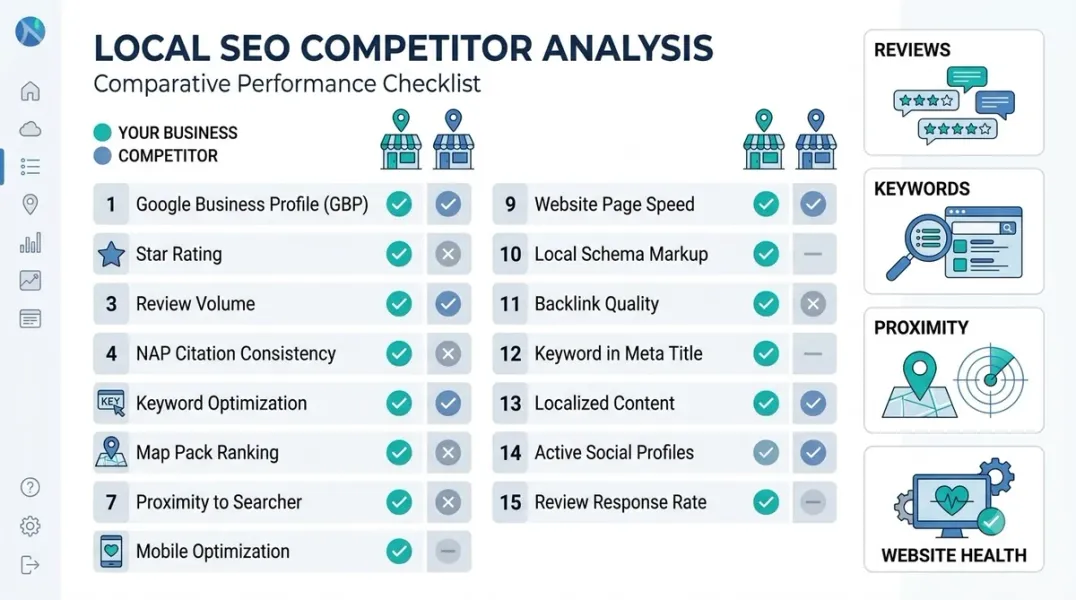
In this guide, we’ll walk through 15 specific things to compare before you spend a single dollar or hour on optimization. Each factor includes what to look for, why it matters, and how to spot opportunities.
Local search ranking isn’t driven by one factor. It’s a combination of relevance, proximity, and prominence—and each of those categories contains multiple sub-factors.
Google Business Profile optimization alone involves categories, descriptions, photos, posts, Q&A, attributes, and review engagement . Your website contributes through on-page SEO, local content, and technical health. And off-site signals like citations and backlinks validate your authority.
If you only compare one or two factors, you’re optimizing blind. The businesses that consistently outrank you are likely doing several things well. You need to know which ones.
The goal: Identify the specific gaps that, once closed, will produce the biggest ranking gains. Not every gap needs to be addressed immediately. But you need to see them all.
The 15 Comparison Points
1. Google Business Profile Primary Category
What to compare: Open each competitor’s GBP. Look for the star icon (⭐) in the category list—that’s the primary category . Compare it to yours.
Why it matters: The primary category is one of the single most important local ranking factors. A business with the exact category that matches a searcher’s intent will outrank a business with a less relevant category, even if everything else is equal.
What to look for: Are competitors using a more specific category than you? “Italian Restaurant” vs. “Restaurant.” “Emergency Plumber” vs. “Plumber.” A more specific primary category is often the difference between being in the Local Pack and being invisible.
Action: If competitors have a more precise primary category that accurately describes your business, consider switching. This is a quick win with potentially significant impact.
2. Google Business Profile Secondary Categories
What to compare: Below the primary category, competitors may have additional secondary categories listed. Note which ones they use that you don’t .
Why it matters: Secondary categories help Google understand the full scope of your services. They can trigger visibility for additional keyword searches.
What to look for: If you offer a service that competitors list as a secondary category but you don’t, you’re missing potential visibility. For example, a dentist might list “Cosmetic Dentist” or “Emergency Dental Service” as secondary categories.
Action: Add relevant secondary categories. Don’t add categories for services you don’t actually offer—that’s a guideline violation.
3. Review Velocity (Not Just Count)
What to compare: Count competitors’ total reviews, but more importantly, check when their most recent reviews were posted .
Why it matters: Review velocity—how consistently new reviews arrive—is increasingly more important than total volume. A business with 80 recent reviews can outrank one with 200 reviews that haven’t received a new review in six months. Google interprets fresh reviews as proof of active customer engagement .
What to look for: Are competitors getting 10-15 new reviews per month, or 2-3? A steady stream signals an active, currently-preferred business. A stagnant review profile signals a “legacy” entity.
Action: Build systems to generate reviews consistently—post-service emails, QR codes on receipts, follow-up texts . Aim for 3-5 new reviews per month as a baseline.
4. Review Recency and Response Rate
What to compare: Read the 20-30 most recent reviews for each competitor. Check whether the business owner responds, and how quickly .
Why it matters: Response rate and response recency signal operational health to Google. High-ranking profiles typically have a high response rate within 24-48 hours . A business that replies to every review—positive and negative—builds more trust with prospective customers .
What to look for: Do competitors respond to every review? Do they respond within a day or two? If they don’t, that’s an opportunity. If they do, you need to match or exceed.
Action: Respond to every review within 24-48 hours. This isn’t just about rankings—it’s about conversion.
5. Review Content and Keywords
What to compare: Read competitors’ reviews and note which services, neighborhoods, or specific terms customers mention .
Why it matters: Google’s natural language processing analyzes review content. When customers mention specific services or neighborhood names, it strengthens the business’s relevance for those terms .
What to look for: Do competitors’ reviews mention “emergency service,” “downtown location,” or specific services? These mentions help them rank for niche, long-tail searches.
Action: Encourage customers to mention specific services or locations in their reviews. A simple prompt can make a difference.
6. GBP Photos and Updates
What to compare: Count photos, check for recent uploads, and note if competitors publish Google Posts regularly .
Why it matters: Google’s own data shows that businesses adding photos receive 42% more requests for directions and 35% more website clicks . Regular posting signals an active, engaged business.
What to look for: Do competitors upload new photos weekly or monthly? Do they publish posts with offers, events, or updates? If they’re inactive and you’re not, that’s a gap you can close.
Action: Upload photos regularly (weekly if possible). Publish Google Posts at least every two weeks.
7. GBP Completeness and Attributes
What to compare: Check whether every field is filled in—hours, description, services, attributes (like “free estimates,” “wheelchair accessible,” “women-owned”) .
Why it matters: Completeness signals legitimacy. Attributes help trigger visibility for specific searches and improve conversion.
What to look for: Are competitors using attributes you haven’t added? Do they have services or products listed that you don’t?
Action: Complete every field. Add all relevant attributes. List all services and products.
8. Website Title Tags and Meta Descriptions
What to compare: Visit competitors’ websites and examine their title tags and meta descriptions for location keywords .
Why it matters: Title tags are a primary on-page ranking signal. Including city names and service terms helps Google understand what the page is about and where the business operates.
What to look for: Do competitors include “[City]” in their title tags? Do they use service keywords? If their titles are generic and yours are optimized, you have an advantage. If theirs are optimized and yours aren’t, that’s a gap.
Action: Ensure every key page includes location and service keywords in title tags and meta descriptions.
9. Location-Specific Pages
What to compare: Check whether competitors have dedicated pages for each city or neighborhood they serve .
Why it matters: Businesses with dedicated location pages often rank higher for searches in those areas than businesses with a single generic service area page .
What to look for: Does a competitor serving five cities have five location pages? Or just one “Areas We Serve” page? Dedicated pages are a significant advantage for geo-targeted searches.
Action: Build unique, valuable location pages for each area you serve. Don’t create thin, duplicate content—each page should offer genuine value.
10. Structured Data / Schema Markup
What to compare: Use a structured data testing tool to see if competitors implement LocalBusiness schema .
Why it matters: Schema markup helps search engines understand your business context. It’s also important for AI Search optimization .
What to look for: Do competitors use LocalBusiness schema? Do they mark up their NAP, hours, and services? If not, implementing it gives you a technical edge.
Action: Add LocalBusiness schema to your website, including all relevant properties.
11. Website Speed and Mobile-Friendliness
What to compare: Run competitors’ key pages through Google PageSpeed Insights. Check mobile responsiveness .
Why it matters: Google prioritizes mobile-first indexing. A slow, non-mobile-friendly website will struggle to rank .
What to look for: Are competitors’ sites fast and mobile-optimized? If they’re slow and yours is fast, you have an advantage. If yours is slower, that’s a technical gap to close.
Action: Optimize page speed and ensure mobile responsiveness. This is table stakes in 2025.
12. Local Citation Consistency
What to compare: Search for competitors’ NAP (Name, Address, Phone) across major directories—Google, Yelp, industry-specific sites .
Why it matters: Consistent citations confirm geographic relevance to Google. Inconsistent citations can confuse search engines and hurt rankings .
What to look for: Are competitors’ citations consistent across directories? Are they listed in industry-specific or local directories you’re missing?
Action: Audit your citations. Ensure NAP consistency. Build citations in directories where competitors are listed but you aren’t.
13. Local Backlink Profile
What to compare: Use a backlink checker to see where competitors get their links. Focus on local sources: news sites, chambers of commerce, business associations, community organizations .
Why it matters: Local backlinks validate both the localness and authority of a business. A link from your city’s chamber of commerce is more valuable than a generic directory link .
What to look for: Do competitors have links from local news, sponsorships, or community organizations? If they have links you don’t, those are opportunities.
Action: Pursue local link opportunities. Sponsor a local event. Join the chamber. Build relationships with local businesses.
14. Domain Authority and Backlink Velocity
What to compare: Check competitors’ Domain Rating (DR) or Domain Authority (DA). Also check how many new referring domains they’ve gained in the last 90 days .
Why it matters: DR 5-15 indicates weak competition. DR 30-50 indicates strong competition . Backlink velocity—new domains per month—shows whether a competitor is actively investing in SEO.
What to look for: A competitor with DR 15 and no new links in six months is vulnerable. A competitor with DR 40 and 10 new links per month is a serious threat.
Action: If competitors have high DR but stagnant link growth, you can outpace them with consistent link building. If they’re actively building, you need to match or exceed.
15. Local Content Strategy
What to compare: Review competitors’ blogs and content. Are they publishing neighborhood guides, local event coverage, or customer success stories?
Why it matters: Local content builds authority and relevance. It gives Google more context about your business’s connection to the community.
What to look for: Do competitors publish content that targets local keywords and interests? If they’re not, that’s a significant content gap you can fill.
Action: Create local content—neighborhood guides, local event coverage, community partnerships. This builds both SEO value and brand connection.
Prioritizing Your Actions
You can’t fix everything at once. Here’s how to prioritize based on impact and effort:
Quick Wins (High Impact, Low Effort)
- Primary category: Switch if a more specific category exists
- Attributes: Add all relevant attributes
- Review responses: Start responding to every review within 48 hours
- Google Posts: Publish a post this week
Medium-Term (High Impact, Moderate Effort)
- Review velocity: Build systems to generate 3-5 reviews per month
- Location pages: Create unique pages for each service area
- Citation audit: Ensure NAP consistency across directories
Long-Term (High Impact, High Effort)
- Local backlinks: Pursue sponsorships, chamber memberships, partnerships
- Content strategy: Build a consistent local content publishing schedule
- Technical SEO: Improve page speed, mobile experience, schema
Conclusion
Local SEO competitor analysis isn’t about copying what others do. It’s about understanding the battlefield so you can make smarter decisions about where to invest your time and resources.
The 15 factors in this guide cover the full spectrum of local search signals—from GBP optimization to website technicals to off-site authority. By comparing each one, you’ll know exactly why competitors are winning, where they’re vulnerable, and what specific actions will move your rankings.
Remember: Google ranks businesses comparatively within each market . Understanding exactly why competitors rank higher reveals specific, actionable improvements rather than generic advice.
Don’t optimize blind. Analyze first. Then act.
Call to Action
Ready to run a complete local SEO competitor analysis?
We’ve built a 15-Point Competitor Analysis Template to make this process fast and repeatable.
👉 Download the template and start comparing your competitors today.
👉 Or run a free GBP audit to see your own profile’s strengths and gaps.
Stop guessing why competitors outrank you. Know exactly what to fix.
FAQs
1. How many competitors should I analyze?
Focus on the top 3 to 5 businesses that appear most consistently for your most valuable keywords . Trying to analyze everyone wastes time and dilutes your insights.
2. What’s the most important factor in local SEO competitor analysis?
There’s no single factor. Primary GBP category, review velocity, and local backlinks are among the highest-impact signals. But the most important factor is the one where you have the biggest gap.
3. Why is review velocity more important than review count?
Google treats fresh reviews as proof of active customer engagement. A business with 80 recent reviews can outrank one with 200 reviews that hasn’t received a new one in six months .
4. How do I check a competitor’s GBP categories?
Open their GBP in Google Maps or Search. Use a Chrome extension like GMB Everywhere or GMB Plug to instantly see primary and secondary categories .
5. What’s a good Domain Rating for local competitors?
DR 5-15 indicates weak competition. DR 30-50 indicates strong competition . But context matters—a competitor with DR 20 and active link building may be more threatening than one with DR 40 and no recent links.
6. How often should I do local SEO competitor analysis?
Re-analyze top competitors quarterly to spot new tactics and monitor when new competitors enter top positions . Review rankings monthly.
7. What if competitors are using spam tactics?
If you suspect fake names, virtual offices, or other guideline violations, report them to Google. Some tools include spam detection features .
8. Should I copy what competitors are doing?
No. Use their tactics as intelligence, not a template. The goal is to find gaps they’ve left open—services they don’t offer, content they haven’t created, areas they haven’t targeted.
9. What’s the fastest win from competitor analysis?
Primary category optimization. If competitors have a more specific category than you, switching can have immediate impact on visibility .
10. How do I track competitor rankings over time?
Use local rank tracking tools like SEOptimer, Local Falcon, or BrightLocal. They monitor positions across keywords and locations automatically .
Internal & External Links
Internal Links
- How to Find Your Competitors in the Google Local Pack
- Local SEO Rank Tracking: Which Keywords Should Local Businesses Monitor?
- Geo-Grid Rank Tracking: How to Measure Your True Local Visibility
- Google Business Profile vs Google Maps: What’s the Difference?
- Why Google Maps Rankings Change by Location: Understanding Local Search Grids
External Sources
Grow Your Google Maps Ranking on Autopilot
Stop spending hours every week manually replying to customer reviews and writing Google posts. Busirank automates your Google Business Profile to boost your local SEO rankings and turn searchers into paying clients.

 Busirank Team
