 Busirank Team
Page 1: What Actually Moves the Needle
The Honest Truth About Maps Rankings
There’s no shortage of advice about ranking on Google Maps. Most of it repeats the same surface-level tips: fill out your profile, get reviews, post regularly. All true—but none of it explains why some businesses rank and others don’t, or what to do when you’ve done the obvious things and still aren’t moving.
Here’s the reality: Google Maps rankings are determined by a weighted combination of three factors—relevance, distance, and prominence—and the weights shift depending on the query, the searcher’s location, and the competitive landscape.
That means there’s no universal checklist that guarantees rankings. There’s a system of levers, and your job is to pull the ones that matter most in your specific market.
What Most Businesses Get Wrong
The most common mistake is treating Maps SEO as a one-time setup. Complete your profile, get some reviews, done. But Maps rankings are dynamic. Competitors move. Algorithms update. Review velocity decays. A profile that ranked well two years ago can quietly slip without any single dramatic change.
The second mistake is optimizing blindly. Most businesses have no idea where they actually rank across their city. They check one search from their office, see themselves at #2, and assume they’re doing well—unaware they’re invisible four miles east where half their customers live.
The third mistake is chasing the wrong signals. Businesses spend hours on attributes and descriptions while neglecting reviews, the single strongest prominence signal. Or they build 200 low-quality citations instead of 15 good ones.
The Three Levers, Ranked by Impact
Based on what’s observable across local markets, here’s roughly how the levers stack up:
| Lever | Impact | Controllability |
|---|---|---|
| Proximity to searcher | Highest | Very low |
| Primary category | High | Full |
| Review quantity and quality | High | High |
| Review velocity and recency | High | High |
| Profile completeness | High | Full |
| NAP consistency and citations | Moderate–high | Full |
| Local backlinks | Moderate | Moderate |
| Posts and engagement | Low–moderate | Full |
| Attributes and services | Low–moderate | Full |
The strategic implication: You can’t fight proximity, so you compete on everything else. In dense markets, relevance and prominence are what separate the top three from everyone else.
What This Guide Covers
Over the next five pages, you’ll work through strategies that actually change rankings:
- Page 1: What moves the needle and what doesn’t
- Page 2: Foundational strategies—profile, category, pin, NAP
- Page 3: Review and engagement strategies
- Page 4: Authority and geographic expansion
- Page 5: Testing, tracking, mistakes, and conclusion
Page 2: Foundational Strategies
Strategy 1: Win the Category Battle
Your primary category is the strongest relevance signal you control. Get it wrong and nothing else compensates.
The process:
- Search your core service in Maps from a neutral location
- Note the top three results
- Inspect their primary categories (visible on their profile)
- Identify the dominant category in your market
- Compare it against what genuinely describes your business Then decide: If the dominant category accurately describes you, use it. If it doesn’t, choose the closest accurate match and compete on prominence instead.
Secondary categories should be added sparingly. Each one expands the queries you’re eligible for, but too many can dilute relevance. Add categories only for services you actively provide and want to rank for.
Test and observe: Category changes often produce ranking shifts within 2–4 weeks. Track before and after with a geo-grid tool.
Strategy 2: Fix Your Map Pin Precisely
An inaccurate pin makes you invisible to nearby searchers. This is more common than most businesses realize.
Check for:
- Pin in the middle of a street
- Pin at a neighboring property
- Pin at a former address
- Pin at a mailbox or virtual office How to fix:
- Open your GBP dashboard
- Navigate to your location settings
- Drag the pin to your exact building entrance
- Save and wait for Google review (typically 3–7 days) Verify by searching your business name in Maps and confirming the pin location.
Strategy 3: Complete Every Field Deliberately
Completeness correlates strongly with rankings. But don’t just fill fields—fill them strategically.
High-impact fields:
- Business description: 750 characters. Lead with what you do and who you serve. Include your city and primary service naturally in the first 250 characters.
- Services: Add each service individually with a short description. “Drain cleaning — same-day service for clogged kitchen and bathroom drains” beats just “Drain cleaning.”
- Products: If applicable, add with photos, descriptions, and prices.
- Attributes: Choose ones that match actual customer search filters—wheelchair accessible, free estimates, online appointments, veteran-owned.
- Hours: Include special hours for holidays at least two weeks ahead.
Strategy 4: Use Real Photos Strategically
Photo count and freshness affect both engagement and prominence.
What to upload:
- Exterior (so people can find you)
- Interior (sets expectations)
- Team (builds trust)
- Work or products (shows quality)
- Short videos under 30 seconds Target: 20+ photos to start, then 2–5 new ones monthly. Avoid stock images—they underperform and reduce authenticity.
Pro tip: Name your image files with descriptive, keyword-relevant names before uploading (e.g., emergency-plumber-austin-tx.jpg). Google reads file names.
Strategy 5: Lock Down NAP Consistency
Inconsistent NAP creates doubt about your location and weakens your geographic anchor.
The audit process:
- Document your canonical NAP in a master file
- Search your business name + phone on Google
- Search your business name + address
- Check the top 20 results for variations
- Fix every inconsistency you find Common culprits: old addresses on forgotten directories, tracking numbers vs. local numbers, “Suite” vs. “Ste” formatting, missing or added “Inc.”
Tools: Moz Local or BrightLocal scan major directories at scale and flag inconsistencies.
Strategy 6: Build the Right Citations
Quality beats quantity. Ten accurate, relevant citations outperform 100 low-quality ones.
Priority order:
- Google Business Profile
- Apple Business Connect
- Bing Places
- Yelp (for consumer-facing businesses)
- Better Business Bureau
- Industry-specific directories
- Local chamber of commerce
- Regional directories and city guides Don’t: buy bulk citation packages that list you on hundreds of irrelevant sites. They add noise, not signal.
Foundational Checklist
- Primary category verified against competitors
- Secondary categories relevant and limited
- Map pin accurate to building entrance
- All GBP fields complete
- Services listed individually with descriptions
- 20+ real photos uploaded
- Image file names descriptive
- NAP documented and audited
- Top 10–20 citations built or corrected
- Duplicates found and resolved
Page 3: Review and Engagement Strategies
Strategy 7: Build Review Volume Systematically
Reviews are the strongest prominence signal you can actively build. They influence rankings, conversion rates, and click-through.
Benchmark first: Check your top three local pack competitors. Note their review counts and ratings. Your target is to match or exceed the highest count while maintaining a rating between 4.3 and 4.8.
The system:
- Get your direct Google review link from your GBP dashboard
- Shorten it and place it everywhere: email signature, receipts, invoices, website footer, SMS follow-ups
- Create QR codes for physical touchpoints
- Train staff to ask at peak satisfaction moments
- Automate requests via email or SMS using a tool like Podium, Birdeye, or GatherUp Volume target: 4–8 new reviews per month minimum. Higher in competitive markets.
Strategy 8: Engineer Review Velocity
Velocity matters as much as total count. A steady flow signals an active business. A burst followed by silence signals stagnation.
How to maintain velocity:
- Build review requests into your standard customer workflow, not as a campaign
- Follow up once if no review after 3 days
- Ask every satisfied customer, every time
- Track monthly review count and set targets Warning sign: If your last review is more than 30 days old, your profile is decaying.
Strategy 9: Improve Review Content Naturally
Review content influences relevance. When reviewers mention specific services and locations, Google gains context.
How to encourage detail:
- Ask a specific question: “Would you mind mentioning what service you had done?”
- Include prompts in your review request: “If you have a moment, a review mentioning your experience with [service] would really help.”
- Never script reviews—just encourage specificity What you can’t do: dictate review content, offer incentives, or gate unhappy customers. All violate Google’s policies.
Strategy 10: Respond to Every Review
Responses signal an active, well-managed business and add fresh content to your profile.
Timing:
-
Positive: within 48 hours
-
Negative: within 24 hours
-
Neutral: within 48 hours Approach:
-
Use the reviewer’s name
-
Reference specifics they mentioned
-
Thank them genuinely
-
For negatives: acknowledge, apologize, move offline
-
Never argue, never get defensive, never share private info Why it matters for rankings: Responding shows engagement, which correlates with stronger Maps visibility over time.
Strategy 11: Post Weekly on Google Business Profile
Posts aren’t a direct ranking factor, but they signal activity and drive engagement—both of which support prominence.
Frequency: At least weekly. “What’s New” posts expire after seven days, so weekly posting keeps your profile consistently active.
Rotation:
| Week | Post Type |
|---|---|
| 1 | Informational (tips, FAQs) |
| 2 | Promotional (offer, service) |
| 3 | Trust-building (team, milestone) |
| 4 | Seasonal or engagement |
Batch and schedule using Podium, Birdeye, or similar tools to avoid scrambling weekly.
Strategy 12: Manage Q&A Actively
The Q&A section appears in search results and influences perception.
Do this:
- Seed your own FAQs and answer them
- Monitor weekly for new questions
- Upvote helpful answers
- Report spam or inappropriate content
- Respond to questions within 48 hours Common questions worth pre-seeding: parking, walk-ins vs. appointments, payment methods, service areas, turnaround times, accessibility.
Strategy 13: Drive Engagement Signals
Google tracks how users interact with your listing. More engagement generally correlates with stronger visibility.
Signals that matter:
-
Calls from your profile
-
Direction requests
-
Website clicks
-
Messages
-
Bookings How to drive them:
-
Make your description action-oriented
-
Add clear CTAs in posts
-
Respond to messages within 24 hours
-
Keep photos fresh and relevant
-
Offer something worth clicking for
Review and Engagement Checklist
- Review count benchmarked against competitors
- Direct review link distributed everywhere
- QR codes at physical touchpoints
- Staff trained on asking
- 4–8 new reviews per month
- Every review responded to within 48 hours
- Review velocity tracked monthly
- Weekly GBP posts published
- Q&A monitored and seeded
- Messages answered within 24 hours
Page 4: Authority and Geographic Expansion
Strategy 14: Earn Local Backlinks
Local backlinks build prominence, which lets you overcome distance and expand your ranking radius.
Where to get them:
-
Local news sites (pitch a story or offer expert commentary)
-
Local blogs and community publications
-
Chamber of commerce membership
-
Sponsorships (sports teams, events, charities)
-
Community organizations (Rotary, Kiwanis, nonprofits)
-
Local university partnerships
-
Supplier and partner websites
-
Local business associations Tactics that work:
-
Sponsor a local event and request a link on their site
-
Offer a scholarship to a local school or college
-
Host a community workshop and pitch it to local press
-
Donate to local charities and ask for a supporters-page link
-
Partner with complementary local businesses for cross-promotion Avoid: paid link schemes, irrelevant directories, link farms, manipulative reciprocal exchanges.
Strategy 15: Build Location Pages for Each Service Area
If your customers come from a 20-mile radius but you only rank within 3 miles, location pages expand your reach.
Structure:
-
/plumber-austin -
/plumber-round-rock -
/plumber-cedar-parkEach page needs: -
Unique content (never copy-paste between cities)
-
Local landmarks, neighborhoods, references
-
Local testimonials or case studies
-
Embedded Google Map
-
LocalBusiness schema
-
Clear CTA Warning: Don’t create dozens of thin pages. Only build pages for areas where you have genuine service capacity and local relevance.
Strategy 16: Add LocalBusiness Schema
Schema helps Google connect your website to your physical location.
Include:
- Business name
- Address
- Phone number
- Geo coordinates
- Opening hours
- Price range
- URL
- Social profiles How: Use Google’s Structured Data Markup Helper, or a WordPress plugin like Yoast, Rank Math, or Schema Pro.
Test: Run pages through Google’s Rich Results Test to confirm validity.
Strategy 17: Set Realistic Service Areas
If you travel to customers, service areas expand the queries you’re eligible for.
Best practices:
- Keep areas realistic—typically 15–30 miles for most trades
- Add individual cities or ZIP codes rather than broad regions
- Don’t cover an entire state if you serve one city
- Update seasonally if coverage changes Note: Service areas don’t override proximity, but they do broaden your eligibility.
Strategy 18: Publish Local Content Consistently
Content builds topical authority and creates ranking opportunities beyond your core pages.
Content types:
- Local guides (“Best Neighborhoods in Austin for First-Time Buyers”)
- Seasonal content (“Winter HVAC Checklist for Ohio Homeowners”)
- FAQ content (“How Much Does a Root Canal Cost in Denver?”)
- Comparison content (“Tankless vs. Traditional Water Heaters in Austin”)
- Community coverage (events, sponsorships, local partnerships) Cadence: One solid post per month beats four thin ones.
Authority and Expansion Checklist
- 10+ local backlinks earned
- Location pages built for each service area
- Each location page has unique content
- LocalBusiness schema added and validated
- Service areas realistic and updated
- Monthly local content published
- Community involvement documented online
Page 5: Testing, Tracking, Mistakes, and Conclusion
Strategy 19: Test One Change at a Time
Maps rankings respond to changes, but if you change five things at once, you won’t know what worked.
Testing framework:
- Run a geo-grid analysis to capture baseline rankings
- Make one change (e.g., adjust primary category, add 10 services, launch a review campaign)
- Wait 2–4 weeks
- Re-run geo-grid analysis
- Compare and decide: keep, revert, or iterate What’s worth testing:
- Primary category variations
- Service descriptions and keyword phrasing
- Review request timing and messaging
- Post frequency and content types
- Photo types and upload cadence
Strategy 20: Track Rankings by Geography, Not Just Position
A single ranking number is misleading. What matters is your visibility pattern.
Use geo-grid tools:
-
Local Falcon
-
BrightLocal
-
Whitespark These generate a grid of rankings across your city, showing:
-
Your visibility radius
-
Dead zones where you’re invisible
-
Competitor strongholds
-
Opportunity areas Run quarterly to measure real progress.
Strategy 21: Monitor the Metrics That Matter
| Metric | Tool | Frequency |
|---|---|---|
| Geo-grid average rank | Local Falcon, BrightLocal | Monthly |
| Local pack position | Manual or rank tracker | Weekly |
| GBP calls | GBP Insights | Monthly |
| Direction requests | GBP Insights | Monthly |
| Website clicks | GBP Insights | Monthly |
| Discovery vs. direct searches | GBP Insights | Monthly |
| Review count and rating | GBP dashboard | Weekly |
| Review velocity | Manual tracking | Monthly |
| Citation accuracy | Moz Local, BrightLocal | Quarterly |
| Website traffic from GBP | GA4 with UTM tags | Monthly |
Tag your GBP website link with UTM parameters so you can measure real traffic and conversions:
?utm_source=google&utm_medium=gbp&utm_campaign=maps_ranking
Common Mistakes That Cap Your Rankings
- Keyword-stuffing your business name — fastest route to suspension
- Wrong primary category — caps relevance permanently
- Inaccurate map pin — makes you invisible nearby
- Inconsistent NAP — undermines geographic trust
- Neglecting reviews or only responding to negatives
- Thin location pages with duplicate content
- No geo-grid tracking — flying blind
- Unrealistic service areas — dilutes relevance
- Not posting on GBP — profile looks dormant
- Chasing national backlinks over local ones
- Changing five things at once — can’t attribute results
- Treating Maps SEO as one-time work
A Realistic Timeline
| Timeframe | Expected Progress |
|---|---|
| Month 1 | Profile complete, categories corrected, pin fixed |
| Month 2–3 | Early ranking movement near your location |
| Month 4–6 | Visibility radius expands, review count grows |
| Month 6–12 | Consistent local pack presence across service area |
| Year 2+ | Defensible visibility, hard to displace |
Quick Ranking Checklist
- Primary category verified and correct
- Map pin accurate
- Profile 100% complete
- 20+ real photos uploaded
- NAP consistent across citations
- 10–20 quality citations built
- 4–8 new reviews per month
- Every review responded to
- Weekly GBP posts
- Q&A monitored
- 10+ local backlinks
- Location pages for each service area
- LocalBusiness schema added
- Geo-grid analysis quarterly
- One change tested at a time
- UTM tracking on GBP link
- Competitor benchmarking monthly
Conclusion
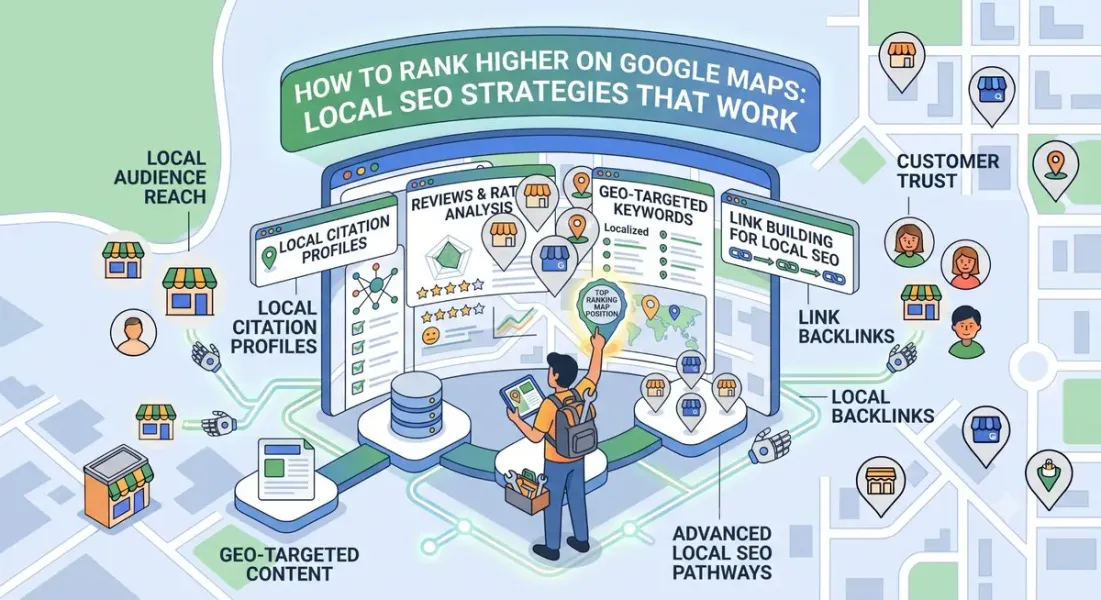
Ranking higher on Google Maps isn’t about finding a secret trick. It’s about systematically working the levers you control—category, profile completeness, reviews, citations, backlinks, and engagement—while accepting that proximity is the one factor you can’t change.
The businesses that win in Maps do three things consistently:
- They keep their profile complete and accurate. Not once, but continuously.
- They build review volume and velocity. Steady, monthly, never stopping.
- They measure real visibility by geography. Not one ranking, but a pattern across their market. Most competitors will do the first step and quit. Some will do the first two. Very few will track and test systematically. That’s where your advantage compounds.
Start with your category and pin. Then build reviews. Then expand geographically. Then test, measure, and repeat.
Twelve months of consistent effort will put you in a position most competitors can’t reach—and once you’re there, it’s very hard to be displaced.
Call to Action
Want to see exactly where you rank across your city—and what’s holding you back? Download our free Google Maps Ranking Toolkit, including a geo-grid tracking template, category testing worksheet, review velocity tracker, and a 90-day ranking plan. [Link to toolkit]
FAQs
How long does it take to rank higher on Google Maps?
Early movement appears in 2–4 weeks after profile changes. Meaningful visibility expansion takes 3–6 months. Compounding gains build over 6–12 months of consistent effort.
What is the fastest way to improve Maps rankings?
Fix your primary category and map pin first—these often produce immediate movement. Then launch a review generation system. Reviews are the strongest lever you can build quickly.
Why do I rank #1 in one area but not another?
Maps rankings are calculated per location. Your visibility forms a geographic pattern—strong near your address, weaker further out. This is normal and expected.
How many reviews do I need to rank in the top three?
Match or exceed your top three local competitors. In most markets that’s 50–300 reviews with a rating between 4.3 and 4.8. Volume and velocity both matter.
Does changing my primary category affect rankings?
Yes, often significantly and within 2–4 weeks. Test one category change at a time and measure with a geo-grid tool to see the impact.
Can I rank in areas where I don’t have an office?
Yes, through service areas and location pages. You won’t outrank businesses physically closer, but you can rank in a wider radius by building prominence and relevance.
Do Google Business Profile posts help rankings?
They’re not a direct ranking factor, but they drive engagement and signal activity. Weekly posting supports overall prominence.
What’s the most common reason businesses don’t rank?
Incomplete profiles and neglected reviews. Most businesses set up their profile once and never return. Consistency is what separates the top three from everyone else.
How do I know if my rankings are actually improving?
Use a geo-grid tool like Local Falcon or BrightLocal to track rankings across your city monthly. A single ranking number is misleading—your visibility pattern is what matters.
Should I use a local SEO agency or do it myself?
Most small businesses can handle the fundamentals themselves. Agencies are worth considering if you’re multi-location, in a highly competitive market, or lack the time to stay consistent.
Internal & External Links
Internal links: Replace these with your own URLs.
-
Schedule GBP posts automatically External links:
Grow Your Google Maps Ranking on Autopilot
Stop spending hours every week manually replying to customer reviews and writing Google posts. Busirank automates your Google Business Profile to boost your local SEO rankings and turn searchers into paying clients.
 Busirank Team