 Busirank Team
Page 1: The 2026 Local Landscape
What Google Actually Says (and Doesn’t Say)
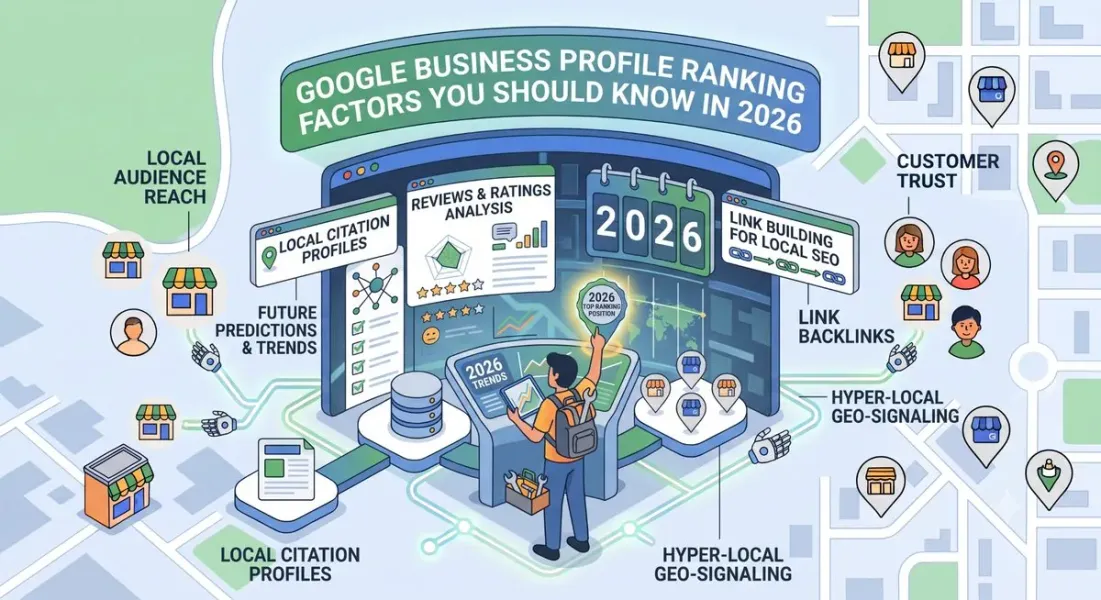
Google has never published a complete list of Google Business Profile ranking factors. What it has stated publicly, consistently, for years, is that local rankings rest on three pillars: relevance, distance, and prominence.
That framework still holds in 2026. What’s changed is the weight and mechanics behind each pillar—and the sheer number of signals Google can now draw from across its ecosystem.
What this means practically: anyone claiming to have “the definitive 2026 ranking factor list” is guessing. What we can do is identify the factors that consistently correlate with higher rankings across thousands of local markets, based on observable patterns, official Google guidance, and controlled testing.
That’s what this guide does.
What’s Shifted Going Into 2026
Several trends have shaped local search over the past few years and continue into 2026:
-
AI-generated answers and local discovery. Google’s AI features increasingly summarize local options. This makes accurate, complete profile data more important, not less—because AI systems pull from structured, verified information.
-
Greater emphasis on authenticity signals. Google has tightened enforcement around fake reviews, keyword-stuffed names, and virtual offices. Legitimate, verifiable businesses benefit.
-
Engagement measurement maturity. Google tracks how users interact with listings—calls, direction requests, website clicks, photo views—with increasing sophistication.
-
Review velocity and recency. Fresh reviews appear to carry more weight than older ones. A profile with 200 reviews from 2020 and nothing since looks stale.
-
Geographic granularity. Maps rankings are calculated per location point. Geo-grid tools have become essential for understanding actual visibility.
-
Video and visual content. Short videos and high-quality photos continue to grow in influence for engagement, which indirectly supports rankings.
The Three Pillars, Still Standing
| Pillar | What It Means | Your Control |
|---|---|---|
| Relevance | How well you match the query | High |
| Distance | How close you are to the searcher | Very low |
| Prominence | How well-known and trusted you appear | High |
Everything in this guide fits into one of these three buckets. The rest is tactical detail.
What This Guide Covers
- Page 1: The 2026 landscape and core framework
- Page 2: Relevance factors—category, name, services, description
- Page 3: Prominence factors—reviews, citations, links, engagement
- Page 4: Proximity signals, profile health, and technical factors
- Page 5: Priority framework, tracking, mistakes, and conclusion
Page 2: Relevance Factors
Primary Category
Impact: Very high
Control: Full Stability: High
Your primary category remains the single strongest relevance signal you control. It tells Google what your business fundamentally is.
How to get it right:
- Search your core service from a neutral location
- Inspect the top three results’ primary categories
- Identify the dominant category in your market
- Compare it against what genuinely describes your business
- Choose the closest accurate match Common mistake: Choosing a category because competitors use it when it doesn’t accurately describe you. This can trigger suspension and attract wrong-fit customers.
Testing note: Category changes often produce ranking shifts within 2–4 weeks. Change one at a time and measure.
Business Name
Impact: High
Control: Limited (must be real-world name) Stability: High
Your business name influences relevance because Google matches query terms against it. This creates an obvious temptation: stuff keywords into your name.
Don’t. Google’s guidelines require your real-world business name. Keyword stuffing can get your profile suspended, wiping out all your local visibility overnight.
What you can do:
- Ensure your name is spelled consistently everywhere
- Use your full legal or trading name as it appears on signage and documents
- Avoid adding descriptors like “Best,” “Cheap,” or service keywords
Secondary Categories
Impact: Moderate
Control: Full Stability: High
Secondary categories expand the queries you’re eligible for. But more isn’t better.
Best practice: Add only categories for services you actively provide and want to rank for. Two to five secondary categories is typical. Ten is usually dilution.
Services and Products
Impact: Moderate–high
Control: Full Stability: Moderate
Individually listed services with descriptions help Google match specific queries.
Instead of: “Plumbing services”
Use:
- Drain cleaning — same-day service for clogged kitchen and bathroom drains
- Water heater installation — tank and tankless, all major brands
- Leak detection — non-invasive detection for hidden pipe leaks Each service becomes a potential match for a specific query.
Business Description
Impact: Low–moderate
Control: Full Stability: Moderate
The 750-character description is a minor ranking factor but a meaningful conversion factor. Front-load your primary service and city in the first 250 characters.
Avoid: Keyword stuffing, promotional language, or copy-pasted content from your website.
Attributes
Impact: Low
Control: Full Stability: Moderate
Attributes help you appear in filtered searches (e.g., “wheelchair accessible,” “online appointments,” “women-led”). They rarely move rankings directly, but they affect which queries you’re eligible for.
Best practice: Fill out every attribute that genuinely applies. Skip the ones that don’t.
Website URL
Impact: Low–moderate
Control: Full Stability: Moderate
Link to a relevant page, not just your homepage. If you offer emergency plumbing, link to that page. This reinforces relevance for that service.
Relevance Checklist
- Primary category verified against competitors
- Business name is your real-world name only
- 2–5 relevant secondary categories
- Services listed individually with descriptions
- Description front-loads service and city
- Attributes completed where applicable
- Website links to a relevant page
Page 3: Prominence Factors
Review Quantity
Impact: High
Control: High Stability: Moderate
Review count is one of the strongest prominence signals. More reviews generally correlate with higher rankings, all else being equal.
Benchmark: Check your top three local pack competitors. Your target is to match or exceed the highest count.
Typical ranges by market:
- Small towns: 20–80 reviews
- Mid-size cities: 100–300 reviews
- Competitive urban markets: 300–1,000+ reviews
Review Quality (Rating)
Impact: High
Control: Moderate Stability: Moderate
Higher ratings correlate with better rankings, but the relationship isn’t linear. Extremely low ratings suppress visibility. A perfect 5.0 with very few reviews can look suspicious to consumers and may not outperform a 4.5 with substantial volume.
Sweet spot: 4.3–4.8 stars.
Review Velocity
Impact: High
Control: High Stability: Moderate
How frequently you receive new reviews matters. A steady flow signals an active business. A burst followed by months of silence signals stagnation.
Target: 4–8 new reviews per month minimum. Higher in competitive markets.
Warning sign: If your most recent review is over 30 days old, your profile is decaying.
Review Recency
Impact: Moderate–high
Control: High Stability: Moderate
Recent reviews carry more weight than older ones. Google wants to know what customers experience now.
Implication: You can’t rest on reviews from three years ago. Continuous generation is required.
Review Content
Impact: Moderate
Control: Low Stability: Moderate
When reviewers naturally mention services, locations, or specialties, Google gains context. A review saying “great service” adds little. A review saying “they fixed our burst pipe at 11pm on a Sunday in Round Rock” adds a lot.
How to encourage: Ask a specific question in your review request: “Would you mind mentioning what service you had done?”
Never: Script reviews, offer incentives, or gate unhappy customers.
Owner Responses
Impact: Moderate
Control: Full Stability: Moderate
Responding to reviews signals an active, engaged business. It also adds fresh content to your profile.
Best practice: Respond to every review within 48 hours—negatives within 24.
Citations and NAP Consistency
Impact: Moderate–high
Control: Full Stability: High
Citations (mentions of your Name, Address, and Phone) reinforce your geographic anchor. Inconsistent NAP creates doubt about your location and weakens prominence.
Priority citations:
- Google Business Profile
- Apple Business Connect
- Bing Places
- Yelp (consumer-facing)
- Better Business Bureau
- Industry-specific directories
- Local chamber of commerce Target: 10–20 accurate, relevant citations. Quality beats quantity.
Local Backlinks
Impact: Moderate
Control: Moderate Stability: High
Backlinks from local and regional sources build prominence, which helps overcome distance.
Where to get them:
- Local news coverage
- Local blogs and community publications
- Chamber of commerce membership
- Sponsorships (sports teams, events, charities)
- Community organizations
- Local university partnerships
- Supplier and partner websites Avoid: paid link schemes, irrelevant directories, link farms.
Engagement Signals
Impact: Moderate
Control: Moderate Stability: Moderate
Google tracks how users interact with your listing:
- Calls
- Direction requests
- Website clicks
- Messages
- Photo views
- Bookings More engagement generally correlates with stronger visibility. Make your description action-oriented, add clear CTAs in posts, and respond to messages quickly.
Prominence Checklist
- Review count matches or exceeds top competitors
- Rating between 4.3 and 4.8
- 4–8 new reviews per month
- Most recent review under 30 days old
- Every review responded to within 48 hours
- NAP consistent across all citations
- 10–20 quality citations built
- 10+ local backlinks earned
- Engagement signals actively driven
Page 4: Proximity Signals, Profile Health, and Technical Factors
Distance and Proximity
Impact: Highest
Control: Very low Stability: Dynamic
Proximity is the strongest single factor in Maps rankings—and the one you can’t change. Your business will almost always rank higher for searchers near your location than for those far away.
What you can influence:
- Map pin accuracy: An inaccurate pin makes you invisible to nearby searchers. Fix it in your GBP dashboard by dragging the pin to your exact building entrance.
- Service areas: If you travel to customers, realistic service areas expand your query eligibility.
- Location pages: Dedicated pages for each service area expand your relevance beyond your physical location.
- Prominence: Strong prominence lets you overcome distance and rank in areas where you’re not the closest business. Reality check: You will never outrank a comparable business that’s significantly closer to the searcher. Focus on winning where distance is equal and expanding your radius through prominence.
Profile Completeness
Impact: High
Control: Full Stability: High
Completeness correlates strongly with rankings. An incomplete profile caps your ceiling regardless of other factors.
Every field matters:
- Business name
- Categories
- Address / service area
- Phone
- Website
- Hours (including special hours)
- Description
- Services
- Products
- Attributes
- Photos
- Q&A Pro tip: Audit your profile quarterly. Fields can go stale—hours change, services get discontinued, photos age.
Map Pin Accuracy
Impact: High
Control: Full Stability: Moderate
An inaccurate pin is a silent ranking killer. Common problems:
- Pin in the middle of a street
- Pin at a neighboring property
- Pin at a former address
- Pin at a virtual office or mailbox How to fix: Open your GBP dashboard, navigate to location settings, drag the pin to your exact building entrance, save. Google reviews changes, typically within 3–7 days.
Hours Accuracy
Impact: Moderate
Control: Full Stability: High
A significant share of local searches include “open now.” Wrong hours exclude you from those results.
Best practice:
- Set regular hours for every day you operate
- Add special hours for holidays at least two weeks ahead
- Mark temporary closures immediately
- Use “more hours” for services like delivery or takeout
Photos and Video
Impact: Moderate
Control: Full Stability: Moderate
Profiles with photos get significantly more direction requests and website clicks than those without. Visual content drives engagement, which indirectly supports rankings.
Target: 20+ photos to start, then 2–5 new ones monthly.
What to upload:
- Exterior (so people can find you)
- Interior (sets expectations)
- Team (builds trust)
- Work or products (shows quality)
- Short videos under 30 seconds Avoid: stock images. They underperform and reduce authenticity.
Posts and Q&A
Impact: Low–moderate
Control: Full Stability: Moderate
Posts and Q&A aren’t direct ranking factors, but they drive engagement and signal activity.
Posts: Publish at least weekly. “What’s New” posts expire after seven days, so consistency matters.
Q&A: Seed your own FAQs, monitor weekly, respond within 48 hours, report spam.
Messages
Impact: Low–moderate
Control: Full Stability: Moderate
If you enable messaging, respond within 24 hours. Slow responses hurt engagement and customer experience.
Google Guaranteed / Verified Badge
Impact: Low
Control: Partial Stability: Moderate
Google Guaranteed (for home services) and verified badges can influence click-through rate and consumer trust. They don’t appear to directly affect rankings, but they support conversion.
Proximity and Profile Health Checklist
- Map pin accurate to building entrance
- Service areas realistic and updated
- Location pages for each service area
- Profile 100% complete
- Hours current including special hours
- 20+ real photos uploaded
- Weekly GBP posts
- Q&A monitored and seeded
- Messages answered within 24 hours
Page 5: Priority Framework, Tracking, and Conclusion
Where to Focus First
Not all factors deserve equal attention. Here’s a priority order based on impact and effort:
Tier 1 — Fix immediately (high impact, easy):
-
Primary category
-
Map pin accuracy
-
Profile completeness
-
NAP consistency Tier 2 — Build systematically (high impact, ongoing):
-
Review generation
-
Review responses
-
Citation building
-
Weekly posts Tier 3 — Expand strategically (moderate impact, ongoing):
-
Local backlinks
-
Location pages
-
LocalBusiness schema
-
Content publishing Tier 4 — Optimize over time (lower impact, supporting):
-
Attributes
-
Products
-
Photos and video
-
Q&A seeding Start at Tier 1. Most businesses skip it and jump to Tier 3, which is why they plateau.
How to Test Ranking Factors
Change one thing at a time. Otherwise, you can’t attribute results.
Testing framework:
- Run a geo-grid analysis to capture baseline rankings
- Make one change
- Wait 2–4 weeks
- Re-run geo-grid analysis
- Compare: keep, revert, or iterate Worth testing:
- Primary category variations
- Service descriptions and keyword phrasing
- Review request timing and messaging
- Post frequency and content types
- Photo types and upload cadence
Tracking the Right Metrics
| Metric | Tool | Frequency |
|---|---|---|
| Geo-grid average rank | Local Falcon, BrightLocal | Monthly |
| Local pack position | Manual or rank tracker | Weekly |
| GBP calls | GBP Insights | Monthly |
| Direction requests | GBP Insights | Monthly |
| Website clicks | GBP Insights | Monthly |
| Review count and rating | GBP dashboard | Weekly |
| Review velocity | Manual tracking | Monthly |
| Citation accuracy | Moz Local, BrightLocal | Quarterly |
| Website traffic from GBP | GA4 with UTM tags | Monthly |
Tag your GBP website link with UTM parameters to measure real traffic:
?utm_source=google&utm_medium=gbp&utm_campaign=ranking_factors
Common Mistakes That Cap Rankings
- Keyword-stuffing your business name — fastest route to suspension
- Wrong primary category — caps relevance permanently
- Inaccurate map pin — makes you invisible nearby
- Inconsistent NAP — undermines geographic trust
- Neglecting reviews or only responding to negatives
- Stale review profile — no new reviews in 30+ days
- Thin location pages with duplicate content
- No geo-grid tracking — flying blind
- Unrealistic service areas — dilutes relevance
- Not posting on GBP — profile looks dormant
- Chasing national backlinks over local ones
- Changing multiple factors at once — can’t attribute results
- Treating ranking factors as a one-time checklist
A Realistic Timeline
| Timeframe | Expected Progress |
|---|---|
| Month 1 | Tier 1 fixes complete, baseline measured |
| Month 2–3 | Early ranking movement, review system running |
| Month 4–6 | Visibility radius expands, citations built |
| Month 6–12 | Consistent local pack presence across service area |
| Year 2+ | Defensible visibility, hard to displace |
Quick Reference Checklist
Relevance:
-
Primary category verified
-
Real-world business name
-
2–5 relevant secondary categories
-
Services listed individually
-
Description front-loads service and city Prominence:
-
Review count matches competitors
-
Rating 4.3–4.8
-
4–8 new reviews monthly
-
All reviews answered within 48 hours
-
NAP consistent
-
10–20 quality citations
-
10+ local backlinks Proximity and Health:
-
Map pin accurate
-
Service areas realistic
-
Profile 100% complete
-
Hours current
-
20+ real photos
-
Weekly posts
-
Q&A monitored Measurement:
-
Geo-grid analysis monthly
-
UTM tracking on GBP link
-
Competitor benchmarking
-
One change tested at a time
Conclusion
Google Business Profile ranking factors in 2026 aren’t mysterious—they’re just numerous and constantly weighted by context. The three-pillar framework of relevance, distance, and prominence still governs everything, but the tactical signals within each pillar have matured.
What separates businesses that rank from those that don’t isn’t secret knowledge. It’s execution:
- Fix your category and pin
- Complete every profile field
- Build review volume and velocity consistently
- Keep NAP clean and citations accurate
- Earn local backlinks
- Track real visibility by geography
- Test one change at a time Most competitors will do the first step and stop. That’s your opening. Twelve months of disciplined execution will put you in a position very few local businesses reach—and once you’re there, displacing you takes far more effort than it took you to arrive.
Call to Action
Want a prioritized action plan based on your specific market? Download our free GBP Ranking Factors Audit Kit, including a factor-by-factor scoring sheet, geo-grid tracking template, review velocity calculator, and a 90-day priority roadmap. [Link to kit]
FAQs
What is the most important Google Business Profile ranking factor?
Proximity is technically the strongest factor, but it’s the one you can’t change. Among factors you control, primary category, review profile, and overall profile completeness have the highest impact.
How many ranking factors does Google Business Profile have?
Google has never published a definitive number. Its official guidance cites relevance, distance, and prominence as the three pillars. Within those, dozens of observable signals contribute.
Do Google reviews affect rankings in 2026?
Yes. Review quantity, quality, velocity, recency, content, and owner responses all correlate with stronger local visibility. Reviews remain the strongest prominence signal you can actively build.
Has keyword stuffing in the business name stopped working?
It’s more heavily enforced than ever. Google actively suspends profiles that violate naming guidelines. Never add service or location keywords to your business name unless they’re part of your real-world name.
How long does it take for ranking factor changes to show results?
Category and profile changes typically show movement within 2–4 weeks. Review and prominence changes compound over 2–6 months. Meaningful visibility shifts across your market take 6–12 months.
Does posting on Google Business Profile improve rankings?
Posts aren’t a direct ranking factor, but they drive engagement and signal activity—both of which support prominence. Weekly posting is recommended.
How many reviews do I need to rank in the top three?
There’s no fixed number. Match or exceed your top three local competitors. In most markets that’s 50–300 reviews with a rating between 4.3 and 4.8.
Do citations still matter for Google Business Profile rankings?
Yes. NAP consistency across quality citations remains a meaningful factor. Focus on 10–20 accurate, relevant citations rather than hundreds of low-quality ones.
What’s the biggest mistake businesses make with ranking factors?
Treating them as a one-time checklist. Rankings are dynamic—competitors move, reviews age, and profiles go stale. Continuous maintenance is required.
How do I know which factors are working for my business?
Change one factor at a time, wait 2–4 weeks, and re-run a geo-grid analysis to measure the impact. Tracking real visibility by geography is far more accurate than checking a single ranking position.
Internal & External Links
Internal links: Replace these with your own URLs.
-
How to respond to Google reviews External links:
Grow Your Google Maps Ranking on Autopilot
Stop spending hours every week manually replying to customer reviews and writing Google posts. Busirank automates your Google Business Profile to boost your local SEO rankings and turn searchers into paying clients.
 Busirank Team