 Busirank Team
Page 1: Why Responding to Google Reviews Matters
The Stakes Are Higher Than You Think
A Google review response is never just a reply to one person. It’s a public statement read by every future customer who lands on your profile.
Think about how consumers actually behave:
- 91% of consumers read online reviews before choosing a local business.
- 89% of consumers expect businesses to respond to their reviews.
- 53% of customers expect a reply to a negative review within a week—and 18% expect one within 24 hours.
- Customers who receive a response to a negative review are willing to spend up to 45% more with that business.
- Businesses that respond to reviews tend to have higher ratings and more reviews over time. Here’s the part most business owners miss: your response isn’t for the reviewer. In most cases, that customer has already moved on. Your response is for the hundreds of prospects who will read it while deciding whether to trust you.
That reframe changes everything. You’re not defending yourself. You’re demonstrating what it’s like to do business with you.
Responding Is a Local SEO Signal Too
Beyond reputation, responses influence visibility. Google has confirmed that responding to reviews is good practice, and profiles with active owner engagement tend to perform better in local search.
Why? Because responses:
- Add fresh, relevant content to your profile
- Include natural keywords about your services and location
- Signal that the business is active and well-managed
- Increase engagement metrics on your listing Every response is a small piece of content on a page Google already ranks. That’s free real estate—use it well.
The Three Audiences of Every Response
When you write a review response, you’re speaking to three groups at once:
-
The reviewer – They want to feel heard, valued, and respected.
-
Future customers – They’re evaluating your character, professionalism, and how you handle problems.
-
Google – The algorithm reads your response as a signal of engagement, relevance, and activity.
Write for all three, and you’ll never go wrong.
What This Guide Covers
Over the next five pages, you’ll learn:
- Page 1: Why responses matter and who’s watching
- Page 2: Core best practices, tone, and timing
- Page 3: How to respond to positive, neutral, and mixed reviews
- Page 4: How to handle negative reviews, fake reviews, and crisis situations
- Page 5: Templates, tracking, mistakes, and conclusion
Page 2: Core Best Practices, Tone, and Timing
The Seven Golden Rules of Review Responses
-
Respond to every review. Positive, negative, or neutral—reply to all of them. Selective responding looks like damage control. Universal responding looks like care.
-
Respond quickly. Aim for 24–48 hours. Anything beyond a week signals neglect. Set up notifications so you never miss one.
-
Keep it short. Two to four sentences is usually enough. Long responses look defensive or over-produced.
-
Personalize. Use the reviewer’s name. Reference the specific service, product, or experience they mentioned. Generic copy-paste replies are obvious and off-putting.
-
Stay professional—always. No sarcasm, no defensiveness, no arguing. Even when you’re right, you can’t win a public fight.
-
Never share private information. No order numbers, medical details, account info, or anything that identifies the customer beyond what they shared publicly.
-
Move problems offline. For negative reviews, invite the conversation to email or phone. Public resolution is rarely the right venue.
Finding the Right Tone
Your tone should match your brand—but within professional bounds. Consider these examples for the same 5-star review:
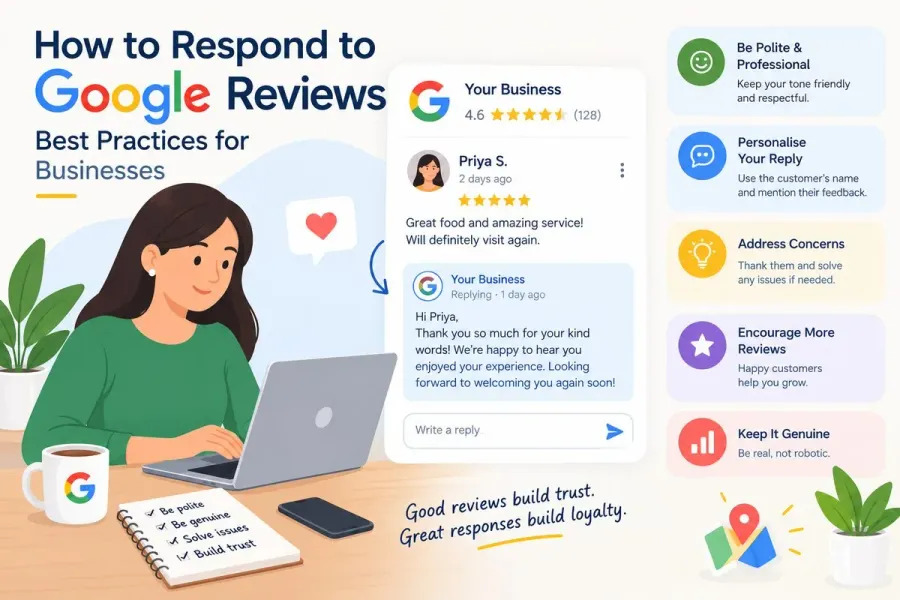
Formal: “Thank you for your kind words, Ms. Patel. We’re delighted that our team could assist with your project, and we appreciate your trust in our services.”
Warm and friendly: “Thank you so much, Priya! It was a pleasure working with you, and we’re thrilled you love the results. Come back anytime!”
Casual and modern: “Thanks, Priya! 🙌 So glad we could help—appreciate you taking the time to share this.”
All three work. What doesn’t work: robotic templates, over-the-top enthusiasm, or corporate jargon. Read your response out loud. If you wouldn’t say it to someone’s face, rewrite it.
Timing Guidelines by Review Type
| Review Type | Ideal Response Time |
|---|---|
| Positive | Within 48 hours |
| Neutral / mixed | Within 24–48 hours |
| Negative | Within 24 hours |
| Crisis / viral | Within 12 hours, then follow up |
| Fake / policy violation | Flag immediately, respond within 24 hours if it stays |
Speed matters most with negative reviews. Every hour a complaint sits unanswered, more prospects see it without your side of the story.
Who Should Respond?
Decide in advance who owns review responses:
- Owner or founder – Best for negative reviews, sensitive issues, or high-value customers
- Marketing or community manager – Best for routine positive responses and consistency
- Customer service lead – Best for operational complaints Best practice: Give one or two people access, but keep the voice consistent. If multiple people respond, agree on a shared tone and template framework so your profile doesn’t feel schizophrenic.
Where to Manage Responses
You can respond to reviews directly from:
- Google Business Profile dashboard (business.google.com)
- Google Maps app (on mobile)
- Third-party tools like Birdeye, Podium, BrightLocal, or GatherUp Third-party tools help if you manage multiple locations or want to track response times and sentiment across platforms.
What to Avoid
- Copy-pasting identical responses (Google and customers notice)
- Getting emotional or defensive
- Mentioning that a review is fake in your public reply
- Asking the reviewer to change their review in the public response
- Offering refunds or compensation publicly—do that privately
- Ignoring negative reviews and only responding to positive ones
- Debating facts point by point
Page 3: Responding to Positive, Neutral, and Mixed Reviews
How to Respond to 5-Star Reviews
Positive reviews are easy to overlook because they don’t feel urgent. Don’t skip them. They’re your best opportunity to reinforce trust and encourage repeat business.
The formula:
- Thank them genuinely
- Reference a specific detail they mentioned
- Add value or invite them back Example:
“Thank you so much, Daniel! We’re thrilled the installation went smoothly and that the team left everything tidy. It was a pleasure working with you—don’t hesitate to reach out if you need anything in the future.”
Why this works: The specific detail proves it’s not a template. The invitation encourages repeat business. The tone is warm but professional.
What to avoid:
- One-word replies (“Thanks!”)
- Generic responses (“We appreciate your business.”)
- Over-the-top responses that feel performative
- Asking for another review or a referral in your reply
How to Respond to 4-Star Reviews
Four-star reviews are gold—but they often hide useful feedback. Read carefully. Sometimes a 4-star review contains a specific complaint buried in praise.
If there’s no complaint:
“Thank you for the 4-star review, Sarah! We’re glad you had a good experience. If there’s anything we could have done to make it a 5-star visit, we’d love to hear it—feel free to reach out at [email].”
If there’s a mild complaint:
“Thank you for the feedback, Sarah. You’re right that the wait time was longer than it should have been—we’ve since adjusted our scheduling to fix that. We’d love the chance to serve you again.”
Why this works: It acknowledges the gap without being defensive, shows you’re listening, and demonstrates improvement.
How to Respond to 3-Star Reviews
Three-star reviews are the most neglected—and the most valuable. These customers are on the fence. A thoughtful response can turn them into loyal advocates.
The formula:
- Thank them for the honest feedback
- Acknowledge what went well
- Address what didn’t, without excuses
- Ask for a chance to improve Example:
“Thanks for the honest feedback, Marcus. We’re glad the food was on point, but we’re sorry the service felt rushed—that’s not the experience we aim for. We’d love another chance to show you what we’re really capable of. Please reach out at [email] if you’d like to share more.”
What to avoid:
- Arguing with their rating
- Explaining away their experience
- Generic apologies with no substance
How to Respond to Mixed Reviews
Mixed reviews—positive on one point, negative on another—require balance. Validate what they praised, acknowledge what they criticized, and offer a path forward.
Example:
“Thank you for the detailed review, Elena. We’re so glad you loved the venue and the staff—but we’re sorry the parking situation caused frustration. We’ve recently added overflow parking to address exactly that. We hope to see you again.”
Responding to Reviews Without Text
Sometimes people leave a star rating with no words. Still respond.
5 stars, no text:
“Thank you for the 5-star rating! We appreciate you taking the time.”
1 star, no text:
“Thank you for the rating. We’re sorry we fell short—if you’re open to sharing more, we’d like to make it right. Please reach out at [email].”
Responding to Reviews in Other Languages
If your business serves multilingual customers, respond in the language they used when possible. It signals genuine care and improves local relevance for that audience.
If you can’t, a short response in English acknowledging their feedback is still better than silence.
Page 4: Handling Negative Reviews, Fake Reviews, and Crises
The Negative Review Playbook
Negative reviews are inevitable. How you handle them is what separates trusted businesses from forgotten ones.
The six-step framework:
-
Pause before responding. Read the review twice. Check your records. Understand what actually happened before you write anything.
-
Respond within 24 hours. Speed shows you take feedback seriously.
-
Thank them for the feedback. Even if it stings. “Thank you for sharing this” is a powerful opener.
-
Acknowledge the specific issue. Reference what they complained about. Generic apologies feel hollow.
-
Apologize sincerely—without excuses. “We’re sorry” works. “We’re sorry you feel that way” does not.
-
Take it offline. Provide a direct contact and invite resolution.
Template:
“Thank you for sharing this, [Name]. We’re genuinely sorry about [specific issue]—that’s not the standard we hold ourselves to. We’d like to make it right. Please contact [Name] directly at [email/phone] so we can resolve this for you.”
What not to do:
- Argue or correct them publicly
- Blame the customer
- Make excuses about staffing, supply, or systems
- Offer a refund publicly (do it privately)
- Threaten legal action
- Delete or hide the review (you usually can’t)
When the Review Is Unfair or Exaggerated
Sometimes a review is misleading or exaggerates what happened. You still can’t argue publicly. Instead:
- Acknowledge their perspective
- State facts calmly and briefly if necessary
- Avoid “but” statements that negate the apology
- Move the conversation offline Example:
“Thank you for your feedback, [Name]. We’re sorry your experience didn’t meet expectations. We did communicate the timeline upfront, but we clearly could have done more to keep you informed. We’d welcome the chance to discuss this directly—please reach out at [email].”
This walks the line: it corrects the record without dismissing the complaint.
How to Handle Fake Reviews
Fake reviews—from competitors, trolls, or people who were never customers—are frustrating but manageable.
Step 1: Verify. Check your records. Were they ever a customer?
Step 2: Flag for removal. In your GBP dashboard, click the review, select “Flag as inappropriate,” and choose the relevant reason. Grounds for removal include:
- Spam or fake content
- Off-topic content
- Hate speech or harassment
- Personal information
- Conflicts of interest
- Advertising or promotional content Step 3: Wait. Google reviews flags manually. It can take days or weeks.
Step 4: If it stays, respond carefully. Don’t call it fake publicly. Instead:
“Thank you for the feedback. We take all reviews seriously, but we’re unable to locate a record matching this experience. If we’ve made a mistake, we’d genuinely like to know—please reach out at [email] so we can look into it.”
This quietly signals to readers that the review may not be legitimate, without accusing anyone.
Step 5: Document. Keep records of fake reviews, flags, and outcomes. If you’re being targeted, patterns matter.
Crisis Situations and Viral Reviews
Occasionally a review goes viral or a wave of negative reviews hits your profile. This is a crisis.
Crisis protocol:
- Assemble a response team immediately (owner, marketing, legal if needed)
- Pause all scheduled posts until the situation is stable
- Draft one master statement and use it consistently across platforms
- Respond to the original review calmly and factually
- Avoid responding to every new negative review individually if it’s coordinated—respond to a few, then step back
- Do not delete or hide reviews unless they violate policy
- Follow up publicly when the issue is resolved
- Learn and adjust internally A crisis response template:
“We’re aware of the recent reviews and take these concerns seriously. We’re actively investigating what happened and are committed to making it right. If you’ve been affected, please contact us directly at [email/phone]. We’ll share an update as soon as we have more information.”
When to Ask for a Review Update
If you successfully resolve a negative experience, it’s acceptable to politely ask the customer to consider updating their review. Do this privately, never publicly, and never pressure them.
Example email:
“Hi [Name], thanks again for giving us the chance to make things right. If you feel we’ve resolved your concern, we’d be grateful if you’d consider updating your review—but we completely understand either way.”
Many won’t update. That’s fine. The effort still matters.
Page 5: Templates, Tracking, Mistakes, and Conclusion
Ready-to-Use Response Templates
Positive review (5 stars):
“Thank you so much, [Name]! We’re thrilled you had a great experience with [specific detail]. It means a lot to our team. Hope to see you again soon!”
4-star with mild complaint:
“Thank you for the feedback, [Name]. We’re glad you enjoyed [positive], and we’re sorry about [issue]. We’ve taken steps to improve, and we’d love to serve you again.”
3-star, neutral:
“Thanks for taking the time to share this, [Name]. We’re glad [positive], but clearly we missed the mark on [issue]. We’d welcome the chance to do better—please reach out at [email].”
Negative review, valid complaint:
“Thank you for sharing this, [Name]. We’re sorry about [issue]—that’s not the experience we want anyone to have. We’d like to make it right. Please contact us at [email/phone].”
Negative review, unfair or exaggerated:
“Thank you for your feedback, [Name]. We’re sorry your experience didn’t meet expectations. We’d welcome the chance to discuss this directly—please reach out at [email].”
Fake review:
“Thank you for the feedback. We take all reviews seriously, but we’re unable to locate a record matching this experience. If we’ve made a mistake, we’d like to know—please reach out at [email].”
Rating-only (5 stars):
“Thank you for the 5-star rating, [Name]! We appreciate you.”
Rating-only (1 star):
“Thank you for the rating. We’re sorry we fell short—if you’re open to sharing more, we’d like to make it right. Please reach out at [email].”
Track Your Response Performance
You can’t improve what you don’t measure. Track these metrics monthly:
| Metric | Why It Matters | Where to Find It |
|---|---|---|
| Response rate | Shows engagement | Manual audit |
| Average response time | Signals care and attention | Review tool or spreadsheet |
| Sentiment trend | Reputation health | Review monitoring tool |
| Review count growth | Ranking and trust | GBP dashboard |
| Average rating | Conversion driver | GBP dashboard |
| Reviewer updates | Success of resolution efforts | Manual audit |
| Flagged reviews removed | Policy enforcement success | Manual tracking |
Benchmark: Aim for a 100% response rate and an average response time under 48 hours.
Common Mistakes to Avoid
- Only responding to negative reviews
- Copy-pasting the same reply everywhere
- Getting defensive or sarcastic
- Arguing facts publicly
- Sharing private customer information
- Asking for review changes publicly
- Ignoring reviews for weeks
- Responding emotionally in the moment
- Using AI-generated responses without personalization
- Failing to track response performance
- Not training staff on review handling
- Deleting or hiding reviews instead of responding
Quick Response Checklist
- Respond to every review
- Reply within 24–48 hours
- Use the reviewer’s name
- Reference specific details
- Keep it short and human
- Apologize sincerely for negatives
- Move problems offline
- Never argue or get defensive
- Never share private information
- Flag policy violations
- Track response rate and time monthly
- Review your tone quarterly
Conclusion
Responding to Google reviews isn’t damage control—it’s marketing. Every reply is a public demonstration of how your business treats people, handles problems, and values feedback.
The businesses that win locally aren’t the ones with zero negative reviews. They’re the ones who respond thoughtfully, quickly, and consistently—turning complaints into trust and compliments into loyalty.
Start with a simple commitment: respond to every review within 48 hours. Use the frameworks and templates in this guide. Keep your tone warm, professional, and human. Then track your performance and refine over time.
Your reviews are a conversation. Join it.
Call to Action
Want to make review responses effortless? Download our free Google Review Response Toolkit, including 15 ready-to-use templates, a response-time tracker, and a negative review playbook. [Link to toolkit]
FAQs
Should I respond to every Google review?
Yes. Responding to every review—positive, negative, or neutral—shows engagement, builds trust, and can improve local visibility. Selective responding looks like damage control.
How quickly should I respond to a Google review?
Aim for 24–48 hours. Negative reviews should be answered within 24 hours. Anything beyond a week signals neglect to both customers and Google.
Can I delete a negative Google review?
You can’t delete reviews directly, but you can flag them if they violate Google’s policies (spam, fake, off-topic, hate speech, personal information, conflicts of interest). If Google won’t remove it, respond professionally.
Should I apologize for a negative review even if I think the customer is wrong?
Yes—apologize for their experience, not necessarily for the facts. “We’re sorry your experience didn’t meet expectations” works without admitting fault. Never argue publicly.
Can I offer a refund or discount in my public response?
Don’t offer compensation publicly. It sets a precedent, can attract opportunists, and may violate platform norms. Instead, invite the customer to contact you privately.
What should I do if a competitor leaves a fake review?
Flag it through your Google Business Profile dashboard as a policy violation. Document it. If it stays, respond carefully without accusing anyone publicly—mention you can’t locate a matching record.
Should I use AI to write my review responses?
AI can help draft, but always personalize. Generic AI responses are obvious and can feel cold. Use AI as a starting point, then add specifics and your brand voice.
How do I respond to a review that contains false information?
Stay calm and factual. Acknowledge their perspective, briefly state the facts without arguing, and invite them to discuss offline. Never get into a public back-and-forth.
What if the customer updates their review after I respond?
Thank them publicly for the update. It shows future readers that you’re responsive and that resolution is possible. Even a partial improvement is worth acknowledging.
How do I handle a wave of negative reviews?
Treat it as a crisis. Assemble a team, pause scheduled posts, draft one master statement, respond calmly to the original review, and follow up publicly once resolved. Don’t respond emotionally to every new review.
Internal & External Links
Internal links: Replace these with your own URLs.
-
Reputation management playbook
-
Customer feedback survey template External links:
Grow Your Google Maps Ranking on Autopilot
Stop spending hours every week manually replying to customer reviews and writing Google posts. Busirank automates your Google Business Profile to boost your local SEO rankings and turn searchers into paying clients.
 Busirank Team