 Busirank Team
Introduction
If your business isn’t showing up in the Google Maps local pack, you’re losing customers to competitors who are. When someone searches “plumber near me” or “best coffee shop in Austin,” Google shows three local businesses at the top of the results. Those three spots capture the majority of clicks, calls, and direction requests.
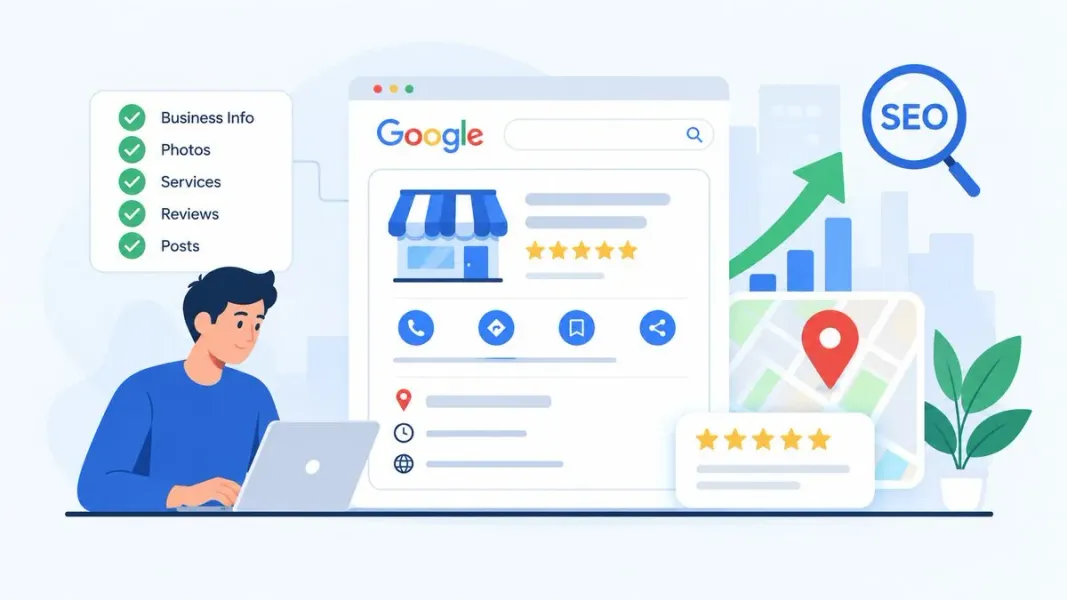
Your Google Business Profile (GBP)—formerly known as Google My Business—is the single most important asset for local SEO. It’s often the first impression people have of your business, and it directly influences whether you appear in the local pack, Google Maps, and standard search results.
Why Google Business Profile Matters for Local Rankings
Google’s local search results are primarily influenced by three factors: relevance, distance, and prominence.
- Relevance: How well your business matches what someone is searching for.
- Distance: How close your business is to the searcher or the location they specified.
- Prominence: How well-known and trusted your business appears based on reviews, citations, links, and online activity. Your GBP directly affects relevance and prominence. A fully optimized profile helps Google understand what you do, where you operate, and why you’re a trustworthy choice. It also gives potential customers the information they need to call, visit, or buy—without leaving the search results.
Consider these stats:
- Businesses with complete Google Business Profiles are 2.7x more likely to be considered reputable.
- 76% of people who search for something nearby on their smartphone visit a related business within a day.
- 28% of local searches result in a purchase. Your profile isn’t just a directory listing. It’s a conversion tool. Every field you fill out, every photo you upload, and every review you respond to shapes how customers perceive you—and how Google ranks you.
Step 1: Claim and Verify Your Profile
Start by claiming your business at business.google.com. If someone else already claimed it, request access. Google will notify the current owner, and if they don’t respond within a set period, you may be able to claim it.
Verification methods include:
- Postcard by mail (takes 5–14 days)
- Phone or email (for select businesses)
- Video verification (increasingly common)
- Instant verification if you’ve already verified your domain in Google Search Console Once verified, you can edit your profile, respond to reviews, and publish posts. Keep your verification information up to date, especially if you move or change your service area. If you lose access, recovery can be time-consuming, so store your login credentials securely and add a secondary owner if possible.
Step 2: Complete Every Core Business Detail
Google rewards completeness. Profiles with all fields filled out tend to rank higher and convert better. Fill out every relevant field:
- Business name: Use your real-world business name. Do not stuff keywords. “Joe’s Plumbing” is correct. “Joe’s Plumbing – Emergency Plumber Austin TX 24/7” violates Google’s guidelines and can get your profile suspended.
- Address or service area: If customers visit you, add your address. If you travel to them, set a service area. You can do both if applicable.
- Phone number: Use a local number if possible. Tracking numbers can work, but they must connect to your business and be consistent with your website.
- Website: Link to a relevant page, not just your homepage. If you offer emergency plumbing, link to your emergency services page.
- Hours: Add regular and special hours, including holidays. Inaccurate hours frustrate customers and can hurt rankings.
- Description: Write a clear 750-character description that explains what you do, who you serve, and what makes you different. Use keywords naturally—don’t force them. Pro tip: Update your hours for holidays at least two weeks in advance. Google often shows “Hours might differ” warnings, which can deter customers.
Step 3: Choose the Most Accurate Primary Category
Your primary category is one of the strongest ranking signals for local search. Choose the category that best describes your core business. Then add secondary categories only if they’re truly relevant.
For example:
- A bakery might use “Bakery” as the primary category and “Cafe” and “Caterer” as secondary categories.
- A marketing agency might use “Marketing Agency” as the primary and “Website Designer” and “Consultant” as secondary. Wrong categories can hurt rankings and attract the wrong customers. If you’re unsure, look at what competitors in your top three local pack results are using. You can also use tools like GMB Everywhere or Local Falcon to analyze category usage.
Step 4: Add Services, Products, and Attributes
List your services and products with clear names and descriptions. Include prices if appropriate. This helps you appear in filtered searches and gives customers confidence before they contact you.
Services: Add each service individually. For example, a plumber might list:
- Drain cleaning
- Water heater installation
- Leak detection
- Emergency plumbing repair Products: If you sell physical goods, add them with photos, descriptions, and prices.
Attributes: Add attributes like:
- Wheelchair accessible
- Women-led
- Free Wi-Fi
- Online appointments
- LGBTQ+ friendly
- Veteran-owned These details help you appear in filtered searches and align your business with customer values.
Step 5: Upload High-Quality Photos and Videos
Profiles with photos get 42% more direction requests and 35% more website clicks than those without. Add a variety of media:
- Exterior photos so people can find you
- Interior photos to set expectations
- Team photos to build trust
- Photos of your work or products
- Short videos under 30 seconds Upload new media regularly. Google favors fresh content. Avoid stock photos and overly edited images—real, helpful visuals perform better. Aim for at least 10–20 photos to start, then add 2–5 new ones each month.
Photo best practices:
- Use natural lighting
- Show real people and real work
- Include your logo as your profile picture
- Add geotags if possible (though Google strips most metadata, it doesn’t hurt)
Step 6: Publish Google Posts and Updates
Google Posts let you share offers, events, new products, and updates directly on your profile. They appear in your listing and can improve engagement while giving Google fresh signals about your business.
Post types:
-
What’s New: General updates
-
Events: Promote upcoming events with dates and times
-
Offers: Share discounts or promotions
-
Products: Highlight specific items Best practices:
-
Post at least once a week, or every two weeks minimum
-
Use a clear, high-quality image
-
Write a short headline and 150–300 character description
-
Add a call to action like “Learn more,” “Call now,” or “Book”
-
Include keywords naturally Posts expire after seven days (offers and events last until their end date), so consistency matters.
Step 7: Manage Reviews and Q&A
Reviews are a major trust signal and can influence local rankings. They also impact conversion rates—91% of consumers read online reviews before choosing a local business.
How to get more reviews:
-
Ask happy customers in person or via follow-up email
-
Include a direct review link in your email signature and receipts
-
Use QR codes in your physical location
-
Send SMS requests after a positive interaction How to respond:
-
Respond to every review—positive and negative
-
Thank reviewers for positive feedback
-
Address negative reviews professionally and offline if possible
-
Never argue or get emotional
-
Never buy fake reviews or offer incentives in exchange for reviews (this violates Google’s policies) Q&A section: Anyone can ask or answer questions on your profile. Monitor it regularly. Seed your own FAQs and answer them accurately. Upvote helpful answers and report spam. This section often appears in search results, so it’s worth managing.
Step 8: Keep NAP Consistent and Build Local Citations
NAP stands for Name, Address, and Phone number. Make sure your NAP is identical across your website, GBP, social profiles, and local directories. Inconsistent information confuses Google and customers.
Where to build citations:
- Yelp
- Bing Places
- Apple Maps
- Industry-specific directories (e.g., Healthgrades for doctors, Avvo for lawyers)
- Local chambers of commerce
- Better Business Bureau You don’t need hundreds of citations. Focus on quality and consistency. A few authoritative, relevant citations are better than dozens of low-quality ones.
Pro tip: Use a citation audit tool like Moz Local or BrightLocal to find and fix inconsistencies.
Step 9: Track Performance and Refine
Use the Performance section in your GBP dashboard to track:
- Searches that found your business
- Calls
- Direction requests
- Website clicks
- Messages
- Bookings Compare your results month over month. If calls are low, improve your description and photos. If direction requests are high but website clicks are low, add a stronger CTA. If you’re getting impressions but no clicks, your categories or services may need adjustment.
Key metrics to watch:
- Discovery vs. Direct searches: Discovery means people found you by searching a category. Direct means they searched your business name. High discovery is good for new customer acquisition.
- Customer actions: Calls, direction requests, and website clicks are the clearest signals of intent.
- Photo views: Compare your photos to competitors to see if you need better visuals. Use insights to guide your next optimization. Local SEO isn’t a one-time task—it’s an ongoing process.
Common Google Business Profile Mistakes to Avoid
- Keyword-stuffing your business name
- Choosing too many irrelevant categories
- Ignoring reviews or responding emotionally
- Letting hours go out of date
- Using a virtual office or fake address
- Uploading stock photos instead of real ones
- Neglecting Q&A and messages
- Not posting regularly
- Using a toll-free number instead of a local one
- Failing to respond to messages within 24 hours
Quick Optimization Checklist
- Claim and verify your profile
- Complete every core field
- Choose the right primary category
- Add services, products, and attributes
- Upload 10+ real photos
- Post weekly or biweekly
- Ask for and respond to reviews
- Monitor Q&A
- Keep NAP consistent
- Build quality local citations
- Track performance monthly
- Update hours for holidays
- Respond to messages promptly
Conclusion
Optimizing your Google Business Profile is one of the highest-ROI local SEO activities you can do. When your profile is complete, accurate, and active, Google has more reasons to show it to nearby customers—and those customers have more reasons to choose you.
Focus on relevance, prominence, and trust. Complete every field, choose the right categories, upload real photos, publish regular posts, manage reviews, and keep your NAP consistent. Then track your results and keep improving.
Local SEO isn’t about quick hacks. It’s about building a strong, trustworthy presence that Google and customers can rely on. Start with your GBP, and you’ll see the impact across your entire local marketing strategy.
Call to Action
Want a faster way to improve your local rankings? Download our free Google Business Profile Optimization Checklist and audit your profile in under 10 minutes. It includes a step-by-step worksheet, a review request template, and a monthly tracking sheet. [Link to checklist]
FAQs
How long does it take to rank in Google Maps?
It varies. Some businesses see improvements in a few weeks, while competitive markets can take several months. Consistency matters more than quick fixes. Profiles that are complete, active, and well-reviewed tend to rank faster.
Does Google Business Profile help SEO?
Yes. A complete, active profile improves your visibility in local search results, Maps, and the local pack. It also drives calls, direction requests, and website visits. While GBP is separate from traditional SEO, it’s a core part of local SEO strategy.
Can I add keywords to my business name?
No. Google’s guidelines require your real-world business name. Keyword stuffing can lead to suspension. Use your description, services, posts, and Q&A for keywords instead.
How often should I post on Google Business Profile?
At least once a week is ideal, but every two weeks is a good minimum. Focus on useful updates, offers, events, and new products. Posts expire after seven days, so consistency is key.
Do reviews affect local rankings?
Reviews influence prominence and trust. A steady flow of authentic, positive reviews—and professional responses—can help your local rankings and conversion rates. Google also considers review quantity, quality, and velocity.
What if I serve customers at their location?
Set a service area instead of showing your address. You can still rank in the areas you serve, but you must verify your business according to Google’s guidelines. Service-area businesses should also create location-specific landing pages.
How do I optimize without a physical address?
If you’re a service-area business, hide your address and define your service areas. Build local landing pages and citations for each area to strengthen relevance. You can still rank in the areas you serve without a storefront.
How many photos should I upload?
Aim for at least 10–20 photos to start, then add 2–5 new ones each month. Profiles with photos get significantly more clicks and direction requests. Real photos of your team, work, and location perform best.
Can I use a virtual office address?
No. Google’s guidelines prohibit virtual offices, PO boxes, and addresses where you don’t actually operate. Using a fake address can get your profile suspended. If you work from home, set a service area instead.
How do I respond to negative reviews?
Respond professionally and promptly. Acknowledge the issue, apologize sincerely, and offer to resolve it offline. Never argue or get defensive. A well-handled negative review can actually improve trust with potential customers.
Internal & External Links
Internal links: Replace these with your own URLs.
-
Google review strategy
-
Local citation guide
-
Service-area business SEO
-
Local landing page template External links:
Grow Your Google Maps Ranking on Autopilot
Stop spending hours every week manually replying to customer reviews and writing Google posts. Busirank automates your Google Business Profile to boost your local SEO rankings and turn searchers into paying clients.
 Busirank Team