 Busirank Team
Page 1: What Local SEO Is and Why Small Businesses Can’t Ignore It
The Opportunity Hiding in Plain Sight
Somewhere in your city right now, someone is searching for exactly what you sell. “Plumber near me.” “Best tacos open now.” “Dentist accepting new patients.” “Emergency locksmith.”
That search is worth money. The person behind it isn’t browsing—they’re ready to buy, often within hours. And Google is deciding which three businesses to show them first.
Local SEO is the practice of making sure your business is one of those three.
For small businesses, this is the great equalizer. You can’t outspend a national chain on advertising. You can’t hire a 20-person marketing department. But you can absolutely outrank a bigger competitor in local search—because local rankings reward relevance, proximity, and reputation, not budget size.
Why Local Search Behaves Differently
Local SEO isn’t just “SEO with a city name attached.” It works on different rules:
-
Proximity matters. A business two blocks away has an advantage over one two miles away. You can’t change your location, but you can optimize everything around it.
-
The local pack dominates. For most local queries, Google shows a three-pack of businesses with a map before any organic results. If you’re not in it, you’re below the fold.
-
Reviews carry enormous weight. In national SEO, reviews are a nice bonus. In local SEO, they’re a primary trust and ranking signal.
-
Citations replace backlinks (partly). Directory listings, NAP consistency, and local mentions do work that backlinks do in national SEO.
-
Mobile is the default. Most local searches happen on phones, often with urgent intent. Page speed, tap targets, and click-to-call matter enormously.
The Numbers Behind the Opportunity
- 46% of all Google searches have local intent.
- 76% of people who search for something nearby visit a business within a day.
- 28% of local searches result in a purchase.
- 88% of consumers who do a local search on a smartphone visit or call within 24 hours.
- “Near me” searches have grown dramatically year over year. If you’re a small business with a physical location or a service area, local search is your highest-intent traffic source. It’s also the one most competitors neglect.
What This Guide Covers
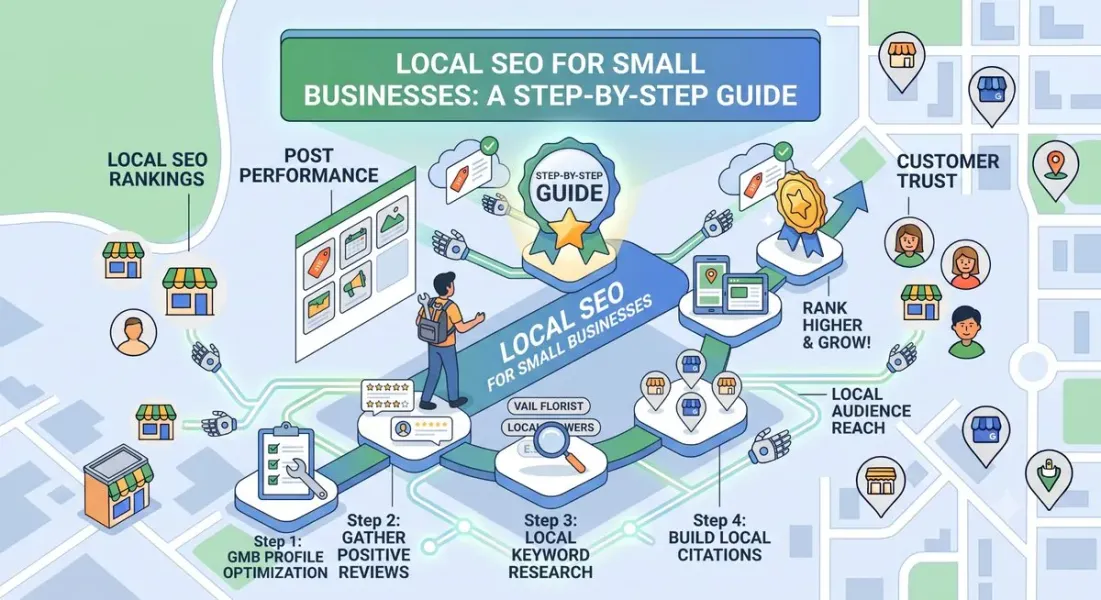
Over the next five pages, you’ll work through a complete local SEO system:
- Page 1: What local SEO is and why it matters
- Page 2: Foundation—Google Business Profile, NAP, and citations
- Page 3: Website and on-page local SEO
- Page 4: Reviews, content, and local link building
- Page 5: Tracking, tools, common mistakes, and conclusion Work through it in order. Each step builds on the last.
Page 2: Building the Foundation
Step 1: Claim and Fully Optimize Your Google Business Profile
Your Google Business Profile (GBP) is the single most important local SEO asset. It’s what powers your appearance in the local pack and Google Maps.
Getting started:
- Go to business.google.com
- Search for your business. If it exists, claim it. If not, create it.
- Complete verification (postcard, phone, email, or video) Then fill out every field:
- Business name: Your real-world name only. No keyword stuffing—it can get you suspended.
- Primary category: The single strongest ranking signal you control. Choose carefully.
- Secondary categories: Only add ones that genuinely apply.
- Address or service area: Add your address if customers visit you. Set service areas if you travel to them.
- Phone number: Use a local number where possible.
- Website: Link to a relevant page, not just your homepage.
- Hours: Include regular and special hours, including holidays.
- Description: 750 characters explaining what you do, who you serve, and what sets you apart.
- Services and products: List each one with descriptions.
- Attributes: Wheelchair accessible, women-led, free estimates, online appointments, etc.
- Photos: At least 10–20 real photos. Exterior, interior, team, work, and products. Pro tip: Look at the top three businesses in your local pack. What categories do they use? How many photos do they have? How many reviews? Match or exceed them.
Step 2: Fix Your NAP Consistency
NAP stands for Name, Address, and Phone number. It’s the foundation of local SEO because Google cross-references it across the web to verify your business is legitimate and located where you say.
The rule: Your NAP must be identical everywhere. Not similar—identical.
Common inconsistencies that hurt:
- “Suite 200” in one place, “Ste 200” in another
- A tracking number on your website, a local number on your GBP
- An old address on a directory you forgot about
- “Inc.” on some listings, missing on others How to audit:
- Search your business name + phone number on Google
- Search your business name + address
- Check the top 20 results for inconsistencies
- Use a tool like Moz Local or BrightLocal to scan major directories Fix everything you find. Then keep a master record of your exact NAP so every future listing uses the same format.
Step 3: Build Core Local Citations
Citations are online mentions of your business name, address, and phone number—with or without a link.
Priority citations for most small businesses:
| Platform | Why It Matters |
|---|---|
| Google Business Profile | The most important by far |
| Apple Maps (Apple Business Connect) | Default maps app on iPhones |
| Bing Places | Powers Bing and some Cortana results |
| Facebook Page | High authority, social proof |
| Yelp | Still influential for restaurants and services |
| Better Business Bureau | Trust signal |
| Industry-specific directories | Healthgrades, Avvo, Houzz, TripAdvisor, etc. |
| Local chamber of commerce | Local authority and networking |
| Local newspaper or city directory | Regional relevance |
Quality over quantity. Ten accurate, relevant citations beat 100 low-quality ones. Focus on:
- Directories your customers actually use
- Industry-specific platforms
- Local and regional directories Tools to help: Moz Local, BrightLocal, Whitespark, Yext. These automate listing distribution and help you find duplicates.
Step 4: Handle Duplicate Listings
Duplicate listings split your authority and confuse customers. If you find one:
- On Google: Claim it, then request a merge or mark it as permanently closed
- On other directories: Claim and merge, or contact the platform to remove it Search your business name on each major platform and check for duplicates quarterly.
Foundation Checklist
- Google Business Profile claimed and 100% complete
- Primary category chosen deliberately
- 10+ real photos uploaded
- NAP documented in a master record
- NAP audit completed across the web
- Top 10–20 citations built or corrected
- Duplicate listings found and resolved
- Apple Maps and Bing Places claimed
Page 3: Website and On-Page Local SEO
Step 5: Create Location-Specific Pages
If you serve multiple cities or neighborhoods, you need dedicated pages for each. Not one “Areas We Serve” page—individual pages.
Structure:
-
/plumber-austin -
/plumber-round-rock -
/plumber-cedar-parkWhat each page needs: -
Unique content (not copied across cities)
-
Local landmarks, neighborhoods, or references
-
Local testimonials or case studies
-
Embedded Google Map
-
Local phone number if applicable
-
LocalBusiness schema markup
-
Clear CTA Warning: Don’t create dozens of thin, near-identical pages. That’s doorway page territory and can hurt you. Each location page should offer genuine value.
Step 6: Add LocalBusiness Schema Markup
Schema is structured data that helps Google understand your content. For local SEO, use LocalBusiness schema (or a more specific subtype like Plumber, Dentist, Restaurant).
Include:
- Business name
- Address
- Phone number
- Geo coordinates
- Opening hours
- Price range
- URL
- Social profiles How to add it: Use Google’s Structured Data Markup Helper, or a plugin if you’re on WordPress (Yoast, Rank Math, and Schema Pro all support LocalBusiness schema).
Test it: Run your page through Google’s Rich Results Test to confirm it’s valid.
Step 7: Optimize Title Tags and Meta Descriptions
Your title tag and meta description are still powerful local signals.
Title tag formula:
Primary Service + City | Business Name
Example: Emergency Plumbing in Austin, TX | Joe’s Plumbing
Meta description: Include your service, city, and a benefit. Keep it 150–160 characters.
Example: 24/7 emergency plumbing in Austin, TX. Same-day service, upfront pricing, licensed technicians. Call now for fast, reliable help.
Apply this across:
- Homepage
- Service pages
- Location pages
- About page
- Contact page
Step 8: Optimize for Mobile and Speed
Most local searches happen on mobile. If your site is slow or hard to use on a phone, you’re losing customers before they ever call.
Priorities:
-
Page speed: Aim under 3 seconds. Use Google PageSpeed Insights to test.
-
Click-to-call: Make your phone number tappable everywhere it appears.
-
Tap targets: Buttons and links should be easy to tap with a thumb.
-
Readable text: No tiny fonts or zooming required.
-
Prominent contact info: Phone, address, and hours should be easy to find. Quick wins:
-
Compress images
-
Enable browser caching
-
Use a CDN
-
Minimize plugins and scripts
-
Choose a fast, mobile-responsive theme
Step 9: Add Local Content Signals
Google looks for evidence that your business is genuinely local.
Add these to your site:
- Embedded Google Map on your contact page
- Physical address in your footer
- Local phone number in your header
- Directions and parking info
- Local testimonials mentioning neighborhoods or landmarks
- Community involvement — sponsorships, events, local charities
- Local blog content — city-specific guides, local FAQs, regional tips
On-Page Checklist
- Location pages created for each service area
- LocalBusiness schema added and validated
- Title tags include service + city
- Meta descriptions include local intent
- Mobile speed under 3 seconds
- Click-to-call enabled
- Google Map embedded on contact page
- Local content signals throughout site
- Google Analytics and Search Console installed
Page 4: Reviews, Content, and Local Link Building
Step 10: Build a Review Engine
Reviews influence both rankings and conversions. They’re not optional.
How to get more:
- Get your direct Google review link from your GBP dashboard
- Put it in email signatures, receipts, invoices, and SMS follow-ups
- Create QR codes for physical locations
- Train staff to ask at peak satisfaction moments
- Automate requests with a tool like Podium or Birdeye Benchmarks:
- Aim for at least 4–8 new reviews per month
- Match or exceed your top three local competitors’ review counts
- Maintain a rating between 4.3 and 4.8 Respond to every review. Positive, negative, or neutral. Within 48 hours. Negative reviews within 24.
Never:
- Buy reviews
- Offer discounts in exchange for reviews
- Use review gating
- Argue publicly with reviewers
Step 11: Publish Local Content Consistently
Content does two jobs in local SEO: it builds topical authority and it gives you something to rank for beyond your core pages.
Content types that work for local businesses:
- Local guides: “Best Neighborhoods in Austin for First-Time Homebuyers”
- Seasonal content: “Winter HVAC Maintenance Checklist for Ohio Homeowners”
- FAQ content: “How Much Does a Root Canal Cost in Denver?”
- Comparison content: “Tankless vs. Traditional Water Heaters: What Austin Homeowners Should Know”
- Community content: Local event coverage, sponsorships, charity partnerships Publishing cadence: One solid post per month beats four thin ones. Focus on quality and local relevance.
Also post on GBP. Weekly Google Business Profile posts keep your listing fresh and active.
Step 12: Earn Local Backlinks
Backlinks still matter, but for local SEO they should come from local and regional sources.
Where to get them:
-
Local news sites — pitch a story, offer expert commentary
-
Local blogs — guest posts about local topics
-
Chamber of commerce — membership usually includes a link
-
Sponsorships — local sports teams, events, charities
-
Community organizations — Rotary, Kiwanis, local nonprofits
-
Local business associations — industry groups and networking orgs
-
Supplier and partner sites — if you work with other local businesses
-
Local universities — guest lectures, internship partnerships, scholarship pages Tactics that work:
-
Sponsor a local event and request a link on their site
-
Offer a scholarship to a local high school or college
-
Host a community workshop and get covered by local press
-
Partner with complementary local businesses for cross-promotion
-
Donate to a local charity and ask for a link on their supporters page Avoid:
-
Paid link schemes
-
Irrelevant directories
-
Link farms
-
Reciprocal link exchanges that look manipulative
Step 13: Stay Active on Local Social and Community Platforms
While not a direct ranking factor, local social activity supports your overall presence.
- Facebook Business Page — keep hours and info updated, post regularly
- Nextdoor — participate in local conversations, respond to recommendations
- Instagram — geo-tag posts, use local hashtags
- Local subreddits — be helpful, not spammy
- Community groups — participate genuinely These activities drive traffic, mentions, and sometimes links—all of which support local SEO indirectly.
Reviews, Content & Links Checklist
- Direct Google review link created and distributed
- Review request system in place
- Every review responded to within 48 hours
- Monthly local content published
- Weekly GBP posts scheduled
- 10+ local backlinks earned
- Local social profiles updated and active
- Community involvement documented online
Page 5: Tracking, Tools, Common Mistakes, and Conclusion
Step 14: Track What’s Working
You can’t improve what you don’t measure. Set up tracking from day one.
Essential tools:
| Tool | Purpose | Cost |
|---|---|---|
| Google Analytics 4 | Website traffic and conversions | Free |
| Google Search Console | Search performance, indexing, issues | Free |
| Google Business Profile Insights | Calls, clicks, direction requests | Free |
| Local rank tracking (Local Falcon, BrightLocal) | Grid-based local rankings | Paid |
| Call tracking (CallRail, WhatConverts) | Attribute calls to sources | Paid |
Metrics to monitor monthly:
- Local pack rankings for your top 10 keywords
- GBP calls, clicks, and direction requests
- Organic traffic to location pages
- Review count, rating, and velocity
- Conversion rate from local traffic
- Citation accuracy across directories Use UTM parameters on your GBP website link so you can isolate that traffic in Analytics:
?utm_source=google&utm_medium=gbp&utm_campaign=local
Step 15: Audit and Refine Quarterly
Local SEO isn’t a one-time project. Every quarter:
- Re-audit NAP across the web
- Check for duplicate listings
- Compare your GBP to top competitors
- Review your review velocity against competitors
- Refresh outdated content
- Check for broken links and technical issues
- Review rankings and adjust strategy
- Update seasonal content and offers
Common Local SEO Mistakes to Avoid
- Keyword-stuffing your business name — can get you suspended
- Choosing the wrong primary category — the single biggest fixable error
- Inconsistent NAP across the web
- Neglecting reviews or only responding to negative ones
- Thin location pages with duplicate content
- Ignoring mobile speed
- Not posting on GBP regularly
- Building low-quality citations instead of a few good ones
- Chasing national backlinks when local ones matter more
- No tracking — flying blind on what works
- Treating local SEO as a one-time task
- Buying reviews or links
- Ignoring the Q&A section of your GBP
A Realistic Timeline
Local SEO compounds, but it isn’t instant. Here’s what to expect:
| Timeframe | What You’ll See |
|---|---|
| Month 1 | Foundation set up, GBP complete, citations built |
| Month 2–3 | Early ranking movement, more GBP views and calls |
| Month 4–6 | Noticeable local pack improvements, review growth |
| Month 6–12 | Consistent lead flow from local search, compounding gains |
| Year 2+ | Defensible local presence, strong competitive moat |
Businesses that stay consistent for 12+ months almost always outperform those that start and stop.
Quick Local SEO Checklist
- Google Business Profile claimed and fully optimized
- NAP consistent across the web
- Top 10–20 citations built
- Duplicates resolved
- Location pages created
- LocalBusiness schema added
- Title tags and meta descriptions optimized
- Mobile speed under 3 seconds
- Review engine running
- Weekly GBP posts
- Monthly local content
- Local backlinks earned
- Tracking set up
- Quarterly audits scheduled
Conclusion
Local SEO for small businesses isn’t complicated—it’s just detailed. There’s no single trick that moves you to the top of the local pack. There’s a system: a complete profile, consistent NAP, quality citations, a fast mobile site, location-specific content, a steady flow of reviews, and local links.
The good news is that most of your competitors won’t do all of this. They’ll claim their Google Business Profile and stop. They’ll get a handful of reviews and move on. They’ll neglect citations, skip location pages, and ignore their Q&A section.
That’s your opening.
Start with the foundation—claim and complete your GBP, fix your NAP, build core citations. Then move to your website, reviews, and content. Track everything. Audit quarterly. Stay consistent.
Twelve months from now, the businesses that did this work will own their local market. The ones that didn’t will wonder why their phones stopped ringing.
Call to Action
Want a complete roadmap you can follow month by month? Download our free Local SEO Starter Kit, including a 90-day action plan, GBP optimization checklist, citation tracker, review request templates, and a monthly reporting dashboard. [Link to kit]
FAQs
How long does local SEO take to work?
Expect early movement in 2–3 months, noticeable improvements in 4–6 months, and compounding results after 6–12 months. Consistency matters more than speed.
What’s the most important local SEO factor?
Your Google Business Profile—specifically your primary category, review profile, and overall completeness. It’s the highest-leverage asset you control.
Do I need a website for local SEO?
You can rank in the local pack without one, but a website dramatically improves your results. It supports location pages, schema, content, and conversion.
How many Google reviews do I need?
There’s no fixed number. Match or exceed your top three local competitors. In most markets, that means 50–300 reviews with a rating between 4.3 and 4.8.
Are citations still important?
Yes. NAP consistency across quality directories remains a core local ranking factor. Focus on 10–20 relevant, authoritative citations rather than hundreds of low-quality ones.
What if I serve multiple cities?
Create individual location pages for each service area, each with unique content, local references, and schema. Avoid thin, duplicated pages.
How often should I post on Google Business Profile?
At least once a week. “What’s New” posts expire after seven days, so weekly posting keeps your profile consistently active.
Can I do local SEO myself?
Yes. Most of the work is process and consistency rather than technical expertise. The main constraint is time—plan for 3–5 hours per month.
What’s the biggest local SEO mistake?
Keyword-stuffing your business name on your Google Business Profile. It’s the fastest way to get suspended and lose all your local visibility.
How do I track local SEO results?
Use Google Business Profile Insights for calls, clicks, and direction requests. Use Google Analytics with UTM parameters for website traffic. Track local pack rankings with a grid-based tool like Local Falcon.
Internal & External Links
Internal links: Replace these with your own URLs.
-
Schedule GBP posts automatically External links:
Grow Your Google Maps Ranking on Autopilot
Stop spending hours every week manually replying to customer reviews and writing Google posts. Busirank automates your Google Business Profile to boost your local SEO rankings and turn searchers into paying clients.
 Busirank Team