 Busirank Team
Introduction
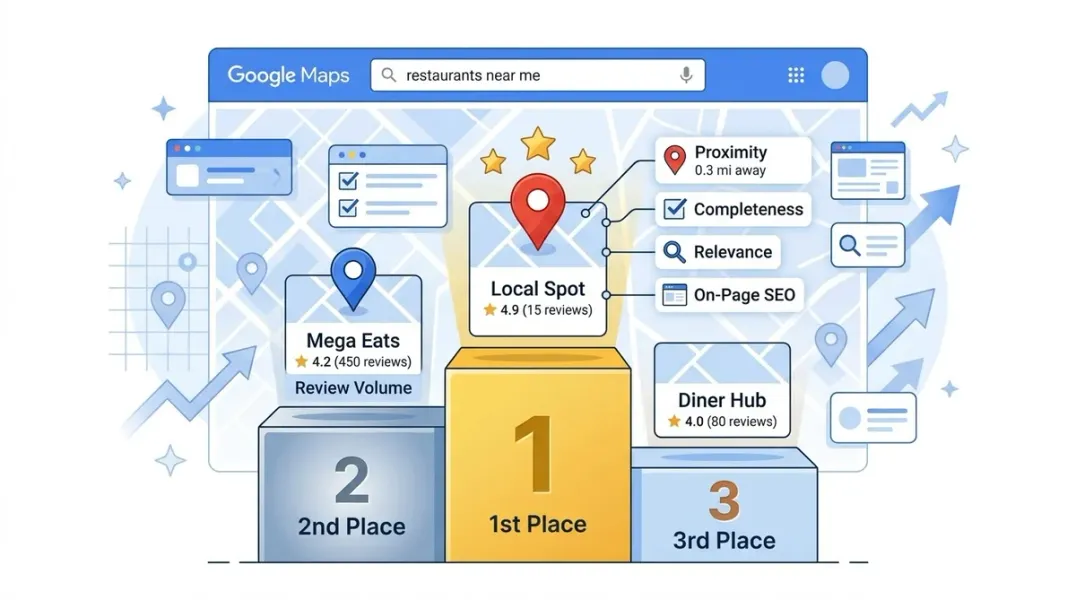
You have 120 reviews. Your competitor has 45. You have a solid 4.7-star rating. They have a respectable 4.5. You’ve been in business for a decade. They opened two years ago.
Yet when customers search for your service, they appear in the Local Pack and you don’t.
This is one of the most frustrating experiences in local SEO. It feels unfair. It feels illogical. And it leads many business owners to conclude that Google’s algorithm is broken—or that reviews don’t matter at all.
Neither is true.
The reality is more nuanced: reviews are a modifier, not the foundation of local rankings. Google doesn’t rank the business with the most reviews. It ranks the business that is the best match for a specific searcher at a specific moment in a specific location .
Reviews help you compete within your zone. They don’t pull you into zones you don’t dominate. If your competitor is outranking you with fewer reviews, the problem almost always comes down to three things: proximity, relevance, and review velocity .
In this guide, we’ll break down exactly why this happens, how to diagnose which factor is hurting you, and what you can do to close the gap.
The Three Pillars of Google Maps Rankings
Before we diagnose your specific situation, let’s review the foundation. Google’s local algorithm evaluates businesses on three primary factors :
- Relevance – How well does your business match what the searcher is looking for?
- Distance (Proximity) – How close are you to the person searching?
- Prominence – How well-known and trusted is your business?
Reviews contribute primarily to prominence—but they also influence relevance through the keywords customers use in review text .
Here’s the critical insight: Google doesn’t compare your total reviews to your competitor’s total reviews in isolation. It compares how relevant you are, how close you are, and how confident Google feels showing you for that exact search .
Reviews are one signal among many. If you’re losing on proximity and relevance, no amount of reviews will fix it.
Reason #1: Proximity Beats Popularity (Almost) Every Time
This is the most common reason a competitor with fewer reviews outranks you.
How Proximity Works
When someone searches “AC repair near me,” Google’s first question is: “Who is physically closest to this searcher right now?”
If a homeowner in North Phoenix searches for AC repair:
- A business 1.2 miles away with 40 reviews will often beat
- A business 6 miles away with 120 reviews
Why? Because “near me” isn’t branding. It’s geography.
Google assumes:
- Closer = faster response
- Faster = better experience
Reviews can’t override distance once the gap is big enough. This is why one neighborhood dominates local rankings while another never breaks the top 3—same city, different proximity zones .
How to Diagnose If Proximity Is Your Problem
Use a geo-grid rank tracking tool like Local Falcon or BrightLocal’s Local Search Grid. These tools show your ranking across multiple points on a map.
If you rank well near your location but disappear as you move outward, proximity is your limiting factor.
What to do: You can’t change your address. But you can strengthen prominence and relevance signals to expand your effective radius. More on that below.
Reason #2: Relevance Gaps Make You Invisible for Specific Searches
Your competitor might have fewer reviews, but their listing might be a better match for the query.
How Relevance Works
Google checks: “Does this business clearly match what the user wants?”
Your competitor might have:
- Primary category: HVAC Contractor (exact match for the search)
- Secondary categories: AC Repair, Furnace Repair
- Services filled with Phoenix-specific wording
- Reviews mentioning “North Phoenix,” “Desert Ridge,” “Scottsdale border”
Meanwhile, your profile might have:
- Generic service descriptions
- No neighborhood language
- Reviews saying “great service” with no context
To Google, one listing screams: “I solve THIS problem HERE.” The other just exists .
The Category Problem
Primary category is one of the single most powerful local ranking factors. Switching from a generic category (“Lawyer”) to a specific one (“Personal Injury Attorney”) can produce an average 3-position improvement within 30 days .
If your competitor has a more specific primary category than you—one that exactly matches the search query—they will outrank you even with fewer reviews.
How to check: Use a Chrome extension like GMBspy or GMB Everywhere. These tools reveal primary and secondary categories directly on Google Maps and Search results .
How to Diagnose If Relevance Is Your Problem
Search for your target keywords. Look at the top 3 results:
- Do their categories match the query more precisely than yours?
- Do their reviews mention specific services or neighborhoods?
- Do they have services listed that you don’t?
What to do: Add relevant secondary categories. Fill your services section with specific descriptions. Encourage customers to mention specific services in reviews (without coaching them—that’s against Google’s policies) .
Reason #3: Review Velocity Matters More Than Total Count
You have 120 reviews. Your competitor has 45. But here’s the question that matters: When was your last review?
The Freshness Signal
Google heavily weights review recency. A business with 50 total reviews but 10 posted in the last 30 days consistently outranks businesses with 200+ total reviews but fewer than 2 in the last 30 days .
Why? Because Google interprets fresh reviews as proof of active customer engagement. A steady stream signals an active, currently-preferred business. A stagnant review profile signals a “legacy” entity living on past reputation .
The Data
Businesses in top 3 local pack positions have an average of 2.3x more reviews than those in positions 4-10 . But the relationship follows a logarithmic curve: the first 50 reviews have the most impact, with diminishing returns after 100 .
More importantly: velocity matters more than volume. A business getting 10 reviews per month outranks one with 200 total reviews but none in the last 6 months .
How to Diagnose If Review Velocity Is Your Problem
Check your competitor’s most recent reviews. Are they getting new reviews weekly? Monthly? Not at all?
Then check yours. If you haven’t received a review in the last 30 days, you’re losing the freshness game.
What to do: Build systems to generate reviews consistently—post-service emails, QR codes on receipts, follow-up texts. Aim for 3-5 new reviews per month as a baseline .
Reason #4: Profile Completeness and Activity Signals
A fully optimized Google Business Profile outranks an incomplete one in nearly every scenario—even when other factors are equal .
What Completeness Includes
- Business name, address, phone (NAP)
- Hours (including special hours)
- Description with relevant keywords
- Services and products listed with detailed descriptions
- Attributes (e.g., “free estimates,” “wheelchair accessible”)
- Photos (100+ across all categories)
- Google Posts (weekly)
- Q&A engagement
What Activity Includes
- Responding to reviews (90%+ response rate correlates with ranking 2.1 positions higher)
- Posting weekly updates
- Uploading new photos regularly
If your competitor is doing all of this and you’re not, they’re sending stronger signals to Google—even with fewer reviews.
What to do: Complete every field. Respond to every review. Post weekly. Upload photos monthly.
Reason #5: Behavioral Signals You Can’t See
Google tracks what users do after they see your listing:
- Website clicks
- Calls
- Direction requests
- Dwell time
If people keep engaging with your competitor’s listing while skipping yours, their visibility strengthens and your ranking gets harder to recover .
Why This Happens
A well-optimized GBP with great photos, strong reviews, and a compelling description naturally generates more clicks and engagement. A sparse listing gets skipped .
What to do: Treat your GBP like a conversion page, not a basic directory listing. Use a professional primary photo, write a clear description, and respond to reviews in a timely, human way. Every improvement makes people more likely to click, call, or request directions .
Reason #6: Citation and NAP Consistency
Google checks your business name, address, and phone number across sites like Yelp, TripAdvisor, BBB, and local directories. When that information matches everywhere, it builds trust. When it’s inconsistent, Google may treat it as a credibility problem .
Citations account for roughly 8-11% of Map Pack rankings, with consistency mattering more than volume .
What to do: Run a citation audit. Fix every mismatch in name, address, and phone number—including small formatting differences. This “boring work” can produce real ranking movement within 30-60 days .
How to Diagnose Your Specific Situation
Here’s a step-by-step framework to identify exactly why your competitor is outranking you.
Step 1: Check Proximity
Use a geo-grid tool to see your ranking across your service area. If you rank well nearby but disappear farther out, proximity is your issue.
Step 2: Compare Categories
Use GMBspy or GMB Everywhere to see your competitor’s primary and secondary categories. Are they more specific than yours?
Step 3: Analyze Review Velocity
Check when your competitor’s most recent reviews were posted. Are they getting new reviews weekly? Compare to your own review frequency .
Step 4: Audit Profile Completeness
Go through every field of your GBP and your competitor’s. Who has more complete information? Who posts more regularly? Who has more photos?
Step 5: Check Citations
Search for your NAP across major directories. Is it consistent? Is your competitor listed in directories where you aren’t?
What You Can Do to Close the Gap
Based on your diagnosis, here are the specific actions to take.
If Proximity Is the Problem
You can’t move your business. But you can strengthen prominence and relevance to expand your effective radius:
- Get more reviews consistently (velocity, not just volume)
- Build local citations in the areas you want to reach
- Earn local backlinks from community organizations, sponsorships, and local news
- Create location-specific content on your website
If Relevance Is the Problem
- Switch to a more specific primary category (if it accurately describes your business)
- Add relevant secondary categories
- Fill your services section with detailed descriptions
- Use neighborhood and city names naturally in your GBP description
If Review Velocity Is the Problem
- Build a review generation system (email, SMS, QR codes)
- Ask every satisfied customer
- Aim for 3-5 new reviews per month
- Respond to every review within 24-48 hours
If Profile Completeness Is the Problem
- Complete every field
- Add 100+ photos across categories
- Post weekly Google Posts
- Engage with Q&A
Conclusion
Your competitor having fewer reviews but ranking higher isn’t a glitch. It’s Google doing exactly what it was designed to do: ranking the best match for a specific searcher at a specific location.
Reviews matter—they’re the second most important ranking factor after GBP signals . But they’re a modifier, not the foundation.
If you’re losing to a competitor with fewer reviews, the problem is almost always one of three things:
- Proximity – They’re closer to the searcher
- Relevance – Their listing matches the query better
- Review velocity – They’re getting fresh reviews while yours are stagnant
The good news: proximity is the only factor you can’t change. Relevance, velocity, profile completeness, citations, and behavioral signals are all within your control.
Diagnose your specific gap. Then take action.
Call to Action
Tired of losing to competitors with fewer reviews?
Use our Local SEO Diagnostic Checklist to identify exactly why they’re outranking you—and what to do about it.
👉 Download the checklist and start closing the gap today.
👉 Run a free geo-grid scan to see your true local visibility across your service area.
Stop guessing. Start diagnosing.
FAQs
1. Can a competitor with fewer reviews really outrank me on Google Maps?
Yes. Reviews are one factor among many. Proximity, relevance (categories, services), review velocity, profile completeness, and behavioral signals all play a role. A business with 45 fresh reviews and a perfect category match can outrank one with 120 stale reviews and a generic category .
2. What’s more important: total reviews or review velocity?
Review velocity. Google heavily weights recency. A business getting 10 reviews per month outranks one with 200 total reviews but none in the last 6 months .
3. How do I check my competitor’s Google Business Profile categories?
Use Chrome extensions like GMBspy or GMB Everywhere. They reveal primary and secondary categories directly on Google Maps and Search results .
4. Why does proximity matter so much in local search?
Google assumes closer = faster = better experience. For “near me” searches, proximity is the dominant factor. Reviews can’t override distance once the gap is big enough .
5. How can I improve my relevance signals?
Choose the most specific primary category that accurately describes your business. Add relevant secondary categories. Fill your services section with detailed descriptions. Use neighborhood names naturally in your description .
6. How often should I get new reviews to stay competitive?
Aim for 3-5 new reviews per month as a baseline. In competitive markets, weekly reviews are ideal .
7. Does responding to reviews affect rankings?
Yes. Businesses that respond to 90%+ of reviews rank an average of 2.1 positions higher than non-responders .
8. What if I can’t change my location?
You can’t move your business, but you can strengthen prominence and relevance to expand your effective radius. Focus on review velocity, citations, backlinks, and local content .
9. How do I know if proximity is my problem?
Use a geo-grid tool. If you rank well near your location but disappear as you move outward, proximity is your limiting factor.
10. What’s the fastest way to improve my Google Maps ranking?
Start with quick wins: respond to all reviews, add relevant attributes, post a Google Post this week, and ensure your primary category is as specific as possible .
Internal & External Links
Internal Links
- How to Find Your Competitors in the Google Local Pack
- Local SEO Competitor Analysis: 15 Things to Compare Before You Optimize
- How to Reverse-Engineer a Competitor’s Local SEO Strategy
- Geo-Grid Rank Tracking: How to Measure Your True Local Visibility
- Local SEO Rank Tracking: Which Keywords Should Local Businesses Monitor?
External Sources
Grow Your Google Maps Ranking on Autopilot
Stop spending hours every week manually replying to customer reviews and writing Google posts. Busirank automates your Google Business Profile to boost your local SEO rankings and turn searchers into paying clients.

 Busirank Team
