 Busirank Team
Page 1: What AI Actually Changes in Local SEO
The Honest Starting Point
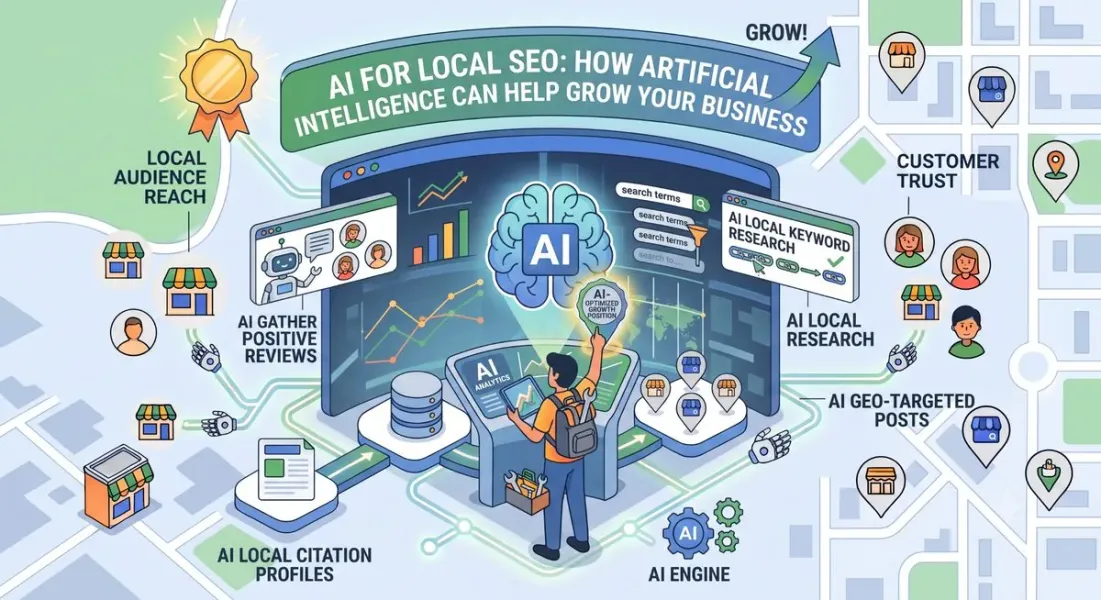
AI has become the most overhyped topic in marketing—and local SEO is no exception. Every tool now claims to be “AI-powered.” Every agency promises “AI-driven local growth.” Most of it is repackaged automation with a new label.
So let’s be precise about what AI actually does for local SEO, and what it doesn’t.
AI does not:
-
Replace your understanding of your customers
-
Fix a wrong primary category by magic
-
Generate authentic reviews (and using AI to fake them is against policy)
-
Guarantee rankings
-
Eliminate the need for consistency AI does:
-
Accelerate repetitive work dramatically
-
Help you produce more content, faster
-
Analyze data at a scale humans can’t match
-
Surface patterns in reviews, rankings, and competitors
-
Handle routine customer interactions
-
Reduce the cost of maintaining a consistent local presence
The businesses winning with AI in local SEO aren’t replacing human judgment. They’re removing the friction that stops them from doing the work consistently.
Why Local SEO Is Uniquely Suited to AI
Local SEO has characteristics that make it a natural fit for AI assistance:
-
It’s repetitive. Weekly posts, review responses, citation updates, hours management—the same tasks repeat constantly.
-
It’s template-friendly. Review responses, post formats, service descriptions, and location page structures follow patterns.
-
It’s data-rich. Rankings, calls, clicks, direction requests, review sentiment—all measurable.
-
It’s multi-location for many businesses. Chains and franchises have hundreds of profiles needing consistent management.
-
It’s text-heavy. Descriptions, posts, Q&A, reviews, and page content all involve writing, which is where large language models excel.
The Three Layers of AI in Local SEO
Think of AI adoption in three layers, from simplest to most advanced:
Layer 1: AI-assisted writing Using tools like ChatGPT, Claude, or Gemini to draft posts, review responses, service descriptions, and location page content. Lowest barrier, fastest payoff.
Layer 2: AI-powered tools Purpose-built platforms like Podium, Birdeye, BrightLocal, and Local Falcon that use AI for review analysis, sentiment tracking, post optimization, and rank prediction.
Layer 3: Integrated AI workflows Custom automation connecting your CRM, GBP, review platforms, and analytics—with AI handling content generation, routing, and reporting. Highest complexity, highest leverage at scale.
Most small businesses should start at Layer 1, add Layer 2 tools where they solve a real problem, and only pursue Layer 3 if they’re managing multiple locations or high volume.
What This Guide Covers
- Page 1: What AI changes and where it fits
- Page 2: AI for profile optimization and content
- Page 3: AI for reviews and reputation
- Page 4: AI for research, citations, and automation
- Page 5: Risks, best practices, tools, and conclusion
Page 2: AI for Profile Optimization and Content
Optimizing Your Google Business Profile With AI
Your GBP has dozens of fields, and each one benefits from careful writing. AI accelerates that process—as long as you review and personalize.
Business description (750 characters): Prompt AI with your business type, city, services, and differentiators, then ask for a draft that front-loads the primary service and location. Edit heavily—AI drafts tend to be generic.
Service descriptions: List your services and ask AI to write one-sentence descriptions for each, focused on customer benefit rather than features. Example output:
- “Drain cleaning — same-day service for clogged kitchen and bathroom drains”
- “Leak detection — non-invasive detection for hidden pipe leaks” Product descriptions: For retail, AI can generate consistent descriptions across dozens of SKUs in minutes.
Attributes and categories: AI can’t choose your categories for you—that requires judgment about your actual business. But it can help you research which categories competitors use and explain the differences between similar options.
Q&A seeding: Ask AI to generate 10–15 likely customer questions for your industry, then write accurate answers. Seed these in your Q&A section before customers ask them.
AI for GBP Posts
Posting weekly is one of the hardest habits to maintain. AI makes it dramatically easier.
The workflow:
- Give AI your business type, city, and this month’s theme
- Ask for 4–8 post ideas across different types (informational, promotional, trust-building, seasonal)
- Request a draft for each: hook in the first 100 characters, 150–300 character body, clear CTA
- Edit for your voice and specifics
- Add a real photo
- Schedule in batches Sample prompt:
“Write 4 Google Business Profile posts for a family-owned HVAC company in Austin, Texas. One informational, one promotional, one trust-building, one seasonal for October. Each post needs a hook in the first 100 characters, a 200-character body, and a call to action. Sound warm and professional, not salesy.”
Why this works: You’re not asking AI to be creative from scratch. You’re giving it a structured brief and editing the output. That’s where AI shines.
What to avoid: Publishing AI drafts without editing. Generic posts perform worse than no posts, because they signal neglect rather than engagement.
AI for Local Content Marketing
Content builds topical authority and creates ranking opportunities beyond your core pages. AI helps you produce more of it without sacrificing quality—if you use it as an assistant, not an author.
Content types AI handles well:
- Local guides (“Best Neighborhoods in Austin for First-Time Buyers”)
- Seasonal checklists (“Winter HVAC Maintenance for Ohio Homeowners”)
- FAQ articles (“How Much Does a Root Canal Cost in Denver?”)
- Comparison content (“Tankless vs. Traditional Water Heaters”)
- Service explainers The workflow:
- Research: Ask AI to outline the topic and identify subtopics
- Draft: Generate a first draft with specific instructions about length, tone, and audience
- Add local specificity: Insert real local references, landmarks, neighborhoods, and customer examples—this is what makes local content rank
- Fact-check: Verify every claim, statistic, and recommendation
- Edit for voice: Rewrite the opening and conclusion yourself
- Add original value: Include your own experience, photos, or case examples Critical rule: AI-generated content without local specificity and original insight won’t rank. Google’s systems are built to identify and deprioritize generic content. The value you add—local knowledge, real experience, unique perspective—is what makes the difference.
AI for Location Pages
If you serve multiple cities, AI can help draft location pages. But each page must be genuinely different.
How to use AI well here:
- Provide unique details for each location: neighborhoods, landmarks, local testimonials, specific services offered there
- Ask AI to write pages that incorporate those details naturally
- Never ask AI to generate 20 pages from the same prompt with only the city name changed—that’s doorway page territory and can hurt you A better approach: Write one location page with AI assistance, then use it as a template for the structure while writing genuinely unique content for each additional location.
Profile and Content Checklist
- Business description drafted and heavily edited
- Service descriptions written for each offering
- Q&A seeded with 10–15 real questions
- 4–8 GBP posts drafted monthly and scheduled
- One local content piece published monthly
- Location pages unique and locally specific
- All AI drafts reviewed for accuracy and voice
Page 3: AI for Reviews and Reputation Management
AI for Review Generation
AI can’t write your reviews—that would violate Google’s policies. But it can dramatically improve your review generation system.
What AI can do:
- Write review request templates tailored to your industry and tone
- Generate SMS and email sequences for follow-up requests
- Create QR code landing page copy that encourages action
- Draft staff scripts for asking in person
- Personalize requests at scale using customer data (name, service, date) Sample prompt:
“Write a 3-message SMS sequence for a dental practice asking patients for a Google review after a cleaning appointment. Message 1 goes out same day, message 2 three days later, message 3 a week later. Friendly, brief, no pressure.”
What AI can’t do: Generate authentic review content. Buying or generating fake reviews violates Google’s policies and can get your profile suspended.
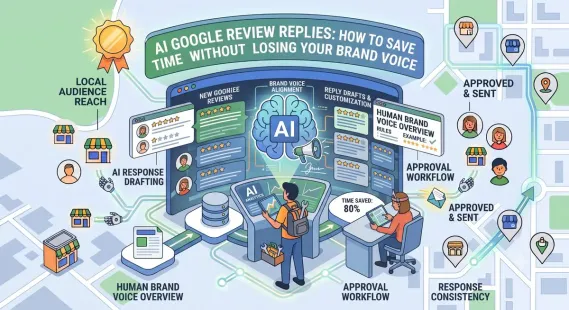
AI for Review Responses
Responding to every review is one of the highest-ROI local SEO habits—and one of the hardest to maintain. AI solves this.
The workflow:
- Export recent reviews from your GBP dashboard or review tool
- Provide AI with your business context, tone guidelines, and any relevant details
- Ask for draft responses categorized by sentiment (positive, neutral, negative)
- Edit each response to add specifics and personalization
- Publish within 48 hours Sample prompt:
“Write a response to this 5-star review for a family-owned Italian restaurant in Chicago. Mention the specific dish they praised (the rigatoni), thank them by name, and invite them back. Warm and personal, not corporate.”
Why personalization matters: Generic AI responses are obvious. Customers and Google both reward specificity. Always add a detail that proves you read the review.
AI for Negative Review Handling
Negative reviews are stressful, and stress leads to bad responses. AI helps by giving you a calm, professional starting point.
Best practice:
- Paste the negative review into AI with context
- Ask for a draft that acknowledges the issue, apologizes sincerely, and moves the conversation offline
- Edit to remove anything that sounds defensive or scripted
- Never publish an AI response without reading it aloud first What AI gets right: Structure, tone, and neutrality. What AI gets wrong: Specificity. It doesn’t know what actually happened. You must add that.
AI for Review Sentiment Analysis
If you have hundreds or thousands of reviews, manual analysis is impossible. AI tools can:
- Categorize reviews by theme (service quality, pricing, wait times, staff)
- Track sentiment trends over time (is satisfaction improving or declining?)
- Identify recurring complaints (so you can fix operational issues)
- Spot review patterns by location (for multi-location businesses)
- Flag potentially fake reviews for manual review Tools that do this well: Birdeye, Podium, BrightLocal, and several reputation management platforms now include AI sentiment analysis as a standard feature.
Why it matters: Reviews contain operational intelligence. If 30% of your negative reviews mention wait times, you have a staffing problem—not a marketing problem. AI surfaces these patterns faster than any manual process.
AI for Competitor Review Analysis
You can also use AI to analyze competitors’ reviews:
- What do customers praise about them?
- What do they complain about?
- Which services come up most often?
- Where are the gaps you could fill? This is competitive intelligence at a scale that used to require hours of manual reading.
Review and Reputation Checklist
- Review request templates written with AI assistance
- SMS and email sequences automated
- Staff scripts drafted and trained
- All reviews responded to within 48 hours
- Negative review responses drafted with AI, edited manually
- Sentiment analysis running monthly
- Competitor reviews analyzed quarterly
Page 4: AI for Research, Citations, and Automation
AI for Keyword and Query Research
Local keyword research used to mean hours in spreadsheets. AI accelerates the discovery phase significantly.
What AI can do:
- Generate long-tail local query variations (“emergency plumber Austin,” “24-hour plumber near me,” “same-day drain cleaning Round Rock”)
- Identify question-based queries customers actually ask
- Group keywords by intent (informational, commercial, transactional)
- Suggest content topics based on query gaps What AI can’t do: Provide accurate search volume. For that, you still need Google Keyword Planner, Semrush, Ahrefs, or a local SEO tool. AI generates ideas; tools validate demand.
Best workflow:
- Use AI to brainstorm query variations
- Validate volume and competition with a keyword tool
- Prioritize based on relevance and opportunity
- Map keywords to specific pages or posts
AI for Citation and NAP Management
Citations are tedious. AI and AI-powered tools make them manageable.
What AI-powered tools do:
- Scan the web for inconsistent NAP across directories
- Identify duplicate listings and flag them for removal
- Suggest priority citations based on your industry and location
- Auto-distribute listings to major directories
- Monitor changes to your listings over time Tools to consider: Moz Local, BrightLocal, Yext, Whitespark.
Why this matters: Manual citation management at scale is nearly impossible. For multi-location businesses, AI-powered citation tools are essentially required.
AI for Local Rank Tracking
Traditional rank tracking shows one number. Modern AI-powered tools show geographic patterns.
What AI-enhanced tools do:
- Geo-grid analysis: Show your ranking at each point across a map
- Competitor overlays: Compare your visibility pattern to competitors’
- Trend detection: Identify whether your radius is expanding or contracting
- Opportunity scoring: Highlight areas with high customer density and low competition
- Predictive ranking: Estimate how changes will affect visibility before you make them Tools: Local Falcon, BrightLocal, Whitespark.
AI for Customer Communication
AI chatbots and automated messaging handle routine local customer interactions.
Common uses:
- Website chat: Answer FAQs about hours, services, pricing ranges, and availability
- GBP messaging: Auto-respond to common inquiries, route complex ones to humans
- Appointment booking: Qualify leads and schedule automatically
- Follow-up sequences: Send review requests, appointment reminders, and re-engagement messages Best practice: Always provide a path to a human. AI handles the routine; humans handle the complex and emotional.
AI for Reporting and Analytics
AI tools can connect your GBP data, website analytics, call tracking, and review platforms into unified reports—and surface insights automatically.
What AI reporting can surface:
- Which services drive the most calls
- Which posts generate the most engagement
- Where your visibility is improving or declining
- How review sentiment correlates with lead volume
- Which locations underperform and why Why it matters: Most small businesses don’t have time for deep analysis. AI delivers the insights without the spreadsheet work.
AI for Multi-Location Management
For franchises and chains, AI’s value multiplies.
What AI enables at scale:
- Consistent posting across hundreds of locations with localized variations
- Centralized review monitoring with location-specific routing
- Automated NAP management across all profiles
- Sentiment analysis by location to spot underperformers
- Rank tracking across markets to identify expansion opportunities
- Unified reporting for stakeholders Tools built for this: SOCi, Yext, Birdeye, Podium, and Reputation.com.
Research and Automation Checklist
- Keyword research accelerated with AI, validated with tools
- Citation management running through an AI-powered platform
- Geo-grid rank tracking in place
- Chat or messaging automation configured
- Unified reporting dashboard set up
- Multi-location workflows documented (if applicable)
Page 5: Risks, Best Practices, Tools, and Conclusion
The Real Risks of AI in Local SEO
AI is powerful, but it introduces risks that businesses need to manage deliberately.
-
Generic content that doesn’t rank. AI defaults to safe, bland writing. Without local specificity and original insight, content won’t perform—and may be actively deprioritized by Google.
-
Factual errors and hallucinations. AI confidently states things that aren’t true. Never publish AI output without verification, especially for regulated industries like healthcare, legal, and finance.
-
Loss of brand voice. If every post reads like AI wrote it, you lose what makes your business distinctive. Edit everything for voice.
-
Policy violations. Using AI to generate fake reviews or manipulate rankings violates Google’s policies and can get your profile suspended.
-
Over-automation. Customers notice when responses feel robotic. Automate routine tasks, but keep humans in the loop for anything sensitive.
-
Data privacy concerns. Don’t paste customer data—names, contact info, medical details—into public AI tools. Use platforms with proper data handling agreements.
-
Complacency. AI makes the work easier, which can lead to less scrutiny. The businesses that win still review, test, and refine.
Best Practices for AI in Local SEO
-
AI drafts, humans decide. Never publish AI output without editing. Every post, response, and page should have human judgment applied.
-
Add local specificity. AI doesn’t know your neighborhood, your customers, or your local quirks. You do. That’s your competitive advantage.
-
Verify everything. Facts, statistics, claims, citations—all must be checked. AI is a drafting tool, not a source of truth.
-
Protect customer data. Use tools with proper data policies. Don’t paste personally identifiable information into general-purpose AI chatbots.
-
Keep humans in sensitive conversations. Negative reviews, complaints, and complex inquiries should involve a human—even if AI drafts the first response.
-
Measure what changes. Test AI-assisted approaches against your previous baseline. If AI-generated posts perform worse, adjust.
-
Stay compliant. Never use AI to generate reviews, manipulate rankings, or violate Google’s guidelines. The short-term gain isn’t worth the long-term risk.
-
Use AI where it’s strongest. Writing, summarizing, categorizing, analyzing, and automating—these are AI’s strengths. Judgment, relationships, and strategy remain human.
Tools Worth Knowing
| Category | Tools |
|---|---|
| AI writing | ChatGPT, Claude, Gemini, Jasper |
| Review management | Podium, Birdeye, GatherUp, Grade.us |
| Local rank tracking | Local Falcon, BrightLocal, Whitespark |
| Citation management | Moz Local, Yext, BrightLocal |
| Multi-location platforms | SOCi, Yext, Reputation.com |
| Analytics and reporting | GA4, Looker Studio, BrightLocal |
| Chat and messaging | Podium, Intercom, Drift |
Recommendation for most small businesses: Start with one AI writing tool and one review management platform. Add rank tracking once you’re posting and generating reviews consistently. Don’t buy five tools on day one.
A Realistic AI Adoption Path
| Phase | Timeframe | Focus |
|---|---|---|
| Phase 1 | Month 1 | AI-assisted writing for posts, responses, descriptions |
| Phase 2 | Month 2–3 | Add review management platform with AI features |
| Phase 3 | Month 4–6 | Add geo-grid rank tracking and citation management |
| Phase 4 | Month 6–12 | Integrate reporting; explore chat automation |
| Phase 5 | Year 2 | Multi-location workflows if applicable |
Move at the pace you can sustain. Tools you don’t use are worse than tools you don’t buy.
Common AI Mistakes in Local SEO
- Publishing AI content without editing
- Using generic prompts that produce generic output
- Skipping local specificity
- Trusting AI facts without verification
- Automating review responses without personalization
- Generating fake reviews (policy violation)
- Pasting customer data into public AI tools
- Over-automating sensitive interactions
- Buying tools before building the underlying habits
- Measuring nothing
Quick AI for Local SEO Checklist
- One AI writing tool selected
- Prompts built for posts, responses, and descriptions
- All AI output edited before publishing
- Local specificity added to every piece of content
- Review management platform in place
- Sentiment analysis running monthly
- Geo-grid rank tracking active
- Citation management automated where possible
- Customer data protected
- Humans in the loop for sensitive conversations
- Results measured against baseline
- Compliance with Google policies maintained
Conclusion
AI doesn’t change what local SEO requires. It changes how fast and how consistently you can do it.
The fundamentals are the same as they’ve always been: a complete Google Business Profile, the right category, an accurate map pin, consistent NAP, steady reviews, thoughtful responses, local content, and ongoing measurement. What AI does is remove the friction that stops businesses from executing on those fundamentals every week.
The businesses winning with AI in local SEO are using it the same way they’d use a competent junior assistant—to draft, summarize, organize, and analyze. The judgment, the local knowledge, and the relationships remain human.
Start small. Pick one tool. Use it to draft your weekly posts and review responses. Edit everything. Measure results. Add complexity only when the simple version is working.
The opportunity isn’t in the technology. It’s in the consistency the technology finally makes possible.
Call to Action
Want a practical AI workflow you can start using this week? Download our free AI for Local SEO Starter Kit, including 25 tested prompts, a review response workflow, a post batching template, and a tool selection guide. [Link to kit]
FAQs
What is AI for local SEO?
AI for local SEO means using artificial intelligence tools to assist with tasks like writing Google Business Profile posts, drafting review responses, analyzing review sentiment, managing citations, tracking rankings, and automating routine customer communication.
Can AI improve my Google Maps rankings?
Indirectly. AI helps you produce more content, respond to more reviews, and maintain consistency—all of which support rankings. AI doesn’t directly manipulate ranking factors, and attempts to do so violate Google’s policies.
Is AI-generated content bad for SEO?
Not inherently. AI-generated content that’s generic, unedited, and lacks original value tends to underperform. AI-assisted content with local specificity, human editing, and original insight performs well.
Can AI write my Google reviews?
No. Generating fake reviews violates Google’s policies and can get your profile suspended. AI can help you request reviews, but real customers must write them.
Should I use AI to respond to reviews?
Yes, as a drafting tool. AI can produce a solid first draft, but you should always edit for personalization and specificity. Generic AI responses are obvious and perform worse.
Which AI tools are best for local SEO?
It depends on the task. ChatGPT, Claude, and Gemini work well for writing. Podium and Birdeye handle reviews and messaging. Local Falcon and BrightLocal handle rank tracking and citations. Most businesses only need one or two.
Will AI replace local SEO professionals?
Unlikely. AI automates routine tasks but can’t replace judgment, local knowledge, relationship building, or strategic thinking. It changes the job more than it eliminates it.
How do I protect customer data when using AI?
Use tools with proper data handling agreements. Avoid pasting names, contact details, medical information, or financial data into general-purpose AI chatbots. When in doubt, anonymize.
What’s the biggest mistake businesses make with AI in local SEO?
Publishing AI output without editing or adding local specificity. Generic content doesn’t rank and doesn’t convert. AI should accelerate your work, not replace your judgment.
How do I measure whether AI is helping my local SEO?
Compare before and after. Track review response rate, post frequency, content output, and—most importantly—calls, direction requests, and website clicks from your Google Business Profile. If the metrics improve, it’s working.
Internal & External Links
Internal links: Replace these with your own URLs.
-
How to respond to Google reviews External links:
Grow Your Google Maps Ranking on Autopilot
Stop spending hours every week manually replying to customer reviews and writing Google posts. Busirank automates your Google Business Profile to boost your local SEO rankings and turn searchers into paying clients.
 Busirank Team