 Busirank Team
Introduction
Your star rating tells you what customers think. It doesn’t tell you why.
A 4.2-star average could mean consistent “pretty good” experiences, or it could mean a mix of glowing five-star reviews and scathing one-star complaints that are dragging you down. Without reading every review—and understanding the sentiment behind the words—you’re operating blind.
This is where review sentiment analysis changes the game.
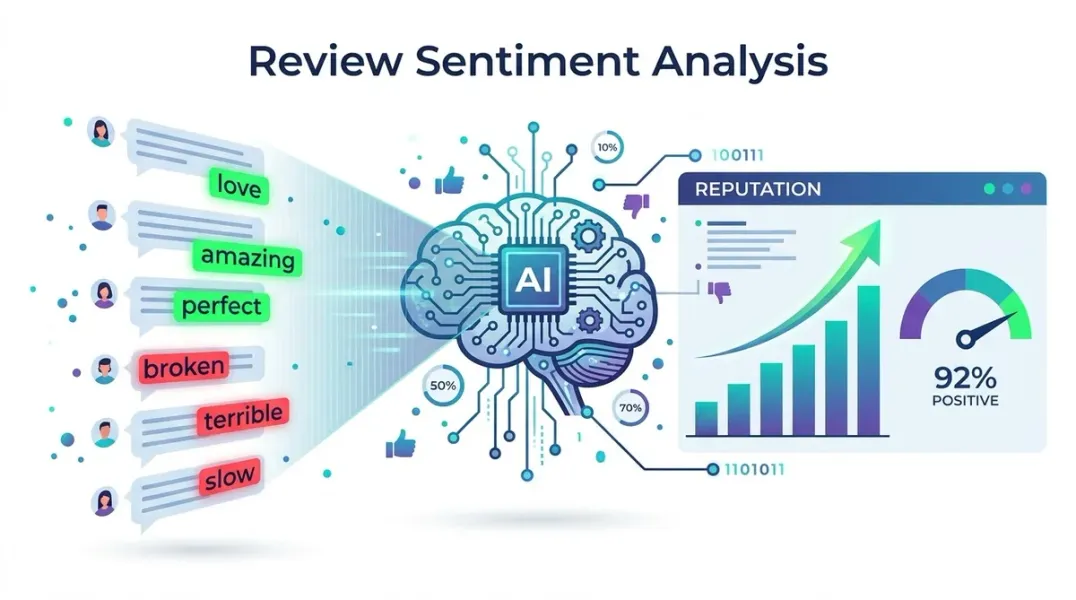
Sentiment analysis uses natural language processing (NLP) to read review text and classify it as positive, negative, or neutral—then goes further to identify themes, emotions, and specific complaints buried inside the words customers write . It transforms raw review data into actionable intelligence.
For local businesses, this matters more than ever. Google’s algorithm now treats review content as semantic data, analyzing the words customers use to validate a business’s expertise, services, and geographic relevance . A profile with 50 detailed, service-specific reviews can outperform one with 500 generic “Good job!” ratings .
In this guide, you’ll learn what review sentiment analysis is, why it’s becoming essential for local reputation management, and how to use it to improve your business—not just your rankings.
What Is Review Sentiment Analysis?
Review sentiment analysis is the process of using AI and machine learning to analyze the emotional tone and content of customer reviews .
At its simplest, it classifies each review as positive, negative, or neutral. But modern tools go much further:
- Theme detection: Identifying recurring topics like “wait time,” “staff friendliness,” “pricing,” or “cleanliness”
- Complaint taxonomy: Categorizing complaints into standardized types so you can spot patterns
- Keyword extraction: Finding the most common words in positive and negative reviews separately
- Trend tracking: Monitoring how sentiment changes over time
- Competitor comparison: Benchmarking your sentiment against competitors
A study analyzing Google Maps reviews for cafes in Indonesia used VADER (Valence Aware Dictionary and sEntiment Reasoner)—a lexicon-based sentiment tool containing over 7,500 unigrams including slang, acronyms, and emoticons—to classify reviews and predict engagement levels . This demonstrates how accessible sentiment analysis has become, even for small businesses.
Why Sentiment Matters More Than Stars Alone
Google’s star rating system is a blunt instrument. Sentiment analysis reveals the nuance that stars miss.
The Star Rating Blind Spot
A 3-star review that says “The food was amazing but we waited 45 minutes” and a 3-star review that says “Mediocre experience, probably won’t return” both contribute equally to your average rating. But they tell completely different stories.
Sentiment analysis separates what customers rated from what customers experienced. It surfaces the specific issues that drive negative sentiment and the specific strengths that drive positive sentiment .
Google Reads Your Reviews
Google’s NLP models now parse review text to understand business context. A patient might write, “The staff was incredibly gentle when my kid broke a tooth.” That single sentence contains emotional sentiment, medical context, and demographic hints. Google’s algorithm extracts all three .
As one analysis noted: “The algorithm starts associating [businesses] with efficiency and modern staffing, even though those terms weren’t on their website homepage” . Reviews create an entity cluster around your business that’s richer than anything you can control directly.
Review Content Influences AI Search
AI-powered local search features—like Google’s Ask Maps—pull from review text to characterize businesses. Review patterns shape how these AI features describe your business to potential customers .
If your reviews consistently mention “emergency service” or “same-day appointments,” AI systems will learn to recommend you for those needs. If your reviews are vague, AI has nothing to work with.
The Business Case: What Sentiment Analysis Reveals
Here’s what you can learn when you analyze sentiment across your reviews.
Emerging Issues Before They Escalate
A rising trend in neutral or negative sentiment about wait times is an early warning sign. You can address it—adjust staffing, post transparent updates about peak hours—before it snowballs into a reputation crisis .
The mid-sized dental practice Oak Street Dentistry in Austin saw a 30% lift in organic visibility after optimizing their response strategy to negative feedback. They stopped ignoring negative reviews and started responding with detailed, specific explanations of what went wrong and how they fixed it internally .
Customer Language for Marketing
Reviews contain the exact phrases real customers use to describe their problems. These are gold for marketing copy, GBP descriptions, and content strategy .
If competitors have 56 one-star reviews about “pricing opacity,” that’s an opportunity to position your business as transparent and upfront about costs .
Service Delivery Gaps
Sentiment analysis surfaces patterns in complaints: no-shows, communication gaps, pricing surprises, rushed jobs. This is a public record of what frustrated customers wish someone else had offered them .
What “Good” Means in Your Market
What customers praise tells you the standard they’re measuring against. If competitors consistently get praised for “fast response” and you don’t, that’s a gap to close. If customers praise your “personal touch,” amplify that in your messaging .
How to Run Sentiment Analysis for Your Business
You don’t need a data science team. Here’s a practical workflow.
Step 1: Export Your Reviews
Pull reviews from your Google Business Profile. Tools that can help:
- GBP Reviews Sentiment Analyzer Chrome extension—runs sentiment analysis during data pull
- Apify actors like Google Maps Reviews Scraper & AI Sentiment Analyzer—scrapes reviews and analyzes sentiment, themes, and keywords
- Moz Local—includes sentiment analysis and platform-specific rating tracking
Step 2: Run Sentiment Analysis
Use AI to categorize reviews into positive, negative, and neutral buckets. You can:
- Use the Google Cloud Natural Language API if you’re comfortable with APIs
- Use a custom GPT with a prompt like the one shared in Search Engine Journal
- Use a dedicated tool like Apify’s Google Maps Review Intelligence, which provides per-review sentiment scores, complaint taxonomies, and topic clusters
Step 3: Build a Topic Cluster Map
Organize recurring themes into clusters. Common categories include:
| Cluster | What It Covers |
|---|---|
| Quality | Workmanship, results, expertise |
| Communication | Responsiveness, updates, follow-through |
| Pricing | Value, transparency, surprises |
| Wait Time | Scheduling, delays, efficiency |
| Staff | Friendliness, professionalism, attentiveness |
| Cleanliness | Facility condition, hygiene |
One analysis framework suggests building clusters based on “credibility factors” like quality, communication, and trust gaps .
Step 4: Identify Actionable Insights
For each cluster, ask:
- What’s the ratio of positive to negative mentions?
- Are there specific phrases that appear repeatedly in complaints?
- What do customers praise most often?
- Where’s the biggest gap between what customers love and what they complain about?
Step 5: Act on the Insights
Sentiment analysis is only valuable if it drives action :
- Operational fixes: If wait time complaints spike, adjust scheduling or staffing.
- Messaging changes: If pricing opacity is a theme, make your pricing more transparent.
- Response strategy: Use sentiment insights to craft more targeted review responses.
- Content creation: Turn positive themes into marketing content; address negative themes in FAQs or service descriptions.
Turning Sentiment into Reputation Growth
Here’s how sentiment analysis directly improves your local reputation.
Better Review Responses
When you understand the sentiment behind a review, you can craft a response that actually addresses the customer’s concern. AI-powered response tools like Moz Local’s Reviews AI generate suggestions that reference specific customer feedback—not generic templates .
Oak Street Dentistry’s approach—responding to every negative review with detailed, specific explanations—directly contributed to their 30% visibility lift .
Improved Local SEO
Google’s algorithm treats review content as semantic data. When your reviews consistently mention specific services, locations, and positive attributes, Google’s NLP models learn to associate your business with those concepts .
A profile with 50 detailed, service-specific reviews will consistently outrank a profile with 500 one-line ratings .
Competitive Intelligence
Sentiment analysis isn’t just for your reviews. Analyzing competitors’ reviews reveals their weaknesses—the gaps you can fill. Search Engine Journal’s framework calls this “the review gap”: finding opportunities in what competitors’ customers complain about .
Early Warning System
By tracking sentiment trends over time, you can spot emerging issues before they become public crises. A rise in neutral sentiment about a specific aspect of your service is an early signal to investigate and address .
Tools for Review Sentiment Analysis
Here are the leading tools for local businesses.
| Tool | Best For | Key Features |
|---|---|---|
| Moz Local | Comprehensive reputation management | Sentiment analysis, review inbox, AI response suggestions, competitor benchmarking |
| Apify Google Maps Review Intelligence | Agencies, multi-location brands | Per-review sentiment scores, complaint taxonomy, topic clusters, competitor delta, drafted responses |
| Vendasta Reputation AI | SMBs, agencies | AI Reputation Specialist, automated responses, NPS feedback analysis, conversational insights |
| Pulse | Multi-location retailers | Sentiment analysis, instant notifications, centralized responses, Google rating calculator |
| Google Maps Reviews Pro (Apify) | Local SEO agencies, chains | Per-review sentiment, 9-topic clustering, owner-response tracking, 12-month trend labels, competitor delta |
For businesses just getting started, the GBP Reviews Sentiment Analyzer Chrome extension offers a free way to run sentiment analysis during data pull .
The 2026 Context: Why This Matters Now
Three shifts have made sentiment analysis essential for local businesses.
-
Google’s algorithm evolved. The company has shifted heavily toward treating review content as unstructured semantic data. The words customers use matter more than the rating they give .
-
AI search relies on reviews. Features like Ask Maps and AI Overviews pull from review text to characterize businesses. If your reviews don’t provide rich context, AI systems can’t recommend you effectively .
-
Volume alone no longer wins. A profile with 50 detailed, service-specific reviews will consistently outrank a profile with 500 generic ratings. Depth of context beats sheer volume .
Conclusion
Star ratings tell you what customers think. Sentiment analysis tells you why.
For local businesses competing in an increasingly AI-driven search landscape, review sentiment analysis is no longer a nice-to-have. It’s a core capability that:
- Surfaces actionable insights from customer feedback
- Reveals competitive gaps you can exploit
- Improves local SEO by enriching the semantic data Google uses to understand your business
- Prevents reputation crises by catching emerging issues early
- Drives better responses by addressing the specific concerns behind each review
The tools are accessible. The framework is simple. Export reviews, run sentiment analysis, build topic clusters, and act on what you find.
The businesses that master this won’t just have better reputations. They’ll have better operations, better marketing, and better local search visibility.
Call to Action
Ready to unlock the insights hiding in your reviews?
We’ve created a Review Sentiment Analysis Workbook with prompts, templates, and a step-by-step framework to turn raw reviews into actionable intelligence.
👉 Download the Workbook and start analyzing your reviews today.
👉 Or run a free GBP audit to see how your review profile compares to competitors.
FAQs
1. What is review sentiment analysis?
Review sentiment analysis uses AI and NLP to analyze the emotional tone and content of customer reviews. It classifies reviews as positive, negative, or neutral and identifies themes, complaints, and keywords .
2. Why does sentiment matter more than star ratings?
Star ratings are a blunt instrument. A 3-star review praising the food but complaining about wait time tells a different story than a generic 3-star review. Sentiment analysis surfaces the specific issues and strengths that drive customer experiences .
3. Does Google use review sentiment for rankings?
Yes. Google’s NLP models parse review text to understand business context. Review content creates an “entity cluster” that associates your business with specific services, locations, and attributes .
4. How can I run sentiment analysis on my reviews?
Export your reviews and use tools like Moz Local, Apify actors, or the GBP Reviews Sentiment Analyzer Chrome extension. You can also use AI prompts to categorize reviews and extract themes .
5. What themes should I look for in sentiment analysis?
Common clusters include quality, communication, pricing, wait time, staff friendliness, and cleanliness. Build clusters based on what matters most to your specific business .
6. How does sentiment analysis improve local SEO?
Google treats review content as semantic data. When reviews consistently mention specific services and positive attributes, Google’s algorithm learns to associate your business with those concepts, improving relevance for related searches .
7. Can sentiment analysis help with competitor research?
Yes. Analyzing competitors’ reviews reveals their weaknesses—the gaps you can fill. Search Engine Journal calls this “the review gap” .
8. What tools are best for review sentiment analysis?
Moz Local, Apify’s Google Maps Review Intelligence, Vendasta Reputation AI, and Pulse are leading tools. For a free option, try the GBP Reviews Sentiment Analyzer Chrome extension .
9. How often should I run sentiment analysis?
Monthly is ideal for most businesses. Weekly is better for competitive markets or active reputation management campaigns.
10. What do I do with the insights?
Act on them. Fix operational issues that appear in negative themes. Amplify positive themes in marketing. Use insights to craft more targeted review responses. Track trends to catch emerging issues early .
Internal & External Links
Internal Links
- How Review Velocity Can Influence Local Search Visibility
- Negative Google Reviews: When to Respond, Report, or Ignore Them
- How to Build a Google Review Funnel That Generates Reviews Consistently
- Google Review Gating: What It Is and Why Businesses Should Avoid It
- How to Identify Fake or Suspicious Google Reviews
External Sources
Grow Your Google Maps Ranking on Autopilot
Stop spending hours every week manually replying to customer reviews and writing Google posts. Busirank automates your Google Business Profile to boost your local SEO rankings and turn searchers into paying clients.

 Busirank Team
