 Busirank Team
Page 1: The Trust Economy and Why Reviews Became Currency
A Fundamental Shift in How People Choose
Twenty years ago, choosing a local business meant asking a neighbor, flipping through the Yellow Pages, or taking a chance on a storefront. Today, it means opening a phone, typing a search, and scanning star ratings before ever making contact.
That shift has made reviews the most powerful trust signal in local commerce. They’ve replaced the neighbor’s recommendation at scale—and unlike a neighbor, they’re public, permanent, and available to thousands of people at once.
The numbers tell the story clearly:
- 91% of consumers read online reviews before choosing a local business.
- 88% of consumers trust online reviews as much as personal recommendations.
- Nearly half of consumers say they’d only use a business rated 4 stars or higher.
- 76% of people who search for something nearby visit a related business within a day.
- A business with a strong review profile can command higher prices than competitors with weaker profiles. Reviews aren’t a nice-to-have anymore. They’re the first filter customers apply—before your website, before your pricing, before your sales pitch.
What Reviews Actually Communicate
A star rating is a summary. But customers read reviews looking for something more specific. They’re asking:
- Is this business competent? Do they deliver what they promise?
- Is this business honest? Do they handle problems fairly?
- Is this business consistent? Do most customers have similar experiences?
- Is this business right for me? Do reviewers resemble me and my needs? A 4.8 rating with 300 reviews answers all four. A 5.0 rating with 6 reviews answers almost none—and can even raise suspicion.
That’s an important nuance: volume matters as much as score. A perfect rating built on a tiny sample looks curated. A strong rating built on hundreds of data points looks earned.
Why This Matters More for Local Than National
National brands have decades of advertising to build familiarity. Local businesses don’t have that luxury. For a plumber, dentist, restaurant, or law firm, reviews often do the heavy lifting that a national ad budget would do elsewhere.
Consider the local search experience:
- A customer searches “emergency plumber near me.”
- Google shows three businesses in the local pack.
- The customer scans star ratings and review counts in seconds.
- They tap the one that looks most credible.
- They call. That decision happens in under ten seconds—and it’s almost entirely driven by reviews. Your website might be excellent. Your pricing might be competitive. But if your review profile looks weak, you never get the chance to prove it.
What This Guide Covers
Over the next five pages, you’ll learn:
- Page 1: Why reviews became the core trust currency in local commerce
- Page 2: How reviews influence local SEO rankings and the algorithm
- Page 3: How reviews shape customer trust and conversion behavior
- Page 4: How reviews work across the customer journey and by industry
- Page 5: Building a review-driven reputation strategy, measurement, and conclusion
Page 2: How Google Reviews Influence Local SEO Rankings
The Three Pillars of Local Ranking
Google’s local ranking system rests on three factors:
- Relevance – How well your business matches the query
- Distance – How close you are to the searcher
- Prominence – How well-known and trusted your business appears Reviews don’t affect distance. But they’re one of the most powerful inputs into both relevance and prominence.
Reviews as a Prominence Signal
Prominence is essentially Google’s attempt to measure reputation. And what better proxy for reputation than what customers publicly say about you?
Google considers several review-related factors when assessing prominence:
-
Review quantity More reviews signal a more established, more frequently used business. A profile with 400 reviews generally outranks one with 40, all else being equal.
-
Review quality (rating) Higher average ratings correlate with better rankings—though the relationship isn’t perfectly linear. Extremely low ratings suppress visibility, while consistently strong ratings (roughly 4.0–4.8) tend to perform best.
-
Review velocity The rate at which you receive new reviews matters. A business that gets 10 new reviews every month looks active. A business that got 200 reviews in 2019 and nothing since looks stale.
-
Review recency Recent reviews carry more weight than old ones. Google wants to know what customers experience now, not five years ago.
-
Keyword content within reviews When reviewers naturally mention your services (“the root canal was painless”), your location, or your specialties, Google gains context about what you offer and where. You can’t control this directly—but you can encourage detailed reviews.
-
Owner responses Responding to reviews signals an active, engaged, well-managed business. Google has confirmed that responding is good practice, and active profiles tend to perform better.
Reviews as a Relevance Signal
Reviews also help Google understand your business. If reviewers consistently mention “emergency,” “24/7,” “same-day,” or “weekend service,” Google gets signals about your service offerings.
This is why review content matters beyond the star rating. A review that says “great service” adds little. A review that says “they fixed our burst pipe at 11pm on a Sunday in Round Rock” tells Google your location, your service, your availability, and your specialty.
The Compounding Effect
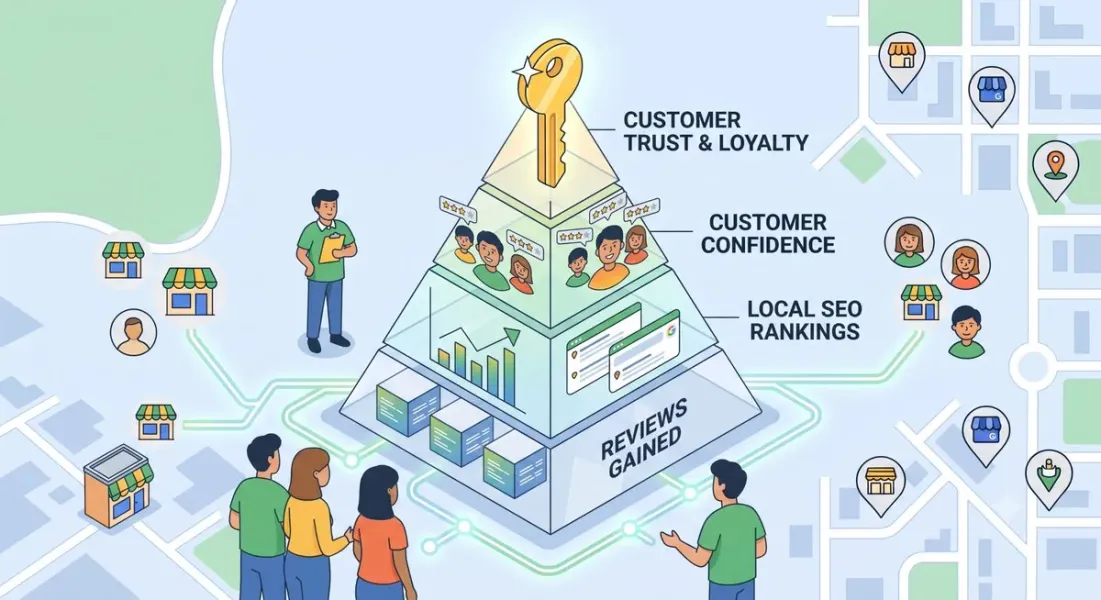
Here’s where reviews become strategically important: they create a feedback loop.
More reviews → higher rankings → more visibility → more customers → more reviews
This flywheel is why review generation compounds over time. Businesses that start early build an advantage that’s very difficult for competitors to close, because review counts and prominence take months or years to build.
Conversely, businesses that neglect reviews fall into a negative loop: fewer reviews → lower rankings → less visibility → fewer customers → fewer reviews.
What Reviews Don’t Do
It’s worth being precise here. Reviews are powerful, but they’re not a magic switch.
- Reviews don’t override proximity. A business two blocks away will usually outrank one five miles away, even with fewer reviews—especially for “near me” searches.
- Reviews don’t fix a bad category choice. If your primary category is wrong, no amount of reviews will save your relevance.
- Reviews don’t compensate for an incomplete profile. Google rewards completeness across the board.
- Reviews don’t guarantee rankings. They’re one strong signal among many, including citations, backlinks, website authority, and on-page SEO. The right mental model: reviews are necessary but not sufficient. They’re a core pillar, not the whole building.
How Reviews Compare to Other Local Ranking Factors
| Factor | Impact on Local Rankings | Difficulty to Improve |
|---|---|---|
| Proximity to searcher | Very high | Very hard |
| Primary category | High | Easy |
| Review quantity & quality | High | Moderate |
| Profile completeness | High | Easy |
| Local citations / NAP | Moderate–high | Moderate |
| Local backlinks | Moderate | Hard |
| Website on-page SEO | Moderate | Moderate |
| Review responses | Moderate | Easy |
| Google Posts activity | Low–moderate | Easy |
The takeaway: reviews are among the highest-impact factors you can actually influence. You can’t move your building, but you can build your reputation.
Page 3: How Reviews Shape Customer Trust and Conversion
The Trust Threshold
Consumers apply mental thresholds when evaluating businesses:
- Below 3.5 stars: Most customers won’t consider you. This is a hard filter for many.
- 3.5–4.0 stars: Considered, but with hesitation. Customers read reviews looking for reassurance.
- 4.0–4.7 stars: The sweet spot. High enough to trust, low enough to feel authentic.
- 4.8–5.0 stars: Trusted, but scrutinized. With few reviews, it can look suspicious. With many, it’s the strongest possible position. That middle range is counterintuitive but well-documented: a business with 4.5 stars and 200 reviews often outperforms one with a perfect 5.0 and 12 reviews. Perfection at low volume reads as curated. Slight imperfection at high volume reads as real.
How Reviews Reduce Perceived Risk
Every purchase involves risk. For local services, the risk is often significant—a bad dentist, a dishonest mechanic, a contractor who disappears mid-job.
Reviews reduce that risk in four ways:
-
Social proof. Other people took the same risk and were fine. That’s reassuring.
-
Specificity. Detailed reviews answer unspoken questions: How long did it take? Was it expensive? Did they show up on time?
-
Volume. Many reviews mean many chances to spot patterns. Consistent praise is more credible than a single glowing testimonial.
-
Responses. How you handle criticism tells prospects more about your character than how you handle praise.
That last point is underrated. A business with a 4.3 rating that responds thoughtfully to every negative review often inspires more confidence than a 4.9 with no owner engagement. It shows you’re real, you’re listening, and problems get handled.
The Conversion Impact
Reviews don’t just influence whether someone considers you. They influence whether they act.
- Businesses with strong review profiles see higher click-through rates in local search.
- Review content appears directly in search results and Maps, often before a customer visits your website.
- Positive reviews reduce the number of questions a prospect needs answered before contacting you.
- Negative reviews—when handled well—can actually increase trust by demonstrating accountability. The practical result: reviews shorten your sales cycle. Prospects arrive pre-sold. They’ve already read that you’re punctual, fairly priced, and easy to work with. Your first conversation starts further along.
The Asymmetry of Negative Reviews
Negative reviews have outsized influence—but not always in the way business owners fear.
When a negative review hurts:
-
It describes a pattern (“third time they’ve been late”)
-
It goes unanswered
-
It’s met with a defensive or hostile reply
-
The business has few positive reviews to balance it When a negative review helps:
-
It’s an isolated complaint among many positives
-
It’s answered professionally and promptly
-
It shows the business takes accountability
-
The complaint is unreasonable and readers can see that A single 1-star review among 200 glowing ones doesn’t sink you. It often makes the other reviews more believable.
Beyond the Star Rating: What Customers Actually Read
Most customers don’t read all your reviews. They scan. Typically they:
- Look at the overall rating
- Read the 2–3 most recent reviews
- Read 1–2 of the most detailed reviews
- Look specifically for negative reviews to see what could go wrong
- Check how the business responded to negatives This means your most recent reviews and your responses to negative reviews carry disproportionate weight. A profile that was strong two years ago but stale today reads as declining. A profile with active recent reviews reads as thriving.
Page 4: Reviews Across the Customer Journey and by Industry
Reviews at Every Stage of the Journey
Reviews aren’t a single touchpoint. They influence customers at multiple stages:
Stage 1: Awareness Reviews appear in search results and Maps. High ratings and review counts increase visibility and click-through. A customer who’s never heard of you may discover you purely because your profile looks credible.
Stage 2: Consideration The customer compares three or four businesses. They read review highlights, look at photos, and check how you respond to criticism. Reviews often decide who makes the shortlist.
Stage 3: Decision The customer is close to choosing. They’re looking for reassurance—specific reviews that match their situation. “They handled our emergency on a holiday” is more persuasive than “great service.”
Stage 4: Post-purchase After the sale, reviews influence whether the customer returns, refers, and leaves their own review. Seeing your response to their review deepens loyalty.
Stage 5: Advocacy Customers who feel heard become advocates. They mention you to friends, share your profile, and review you unprompted.
How Review Weight Varies by Industry
Not all reviews matter equally across industries. Consider how purchase risk and frequency change the calculus:
| Industry | Review Importance | Why |
|---|---|---|
| Restaurants & cafes | Very high | High frequency, low switching cost, discovery-driven |
| Home services (plumbing, HVAC, roofing) | Very high | High risk, high cost, trust-dependent |
| Medical & dental | Very high | High stakes, personal, credential-sensitive |
| Legal services | High | High cost, high consequence, referral-driven |
| Auto repair | Very high | Historically low trust, high cost |
| Salons & spas | High | Personal service, repeat business |
| Retail (physical) | Moderate | Lower risk, often price-driven |
| Professional services (accounting, consulting) | High | Relationship-driven, referral-heavy |
| Hospitality & hotels | Very high | Booking decisions made entirely on reviews |
| Contractors & builders | Very high | Large financial commitment, long project timelines |
The pattern: the higher the risk, the higher the cost, and the more personal the service, the more reviews matter. Industries where trust has historically been low—auto repair, contractors, used car sales—benefit most from strong review profiles.
The Local Ecosystem Effect
Reviews don’t exist in isolation. They interact with the rest of your local presence:
- Reviews + Google Business Profile completeness compound each other. A complete profile with strong reviews outperforms either alone.
- Reviews + citations reinforce consistency. Google cross-references signals across the web.
- Reviews + website content creates alignment. If reviews mention a service, having a page for that service strengthens relevance.
- Reviews + social proof on your website extends trust beyond search. Testimonials on your site keep the credibility going after the click. Each signal reinforces the others. Reviews are a multiplier—they make every other local SEO investment work harder.
What Happens When You Ignore Reviews
The cost of neglect is rarely dramatic. It’s gradual and quiet.
Month 1–3: Nothing obvious. You might not notice.
Month 4–6: Competitors with more reviews start appearing above you in the local pack. You attribute it to “algorithm changes.”
Month 7–12: Your click-through rate drops. Calls slow. You assume it’s seasonality.
Year 2: A competitor who started later but built a review engine now consistently outranks you. Catching up requires months of consistent effort.
This is the trap: reviews are a slow-burn asset. Neglecting them doesn’t hurt immediately, which makes it easy to deprioritize—until the gap is expensive to close.
Page 5: Building a Review-Driven Reputation Strategy
The Four Pillars of a Review Strategy
A strong review profile isn’t accidental. It’s built on four pillars:
-
Volume – Enough reviews to establish credibility. Aim to at least match your top three local competitors.
-
Quality – A rating in the 4.3–4.8 range, which balances trust and authenticity.
-
Velocity – A steady flow of new reviews, ideally weekly or monthly, not bursts.
-
Engagement – Consistent, thoughtful responses to every review.
Miss any one pillar and the others weaken. Volume without quality looks bought. Quality without volume looks curated. Both without velocity look stale. All three without engagement look indifferent.
Building the System
Step 1: Get your direct review link. From your Google Business Profile dashboard, click “Ask for reviews” and copy the link. Shorten it. Put it everywhere.
Step 2: Identify your peak satisfaction moments. When are customers happiest? That’s when you ask.
Step 3: Build the ask into your process. Not a campaign—a process. Every customer, every time. Automation via email or SMS helps.
Step 4: Train your team. A simple script beats an elaborate program nobody uses.
Step 5: Respond to everything. Within 48 hours. Every review.
Step 6: Track monthly. Review count, average rating, velocity, response rate, response time.
Step 7: Refine quarterly. Look at what’s working and adjust.
Connecting Reviews to Business Outcomes
Reviews shouldn’t be tracked as a vanity metric. Connect them to real outcomes:
| Review Metric | Business Outcome It Influences |
|---|---|
| Review count | Local pack visibility, click-through rate |
| Average rating | Conversion rate, price tolerance |
| Review velocity | Ranking stability, algorithmic prominence |
| Review content | Relevance signals, keyword association |
| Review responses | Trust perception, customer retention |
| Review sentiment | Referral rate, brand reputation |
If you can connect review growth to call volume, form submissions, or bookings, you can justify investing in it. Most businesses find that review improvements correlate directly with lead volume within 60–90 days.
The Compounding Value of a Strong Reputation
Here’s what makes reviews strategically different from most marketing channels: they don’t depreciate when you stop spending.
A paid ad stops working the moment you stop paying. A well-built review profile keeps working for years. Each review is a permanent, public endorsement that:
- Ranks in search results
- Appears in Maps
- Builds trust with every future prospect
- Reinforces every other marketing effort This is why review generation is one of the highest-ROI investments a local business can make. The cost is mostly time and process. The return compounds.
Common Mistakes That Undermine Review Strategy
- Focusing only on star rating, not volume or velocity
- Asking customers to review but making it hard to do
- Only responding to negative reviews
- Buying or incentivizing reviews (violates Google’s policies)
- Using review gating to filter out unhappy customers
- Ignoring reviews for months, then panicking
- Not training staff to ask
- Failing to track results
- Treating reviews as a one-time project instead of an ongoing system
- Comparing your review count to national brands instead of local competitors
Quick Reputation Strategy Checklist
- Claim and complete your Google Business Profile
- Get your direct review link and distribute it everywhere
- Identify peak satisfaction moments per service
- Build review requests into every customer journey
- Train staff with a simple, natural script
- Respond to every review within 48 hours
- Track review count, rating, velocity, and response rate monthly
- Connect review metrics to lead volume
- Audit your profile against top local competitors quarterly
- Stay compliant with Google’s review policies
Conclusion
Google reviews matter because they solve two problems at once. They tell Google your business is prominent and relevant—and they tell customers your business is trustworthy and worth choosing.
That dual role is what makes them uniquely valuable. A backlink improves rankings but doesn’t convert customers. A great website converts visitors but doesn’t help you get discovered. Reviews do both. They’re simultaneously a ranking asset and a conversion asset, which is rare in marketing.
The businesses that understand this treat reviews as infrastructure, not a campaign. They build systems that generate reviews continuously, respond to every one, and track the results. Over time, that consistency creates a reputation moat that competitors struggle to cross.
You don’t need a huge budget to build that moat. You need a process, a little discipline, and the patience to let it compound. Start today, and twelve months from now you’ll be the business others are trying to catch.
Call to Action
Ready to build a review engine that strengthens both your rankings and your reputation? Download our free Local Reputation Playbook, including a review request system, response templates, a competitor review audit, and a monthly tracking dashboard. [Link to playbook]
FAQs
Why do Google reviews matter for local SEO?
Reviews influence prominence and relevance—two of the three core local ranking factors. Google considers review quantity, quality, velocity, recency, content, and owner responses when assessing how to rank local businesses.
How many Google reviews do I need to rank well?
There’s no fixed number. Audit the top three businesses in your local pack and aim to match or exceed their review count while maintaining a competitive rating. In most markets, that means dozens to a few hundred reviews.
Do reviews matter more than backlinks for local SEO?
They affect different things. Backlinks build overall domain authority; reviews build local prominence and directly influence customer decisions. For most local businesses, reviews have a faster and more visible impact.
Is a perfect 5.0 rating better than 4.5?
Not necessarily. A perfect rating with very few reviews can look curated or suspicious. A 4.3–4.8 rating with substantial volume often converts better and looks more authentic to consumers.
How quickly do reviews affect local rankings?
Some businesses see movement within a few weeks, especially with consistent velocity. Meaningful ranking changes typically take 60–90 days of steady review activity.
Do negative reviews hurt my rankings?
They can, particularly if they’re recent, unanswered, or part of a pattern. But a well-handled negative review can improve trust with prospects and signals active management to Google.
Can I remove negative reviews?
Only if they violate Google’s policies—spam, fake content, off-topic content, hate speech, personal information, or conflicts of interest. Otherwise, respond professionally and move on.
Do review responses affect SEO?
Yes. Responding signals an active, engaged business and adds fresh content to your profile. It also influences conversion by showing prospects how you handle feedback.
How do reviews affect customer trust?
Reviews reduce perceived risk by providing social proof, specificity, and evidence of consistency. They’re especially powerful in high-cost, high-risk industries like home services, medical, legal, and auto repair.
What’s the biggest mistake businesses make with reviews?
Treating reviews as a one-time project instead of an ongoing system. Consistency in requesting, responding, and tracking matters far more than any single tactic.
Internal & External Links
Internal links: Replace these with your own URLs.
-
Reputation management playbook External links:
Grow Your Google Maps Ranking on Autopilot
Stop spending hours every week manually replying to customer reviews and writing Google posts. Busirank automates your Google Business Profile to boost your local SEO rankings and turn searchers into paying clients.
 Busirank Team
