 Busirank Team
Introduction
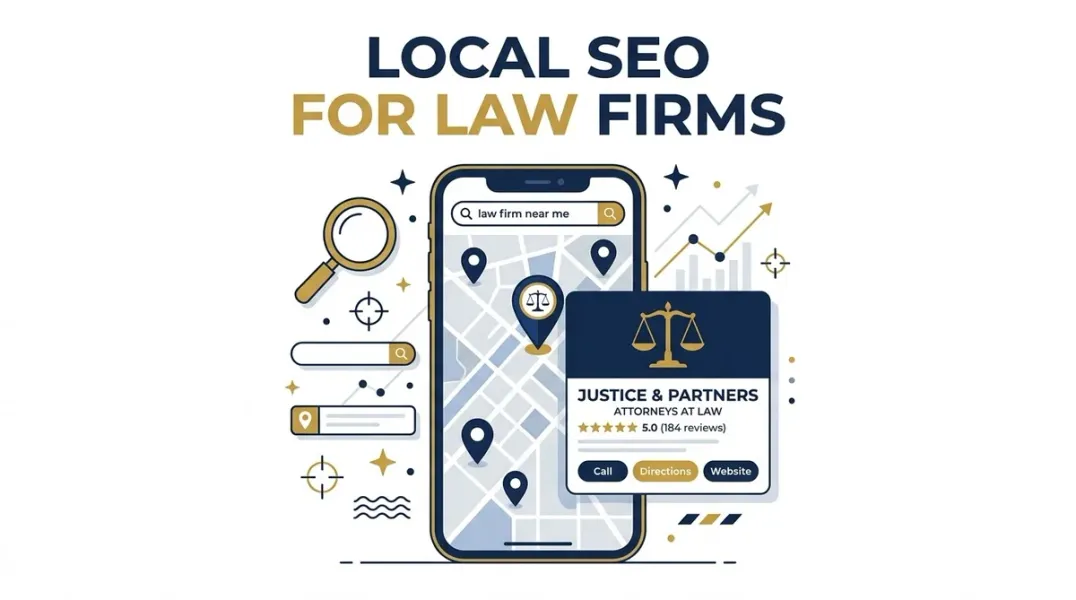
When someone searches for “personal injury lawyer near me” at 11 p.m. after a car accident, they’re not browsing. They’re not comparing. They’re looking for help right now. The law firm that appears in the Map Pack—with a phone number, directions, and a strong rating—gets that call.
This is the reality of local SEO for law firms. Legal services sit squarely in Google’s “Your Money or Your Life” (YMYL) category, where content is held to elevated standards of trust, accuracy, and expertise . A potential client searching for legal help is making a high-stakes decision under stress, and Google treats legal content accordingly .
But legal SEO comes with constraints most industries don’t face: bar association advertising rules, ethical obligations around client testimonials, and strict requirements about practice area claims . Getting local SEO wrong for a law firm isn’t just a marketing problem—it can be a compliance problem.
In this guide, you’ll learn how law firms build dominant local search visibility while staying within ethical and professional guardrails. We’ll cover Google Business Profile optimization, practice-area pages that convert, ethical review generation, legal schema markup, and the authority signals that Google and AI tools require from legal practices.
Law firm local SEO operates under three constraints that don’t apply to most local businesses.
1. YMYL Standards and the Trust Filter
Google classifies legal content as YMYL—a category where being wrong, misleading, or thin carries real consequences for the reader . For ordinary topics, E-E-A-T signals act as a tie-breaker. For legal topics, they are closer to a gate .
A law firm page competing on thin content and clever keywords is fighting uphill against a scoring system built to distrust exactly that. You can’t shortcut your way past a trust filter—you have to feed it .
2. Ethical and Bar Association Constraints
Most state bars prohibit soliciting testimonials that constitute “endorsements” or create unjustified expectations. The safest approach is reviews that describe the client experience—communication, professionalism, responsiveness—without guaranteeing outcomes .
Google has also become aggressive about suspending law firm GBP listings that use keyword-stuffed business names. Use your registered business name only. Adding descriptors risks suspension and a 30+ day recovery process .
3. The Local Pack Is the Battleground
For most law firms, the three listings in Google’s Map Pack are worth more than every organic result beneath them combined. They sit above standard listings, carry a phone number and directions, and are what someone in immediate need actually taps .
Google names three factors in local rankings: relevance, distance, and prominence. Distance is largely outside your control. Relevance and prominence are not—and that’s where the work sits .
Step 1: Master Your Google Business Profile
Your Google Business Profile (GBP) is arguably the single most important local SEO asset you have. It’s free, it populates the Local Pack, and for a law firm, it’s often the first thing a potential client sees .
Choose the Right Primary Category
Set your primary GBP category to your specific practice area, not a generic one :
- “Personal Injury Attorney” outperforms “Lawyer”
- “Family Law Attorney” outperforms “Legal Services”
- “Criminal Justice Attorney” outperforms “Attorney”
Google uses this category as one of the strongest signals for which searches your listing should show up in . If you’re a general practice, use “Law Firm” as primary and add practice-specific secondary categories .
Red flag: Keyword-stuffed business names (e.g., “Smith & Associates | Best Personal Injury Lawyer Dallas”) violate Google’s guidelines and can trigger suspension .
Complete Every Field
Fill out every section completely :
- Hours: Including special holiday hours. Inconsistent hours drop Google’s confidence in your listing.
- Phone: Local number, not toll-free.
- Website: Link to a locally optimized landing page.
- Services: Add each practice area as a listed service within your profile, not just somewhere in your business description .
- Photos: Real photos of your office and team. Listings with photos receive 42% more requests for directions and 35% more website clicks . Avoid stock photos—authentic photos resonate better with clients and help Google trust your listing .
Use GBP Features for Law Firms
Google Business Profile offers features tailor-made for lawyers :
- Q&A: Pre-populate with common questions: “Do you offer free consultations?” “How soon can I speak with an attorney?”
- Posts: Share firm news, legal tips, or updates. Regular posts signal an active, engaged business.
- Messaging: Enable it for instant chats with potential clients.
Granular Service Mapping for Hyper-Local Intent
A generic GBP is no longer sufficient. AI-driven search allows users to be incredibly specific .
If a user asks for a “lawyer for truck accidents on I-95,” a profile that explicitly lists “Commercial Truck Accident Litigation” as a service is far more likely to be chosen than one that simply lists “Personal Injury” .
Action: Use the custom services feature to list every specific type of case you handle :
- Personal Injury: “DUI Accident Victim Representation,” “Commercial Truck Accident Litigation,” “Slip and Fall Liability”
- Criminal Defense: “DUI Defense,” “Misdemeanor Drug Possession,” “Federal White-Collar Crime Defense”
- Family Law: “Uncontested Divorce,” “Spousal Support Negotiation,” “Child Relocation Agreements”
Each granular service should correspond to a dedicated page on your website, creating a consistent “entity” signal that AI can easily understand and trust .
Step 2: Build Practice Area Pages That Convert
Every practice area needs its own dedicated, in-depth page targeting “[practice area] attorney [city].” A single “Practice Areas” page that briefly mentions 8 different services can’t compete with a dedicated page built around one specific keyword—it doesn’t give Google or the reader enough depth on any single topic to feel authoritative .
What Each Practice Area Page Needs
Legal content needs to go deeper than other industries. Potential clients are researching their legal situation—they want to understand the process, timeline, and potential outcomes before they call. Pages that answer these questions pre-qualify leads and convert at 3-5x the rate of thin service pages .
Essential elements:
- Who you serve
- What types of cases you handle
- What outcomes you pursue
- Typical timeline
- Key evidence elements
- How the process works
- Fee structure (if applicable)
- FAQs
- Clear call to action for consultation
Localize with Real Detail
For firms with multiple offices, each location needs its own page with genuinely local content—not templated pages with the city name swapped .
What makes a location page genuinely local:
- The actual address, an embedded map, parking and transit notes
- The courts served
- The attorneys who work there
- Distinct copy that speaks to that jurisdiction
Critical rule: One page per staffed office. Not one per city you’d like cases from. Pages for places you have no presence are thin content and are treated as such .
Answer Real Questions, Not Keywords
Large language models synthesize answers to natural-language questions. The old SEO habit of writing around a keyword phrase has been replaced by writing around the question a real client would ask .
Lead every page with the answer. If a bio’s first line is “Jane Doe is a partner in the Corporate Group,” you’ve buried the lead. Try: “Jane Doe advises multinational buyers and sellers on M&A transactions across Latin America, with a focus on real estate-backed acquisitions” .
Add an FAQ block to every practice page. AI engines preferentially extract content already structured as question-and-answer pairs. Three to five real questions per page, each with a 40- to 80-word answer .
Step 3: Generate Reviews Ethically (and Consistently)
Reviews are the second-most important ranking factor for law firms, but attorneys face unique ethical constraints .
The Ethical Two-Step Process
Most state bars prohibit soliciting testimonials that constitute “endorsements” or create unjustified expectations. The safest approach :
- After case resolution, send a satisfaction survey first
- If the client responds positively, follow up with a Google review request that includes guidance: “We’d appreciate you sharing your experience working with our team”—rather than asking them to talk about results.
Some firms include a one-page review guide explaining what’s appropriate to share publicly. Always check your state bar’s specific rules before implementing any review management system .
Review Velocity and Recency
The bar has risen sharply. BrightLocal’s 2026 Local Consumer Review Survey found that 97% of consumers read reviews for local businesses, 74% want feedback posted within the last three months, and 31% will only use a business rated 4.5 stars or higher—nearly double the 17% who said so a year earlier .
A strong rating earned three years ago no longer does the job by itself. The flow matters as much as the total. A firm collecting two reviews a month indefinitely will outperform one that gathered thirty during a single push two years ago .
Respond to Every Review
A thoughtful response to a negative review often does more for your credibility than a dozen 5-star reviews with no engagement from the firm .
HIPAA-style caution for legal responses: Never disclose confidential case details. Keep responses professional and brief. Provide a contact for further discussion .
Step 4: Implement Legal Schema Markup
Structured data helps Google and AI tools understand your practice. It’s increasingly critical as potential clients use AI assistants for legal research .
Essential Schema Types
- Attorney or LegalService as your primary type
- Person schema on every attorney bio, including credentials, bar admissions, and education
- FAQPage schema on practice area pages with question blocks
Key Properties to Include
- areaServed with specific jurisdictions (counties and states you’re licensed in)
- hasOfferCatalog listing each practice area as a service
- knowsAbout referencing specific legal topics
- sameAs linking to your Avvo, Justia, and other directory profiles
Microsoft has publicly confirmed that schema markup helps its LLMs understand content. Research shows factual accuracy improvements from roughly 16% to more than 50% when structured data is part of the retrieval layer .
Step 5: Build Local Citations and Authority
Essential Citations for Law Firms
Start with Google Business Profile, Apple Business Connect, and Bing Places, then the legal-specific directories :
- Avvo – Attorney profiles with ratings and disciplinary history (DR 90)
- FindLaw – Comprehensive lawyer directory (DR 88)
- Justia – Free legal directory (DR 88)
- Lawyers.com – Martindale-Hubbell directory
- State and local bar association directories
Data from Zenodo’s September 2026 directory coverage snapshot shows that 94% of law firm citations are free, with FindLaw, Avvo, and Justia being the highest-authority sources .
Critical: Ensure NAP consistency across every citation. Inconsistent information drops Google’s confidence in your practice .
Earning Local Backlinks
Legal-specific link building leverages your expertise :
- Write guest columns for local business journals and newspapers on legal topics affecting the community
- Offer free CLE-style webinars and get listed on continuing education directories
- Get quoted in trade publications as an expert source
- Join local chambers of commerce and bar association roundups
For law firms, the best links come from legal press, bar and association listings, journalists after expert comment, and genuine local partnerships. Quality and relevance win. Cheap or spammy links are a fast route to a Google penalty .
Step 6: Optimize for AI Search (GEO)
A growing share of people never click a traditional link. They read the AI Overview, or ask an AI assistant to recommend a firm and act on the answer. Generative Engine Optimization (GEO) is how you make sure your firm is the one it names .
What AI Engines Look For
AI leans on the same trust signals as search, plus one more: clarity. It favors content that answers a question directly and is easy to parse, firms with consistent details and a clear identity across the web, and brands mentioned and cited by other credible sources .
Research shows that AI-driven traffic grew 187% from January to December 2025, nearly tripling over the calendar year .
GEO Tactics for Law Firms
- Write clear, question-led content with self-contained answers
- Use structured data so machines can interpret your pages
- Keep your firm’s information consistent and current everywhere it appears
- Earn third-party mentions from credible sources
- Lead with the answer — the first sentence should answer the core question
Common Mistakes Law Firms Make
-
Keyword-stuffed business names. “Smith & Associates | Best Personal Injury Lawyer Dallas” violates Google’s policies and can trigger suspension and a 30+ day recovery process .
-
Chasing the Map Pack without building authority. You cannot rank 50 miles away with a single map pin. Build city-specific pages for every real service area. One office location cannot cover multiple cities .
-
Templated location pages. Pages with the city name swapped are the most common local SEO failure in legal, and they are trivially easy for Google to identify .
-
Neglecting reviews. 97% of consumers read reviews. A firm with a strong rating from three years ago won’t compete with one collecting reviews consistently today .
-
Ignoring AI search. AI Overviews now sit at the top of many legal searches. Firms that don’t structure content for AI extraction are becoming invisible at the moment of consideration .
-
Using virtual offices. Virtual offices are a common cause of suspended profiles in the legal category. Use a genuine, staffed address .
Conclusion
Local SEO for law firms requires a balance: visibility and trust, reach and compliance.
The foundation is your Google Business Profile—specific categories, complete information, granular service mapping, and authentic photos. Reviews require an ethical approach: a satisfaction survey first, then a review request that focuses on client experience, not outcomes.
Practice area pages need depth, not breadth. Each practice area deserves its own dedicated page that answers the real questions clients ask. Location pages need genuine local detail, not templated content.
Schema markup and AI optimization help Google and AI tools understand your expertise. Citations from Avvo, FindLaw, and Justia build authority signals that legal content requires.
The stakes are high. A single personal injury case can be worth tens of thousands in fees. A retained family law client generates revenue for months. The firms that invest in structured, compliant local SEO now will be the ones clients find—and trust—when they search for help.
Call to Action
Ready to capture high-intent local legal searches?
We’ve created a Law Firm Local SEO Checklist covering GBP optimization, ethical review generation, legal schema, and practice-area page templates.
👉 Download the Checklist and start building your firm’s local presence today.
👉 Or run a free GBP audit to see how your firm compares to competitors in the Map Pack.
FAQs
1. How is local SEO different for law firms?
Legal content is classified as YMYL (Your Money or Your Life), held to elevated E-E-A-T standards. Law firms also face bar association advertising rules and ethical constraints around testimonials that other industries don’t face .
2. What’s the most important ranking factor for law firm local SEO?
Your Google Business Profile—specifically the primary category and its completeness. GBP is the foundation of Map Pack visibility, and the primary category is the single most consequential field .
3. Can I ask clients for Google reviews?
Yes, but the safest approach is a two-step process: send a satisfaction survey first, then request a Google review only from satisfied clients. Never ask clients to discuss case results. Check your state bar’s specific rules .
4. How many reviews do I need to rank in the Map Pack?
More important than total count is recency and velocity. 74% of consumers want feedback posted within the last three months. A steady flow of reviews beats a single burst from years ago .
5. What schema markup should a law firm use?
Use Attorney or LegalService schema with areaServed, hasOfferCatalog, and knowsAbout properties. Add Person schema on attorney bios and FAQPage schema on practice area pages .
6. How do I rank in cities where I don’t have an office?
You can’t fake a physical presence. Build city-specific pages for every real service area—staffed offices only. Pages for places you have no presence are thin content and are treated as such .
7. How long does law firm local SEO take?
Typically, noticeable improvements in local visibility take 3 to 6 months. With consistent effort, firms often see steady growth in traffic and leads .
8. What’s the biggest mistake law firms make with local SEO?
Keyword-stuffing the business name. It violates Google’s policies and can trigger suspension and a 30+ day recovery process. Use your registered business name only .
9. How do I optimize for AI search as a law firm?
Write clear, question-led content with self-contained answers. Use structured data. Keep your firm’s information consistent across the web. Earn third-party mentions from credible sources. Lead with the answer .
10. Are virtual offices okay for law firm GBP listings?
No. Virtual offices are a common cause of suspended profiles in the legal category. Use a genuine, staffed address .
Internal & External Links
Internal Links
- Google Business Profile vs Google Maps: What’s the Difference?
- How Review Velocity Can Influence Local Search Visibility
- Local SEO for Healthcare Businesses: Building Visibility and Trust
- Industry-Specific Citations: How to Find the Best Directories for Your Business
- How to Reverse-Engineer a Competitor’s Local SEO Strategy
External Sources
Grow Your Google Maps Ranking on Autopilot
Stop spending hours every week manually replying to customer reviews and writing Google posts. Busirank automates your Google Business Profile to boost your local SEO rankings and turn searchers into paying clients.

 Busirank Team
