 Busirank Team
Introduction
Nearly 77% of patients search online before booking an appointment, and 58% go specifically to Google . For healthcare providers, this means your online presence is often the first patient interaction—before they ever call your office or walk through your door.
But healthcare local SEO isn’t like SEO for restaurants or retail. Patients searching for care are navigating a high-stakes decision. They’re comparing providers, reading reviews, checking credentials, and looking for signals that you’re both visible and trustworthy.
The stakes are higher, too. Google classifies health content as “Your Money or Your Life” (YMYL)—a category held to elevated standards of accuracy, expertise, and credibility . A restaurant with a thin website might still get customers. A medical practice with unclear credentials, sparse service pages, or a neglected Google Business Profile will be skipped.
There’s also a constraint most industries don’t face: HIPAA. How you handle patient reviews, testimonials, and online communications carries genuine legal risk . Getting local SEO wrong for a healthcare practice isn’t just a marketing problem—it can be a compliance problem.
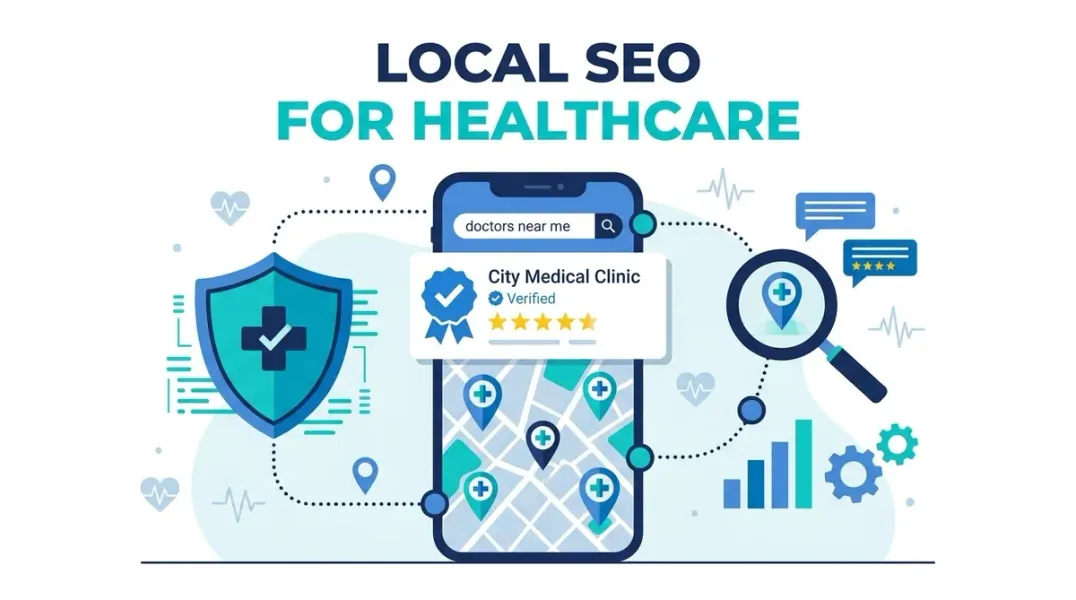
In this guide, you’ll learn how healthcare practices build local search visibility while maintaining trust and compliance. We’ll cover Google Business Profile optimization, HIPAA-compliant review management, medical schema markup, provider pages, and the E-E-A-T signals that Google and AI tools require.
Healthcare local SEO operates under three constraints that don’t apply to most local businesses.
1. YMYL Standards
Google holds healthcare content to elevated standards. The E-E-A-T framework—Experience, Expertise, Authoritativeness, Trustworthiness—isn’t optional for medical practices. Google wants clear signals that content is accurate, current, and authored or reviewed by qualified professionals .
This means:
- Every medical page should have a clear author or reviewer with credentials
- Content should cite reputable sources (Mayo Clinic, NIH, peer-reviewed journals)
- Pages should display last-updated dates
- Provider bios should include board certifications, education, and clinical interests
2. HIPAA Compliance
Review management for medical practices must follow HIPAA rules strictly. You can request reviews—HIPAA doesn’t prohibit this. What HIPAA prohibits is confirming or denying a patient relationship and sharing any protected health information (PHI) in review responses .
HIPAA violation fines range from $100 to $1.9 million per incident. When responding to reviews, especially negative ones, never:
- Confirm the reviewer is a patient
- Reference any treatment, diagnosis, or appointment details
- Share information that could identify the patient
A safe response template: “Thank you for your feedback. We take all feedback seriously. Please contact our patient relations team at [number] to discuss your experience.”
3. Three Ranking Factors, Elevated
Healthcare local rankings follow Google’s core factors—relevance, proximity, prominence—but with higher weight on trust and authority signals . Reviews, backlinks from medical organizations, and verified credentials carry significant weight.
Step 1: Optimize Your Google Business Profile
Your GBP is often the first thing patients see. For healthcare practices, it directly affects whether you appear in “near me” searches .
Choose the Most Specific Category
Set your primary GBP category to your specific medical specialty, not a general one .
- “Dermatologist” outperforms “Doctor”
- “Family Practice Physician” outperforms “Medical Clinic”
- “Orthopedic Surgeon” outperforms “Surgeon”
Add secondary categories for sub-specialties and ancillary services: “Medical Spa,” “Weight Loss Service,” “Allergist,” etc.
Complete Every Field
- Hours: Including special holiday hours. Inconsistent hours drop Google’s confidence in your listing .
- Phone: Local number, not toll-free.
- Website: Link to a locally optimized landing page.
- Services: List every service with descriptions. Include “isAcceptingNewPatients” if applicable.
- Attributes: Toggle everything that applies—wheelchair accessible, telehealth, etc.
HIPAA-Compliant GBP Posts
Be cautious with GBP posts. Google’s automated enforcement has become stricter, and promotional posts can be flagged . For healthcare practices:
- Avoid posting offers, promotions, or pricing
- Avoid calls to action like “Book Now”
- Avoid AI-generated images with text overlays
- Keep posts informational, with real photos of your practice
- Never include phone numbers in post descriptions
If you do post, keep it simple: plain text, authentic photos, no CTAs, no links, no pricing .
Photos That Build Trust
Upload real photos of your team, office, and patient experience. Authentic visuals help patients feel more comfortable calling you . Avoid stock photos—they undermine trust in healthcare contexts.
Step 2: HIPAA-Compliant Review Management
Reviews are both a ranking factor and a trust signal. But healthcare review management requires a careful approach.
The Two-Step Review Generation Process
The safest approach is a post-visit satisfaction workflow :
- Send a HIPAA-compliant satisfaction survey first (through your patient portal or an encrypted communication channel)
- If the patient responds positively, follow up with a Google review request
This filters out dissatisfied patients before they reach Google and ensures you’re directing happy patients to your public profile. Never mention their visit reason or health details in the review request .
Respond to Every Review—Compliantly
Responding to reviews shows engagement and builds trust. But in healthcare, responses must be HIPAA-compliant .
Safe response principles:
- Thank them for feedback
- Never confirm they’re a patient
- Never reference treatment or diagnosis
- Provide a contact number for patient relations
- Keep it brief and professional
Example response: “Thank you for taking the time to share your experience. We take all feedback seriously and are always working to improve. If you’d like to discuss your experience further, please contact our patient relations team at [number].”
Review Velocity and Recency
Google weighs recent reviews more heavily. A steady trickle of new reviews signals an active, currently-preferred practice . Focus on consistency over bursts.
Encourage patients to mention specific services in reviews (without coaching them—that violates Google’s policies). Reviews mentioning specific treatments help with relevance signals .
Step 3: Implement Medical Schema Markup
Structured data helps Google and AI tools understand your practice. It’s increasingly critical as patients use AI assistants for health information .
Essential Schema Types
| Schema Type | Use Case | SEO Impact |
|---|---|---|
| Physician | Individual doctor profiles with credentials, specialties | Triggers Knowledge Panel and doctor-specific searches |
| MedicalBusiness | Practice-level entity with services, insurance, hours | Map Pack eligibility and rich business panel |
| MedicalCondition | Condition pages (diabetes management, etc.) | Featured snippets and AI Overview citations |
| MedicalProcedure | Procedure descriptions with preparation info | Rich results for procedure-specific searches |
| FAQPage | Patient education questions | Featured snippets and AI Overview citations |
Key Properties to Include
- medicalSpecialty — matching your practice area
- availableService — each service listed individually
- isAcceptingNewPatients — a powerful search trigger
- insurance — the plans you accept
For multi-provider practices, add individual Physician schema per doctor with affiliation pointing at the practice entity .
Step 4: Build Provider Pages
Patients search for individual doctors by name, especially after receiving a referral. Every physician needs their own page .
What Belongs on a Provider Page
- Professional headshot
- Board certifications
- Medical school and residency
- Clinical interests
- Accepted insurance plans
- A patient-friendly biography
Referred patients arrive already knowing the name—the page just has to confirm they found the right person.
Internal Linking Structure
Link provider pages to the services they offer. Link service pages to relevant blog content. Link blog articles back to the author’s provider page. This structure helps Google understand the relationships between your clinics, departments, and medical professionals .
Step 5: Build Local Citations and Authority
Citations are mentions of your practice’s Name, Address, and Phone (NAP) across the web. For healthcare, they’re particularly important for verification .
Essential Citations
- Major platforms: Google Business Profile, Apple Maps, Bing Places, Yelp, Facebook
- Healthcare-specific: Healthgrades, Vitals, ZocDoc, WebMD, RateMDs
- Professional associations: American Medical Association, state medical society, specialty associations
- Local: Chamber of Commerce, BBB, local business directories
Critical: Ensure NAP consistency across every citation. Inconsistent information drops Google’s confidence in your practice .
Earning Local Backlinks
For healthcare, links from authoritative medical sources carry significant weight :
- Professional directories and associations: Listings on AMA, state societies, and specialty boards
- Guest posts in trade media: Articles for medical portals and local health publications
- Content with real value: Prevention checklists, condition guides, infographics that others want to cite
Community Partnerships
Sponsor local events, join community organizations, and partner with complementary healthcare providers. These relationships generate local links and reinforce your presence in the community .
Step 6: Optimize for AI Search
More patients are using AI tools like ChatGPT, Gemini, and Perplexity for health information. According to Rock Health’s 2025 survey, 32% of U.S. adults have used AI chatbots for health information .
What AI Engines Look For
AI tools reward clarity, not volume :
- Aligned facts across all sources — hours, services, specialties, provider names must be consistent
- Structurally clear pages — headings, concise sections, FAQs
- Expert signals — medically reviewed content, provider bios, service definitions
- Local specificity — which clinic does what, for whom, and where
If your data is scattered or contradictory, AI systems choose a competitor whose information is more coherent .
How to Optimize
- Lead with the answer: Start each section with the key message or direct answer
- Keep paragraphs short: AI tools prefer clear hierarchy
- Implement schema markup: Helps AI recognize relationships between entities
- Maintain consistency: Your GBP, website, and citations should all match
Common Mistakes Healthcare Practices Make
-
Keyword-stuffed business names. “Dr. Smith’s Best Dental Office with Free Consultations” violates Google’s policies and can trigger suspension .
-
Ignoring warnings. Google usually sends warnings before suspension. Yellow icons or “needs verification” messages should be addressed within 7 days .
-
HIPAA violations in review responses. Confirming a patient relationship or referencing treatment details in a public response can trigger fines up to $1.9 million .
-
Thin service pages. Generic content that doesn’t clearly explain services won’t rank. Each service deserves its own page .
-
Neglecting provider pages. Patients search for doctors by name. Without individual provider pages, you miss referral-driven traffic .
-
Inconsistent NAP data. Conflicting information across directories drops Google’s trust in your practice .
Conclusion
Local SEO for healthcare practices requires a balance: visibility and trust, reach and compliance.
The foundation is your Google Business Profile—specific categories, complete information, authentic photos, and HIPAA-compliant engagement.
Reviews require a careful approach. Use a two-step satisfaction workflow to generate reviews safely. Respond to every review with HIPAA-compliant language that never confirms patient relationships or references treatment details.
Schema markup and provider pages help Google and AI tools understand your expertise and credentials. Citations and local backlinks build authority signals that medical content requires.
Results take time. Expect small improvements in 3 months, visible growth around 6 months, and sustained performance by 12 months . Consistency matters more than speed.
The practices that invest in structured, compliant local SEO now will be the ones patients find—and trust—when they search for care.
Call to Action
Ready to build local visibility and patient trust?
We’ve created a Healthcare Local SEO Checklist covering GBP optimization, HIPAA-compliant review management, medical schema, and provider pages.
👉 Download the Checklist and start strengthening your practice’s local presence today.
👉 Or run a free GBP audit to see how your practice compares to competitors.
FAQs
1. How is local SEO different for healthcare practices?
Healthcare local SEO operates under YMYL (Your Money or Your Life) standards, HIPAA compliance requirements, and elevated E-E-A-T expectations. Reviews and content must meet higher trust standards than other industries .
2. Can I ask patients for Google reviews?
Yes, but the safest approach is a two-step process: send a HIPAA-compliant satisfaction survey first, then request a Google review only from satisfied patients. Never mention visit details in the request .
3. How do I respond to negative reviews without violating HIPAA?
Never confirm the reviewer is a patient, reference treatment details, or share identifying information. A safe response: “Thank you for your feedback. Please contact our patient relations team at [number] to discuss your experience” .
4. What schema markup should a medical practice use?
Use MedicalBusiness or Physician schema, plus MedicalCondition, MedicalProcedure, and FAQPage for content pages. Include medicalSpecialty, availableService, isAcceptingNewPatients, and insurance properties .
5. How do I get patients to find me in “near me” searches?
Optimize your Google Business Profile with specific categories, complete information, and authentic photos. Generate reviews consistently. Build local citations and backlinks from medical organizations .
6. What’s the biggest mistake medical practices make with GBP?
Keyword-stuffing the business name. “Dr. Smith’s Best Dental Office” violates policies and can trigger suspension. Use your real-world name .
7. How long does healthcare local SEO take?
Expect small improvements in 3 months, visible growth around 6 months, and sustained performance by 12 months. Consistency is key .
8. Should I post promotional content on my GBP?
No. Google’s automated systems are flagging promotional posts in healthcare. Avoid offers, pricing, CTAs, and AI-generated images. Keep posts informational with real photos .
9. How do I compete with larger practices in local search?
Focus on specific categories, comprehensive service pages, strong review velocity, and local backlinks. Large groups often neglect location-level optimization—you can outrank them with focused local effort .
10. What are the most important citations for healthcare practices?
Google Business Profile, Healthgrades, Vitals, ZocDoc, WebMD, RateMDs, plus professional association directories (AMA, state societies) and local platforms .
Internal & External Links
Internal Links
- Google Business Profile vs Google Maps: What’s the Difference?
- How Review Velocity Can Influence Local Search Visibility
- How to Build a Google Review Funnel That Generates Reviews Consistently
- Industry-Specific Citations: How to Find the Best Directories for Your Business
- Local SEO for Home-Based Businesses: What You Need to Know
External Sources
Grow Your Google Maps Ranking on Autopilot
Stop spending hours every week manually replying to customer reviews and writing Google posts. Busirank automates your Google Business Profile to boost your local SEO rankings and turn searchers into paying clients.

 Busirank Team
