 Busirank Team
Introduction
Every local SEO guide tells you to “build citations.” But which ones? With thousands of online directories competing for your attention—and your marketing budget—how do you know which platforms actually move the needle for local search visibility?
The answer is more nuanced than most businesses realize. In 2026, citations still matter—but their role has evolved. They’re no longer a volume game where more is always better. Instead, they function as a trust verification system, helping Google and AI-powered search tools confirm that your business is real, located where you claim, and legitimate.
As one industry analysis puts it: “A citation is any online mention of your business’s Name, Address, and Phone number (NAP). Citations help search engines verify that your business exists, operates at the stated location, and can be trusted”.
But here’s the critical insight: not all citations carry equal weight. A listing on Google Business Profile is worth more than a listing on a low-authority directory that no one visits. A citation from your industry’s leading platform can outperform dozens of generic directory listings.
In this guide, we’ll break down exactly which business directories actually matter, how to prioritize your citation building, and why consistency beats volume every time.
What Are Local Citations (And What They’re Not)
Before diving into which directories matter, let’s clarify what citations actually are—and what they’re not.
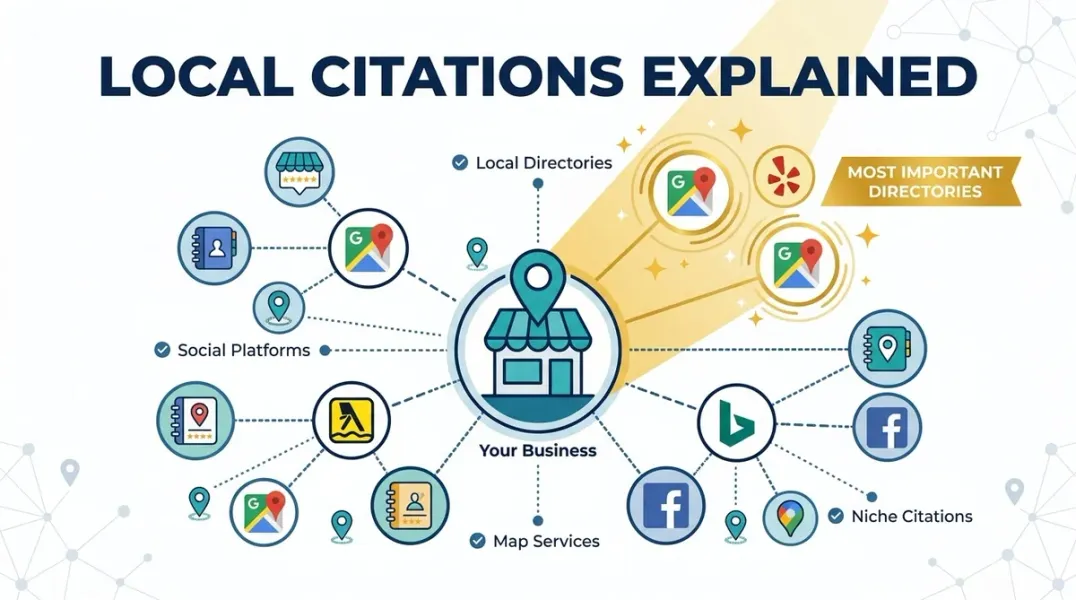
A local citation is any online mention of your business’s NAP (Name, Address, Phone number), whether on a directory, social platform, data aggregator, or industry-specific website. Citations can also include your website URL, business hours, description, and other details.
Here’s the crucial distinction: Citations are not the same as backlinks.
| Citations | Backlinks |
|---|---|
| NAP mention that may or may not include a link | A clickable link from another site to yours |
| Improve local/Map Pack rankings | Improve organic search rankings |
| Must be consistent (same NAP everywhere) | Should be varied (diverse anchor text) |
| Primarily affect local results | Affect both local and organic results |
As BrightLocal explains: “A citation must include your Business Name, Address, and Phone Number (NAP), but a link doesn’t have to. A link must be clickable, whereas a citation doesn’t have to be”.
The key takeaway: You need both—but they serve different purposes.
Do Citations Still Matter in 2026?
Yes, but their role has shifted.
According to Locafy’s 2026 local SEO ranking factors analysis, citation signals account for approximately 8% of local pack ranking weight—a decrease from previous years. The biggest trends have been the increased weight of review signals and behavioral signals, with a corresponding decrease in citation weight.
But don’t mistake “decreased weight” for “irrelevant.” Citations remain a foundational signal. As Locafy notes: “What matters most is NAP consistency across all listings, citation volume on authoritative directories, and the quality of directories where you appear. Inconsistent citations actively hurt your rankings by creating confusion about your business identity”.
The new reality is this: Citations are the trust floor, not the ranking ceiling. They won’t single-handedly push you to #1, but missing or inconsistent citations will hold you back.
The Citation Hierarchy: Which Directories Actually Matter
Not all directories are created equal. Here’s how to prioritize your citation building based on impact.
Tier 1: Essential Platforms (The Non-Negotiables)
These are the platforms Google and other search engines use directly to verify business information. Missing any of these is a critical gap.
| Platform | Why It Matters |
|---|---|
| Google Business Profile | Powers Google Search and Maps; the single most important citation |
| Apple Business Connect | Powers Apple Maps and Siri; essential for reaching iOS users |
| Bing Places | Powers Microsoft search results, including Windows and Cortana |
These three form the foundation of your local presence. If you’re not listed—and verified—on all three, stop reading and fix that first.
Tier 2: Data Aggregators (The Multipliers)
Data aggregators collect business information and distribute it to hundreds of downstream directories. A single submission can propagate your NAP to 100+ sites over 2-6 months.
| Aggregator | What It Does |
|---|---|
| Data Axle (InfoUSA) | Distributes to major directories and mapping platforms |
| Neustar Localeze | Feeds data to a wide network of directories |
| Foursquare | Powers location data for many apps and services |
Submitting to these aggregators creates a cascade effect across the citation ecosystem. It’s often the highest-leverage citation work you can do.
Tier 3: Major Directories (The Trust Builders)
These are widely recognized directories that strengthen your overall citation profile and provide additional trust signals.
| Directory | Best For | Cost |
|---|---|---|
| Yelp | All local businesses; strong review platform | Free |
| Better Business Bureau (BBB) | High trust signal; builds credibility | Paid |
| Yellow Pages | Legacy directory with broad reach | Free |
| Facebook Business Page | Social proof and messaging; community-based businesses | Free |
| LinkedIn Company Page | Professional services; B2B | Free |
| Nextdoor | Neighborhood-based social network | Free |
Tier 4: Industry & Niche Directories (The High-Converters)
This is where citation strategy gets strategic. Niche platforms carry extra weight in their verticals and often convert better than generic directories.
| Industry | Key Directories |
|---|---|
| Legal | Avvo, FindLaw, Justia |
| Healthcare | Healthgrades, Zocdoc, Vitals |
| Restaurants | TripAdvisor, OpenTable |
| Home Services | Angi, HomeAdvisor, Thumbtack |
| Real Estate | Realtor.com, Zillow |
| Hospitality | TripAdvisor, Expedia |
| Therapists | Psychology Today |
As Neil Patel notes: “Niche platforms like OpenTable (restaurants), Avvo (legal), Zocdoc (medical), or TripAdvisor (travel) carry extra weight in their verticals and often convert better”.
How Many Citations Do You Actually Need?
The answer depends on your market competitiveness.
According to Locafy’s 2026 guidance: “In low-competition markets, 40-50 high-quality citations on the best business directories may be sufficient. In competitive metros, businesses in the Map Pack often have 100-200+ citations. Quality and consistency matter more than raw quantity—50 perfectly consistent citations outperform 200 inconsistent ones”.
Neil Patel offers a similar benchmark: “A good starting point is generally 30 to 50 accurate, high-quality citations to build a strong foundation and establish a baseline. Depending on your industry and market size, you may need more”.
The key principle: Depth beats breadth. Ten citations on high-authority, relevant directories will outperform fifty citations on low-quality sites.
The Consistency Imperative
Here’s the single most important rule of citation building: NAP consistency.
Your Name, Address, and Phone number must be identical across every platform. Not just similar—identical. Right down to “Street” vs “St” and phone number formatting.
Why? Because inconsistent citations create conflicting signals that confuse search engines. As LocaliQ explains: “When search engines encounter conflicting business data, trust signals weaken. Consistency ensures ranking strength is consolidated under one verified business entity”.
A study by LocaliQ found that 40% of the directories they examined were fully missing a phone number—leaving them susceptible to duplication and amplification of incorrect information.
The fix: Before building new citations, audit your existing ones. Old phone numbers, previous addresses, and duplicate listings all need to be corrected or removed.
Building Citations: The Right Order
Effective citation building follows a specific hierarchy. Here’s the priority order recommended by industry experts:
- Data aggregators – Data Axle, Neustar Localeze, Foursquare
- Core platforms – Google Business Profile, Apple Maps, Bing Places
- Major directories – Yelp, Facebook, BBB, Yellow Pages
- Industry directories – Niche platforms specific to your vertical
- Local directories – City/county business directories, Chamber of Commerce
- Social profiles – LinkedIn, Instagram, Twitter/X
Start at the top. Build outward. Don’t skip to Tier 4 before you’ve nailed Tiers 1-3.
Citations and AI Search: The New Frontier
The rise of AI-powered search is changing how citations matter—and making them more important than ever.
Platforms like Google’s AI Overviews, ChatGPT, and Perplexity pull data from structured, verified sources. As Neil Patel explains: “Your business listings on sites like Google Business Profile, Yelp, Bing Places, and TripAdvisor may be referenced automatically, if the information is accurate and consistent”.
A recent BrightLocal study analyzed which sources AI tools cite for local information. The findings were striking: Instagram and Reddit dominated as sources, with 82.5% of businesses having Instagram cited and 88.9% having Reddit cited.
This means your citation strategy needs to extend beyond traditional directories. Social proof on Reddit, engagement on Instagram, and presence on community platforms now contribute to how AI tools understand and recommend your business.
As Neil Patel puts it: “LLMs don’t crawl the web like Googlebot, but they rely heavily on trustworthy, indexed data. A clean citation profile gives your business a better shot at showing up in AI summaries, especially for local service queries”.
Tools for Citation Building and Management
Managing citations manually becomes unsustainable at scale. Here are the leading tools:
| Tool | Best For | Key Features |
|---|---|---|
| BrightLocal | All-in-one citation management | Submit to 100+ directories, audit existing listings, track status |
| Whitespark | Competitor citation discovery | Local Citation Finder identifies where competitors are listed |
| Semrush Listing Management | Integrated with SEO toolkit | Distribute to major directories, sync with existing SEO data |
| Moz Local | Simplified citation building | Submit to top directories, monitor accuracy |
For DIY-ers, BrightLocal offers individual citation submissions from $2 per site, making it accessible for small businesses.
Common Citation Mistakes to Avoid
- Inconsistent NAP – The #1 citation killer. Same format everywhere, always.
- Duplicate listings – Multiple listings for the same location dilute authority.
- Ignoring industry directories – Generic listings miss high-intent niche traffic.
- Building too many low-quality citations – 50 consistent citations beat 200 inconsistent ones.
- Neglecting unstructured citations – Mentions in news articles, blogs, and social posts also matter.
Conclusion
Local citations in 2026 are not a volume game. They’re a trust verification system.
The businesses that win at local SEO understand this: citations are the foundation, not the finish line. They don’t replace reviews, GBP optimization, or local content—but without them, everything else struggles to gain traction.
Your action plan:
- Audit your existing citations for consistency
- Claim the Tier 1 platforms (Google, Apple, Bing)
- Submit to data aggregators for multiplier effect
- Build on major directories (Yelp, BBB, Facebook)
- Expand into industry-specific and local directories
- Extend into social platforms that AI tools now cite
Quality and consistency beat volume every time. A clean, verified citation profile signals to Google—and to AI—that your business is legitimate, trustworthy, and here to stay.
Call to Action
Ready to audit your citation profile?
We’ve created a Citation Audit Checklist to help you identify inconsistencies, find missing directories, and prioritize your citation building for maximum local SEO impact.
👉 Download the Checklist and start building a citation foundation that supports rankings.
👉 Or run a free citation scan to see where your business is listed—and where it’s missing.
FAQs
1. What is a local citation?
A local citation is any online mention of your business’s Name, Address, and Phone number (NAP), whether on a directory, social platform, or industry-specific website.
2. Do citations still matter for local SEO in 2026?
Yes. Citation signals account for approximately 8% of local pack ranking weight. They’re a foundational trust signal—inconsistent citations actively hurt rankings.
3. What’s the difference between a citation and a backlink?
A citation is a NAP mention that may or may not include a link. A backlink is a clickable link from another site. Citations primarily affect local/Map Pack rankings; backlinks affect organic rankings.
4. Which business directories matter most?
Google Business Profile, Apple Business Connect, and Bing Places are essential. Data aggregators (Data Axle, Neustar Localeze, Foursquare) create multiplier effects. Major directories (Yelp, BBB) and industry-specific platforms add trust and relevance.
5. How many citations do I need?
In low-competition markets, 40-50 high-quality citations may suffice. In competitive metros, 100-200+ citations are common. Quality and consistency matter more than raw quantity.
6. What’s NAP consistency and why does it matter?
NAP consistency means your Name, Address, and Phone number are identical across every platform—right down to formatting. Inconsistent citations confuse search engines and weaken trust signals.
7. How do I find where my business is already listed?
Use citation scanning tools like BrightLocal, Whitespark, or Moz Local to audit your existing listings and identify inconsistencies or duplicates.
8. Do data aggregators really work?
Yes. A single aggregator submission can propagate your business data to 100+ downstream directories over 2-6 months.
9. How do citations affect AI search?
AI tools like ChatGPT and Google AI Overviews pull from structured, verified sources. A clean citation profile improves your chances of being referenced in AI-generated local recommendations.
10. What’s the biggest citation mistake businesses make?
Inconsistent NAP data. One inaccurate listing can hurt trust and confuse Google’s local algorithms.
Internal & External Links
Internal Links
- How to Audit Local Citations and Find Inconsistent Business Information
- Industry-Specific Citations: How to Find the Best Directories for Your Business
- Local Citation Building vs Link Building: What’s the Difference?
- Google Business Profile vs Google Maps: What’s the Difference?
- How to Reverse-Engineer a Competitor’s Local SEO Strategy
External Sources
Grow Your Google Maps Ranking on Autopilot
Stop spending hours every week manually replying to customer reviews and writing Google posts. Busirank automates your Google Business Profile to boost your local SEO rankings and turn searchers into paying clients.

 Busirank Team
