 Busirank Team
Introduction
A one-star review is not a single thing. It can be a customer annoyed about parking, a customer who had a genuinely bad experience with a product, a customer alleging a safety incident, or a customer threatening legal action. All four carry the same star rating. Only one or two of them require a manager to be woken up.
Treating every one-star review as an emergency produces alert fatigue: managers stop reading the alerts, escalation becomes noise, and the review that actually matters gets lost in the volume. Treating every one-star review as routine produces the opposite failure: the high-risk review sits in a shared queue while the situation escalates outside the business’s control.
Escalation rules exist to separate these cases. They define which reviews require immediate human attention, who receives the alert, what the response should look like, and when the situation should move beyond the review response into a different process. This guide explains how to build those rules.
What Escalation Is—and What It Is Not
Escalation is often conflated with “responding quickly.” They are related but distinct. A fast response is a response that happens within the response target. Escalation is a routing decision: this review carries risk that exceeds the standard response process, so it goes to a different person, with a different process, on a different timeline.
Three things make a review escalate. Risk—the review alleges something that could have legal, safety, health, or reputational consequences. Pattern—the review is part of a cluster that suggests a systemic issue. Failure to resolve—the review has been responded to, but the customer remains dissatisfied and the situation is escalating in public or through other channels.
Escalation is not the same as “this review made us unhappy.” A one-star review about slow service is a routine negative review. It deserves a prompt, empathetic response, but it does not need a manager on the phone within the hour. Escalation is reserved for reviews where the standard process is not sufficient.
The Signals That Trigger Escalation
Define the signals explicitly, so that the decision to escalate is not a judgment call made under time pressure.
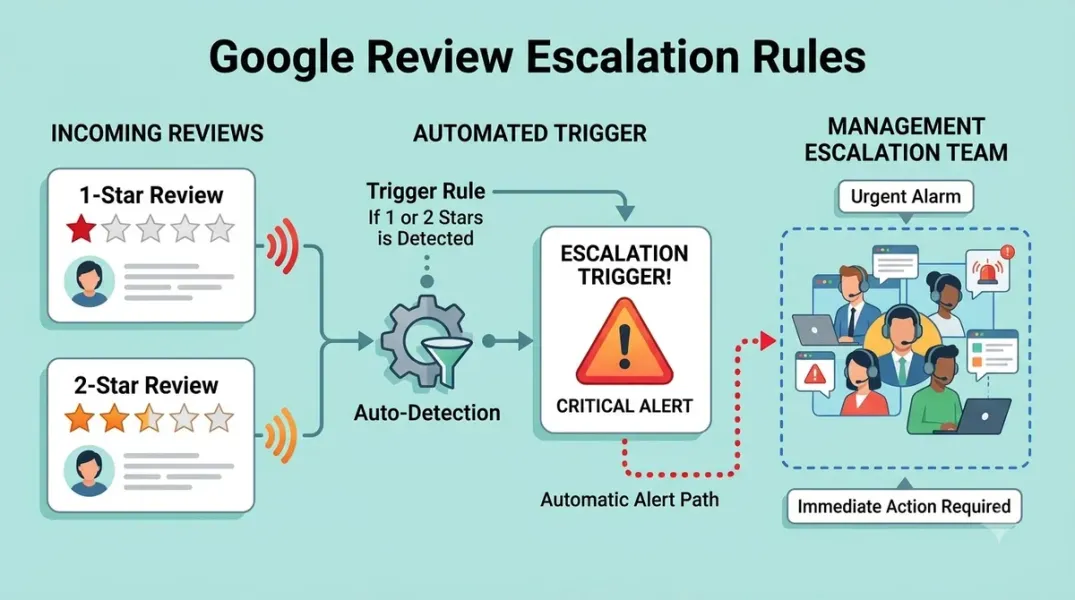
Star rating alone is too blunt, but one-star reviews should default to a higher-priority routing than two-star reviews, which in turn are higher than three-star. A common model routes one-star reviews to a manager-level queue immediately and two-star reviews to the standard responder with a shorter response target.
Keyword and topic detection identifies risk that star rating misses. Reviews mentioning injury, illness, safety, discrimination, harassment, legal action, refunds, chargebacks, police, or media attention should escalate regardless of star rating. This is where automated tools earn their value—keyword detection across high review volumes catches what a human reviewer might skim past.
Reviewer history and profile can indicate risk. A reviewer who has left multiple negative reviews across locations, or whose profile suggests they are acting in an official capacity (a journalist, a regulator, a lawyer), warrants closer attention. This signal is imperfect and should be used with judgment.
Public visibility and engagement matters. A review that has received many “helpful” votes or has been shared widely is a higher-risk review than one that sits quietly. Some platforms expose this; others do not, and the signal is often unavailable.
Patterns across locations identify systemic issues. If three locations receive one-star reviews about the same product defect in a week, the issue is not location-specific and should escalate to the brand or operations level rather than being handled locally.
Designing the Escalation Tiers
Escalation rules should be tiered, with different responses at different levels of risk. A workable model has three tiers.
Tier 1: Standard negative. One- and two-star reviews without escalation keywords. Routed to the location’s primary responder. Response target is same business day. The response is empathetic, acknowledges the issue, invites the customer to a private channel, and does not admit liability. No manager involvement unless the responder escalates.
Tier 2: High-risk. Reviews containing escalation keywords, or reviews from customers whose history suggests elevated risk, or reviews that have gone unanswered beyond the response target. Routed to the location manager and the regional lead. Response target is within a few hours. The manager reviews the response before it publishes. Private follow-up is expected.
Tier 3: Critical. Reviews alleging injury, illness, safety incidents, discrimination, or legal action, or reviews that have already caused public escalation. Routed to the legal or compliance contact and the senior operations lead, with the community manager coordinating. Response may be delayed until reviewed. Public response is carefully worded, often by a senior person, and private follow-up is immediate.
The tier definitions should be written down, with examples for each. The examples are what makes the tiers usable under pressure—a responder facing an ambiguous review can match it to the closest example.
Who Receives the Escalation
Escalation routing should name roles, not individuals, and should have a backup for each role.
The primary responder for each location or location group handles Tier 1. The location manager handles Tier 2 for their location. The regional lead is the escalation point if the location manager is unavailable or if the issue spans locations. The legal or compliance contact handles Tier 3. The community or reputation manager coordinates across tiers and maintains the audit trail.
Escalation routing should also define the communication channel. Tier 1 can go to a shared queue or email. Tier 2 should go to a channel that is checked frequently—Slack, SMS, or a phone call, depending on urgency. Tier 3 should include a direct call to the named contact.
The routing should be tested. A quarterly test—a simulated critical review sent through the routing—confirms that the alerts reach the right people and that the process works as designed.
Response Playbooks by Tier
Each tier needs a response playbook: what to say, what not to say, and what actions to take.
Tier 1 playbook: Thank the customer for the feedback, acknowledge the issue specifically, apologize for the experience without admitting fault, invite the customer to contact the business privately, and state the intent to make it right. Do not argue, do not dispute facts publicly, do not offer refunds in the public response. Keep it short and professional.
Tier 2 playbook: Everything in Tier 1, plus a specific commitment to investigate the issue, a named point of contact for the private follow-up, and a timeline. The public response should signal that the business takes the issue seriously without disclosing details. The private follow-up should happen within the response target.
Tier 3 playbook: The public response may be a brief acknowledgment that the business is aware of the situation and is addressing it through the appropriate channel, without further detail. The substantive response happens privately, coordinated with legal or compliance. In some cases, the public response may be delayed until the situation is understood. The playbook should specify who has authority to approve the public response and what can and cannot be said.
The playbooks should be reviewed by whoever has brand and legal authority. A playbook that has not been reviewed is a guess under pressure.
Tracking and Learning From Escalations
Escalation is a signal about the business, not just about the review. Tracking escalations over time reveals patterns.
Track the number of escalations by tier, by location, by category (safety, service, product, billing), and by outcome. A location with a rising rate of Tier 2 escalations has an operational issue. A product category with recurring Tier 3 escalations has a product issue. A region with poor Tier 1 response times has a capacity issue.
Review escalation data in the monthly review. The findings should feed back into operations—not just into the review response process. The review response recovers the individual customer; the operational fix prevents the next one.
Conclusion
Escalation rules turn a reactive process into a routing system. They define what counts as a high-risk review, who receives it, how quickly, and what the response should be. The businesses that handle negative reviews well are not the ones that respond to every one-star review with the same urgency. They are the ones that have separated the routine from the critical and built a process for each.
Call to Action
Define your escalation tiers this week, with examples for each. Name the roles responsible for each tier and the channels where alerts are delivered. Write a one-page playbook for each tier and have it reviewed by brand and legal. Test the routing with a simulated critical review.
FAQs
Should every one-star review be escalated?No. Every one-star review deserves a prompt response, but escalation should be reserved for reviews that carry elevated risk, such as safety, legal, or discrimination issues.
How do I detect escalation keywords at scale?Use a review management tool or an API-based pipeline with keyword detection. Manual review is unreliable at high volume.
Who should receive Tier 3 escalations?Legal or compliance, plus the senior operations lead, with the community manager coordinating. The exact roles depend on the organization.
What if the customer is not satisfied after the private follow-up?Escalate to the next tier. If the situation is already Tier 3, involve legal or compliance. Do not continue to respond publicly.
How often should escalation rules be reviewed?At least annually, and any time the business has a significant incident or a pattern of escalations suggests the rules are not catching the right cases.
Internal and External Links
Internal links:
- How to Prioritize Customer Reviews by Urgency Instead of Reading Them in Date Order
- How to Create Review Reply Templates for Different Customer Situations
- How to Set Up Review Notifications So Important Customer Feedback Is Never Missed
External links:
- Google Business Profile Help: Respond to reviews
- Google Business Profile APIs: Reviews reference
- FTC: Responding to negative online reviews
Grow Your Google Maps Ranking on Autopilot
Stop spending hours every week manually replying to customer reviews and writing Google posts. Busirank automates your Google Business Profile to boost your local SEO rankings and turn searchers into paying clients.
 Busirank Team