 Busirank Team
Introduction
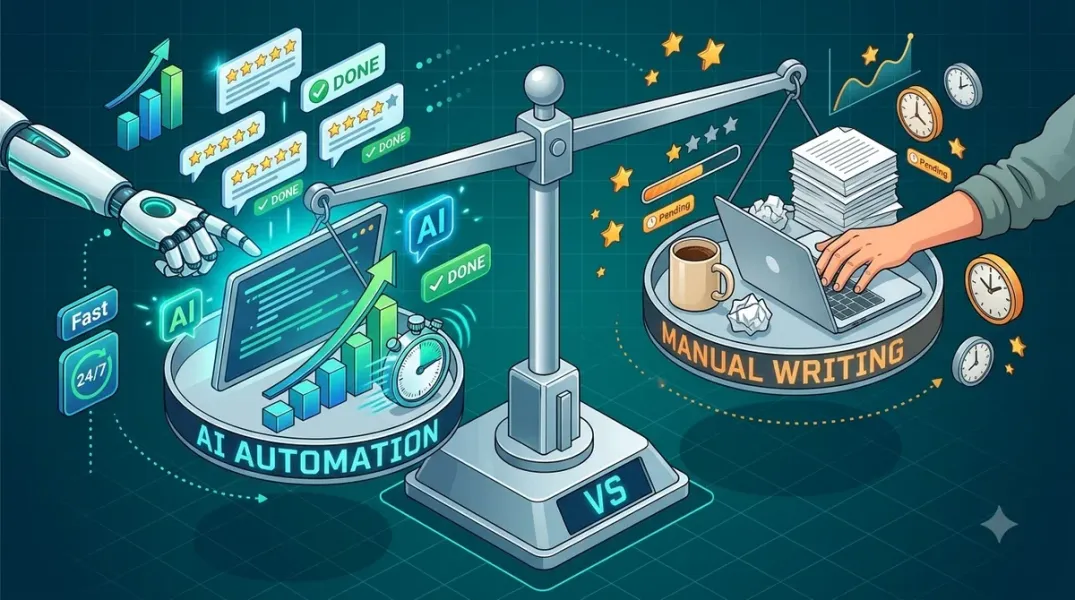
The question sounds like a simple productivity comparison: does an AI review reply generator save more time than writing responses yourself? The intuitive answer is yes, but the honest answer is more specific—it depends on which part of the workflow you are measuring, and on whether you compare AI to a blank page or to a mature manual process.
The data from 2026 is unusually clear on one point: the time savings are real and large, but they are concentrated in the drafting stage, not in the judgment stage. An AI review reply generator can produce a usable draft in seconds. A human still decides whether it is right. The businesses that save the most time are not the ones that remove the human—they are the ones that remove the blank page while keeping the human where judgment matters.
This guide puts the two workflows side by side using real benchmark data, then identifies which model actually wins on time for different review volumes, team sizes, and risk profiles.
The Baseline: What Manual Review Response Actually Costs in Time
Manual review responses are slower than most owners estimate, because the visible task (typing a reply) is only part of the work. The full cycle includes reading the review, deciding what to address, drafting, proofreading, and publishing.
The estimates converge across sources. A widely cited practitioner figure puts manual drafting at 5 to 10 minutes per review for hotels, with AI-assisted drafting dropping to 30 seconds per review. A separate analysis puts the manual drafting average at 3 to 5 minutes for a proper response, rising with volume: 20 reviews a month costs 1 to 1.5 hours; 50 reviews costs 2.5 to 4 hours; 100 reviews across locations costs up to 8 hours per month. Another source reports business owners spending 15 to 20 minutes crafting a single response, which at 10 reviews a month amounts to roughly half a workday spent on thank-yous alone.
The range is wide because “manual” means different things. A one-line “Thanks!” takes thirty seconds. A response that references the specific complaint, offers a resolution path, and matches brand tone takes five to twenty. The comparison only becomes meaningful when both workflows are measured against the same quality standard.
The AI Workflow: Where the Time Actually Goes
An AI review reply generator does not eliminate the response task; it changes its shape. The mechanical step—producing a coherent, personalized draft—collapses from minutes to seconds. The judgment step remains.
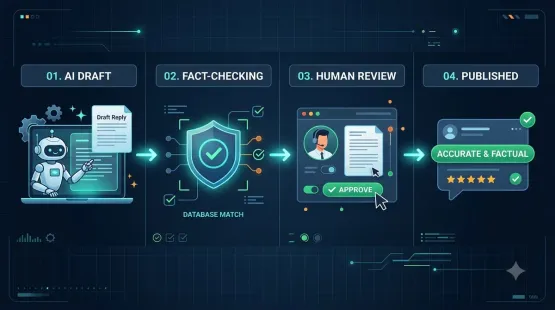
A typical AI-assisted cycle runs: the tool detects the review, analyzes sentiment and topics, drafts a response in the configured brand voice, and presents it for review. The human reads, edits if needed, and publishes. In tools built for this, reviewing and publishing a draft takes 20 to 30 seconds. For a business handling 50 reviews a month, that is the difference between roughly three hours of manual drafting and under half an hour of review-and-publish work.
The savings hold at scale. In a documented case study, Bonterra used a two-agent AI workflow to respond to a full quarter of customer reviews across G2, TrustRadius, and Gartner in under two hours—down from 12 or more hours for the same task, an 83% reduction. A digital marketing agency that built a custom review response generator saw response time drop from 5 days to 4 hours, with the system monitoring Google, Trustpilot, and G2 and posting after approval.
The pattern is consistent: AI compresses the drafting stage by roughly 80–90%, and the remaining time is review and judgment, not writing.
The Benchmark That Reframes the Debate: Hybrid Wins
The most important 2026 data point is not “AI is faster.” It is that the highest-performing workflow is neither fully manual nor fully automated. A first-party benchmark of active review-management accounts found that 57% used a hybrid workflow—both human approval and auto-posting—while the remaining accounts split evenly between approval-only and auto-only.
The same benchmark surfaced three signals that matter for anyone designing a workflow:
Human approval is applied by risk, not uniformly. Businesses used human approval on 88% of replies to reviews rated 1 to 4 stars, compared with 74% of 5-star replies. Higher-risk reviews get more oversight; routine positive reviews move faster.
Approval rarely requires editing. Of successfully posted AI replies that went through human approval, 87% were approved without a recorded edit. The human is a checkpoint, not a rewrite station. This is the detail that explains why hybrid is fast: the review step is usually a glance, not a revision.
Automation delivers speed where risk is low. 99% of eligible auto-posted replies were submitted within one hour of the review timestamp. Compare that with manual response windows that commonly run to 48+ hours, and the speed advantage is structural, not incremental.
The practical takeaway: the time question is not “AI or manual.” It is “which reviews can move automatically, and which need a human checkpoint?” The hybrid model wins because it applies the cheaper workflow (auto-post) to the reviews where judgment adds least, and the more expensive workflow (human approval) to the reviews where it adds most.
A Concrete Time Comparison by Volume
To make the trade-off tangible, here is how the two workflows compare at different monthly review volumes, using the midpoints of the observed ranges.
At 10 reviews per month: Manual, at 5 minutes each, costs roughly 50 minutes. AI-assisted, at 30 seconds of review-and-publish per review, costs 5 minutes—plus a one-time setup of brand voice and guardrails. The saving is real but modest in absolute terms.
At 50 reviews per month: Manual costs 4+ hours. AI-assisted review-and-publish costs 25 minutes. The saving is now measured in half-days.
At 100 reviews per month across locations: Manual costs 8+ hours, which is where quality starts to slip or responses stop entirely. AI-assisted costs under an hour. At this volume, the comparison stops being about efficiency and starts being about whether full coverage is achievable at all.
The crossover point is not a fixed number, but the direction is consistent: the more reviews you receive, the more the AI workflow’s time advantage compounds, because the human step stays roughly constant per review while the drafting step approaches zero.
Where Manual Still Wins (and Why It Matters for the Time Calculation)
Manual responses are not obsolete. There are categories where the AI workflow’s time advantage shrinks or disappears, and pretending otherwise produces bad advice.
Sensitive or high-stakes complaints. A negative review involving safety, legal exposure, or a named employee requires contextual judgment that a draft cannot supply. The human will rewrite, not approve. In these cases, the AI draft may still help by providing a non-defensive starting point, but the time saving is smaller.
Loyal regulars and relationship-critical reviews. A long-time customer who leaves a detailed review deserves a response that acknowledges history the AI does not have. The human touch is the point, and the time cost is justified.
Low-volume, high-touch businesses. A single-location business receiving fewer than 20 reviews a month can handle responses manually in under two hours a month. For that profile, the setup and oversight cost of a dedicated AI workflow may not pay back, and Google’s native tools plus a chat assistant may be sufficient.
The honest framing is that manual wins on judgment-heavy reviews, AI wins on volume and routine positive reviews, and the hybrid model wins overall because it routes each review to the cheaper workflow that still meets the quality bar.
The Hidden Time Costs of Each Workflow
A fair comparison has to include the costs that do not appear in the per-review calculation.
Manual workflow’s hidden cost is drift and backlog. When volume rises, response quality drops or responses stop—both outcomes damage reputation, and the recovery work (apologizing for silence, re-engaging) costs more time than the original responses would have.
AI workflow’s hidden cost is setup and governance. Configuring brand voice, writing guardrails, defining approval rules by star rating, and auditing a sample of replies each month all take time upfront. The benchmark data suggests this investment pays back quickly at volume, but it is not zero, and a poorly configured AI workflow can produce generic replies that require more editing than a blank page would have.
The workflow that saves the most time is the one where the setup cost is amortized across enough reviews, and where the approval step is a glance rather than a rewrite—which is exactly what the 87% no-edit approval rate describes.
Conclusion
On pure drafting speed, the AI review reply generator wins decisively: minutes become seconds, and the savings compound with volume. On judgment-heavy reviews, manual still produces a better response, and the time saving from AI shrinks accordingly.
But the more useful conclusion is that the binary comparison is the wrong frame. The 2026 benchmark data shows that most successful operations run a hybrid workflow: auto-post or one-click approve the routine positive reviews, require human approval on lower-rated and sensitive reviews, and audit a sample regularly. That model saves the majority of the manual drafting time without removing the human from the decisions that carry public risk.
If your review volume is low and your responses are already timely, manual is fine. If volume is rising, response times are slipping, or coverage is incomplete, the AI-assisted hybrid workflow is the one that saves time and makes full coverage achievable. The question is not whether to automate—it is which reviews to automate first.
Call to Action
Measure your current cost per review before you change anything. For one week, time how long it actually takes you to read, draft, proofread, and publish a response—then multiply by your monthly volume. If the total exceeds two hours a month, or if your average response time is drifting past 48 hours, you have a clear case for the hybrid workflow. Start with auto-approval on 4–5 star reviews only, keep mandatory human approval on 1–3 star reviews, and audit ten replies after the first month. That sequence captures most of the time saving while keeping the judgment step where it belongs.
FAQs
How much time does an AI review reply generator actually save per review?The drafting stage drops from an average of 3–10 minutes to a 20–30 second review-and-publish step. Across a month’s volume, that typically translates to an 80–90% reduction in total time spent on review management, with the exact figure depending on how many reviews require human editing versus a quick approval.
Is the AI workflow always faster than manual responses?Not always. For a low-volume business (under 20 reviews a month) with manageable response times, the setup and oversight cost of a dedicated AI workflow may not pay back. For sensitive complaints or relationship-critical reviews, the human will rewrite rather than approve, so the saving shrinks. The AI advantage is largest on routine positive reviews at volume.
What is the hybrid review response workflow?It is a model where some reviews are auto-posted or one-click approved, while others require human approval. In 2026 benchmark data, 57% of active accounts used this hybrid approach, applying human approval to 88% of replies on 1–4 star reviews but only 74% on 5-star reviews. It captures most of the speed benefit while retaining oversight where risk is higher.
How often do humans actually edit AI-drafted replies?Less often than expected. In the benchmark data, 87% of AI replies that went through human approval were approved without a recorded edit. The approval step functions primarily as a checkpoint, which is why the hybrid workflow remains fast despite keeping a human in the loop.
What is the biggest hidden cost of switching to AI review replies?Setup and governance: configuring brand voice, writing guardrails, defining approval rules, and auditing samples. A poorly configured workflow can produce generic drafts that require heavy editing, eroding the time advantage. The payback period depends on volume; the benchmark data suggests the investment amortizes quickly once review volume is meaningful.
Can I start with AI replies without a paid tool?Yes, to a point. Google Business Profile has been testing AI-generated reply suggestions within the native interface, and a general chat assistant can draft replies if you provide the review text and tone instructions. That approach works for low volume, but it lacks automated detection, brand-voice persistence, and approval workflows—which are the features that produce the large time savings at scale.
Internal & External Links
Internal links (to other posts in this series):
- How to Automate Google Review Responses Without Losing Your Brand Voice (previous post)
- How to Set Up Review Approval Workflows for Your Marketing Team
- How to Build a Google Review Monitoring Workflow for Busy Teams
- How to Track Review Response Rate and Response Time Across Your Locations
- How to Audit Your Team’s Review Responses for Quality and Consistency
- Best Google Business Profile Management Software for Small Businesses in 2026
External links (sources referenced in this article):
- Jasper — How Bonterra Responded to 3 Months of Customer Reviews in Under 2 Hours: https://www.jasper.ai/case-studies/bonterra
- Reply Champion — Google Review Response Workflow Benchmark (2026): https://www.replychampion.com/research/google-review-response-workflow-benchmark
- Relvio — How to automate Google review responses with AI: https://www.relvio.io/en/blog/automate-google-review-responses-ai
- Flavia Voican (LinkedIn) — Manual vs AI review response time comparison: https://www.linkedin.com/posts/flavia-voican-9a2943130_hotelmarketing-hospitality-bookdirect-activity-7441985802739548162-U065
- ReplyOnTheFly (LinkedIn) — AI-generated review responses outperform manual writing: https://www.linkedin.com/posts/replyonthefly_can-ai-write-google-review-responses-yes-activity-7434783752939134976-450I
- Muneeb Rehman (LinkedIn) — Review response generator case study: https://www.linkedin.com/posts/muneeb-rehman-403369255_artificialintelligence-businessautomation-activity-7454213509912915968-KQcF
- Sagnik Bhattacharya — AI Review Management Tools for Small Businesses (2026): https://sagnikbhattacharya.com/blog/ai-review-management-tools
- Dynamic Digital Marketing — How to Automate Your Reputation Management With AI: https://fastseo.services/
How to Set Up Review Approval Workflows for Your Marketing Team
Grow Your Google Maps Ranking on Autopilot
Stop spending hours every week manually replying to customer reviews and writing Google posts. Busirank automates your Google Business Profile to boost your local SEO rankings and turn searchers into paying clients.
 Busirank Team