 Busirank Team
Introduction
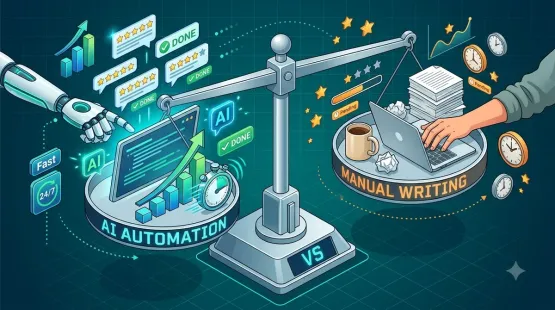
AI-generated review responses solve a real problem. A multi-location business with hundreds of reviews a month cannot manually draft a unique, on-brand response to every one. AI can produce a thoughtful response in seconds, in the brand’s voice, tailored to the review’s content. The time savings are real, and so are the consistency gains.
The risk is equally real. AI models generate text that is plausible rather than verified. They can invent details—a refund that was never offered, a policy that does not exist, a manager who was never involved, a cause of the issue that was never established. They can make commitments the business cannot keep, admit liability the business did not intend to admit, or reference information that is not true. And because these responses publish publicly under the business’s name, an unsupported claim is not a private draft—it is a public statement.
The goal is not to avoid AI. It is to use AI within guardrails that keep the output accurate, compliant, and consistent with what the business can actually stand behind. This guide explains how to build those guardrails.
Why AI Responses Drift From Reality
Understanding the failure modes is the first step to preventing them. AI review responses go wrong for a small number of recurring reasons.
Hallucination is the model generating a detail that was never provided. Asked to respond to a review about a delayed order, the model may invent a cause—“we experienced a systems outage”—when no such outage occurred. The detail sounds specific and credible, which is what makes it dangerous.
Overcommitment is the model promising something the business has not authorized. A response may offer a refund, a free replacement, or a discount that the business does not offer as a matter of policy. The customer then expects it, and the business is bound by a public statement.
Admission of fault is the model acknowledging liability in a way the business would not. In regulated industries, an admission in a public review response can have legal consequences.
Tone drift is the model producing a response that does not match the brand voice—too casual, too formal, too apologetic, too defensive. The response is accurate but off-brand.
Unsupported factual claims are the model stating something as fact that the business cannot verify—“our team has been retrained,” “this issue has been resolved,” “we have contacted you directly”—when none of those things is true.
Each of these failure modes is predictable, which means each can be guarded against.
The Guardrails: What to Constrain
Guardrails work by constraining what the AI is allowed to do. A well-constrained AI review response system has five components.
A knowledge base of verified facts. The AI should have access to a defined set of facts it is allowed to use—the business’s policies, its service commitments, its standard offers, its contact channels, and its brand voice guide. The AI should not generate facts outside this set. If a review asks about something outside the knowledge base, the response should acknowledge the review and route the customer to a private channel rather than invent an answer.
Templates and approved response patterns. Rather than asking the AI to write from scratch, provide approved response patterns for common review types—positive, neutral, negative service, negative product, escalation. The AI’s job is to adapt the pattern to the specific review, not to invent the structure. This constrains tone and structure while allowing personalization.
Prohibited claims and language. Define what the AI must not say: no refunds or compensation unless authorized, no admissions of fault, no comments on legal matters, no promises about timelines or outcomes, no claims about actions taken unless verified. These prohibitions should be built into the prompt and checked in review.
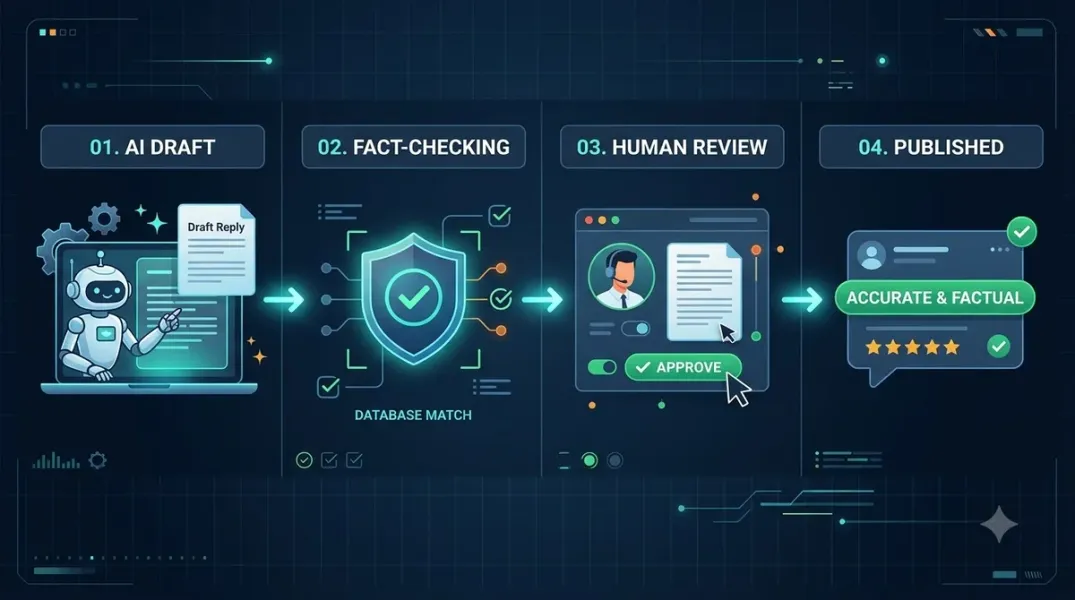
Human review before publishing. Every AI-generated response should pass through a human reviewer before it publishes. The reviewer checks for accuracy, compliance, and tone. For high-risk reviews—Tier 2 and Tier 3 in an escalation model—the review is mandatory and may involve a manager or legal. For routine positive reviews, the review may be a quick scan, but it should still happen.
Feedback and correction. When a reviewer corrects an AI response, the correction should be logged. Patterns in corrections reveal gaps in the knowledge base or the prompt, and they feed back into improving the system.
Prompt Design: Telling the AI What It Can and Cannot Do
The prompt is where the guardrails are implemented. A well-designed prompt for review responses contains several elements.
It defines the role: “You are drafting a response to a customer review on behalf of [business], in the voice described in the attached brand guide.” It defines the inputs: the review text, the star rating, the location, the reviewer’s name if available, and any verified facts relevant to the review.
It defines the response structure: thank the reviewer, acknowledge the specific issue, apologize for the experience without admitting fault, invite the customer to a private channel, and state the intent to address the issue. It defines the constraints: do not offer compensation, do not admit liability, do not make claims about actions taken, do not reference information not provided, keep the response under a specified length.
It defines the escalation path: if the review contains keywords related to safety, legal, discrimination, or health, do not draft a response—flag the review for human handling.
A prompt that specifies these constraints produces responses that are much more likely to be accurate. A prompt that simply says “write a response to this review” produces the failure modes described earlier.
The Human Review Layer
The human review layer is not a formality. It is the control that catches what the AI missed, and it should be designed with the same care as the AI system.
The reviewer should have a checklist: does the response contain any claim not supported by the verified facts, does it offer anything the business has not authorized, does it admit fault, does it match the brand voice, does it invite the customer to a private channel where appropriate? The checklist should take seconds per response for routine reviews and minutes for high-risk ones.
The reviewer should have authority to edit or reject the response. A reviewer who can only approve is not a control. The reviewer should also have a way to flag the AI system—“this response invented a cause of the issue”—so that the prompt or knowledge base can be improved.
For high-volume operations, the review may be sampled rather than complete for low-risk reviews, with full review for high-risk ones. Sampling is a trade-off: it reduces reviewer burden but increases the chance of an unsupported claim slipping through. The right balance depends on the risk tolerance and the review volume.
Measuring Accuracy
Accuracy should be measured, not assumed. Define what “accurate” means—no unsupported claims, no unauthorized commitments, no admissions of fault, no off-brand tone—and track how often responses fail those criteria.
A practical approach is to sample published AI responses monthly and score them against the criteria. Track the failure rate and the types of failures. A rising failure rate is a signal that the knowledge base or prompt needs updating. A high rate of a specific failure type—say, invented causes—points to a specific fix.
Also track the human review rate: what percentage of AI responses were edited, rejected, or escalated? A high edit rate suggests the AI is not yet ready for the volume it is handling. A low edit rate with a high accuracy score suggests the system is working.
When Not to Use AI
AI is appropriate for routine responses—positive reviews, routine negative reviews, and reviews where the response is largely acknowledgment and invitation to a private channel. It is not appropriate for Tier 2 and Tier 3 escalations, for reviews involving legal or safety issues, or for reviews where the response requires a judgment the AI cannot make.
Define the boundary explicitly. A one-star review about a service delay may be appropriate for AI drafting with human review. A one-star review alleging a safety incident should not be drafted by AI at all—it should route directly to a human with authority to handle it.
Conclusion
AI-generated review responses are a legitimate tool, but they are only safe within guardrails that constrain what they can say. A verified knowledge base, approved response patterns, explicit prohibitions, human review, and measured accuracy together produce responses that are fast, consistent, and defensible. Without those guardrails, AI produces responses that are fast, consistent, and occasionally damaging. The difference is not the model. It is the system around it.
Call to Action
Audit a sample of your published AI-generated responses against the four failure modes: hallucination, overcommitment, admission of fault, and unsupported claims. If you find any, review your prompt and knowledge base, add a human review checklist, and sample monthly to confirm the fix.
FAQs
Can AI-generated review responses be published without human review?For low-risk reviews, some businesses publish with sampling. For high-risk reviews, human review should be mandatory. The right level depends on the risk tolerance and the review volume.
How do I stop the AI from inventing details?Constrain it to a verified knowledge base and prohibit claims outside that base. Instruct it to acknowledge the review and route to a private channel rather than invent an answer.
What should the human reviewer check?Unsupported claims, unauthorized commitments, admissions of fault, brand voice, and the private-channel invitation. A short checklist makes the review fast and consistent.
How do I measure whether AI responses are accurate?Sample published responses monthly and score them against defined criteria. Track the failure rate and the types of failures.
Which reviews should not be handled by AI?Tier 2 and Tier 3 escalations, reviews involving legal or safety issues, and reviews that require a judgment the AI cannot make. Route these directly to a human.
Internal and External Links
Internal links:
- How to Create Review Reply Templates for Different Customer Situations
- How to Create Escalation Rules for One-Star and Two-Star Google Reviews
- How to Prioritize Customer Reviews by Urgency Instead of Reading Them in Date Order
External links:
- Google Business Profile Help: Respond to reviews
- NIST: AI Risk Management Framework
- FTC: AI claims and advertising guidance
Grow Your Google Maps Ranking on Autopilot
Stop spending hours every week manually replying to customer reviews and writing Google posts. Busirank automates your Google Business Profile to boost your local SEO rankings and turn searchers into paying clients.
 Busirank Team