 Busirank Team
Introduction
Healthcare groups face a problem that no other industry has to solve at the same scale. They are told to respond to every review, and they are also told that a single careless sentence in a public reply can constitute a HIPAA disclosure. A warm, personal response that would be excellent practice in a restaurant is a compliance risk in a clinic. The two instructions are both correct and they pull in opposite directions.
The data shows how badly this is going. A 2026 study collected 80,300 recent Google review replies across 4,019 medical and dental practices and estimated that 26.3%—roughly 21,117 replies—contained language that disclosed or confirmed patient information under a conservative rubric. The most common problem was not a dramatic disclosure. It was ordinary warmth: confirming a visit relationship, referencing a treatment, or naming a billing detail in a reply that felt helpful at the time.
That is the case for an AI-powered review management workflow built specifically for healthcare. Not a generic reputation tool with a HIPAA disclaimer, and not a fully automated system that publishes without review. A three-layer workflow—generation, risk-tiered approval, and monitoring—that lets a healthcare group respond at speed without putting patient privacy in the hands of whoever happens to be at the keyboard.
This guide covers the PHI risk that makes healthcare different, the tiered approval model that scales, the review generation strategy that actually produces volume, the tools built for the category, and the metrics that prove the workflow is working.
The PHI Problem That Makes Healthcare Reviews Different
HIPAA does not prevent a practice from asking for reviews. It prevents the practice from responding in a way that confirms someone is or was a patient, discloses why they visited, or reveals any detail about their health status or care. The patient can disclose anything they want in the review. The provider cannot confirm it, expand on it, or connect the reviewer’s identity to care in the reply.
The line is thinner than it looks. A compliant response to a positive review says “Thank you for taking the time to share your experience—we appreciate your support.” It does not say “We are so glad your [condition] trial went well”. Even a phrase as ordinary as “thanks for coming in” can confirm a patient relationship, and three of the five OCR review-response enforcement actions have involved dental practices.
The discipline rule that follows is simple and non-negotiable: never confirm, never expand, never personalize with clinical detail. Acknowledge the experience, thank the reviewer, and move any substantive conversation to a private channel.
Step 1: Build the Workflow in Three Layers, Not One
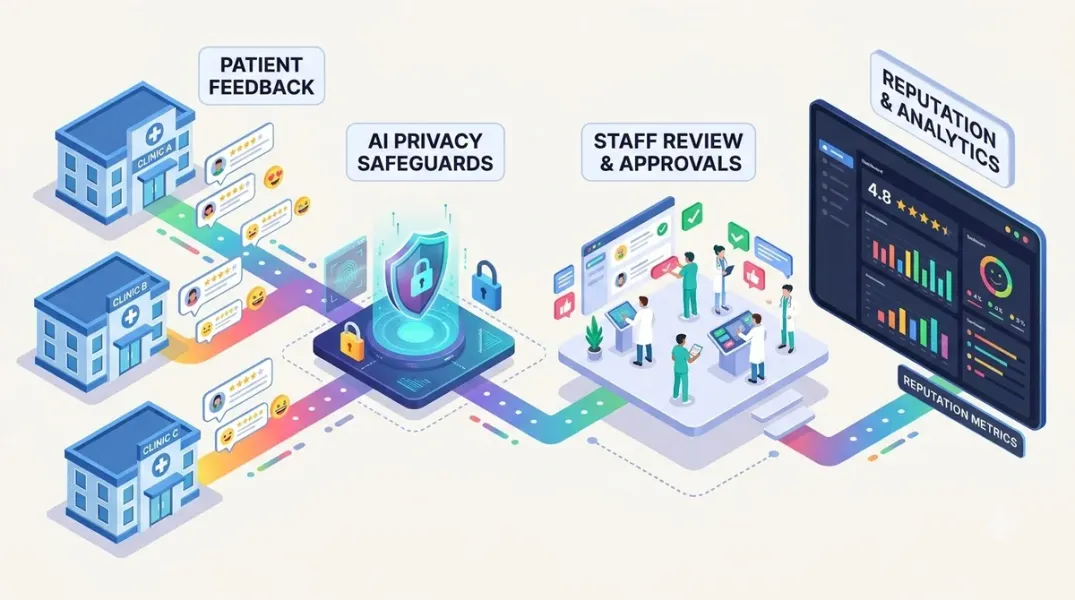
The workflow that holds up in healthcare separates into three layers, each with a different owner and a different risk profile.
Layer 1 — Generation. The review request goes out at the moment the patient is most satisfied, through a HIPAA-safe channel, with no incentive and no request to name a specific provider. This layer is where volume is created, and it is also where the 2026 policy changes bite: Google’s April 2026 update made asking patients to name specific team members an explicit policy violation, and it also banned in-office iPads and staff review quotas.
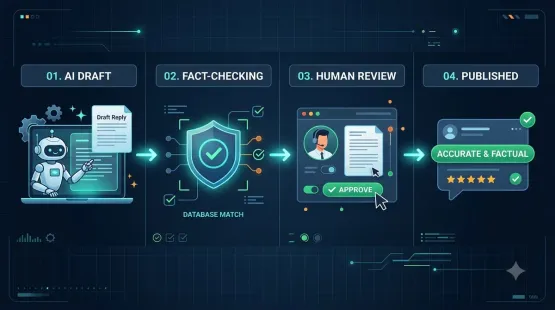
Layer 2 — Drafting and approval. AI drafts every reply in the practice’s tone, with HIPAA-aware language by default. The draft is tiered by risk: routine positive reviews can auto-post or one-click approve; negative and sensitive reviews require mandatory human review before publishing. Tools built for healthcare now implement exactly this—KloudMD drafts each reply and waits for one-click approval, with auto-post rules by star rating and instant alerts on low ratings.
Layer 3 — Monitoring and escalation. Every new review triggers an alert, every low rating routes to a named escalation owner, and the response rate and rating trend are tracked per location. The monitoring layer is what catches the clinic that stopped replying before the rating drops.
Step 2: Tier the Approval by Clinical and Legal Risk
The approval model is the heart of the workflow, and it has to be risk-tiered rather than uniform. Approving every reply manually does not scale across a healthcare group; approving none of them is a compliance incident waiting to happen.
The tiering that works:
Tier 0 — Positive reviews with no clinical detail. AI drafts and auto-posts, or a single click approves. These are the highest-volume replies and the lowest-risk. KloudMD explicitly supports this pattern: many practices auto-post five-star replies and review anything lower by hand.
Tier 1 — Neutral or mixed reviews. AI drafts, a trained team member reviews before publishing. The review is checking that no detail confirms a patient relationship.
Tier 2 — Negative reviews with a specific complaint. AI drafts, but the draft is designed to apologize, avoid confirming a treatment relationship, and move the conversation offline—then alert the team. Mandatory human approval, every time.
Tier 3 — Sensitive reviews (safety, legal, clinical outcome, staff conduct, discrimination). Immediate escalation to a compliance or clinical owner. No public reply until that person approves. The public acknowledgment stays neutral; the substance moves to a private channel.
Tebra’s AI Review Replies implements the same logic: it detects sentiment and generates a HIPAA-compliant response, but always gives staff final approval before posting and never includes protected health information. That is the standard the workflow should meet, regardless of tool.
Step 3: Generate Reviews Consistently, Not Sporadically
The workflow is only as good as the review volume flowing into it. The most useful case study in the category is UT Physicians, a Houston group with more than 2,000 clinicians and over 100 locations. It went from 280 Google reviews to 2,173 in one year—a 676% increase—and its average rating climbed from 2.9 to 4.6, with five-star reviews rising from 41% to 87%.
The mechanism was speed and consistency, not cleverness. The patient experience team surveys patients the same day as their visit, invites a review at the end of the survey while the experience is still fresh, and has a dedicated team member responding to reviews, with a named backup so no review waits. They respond to everything—positive reviews get acknowledged, negative reviews get a real response as close to real time as possible.
The benchmark from rater8 shows what a category-specific tool can add: Campbell Clinic Orthopaedics recorded a 443% increase in patient reviews in year one (92% five-star) and an 84% increase in Google listing views, which translated to more booked appointments. Across all rater8 customers, 98% of posted reviews are 4- and 5-star, and the average physician rating is 4.90.
The generation rules that follow from this evidence: ask at the point of satisfaction, through a HIPAA-safe channel, consistently rather than when someone remembers, and never with an incentive or a request to name a provider. Build the request into the standard patient workflow so it happens every time.
Step 4: Use AI for Drafting, Never for Autonomy
The distinction that separates a compliant workflow from a liability is what the AI is allowed to do without a human. In healthcare, the answer should be narrow.
AI should do: read every review, detect sentiment and theme, draft a reply in the practice’s voice, avoid PHI by default, route the draft to the right tier, and flag low ratings for immediate attention. KloudMD’s design is the clearest example: drafts are HIPAA-safe by default—no confirming who was a patient, no clinical specifics—and the tone, length, and signature follow the practice’s settings rather than a generic template.
AI should not do: confirm a patient relationship, reference a treatment, name a clinical detail, promise an outcome, or publish without approval on any review below the positive threshold. The 26% disclosure-risk finding is what happens when well-intentioned replies are written without a PHI check—and it is why the approval tier exists.
The drafting prompt and the guardrails should be written down and reviewed by legal or compliance, not left to the default settings of a general-purpose tool. The guardrail list should include: never confirm the reviewer is a patient; never reference a diagnosis, treatment, or outcome; never name a provider in a negative context; never discuss billing or insurance detail; always offer a private channel for resolution.
Step 5: Centralize Ownership and Set the Response Clock
The review workflow fails when ownership is diffuse. Yext’s healthcare guidance is direct: centralize review responses, usually within marketing or patient experience teams, because spreading the duty too widely leads to inconsistency and compliance risk. Providers and leaders should be updated on feedback, but the reply itself should come from a trained central function working with legal and compliance.
The response clock should be set by risk. Positive reviews: 24–48 hours. Negative reviews: same business day, with a first human touch faster. Sensitive reviews: immediate escalation, neutral holding response only if needed. The benchmark from Universal Health Services is useful: a 29-hospital system sent more than 1 million text messages to solicit reviews and responded in an average of 12 hours. That is the order of magnitude a healthcare group should aim for.
The ownership structure that scales is two-tier: a central patient-experience reviewer owns the queue and the voice; a named clinical or compliance owner receives Tier 3 escalations. A backup is named for both roles, because a review that waits for one person to return from vacation is a review that sits public and unanswered.
Step 6: Measure Response Coverage, Speed, and Sentiment—Not Just Star Rating
The metrics that matter for a healthcare review workflow are the ones that catch a failing location before the rating moves.
Response coverage — the share of reviews receiving a reply. The target is 100%; below 80% is a process failure. Response time by rating tier — median first response for positive, negative, and escalated reviews, reported separately. Sentiment by theme — wait times, scheduling, staff, communication, and care, which are the five areas Tebra’s AI Review Insights categorizes feedback into. And review velocity per location — new reviews per month, because a location with 30 recent reviews can outrank one with 80 stale ones.
The reporting cadence should be monthly scorecards per location, quarterly review, with the scorecard showing gap from the group median rather than a raw ranking. An average across 100 locations hides the twelve that are invisible, and those are the ones the workflow exists to find.
The performance case for responding at all is measurable: practices using Tebra’s AI Review Replies have seen an 81% increase in Google impressions, 60% higher map pack visibility, and 45% more website clicks. And research analyzing 100,000 small businesses found that each 25% increase in reviews responded to correlates with a 6% increase in booking conversions. Response coverage is not a vanity metric. It is a growth lever.
The Tools Built for Healthcare Review Management
The market has split into EHR-native tools, healthcare-specific reputation platforms, and general multi-location platforms with healthcare configurations. The right choice depends on whether the group needs compliance depth, workflow integration, or scale.
EHR-native and healthcare-specific. Tebra offers AI Review Replies and AI Review Insights natively inside its EHR+ Patient Experience package—the only EHR with native AI sentiment analysis and automated HIPAA-compliant review responses, according to the company. rater8 is embedded in athenaOne through an athenahealth partnership, used by nearly 300 athenahealth customers across more than 30 specialties, with a free plan available and paid plans from $89/month**. KloudMD provides review reply AI with EHR/EMR integration, auto-post rules by star rating, and HIPAA-aware drafts from the ground up. Doctible is positioned for post-appointment review requests, from **$249/month. NexHealth is the pick for EHR-integrated review management, priced on request.
Healthcare reputation platforms. Reputation.com starts from $80 per location per month and is positioned for healthcare listings and directories. Solutionreach covers patient satisfaction insights and surveys, and Reputation (Repugen) handles compliant patient feedback workflows, both priced on request.
General multi-location platforms with healthcare depth. Birdeye is the strongest general platform for multi-location healthcare, with review generation, messaging, and AI-powered sentiment analysis across 200+ review sites, priced for groups with 3+ locations and generally more capable than Podium for multi-location management. Podium starts at approximately $399/month for a single location and is positioned for patient review automation via text. Weave ties reviews to patient communication.
The buying rule is the narrowest tool that closes the compliance gap. A single-location practice does not need an enterprise reputation suite. A 100-location group does not need a scheduler with a review button. The differentiator to verify in every demo is whether the tool signs a BAA and whether the AI guardrails are configurable by compliance, not just by marketing.
Conclusion
Building an AI-powered review management workflow for a healthcare group is not a marketing automation project. It is a compliance workflow with a growth engine attached. The three layers—HIPAA-safe generation, risk-tiered approval, and centralized monitoring—are what let a group respond at the speed patients expect without putting protected health information in a public reply.
The evidence for doing it this way is unambiguous. 26% of healthcare review replies contain disclosure-risk language. UT Physicians moved from 2.9 to 4.6 stars and grew reviews 676% by surveying same-day and responding to everything. Campbell Clinic grew reviews 443% and listing views 84% in year one with a healthcare-specific platform. And responding to more reviews correlates directly with more booking conversions.
The workflow does not remove the human from healthcare reviews. It puts the human exactly where judgment is required—negative reviews, sensitive complaints, anything that could confirm a patient relationship—and lets AI handle the drafting and the routine positive replies that would otherwise never get written at all.
Call to Action
Audit your last 30 review replies before you change the workflow. Read them against the PHI rule: does any reply confirm the reviewer was a patient, reference a treatment, or mention a clinical or billing detail? If the answer is yes for even one, the gap is real. Then build the three layers: a same-day review request through a HIPAA-safe channel, a tiered approval model with auto-post only on routine positive reviews, and a central owner with a named backup for escalations. Verify in every tool demo that the vendor signs a BAA and that the AI guardrails are configurable by compliance. Start with the positive tier—it is the highest volume, lowest risk, and fastest place to prove the workflow works before you extend automation to anything a patient could read as a confirmation of care.
FAQs
How common are HIPAA violations in healthcare review replies?A 2026 study of 80,300 Google review replies across 4,019 medical and dental practices estimated that 26.3%—about 21,117 replies—contained disclosure-risk language under a conservative rubric. The most common problem was not dramatic disclosure but ordinary warmth: confirming a visit relationship, referencing treatment, or naming a billing detail.
Can a healthcare practice respond to Google reviews without violating HIPAA?Yes, if the reply never confirms the reviewer is a patient, never references a diagnosis or treatment, and never reveals clinical or billing detail. HIPAA does not prevent asking for reviews; it prevents responding in a way that confirms care or discloses PHI. A compliant positive reply thanks the reviewer generically without confirming any relationship.
Should AI auto-post review replies for a healthcare practice?Only for routine positive reviews with no clinical detail, and only with a clear approval rule. The standard practice is to auto-post five-star replies and require human review for anything lower. Tebra’s AI Review Replies always gives staff final approval before posting and never includes PHI. Anything that could confirm a patient relationship or reference clinical care should never auto-post.
What is the right review generation strategy for a healthcare group?Ask at the point of satisfaction, through a HIPAA-safe channel, consistently rather than sporadically, and never with an incentive or a request to name a specific provider. UT Physicians grew from 280 to 2,173 reviews and moved from 2.9 to 4.6 stars by surveying patients the same day and inviting a review at the end of the survey. Google’s April 2026 policy update explicitly banned asking patients to name team members and banned in-office iPads and staff review quotas.
Who should own review responses in a healthcare group?Centralize the function, usually within marketing or patient experience, and coordinate with legal and compliance on the rules. Yext’s guidance is explicit that spreading the duty too widely leads to inconsistency and compliance risk. A named backup is essential so no review waits when the primary owner is unavailable.
Which tools are built for healthcare review management?Tebra (native AI Review Replies and Insights in EHR+), rater8 (embedded in athenaOne, used by nearly 300 athenahealth customers), KloudMD (HIPAA-aware drafts with EHR integration), Reputation.com (from $80/location/month), Doctible (from $249/month), Birdeye (multi-location with AI sentiment), and Podium (from ~$399/month for a single location) are among the tools built for or configured for healthcare.
What metrics should a healthcare review workflow track?Response coverage (target 100%; below 80% is a process failure), response time by rating tier, sentiment by theme (wait times, scheduling, staff, communication, care), and review velocity per location. Report monthly scorecards with gap from the group median, not a raw ranking, because a group average hides the locations that are invisible.
Internal & External Links
Internal links (to other posts in this series):
- How to Automate Local Marketing Tasks Without Hiring a Larger Team (previous post)
- How Restaurants Can Coordinate Google Reviews and Promotional Posts From One Platform (next in series)
- How to Automate Google Review Responses Without Losing Your Brand Voice
- How to Use Review Sentiment Analysis to Discover Customer Pain Points
- How to Set Up Review Approval Workflows for Your Marketing Team
- How to Create a Review Escalation Process for Unhappy Customers
- How to Audit Your Team’s Review Responses for Quality and Consistency
- Best Google Business Profile Management Software for Small Businesses in 2026
External links (sources referenced in this article):
- HIPAA Journal — We Reviewed 80,300 Healthcare Review Replies. The HIPAA Risk Was Hiding in Plain Sight: https://www.hipaajournal.com/study-healthcare-review-replies-hipaa-violations/
- NRC Health — How UT Physicians improved ratings and increased web visibility: https://nrchealth.com/blog/how-ut-physicians-improved-ratings-and-increased-web-visibility/
- athenahealth — athenahealth Partners with rater8 to Add AI-Powered Reputation Management: https://www.athenahealth.com/about/press-releases/athenahealth-partners-with-rater8
- Tebra / Business Wire — Tebra Launches Industry-First AI Review Replies and AI Review Insights: https://www.businesswire.com/news/home/20251007771832/en/
- KloudMD — AI Google Review Replies for Medical Practices: https://kloudmd.com/review-reply-ai/
- Yext — FAQ: Online Reputation Management for Healthcare: https://www.yext.com/blog/faq-online-reputation-management-for-healthcare
- The Medical Practice — 10 Best Healthcare Reputation Management Software in 2026: https://themedicalpractice.com/tools/best-healthcare-reputation-management-software/
- Avarcado — Building Google Reviews for Clinical Research Sites Without Violating HIPAA: https://avarcado.com/google-reviews-clinical-research-sites-hipaa/
- WEO Media — Google Review Policy for Dental Practices: How to Stay Compliant and Avoid Penalty Banners in 2026: https://weomedia.com
- Zanda — How to Manage and Respond to Google Reviews in Healthcare: https://zandahealth.com
- USTech Automations — Birdeye vs Podium for Medical Practices: 3-Tool Breakdown 2026: https://ustechautomations.com
- Sii Poland — Online monitoring of patient opinions for a global healthcare group: https://sii.pl/en/case-study/online-monitoring-of-patient-opinions-for-a-global-healthcare-group/
How Restaurants Can Coordinate Google Reviews and Promotional Posts From One Platform
Grow Your Google Maps Ranking on Autopilot
Stop spending hours every week manually replying to customer reviews and writing Google posts. Busirank automates your Google Business Profile to boost your local SEO rankings and turn searchers into paying clients.
 Busirank Team