 Busirank Team
Introduction
The tension is familiar to anyone managing a multi-location brand. Corporate wants every post to look and sound the same, because consistency builds recognition and protects the brand. Local teams want to write posts that reflect their location—the neighborhood, the local offer, the staff, the event—because local relevance is what makes a post feel like it was written for the person reading it.
Both instincts are correct, and both, taken to an extreme, are wrong. Corporate posts that read identically across every location feel generic and ignore the very local signals that make Google Business Profile effective. Purely local posts drift in voice, quality, and sometimes compliance, and the brand becomes a collection of inconsistent local voices.
The solution is not to choose one side. It is to design a post structure that allows local variation within brand guardrails. This guide explains how to do that.
What Brand Consistency Actually Requires
Brand consistency is often misunderstood as “every post must be identical.” It is not. Consistency means that the elements customers use to recognize and trust the brand are present and coherent across locations, even when the content varies.
Those elements typically include: the brand voice (tone, formality, humor, and personality), the visual identity (logo usage, colors, typography, image style), the value proposition (what the brand promises), the compliance standards (claims, disclaimers, regulated language), and the calls to action (how the brand invites customers to act).
Local variation is appropriate for: the specific offer or event, the location and neighborhood references, the staff or team mentions, the local partnerships, the seasonal or cultural context, and the language appropriate to the local community.
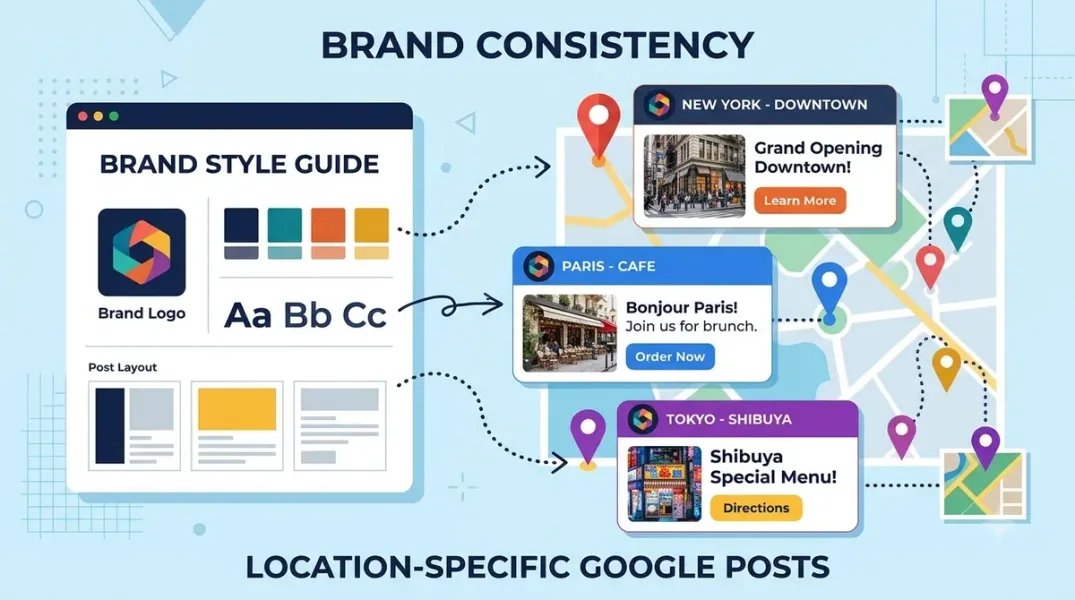
The design principle is: the brand provides the frame, the location provides the content.
Building a Post Template With Variable Slots
The most effective way to maintain consistency across variable posts is a template with defined slots.
A template for a local offer post might have fixed elements—the brand promise statement, the tone, the visual style, the call-to-action format, the required disclaimer—and variable slots—the specific offer, the local relevance line, the location name, and the dates.
A template for an event post might fix the event title format, the description structure, the image requirements, and the call to action, while allowing variation in the event details, the venue, the audience, and the local hook.
A template for a routine update might fix the opening line and the call to action, allowing variation in the content—a new team member, a local milestone, a neighborhood mention.
The template should be written down, with examples. A one-page template document with a fixed example and two varied examples makes it easy for local teams to understand what stays and what changes.
Templates work because they encode the brand requirements into the structure, so that every post that follows the template is consistent by construction. The local team’s creative energy goes into the variable content, not into re-deriving the brand voice from scratch.
Setting Rules for Local Variation
Templates need rules that define where variation is allowed and where it is not. Without rules, templates are suggestions, and suggestions get ignored under deadline pressure.
Rules to define include: Which fields are fixed—the brand promise line, the call-to-action format, the disclaimer, the logo usage. Which fields are variable—the local offer, the location name, the local reference. What cannot be changed—prohibited claims, prohibited categories, prohibited imagery, off-brand language. What must be checked—the checklist items that apply to any post, regardless of variation.
The rules should be short enough to remember and specific enough to enforce. A rule like “maintain brand voice” is too vague. A rule like “do not use exclamation marks; do not use slang; end with the standard call-to-action line” is enforceable.
Publish the rules alongside the templates, and include them in the training for anyone who drafts local posts.
Training Local Teams
Consistency at scale depends on the people writing the posts. Local teams who understand the brand and the rules produce consistent posts. Local teams who do not produce drift.
Training should cover four things: the brand—what the brand stands for, what voice it uses, what it avoids. the templates—how to use them, what changes and what does not. the rules—what is fixed, what is variable, what is prohibited. the approval process—how posts are reviewed and by whom.
Training does not need to be long. A one-hour session with examples and a short quiz is enough for most local teams. What matters is that it happens before anyone drafts a post, and that it is refreshed when templates or rules change.
Pair training with examples. Show a strong location-specific post that maintains brand consistency, and a weak one that drifts. The contrast makes the principle concrete.
Reviewing Local Posts for Consistency
Even with templates and training, some drift is inevitable. A review process catches it before it publishes.
Review local posts for: adherence to the template structure, presence of the fixed elements, appropriate use of variable content, compliance with rules, and overall brand voice. The review can be performed by the approver in the publishing workflow (see our guide to post approval processes), and it can be supported by a checklist.
The review should not aim to make every post identical. It should aim to ensure that the brand elements are present and the variation is appropriate. A post that varies from the template in a way that serves the location and preserves the brand elements is a good post, not a violation.
Review findings should feed back into templates and training. If local teams consistently vary in a particular way, either the template is too restrictive or the training is insufficient. Adjust accordingly.
Examples of Strong Location-Specific Posts
A strong location-specific post looks different from a generic post in identifiable ways.
It references the specific neighborhood or location—“our team on Main Street,” “near the Riverwalk,” “in the Eastside neighborhood”—rather than a generic “our location.”
It features local relevance—a staff member by name, a local partnership, a community event, a local landmark—that a customer in that location would recognize.
It uses the same brand voice as every other post—same tone, same structure, same call to action—so that a customer reading posts from three locations would recognize all three as the same brand.
It varies in content but not in character. The frame is the brand; the content is the location.
Conclusion
Location-specific posts and brand consistency are not opposites. They are complementary when the brand provides the frame and the location provides the content. Build templates with fixed and variable slots, set clear rules for variation, train local teams on the templates and rules, review posts for consistency, and feed review findings back into the system. The result is posts that feel local and sound like the brand—which is what customers want and what the brand needs.
Call to Action
Audit ten of your most recent local posts. Check whether they follow a consistent structure, whether they include the brand elements, and whether they vary in ways that serve the location. Use the findings to build or refine your post templates, and train local teams on the templates and rules before the next campaign.
FAQs
Should local teams be allowed to write their own posts?Yes, within a template. Local teams know their customers and can add relevance that corporate cannot. Templates and rules keep the variation consistent.
How much variation is too much?If a customer reading posts from multiple locations would not recognize them as the same brand, there is too much variation. The brand elements should be present in every post.
Do templates make posts feel generic?Only if they leave no room for local content. Templates that fix the frame and allow local variation in the content produce posts that feel both branded and local.
How do I train local teams quickly?A one-hour session with examples, a one-page template document, and a short quiz covers the essentials. Refresh training when templates or rules change.
Should every local post go through approval?Low-risk local updates can be published within templates by trained teams. Offers, events, and posts with regulated content should go through approval.
Internal and External Links
Internal links:
- How to Prevent Conflicting Google Business Posts When Multiple Team Members Publish Content
- How to Build a Google Business Post Approval Process Before Campaign Launch
- How to Reuse Existing Marketing Assets for Google Business Profile Campaigns
External links:
- Google Business Profile Help: Create and manage posts
- Google Business Profile Help: Posts content policy
- Google Business Profile Help: Best practices for posts
Grow Your Google Maps Ranking on Autopilot
Stop spending hours every week manually replying to customer reviews and writing Google posts. Busirank automates your Google Business Profile to boost your local SEO rankings and turn searchers into paying clients.

 Busirank Team