 Busirank Team
Introduction
A monthly report can be accurate, well-designed, and comprehensive, and still fail at the only thing that matters: getting the client to do something differently. The data is there, the charts are clear, the trends are visible—and the client reads it, nods, and waits for next month.
The gap is the recommendations. Most reports end with data and leave the interpretation to the client, who does not have the time, the context, or the expertise to decide what to do next. The agency or in-house team knows what the data means and what should happen because of it, but that knowledge is not in the report. It is in the team’s head, or in a conversation that never happens, or in a follow-up email the client skims.
Turning reports into recommendations is a discipline. It requires converting observations into proposed actions, ranking those actions by expected impact and effort, connecting each to evidence, and framing them so the client can make a decision. This guide explains how to do it.
Why Reports Without Recommendations Fail
A report without recommendations fails for three reasons, and each is worth understanding before designing a fix.
It shifts the interpretive burden to the client. The client hired the agency or the team for expertise. A report that presents data without interpretation asks the client to supply the expertise, which they may not have and which they did not hire for.
It creates a decision vacuum. When no recommendation is offered, the default decision is no decision. The month passes, the metrics move, and the same issues appear in the next report. The absence of a recommendation is not neutral—it is a decision to do nothing.
It obscures accountability. Without a recommendation, there is nothing to approve or reject, and therefore nothing to track. The team cannot be measured on whether its advice worked, and the client cannot see the value of the engagement.
A report with recommendations solves all three. It supplies the interpretation, creates a decision, and establishes accountability.
From Observation to Recommendation
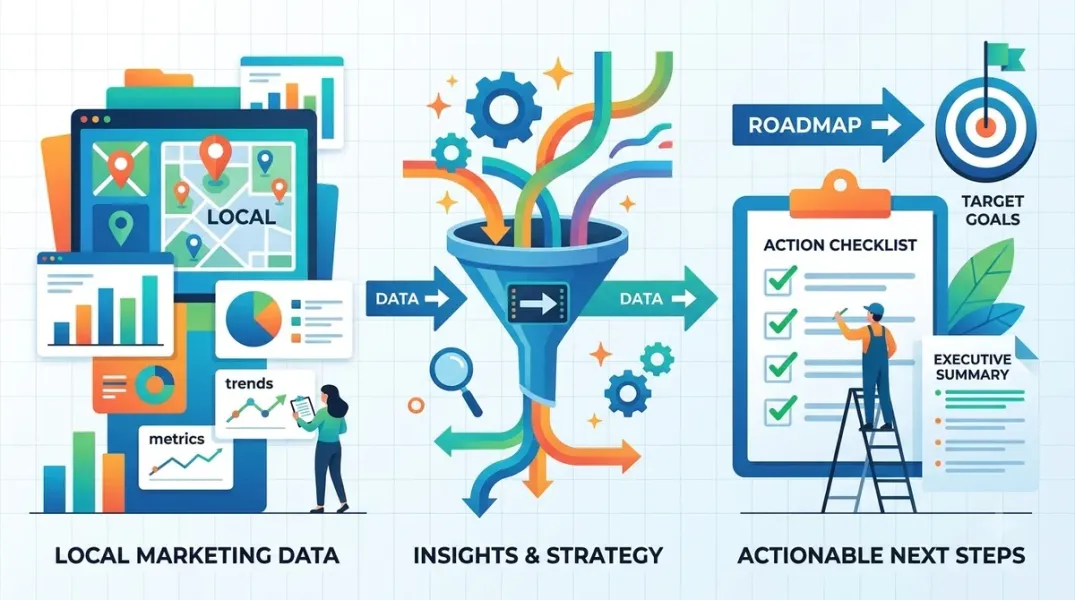
The conversion from observation to recommendation has four steps: observe, interpret, propose, and connect.
Observe means identifying what changed in the data. “Profile views increased 14 percent.” “Calls from mobile search increased 22 percent.” “Review velocity declined for the third consecutive month at four locations.”
Interpret means explaining what the change means. “Profile views increased 14 percent, likely driven by the new service pages and the seasonal increase in local searches.” “Review velocity declined because the review request process was paused during the system migration.”
Propose means stating what should be done. “Continue the service page rollout to the remaining twelve locations.” “Restart the review request process and add a reminder in the booking confirmation.”
Connect means linking the proposal back to the observation and to the client’s goals. “Continuing the rollout is expected to lift profile views at the remaining locations, supporting the goal of 20 percent more calls this quarter.”
A recommendation that has all four steps is complete. A recommendation that skips interpretation is a guess. One that skips connection is a preference. One that skips proposal is not a recommendation at all.
Ranking Recommendations by Impact and Effort
Not all recommendations are equal, and a list of twenty is a list the client will ignore. Rank the recommendations so the client knows where to start.
A simple ranking uses two dimensions: expected impact and effort required. High-impact, low-effort recommendations go first—they are the quick wins. High-impact, high-effort recommendations go next, with a note about the resource requirement. Low-impact, low-effort recommendations go last or are omitted. Low-impact, high-effort recommendations should be dropped unless there is a strategic reason to include them.
For each recommendation, estimate the impact in terms the client cares about—calls, visits, bookings, revenue—rather than in metrics. “Expected to increase calls from Google by 5 to 10 percent at the affected locations” is more useful than “expected to increase profile views.”
Ranking should be explicit. A one-page recommendation table with columns for recommendation, expected impact, effort, priority, and owner makes the ranking visible and the decisions easier.
Making Recommendations Specific
A specific recommendation can be approved and executed. A vague one cannot.
“Improve local SEO” is vague. “Update the primary category from ‘Restaurant’ to ‘Italian Restaurant’ at the six locations where the menu is Italian, and monitor impressions for four weeks” is specific. It states what will be done, where, and how the result will be measured.
A specific recommendation includes: the action, the target (locations, pages, posts, or profiles), the expected outcome, the timeline, and the metric that will be used to evaluate it. Each of these is a decision the client can approve or modify.
Vagueness often comes from the team not having decided what to recommend. If the recommendation is vague, the underlying analysis is probably incomplete. Return to the data and decide what should actually be done before writing the recommendation.
Framing Recommendations for Client Decisions
The framing of a recommendation determines whether the client feels able to decide. A recommendation framed as a question—“Should we consider increasing posting frequency?”—invites discussion without a proposal. A recommendation framed as a statement—“We recommend increasing posting frequency from once to twice a week at the top five locations, starting next month”—invites a decision.
The statement framing is better. It gives the client something to approve, reject, or modify. It also states the team’s professional judgment, which is what the client is paying for.
Each recommendation should be paired with the evidence that supports it and the risk if it is not taken. “Review velocity has declined for three months; if the review request process is not restarted, we expect ratings to erode over the next two quarters.” The evidence and the risk together give the client a clear basis for the decision.
For recommendations that require budget or significant effort, provide options. “Option A: full rollout at all locations, expected impact X, cost Y. Option B: pilot at five locations, expected impact Z, cost W.” Options turn a yes/no decision into a choice, which is often easier for clients to make.
Connecting Recommendations to Goals
Recommendations are more persuasive when they connect to the goals the client has already stated. If the client’s goal is to increase calls by 20 percent this quarter, every recommendation should be traceable to that goal.
This connection is often missing because the report and the goals are maintained separately. The fix is to reference the goals explicitly in the report and in each recommendation. A recommendation that says “this supports the Q3 goal of 20 percent more calls” is more likely to be approved than one that stands alone.
When a recommendation does not connect to a stated goal, either the goal needs updating or the recommendation needs reconsidering. Both are useful conversations, and both are better than a report full of disconnected suggestions.
Following Up on Recommendations
Recommendations that are not tracked are recommendations that are not taken. The report should include a status update on the prior month’s recommendations: which were approved, which were executed, which are in progress, and which were declined.
Tracking creates accountability in both directions. The client sees that the team is following through. The team sees which recommendations are being adopted and can adjust the framing or the type of recommendation in future reports.
When a recommendation is declined, note the reason. The reason often reveals a constraint the team did not know about—budget, timing, brand policy—and that constraint should shape the next month’s recommendations. A declined recommendation is data, not a dead end.
Conclusion
A report that ends with data leaves the client to do the work the team was hired to do. Converting observations into recommendations—interpreted, proposed, connected, ranked, and tracked—turns the report into a decision tool. The client knows what happened, why it matters, what to do next, and what it will achieve. The team knows which recommendations were taken and can measure their effect. The report becomes the mechanism through which the engagement actually produces change.
Call to Action
Review your last monthly report and count the number of specific, ranked, connected recommendations it contains. If the answer is zero, rewrite the recommendations section before the next report: for each significant finding, write an observation, an interpretation, a proposal, and a connection to a client goal. Rank them and present them for decision.
FAQs
How many recommendations should a report include?Three to five is a manageable number. More than that and the client will not act on any of them. Rank them so the client knows where to start.
What if the client does not want recommendations?Most clients want recommendations but may not have asked for them explicitly. Offer them and let the client decline. A report that offers clear recommendations demonstrates expertise.
Should recommendations include cost estimates?Where relevant, yes. Impact and effort estimates help the client prioritize. Even rough estimates are more useful than none.
How do I handle recommendations the client declines?Note the reason and adjust future recommendations to reflect the constraint. A declined recommendation is data about what the client can actually approve.
Can recommendations be automated?The data analysis can be automated; the recommendation requires judgment and should be written by the team. Tools can suggest, but the team should decide and frame.
Internal and External Links
Internal links:
- How to Build Monthly Local Marketing Reports That Clients Can Understand
- How to Create a Repeatable Monthly Local SEO Reporting Checklist for Agencies
- How to Turn Local Marketing Reports Into Clear Next-Step Recommendations
External links:
- Google Business Profile Help: Understand your business insights
- Google Analytics: Reporting overview
- BrightLocal: Local SEO reporting guide
Grow Your Google Maps Ranking on Autopilot
Stop spending hours every week manually replying to customer reviews and writing Google posts. Busirank automates your Google Business Profile to boost your local SEO rankings and turn searchers into paying clients.

 Busirank Team