 Busirank Team
Introduction
Every local business owner knows a loyal customer is worth more than a one-time buyer. But how much more? Without a number, marketing decisions become guesswork. You might overspend to acquire a customer who never returns—or underspend on a channel that brings in regulars who visit for years.
Customer lifetime value for local businesses answers that question with a dollar figure: the total profit a customer generates over their entire relationship with your business. Once you know that number, you can decide how much you can afford to spend to acquire a customer, which customers are worth investing in, and which retention efforts actually pay off.
This guide explains how to calculate customer lifetime value step by step, with formulas, worked examples, and common mistakes to avoid. It also shows how to use CLV to make smarter decisions about local advertising, loyalty programs, and customer retention.
1. What Is Customer Lifetime Value?
Customer lifetime value (CLV or LTV) is the total net profit a customer is expected to generate for your business over the entire time they remain a customer.
The key word is profit, not revenue. Revenue counts every dollar a customer spends. Profit counts what remains after you subtract the costs of delivering your product or service. A customer who spends $1,000 but costs you $900 to serve is worth far less than a customer who spends $500 but costs you $100.
CLV is different from a single transaction. It accounts for repeat purchases, purchase frequency, and how long customers stay with you. For local businesses—where customers often return for years—this long-term view changes how you think about marketing spend and service quality.
2. Why CLV Matters for Local Businesses
Local businesses have a natural advantage in CLV: customers live nearby and can return easily. That makes retention and repeat business especially valuable.
CLV matters because it helps you:
- Set acquisition budgets. If a customer is worth $800 over their lifetime, spending $200 to acquire them is a smart investment. If they are worth $60, it is not.
- Choose the right channels. Compare CLV across channels to see where your best long-term customers come from.
- Justify retention spending. Loyalty programs, follow-up systems, and great service cost money. CLV shows whether they pay off.
- Segment customers. Identify high-value customers and invest more in keeping them.
- Make pricing and service decisions. Understand which services or customer types generate the most long-term profit.
Fix: Calculate CLV for your business and use it as a benchmark for every marketing decision. If a campaign’s cost per acquisition is close to or above your CLV, it is not sustainable.
3. The Simple CLV Formula
Start with the simplest version. It gives you a workable estimate without complex modeling.
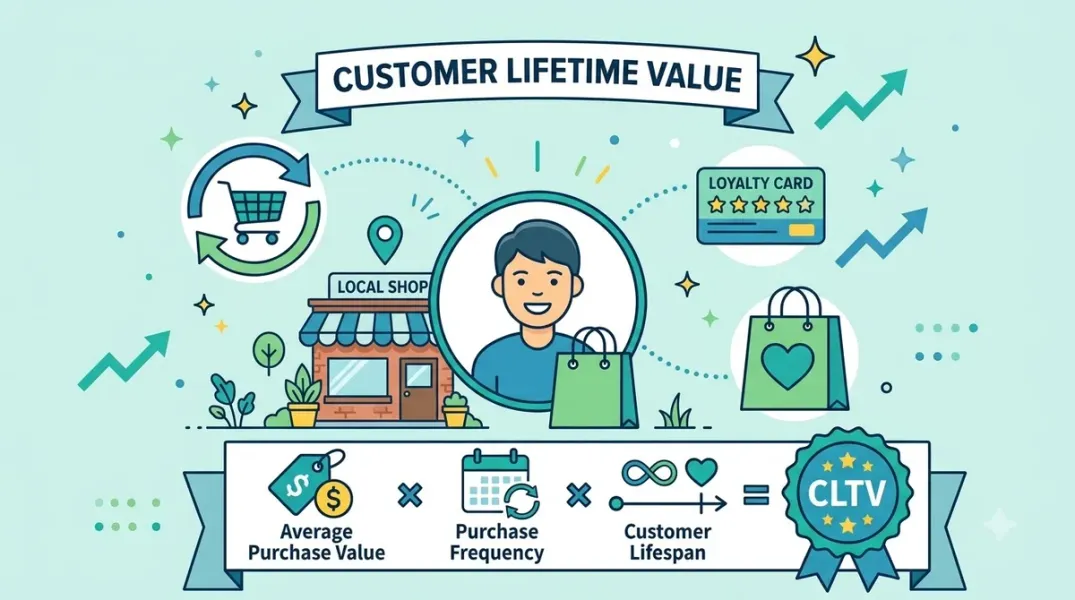
CLV = Average Purchase Value × Average Purchase Frequency × Average Customer Lifespan
Where:
- Average Purchase Value = Total revenue ÷ Number of purchases
- Average Purchase Frequency = Number of purchases ÷ Number of unique customers
- Average Customer Lifespan = Average number of years (or months) a customer stays with you
Example: A local coffee shop has average revenue of $12 per purchase, customers buy 60 times per year, and the average customer stays for 3 years.
CLV = 2,160 in revenue**
This is revenue, not profit. To get profit-based CLV, multiply by your profit margin.
4. The Profit-Based CLV Formula
Revenue-based CLV overstates value because it ignores the cost of serving customers. For decision-making, use profit-based CLV.
CLV (profit) = Average Purchase Value × Purchase Frequency × Customer Lifespan × Profit Margin
Using the coffee shop example with a 40% profit margin:
CLV = 864 in profit**
This $864 is the number you should compare against acquisition costs. If it costs $150 in advertising to acquire a regular coffee customer, the investment is clearly worthwhile.
Fix: Always calculate CLV using profit margin, not gross revenue. Revenue-based CLV leads to overspending on acquisition.
5. A Worked Example for a Local Service Business
Let’s walk through a service business—a residential cleaning company.
Step 1: Gather the inputs
- Average service price: $150
- Average number of cleanings per customer per year: 12
- Average customer lifespan: 2.5 years
- Profit margin: 30%
Step 2: Calculate annual revenue per customer$150 × 12 = $1,800 per year
Step 3: Calculate lifetime revenue$1,800 × 2.5 = $4,500 lifetime revenue
Step 4: Calculate profit-based CLV1,350 lifetime profit**
Step 5: Set an acquisition ceilingWith a $1,350 CLV, the cleaning company can comfortably spend up to roughly 450 to acquire a customer and still maintain healthy margins. This gives clear guidance for local ad campaigns, referral bonuses, and lead generation spending.
6. A Worked Example for a Local Retail Business
Now consider a local pet supply store.
Step 1: Inputs
- Average transaction value: $45
- Average visits per month: 2
- Average customer lifespan: 4 years
- Profit margin: 35%
Step 2: Annual revenue per customer$45 × 2 × 12 = $1,080 per year
Step 3: Lifetime revenue$1,080 × 4 = $4,320
Step 4: Profit-based CLV1,512 lifetime profit**
This tells the store that a loyal pet owner is worth over $1,500 in profit. That justifies investing in a loyalty program, personalized reminders for pet food reorders, and community events that build relationships.
7. Adjust for Churn and Retention Rate
The simple formulas assume customers stay for a fixed lifespan. In reality, customers leave at different rates. A more accurate approach accounts for retention rate.
Retention rate is the percentage of customers who remain customers over a period. If 80% of your customers return each year, your retention rate is 80%.
A churn-adjusted CLV formula:
CLV = (Average Purchase Value × Purchase Frequency × Profit Margin) ÷ Churn Rate
Where Churn Rate = 1 − Retention Rate.
Example: A gym has an average monthly fee of $50, a 70% monthly retention rate (so churn is 30%), and a 50% profit margin.
CLV = ($50 × 1 × 0.50) ÷ 0.30 = $25 ÷ 0.30 = $83.33 per month of expected value
Over 12 months, this works out to roughly $1,000 in lifetime profit per member.
Fix: If you can measure retention, use the churn-adjusted formula. It gives a more realistic picture, especially for subscription-style or recurring-service businesses.
8. Segment CLV by Customer Type
A single average CLV hides important differences. Your best customers may be worth five times the average. Segmenting CLV shows where to focus.
Useful CLV segments for local businesses:
- New vs. repeat customers
- Service type (e.g., emergency repairs vs. routine maintenance)
- Acquisition channel (Google Ads vs. organic vs. referral)
- Neighborhood or service area
- Purchase frequency (occasional vs. regular)
- Spend level (high-value vs. budget)
Example: A landscaping company might find that customers acquired through referrals have a CLV of $3,200, while customers from a discount ad campaign have a CLV of $800. That insight should shift budget toward referrals.
Fix: Calculate CLV by segment quarterly. Use the results to prioritize high-value segments and channels.
9. Common CLV Calculation Mistakes
CLV is easy to calculate badly. Watch for these common errors.
Mistakes to avoid:
- Using revenue instead of profit. This inflates CLV and leads to overspending.
- Ignoring churn. Assuming every customer stays forever overstates value.
- Using too short a timeframe. Local customers often stay for years. A six-month view understates CLV.
- Averaging across all customers. Your best customers may be worth far more than the average. Segment when possible.
- Forgetting service costs. Delivery, support, returns, and discounts all reduce profit.
- Treating CLV as fixed. CLV changes as retention, pricing, and costs change. Recalculate regularly.
- Double-counting referrals. Referral value is real, but calculate it separately rather than baking it into CLV without evidence.
Fix: Document your formula and assumptions. Review them quarterly and update when prices, margins, or retention change.
10. Use CLV to Guide Local Marketing Decisions
CLV is only useful if it changes what you do. Here are practical ways to apply it.
Set cost-per-acquisition targets. A common rule is to keep acquisition cost below one-third of CLV. If CLV is $900, target a cost per acquisition under $300.
Compare channels. Calculate CLV by acquisition source—Google Ads, organic search, referrals, social media, direct mail. Shift budget toward channels that bring high-CLV customers, not just cheap leads.
Justify retention investment. If increasing retention from 60% to 70% raises CLV by $200, a loyalty program costing $50 per customer is clearly worthwhile.
Prioritize high-value segments. If commercial clients have triple the CLV of residential clients, invest more in reaching and retaining them.
Evaluate promotions. A discount that attracts one-time buyers with low CLV may be less profitable than a smaller offer that attracts loyal, high-CLV customers.
Fix: Build CLV into your monthly marketing review. Compare cost per acquisition against CLV for every active channel.
11. Increase CLV With Practical Local Tactics
Once you know your CLV, the next step is to increase it. Small improvements compound over a customer’s lifetime.
Ways to raise CLV:
- Improve retention. Better onboarding, follow-up, and service quality keep customers longer.
- Increase purchase frequency. Reminders, subscriptions, and seasonal offers encourage repeat visits.
- Increase average order value. Bundles, upgrades, and complementary services raise spend per visit.
- Reduce churn. Identify at-risk customers and re-engage them before they leave.
- Build loyalty programs. Rewards give customers a reason to return.
- Ask for referrals. Referred customers often have higher CLV and lower acquisition costs.
Fix: Pick one or two levers and measure the impact on CLV over six to twelve months.
Conclusion
Customer lifetime value turns a vague sense of customer worth into a concrete number you can use to make better decisions. By calculating CLV with profit margins, accounting for churn, segmenting by customer type, and applying the results to acquisition budgets and retention investments, local businesses can spend smarter and grow more profitably.
The formula is simple. The discipline is in using it consistently—and in remembering that CLV is not just a metric. It is a reminder that every customer interaction, from first contact to repeat visit, shapes the long-term value of your local business.
Call to Action
Want to know what a customer is really worth to your business? Start by gathering your average purchase value, purchase frequency, customer lifespan, and profit margin—then run the simple formula. If you want help building a CLV model and using it to guide your marketing budget, contact us for a free CLV analysis consultation and get a clear plan for your next steps.
FAQs
Q1: What is customer lifetime value for local businesses?A: CLV is the total net profit a customer is expected to generate over their entire relationship with your business. It accounts for purchase value, frequency, lifespan, and profit margin.
Q2: What is a good customer lifetime value?A: There is no universal number—it depends on your industry and margins. What matters is the ratio of CLV to customer acquisition cost. A common guideline is to keep acquisition cost below one-third of CLV.
Q3: Should I use revenue or profit to calculate CLV?A: Use profit. Revenue-based CLV overstates customer value and can lead you to overspend on acquisition and retention.
Q4: How do I calculate CLV if I don’t know my customer lifespan?A: Estimate it from your records—how long customers typically stay active—or use a retention rate and churn-adjusted formula. Start with an estimate and refine it as you collect more data.
Q5: How often should I recalculate CLV?A: Review CLV quarterly or at least annually. Recalculate whenever prices, margins, retention rates, or your customer mix change significantly.
Grow Your Google Maps Ranking on Autopilot
Stop spending hours every week manually replying to customer reviews and writing Google posts. Busirank automates your Google Business Profile to boost your local SEO rankings and turn searchers into paying clients.
 Busirank Team