 Busirank Team
Introduction
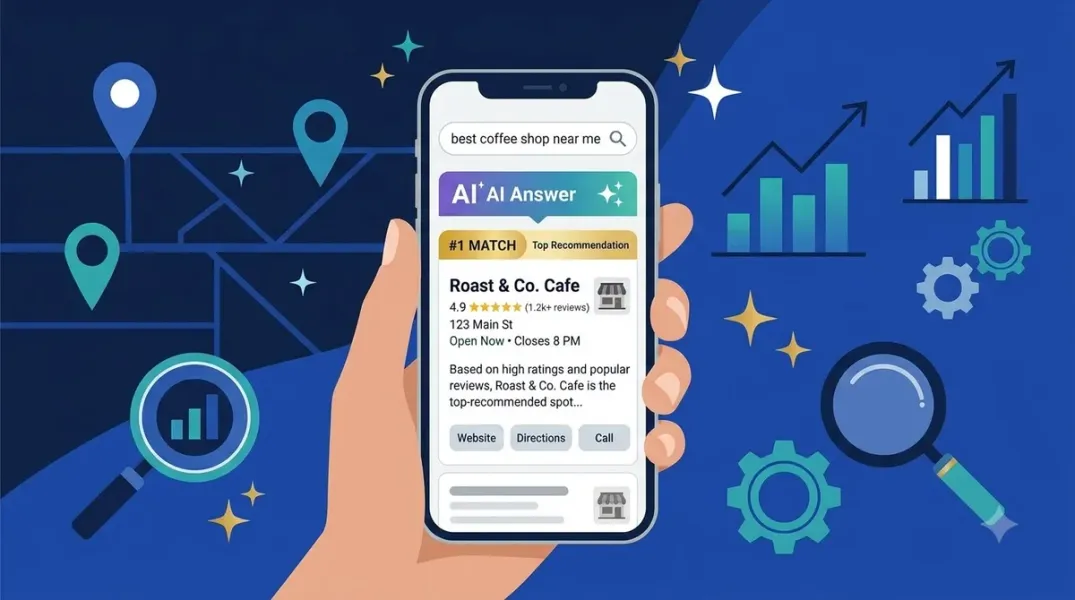
Local search has split into two games. In one, you compete for a spot in the traditional Google local pack—the three-business map result that has driven local customers for years. In the other, you compete to be named, cited, or recommended inside an AI-generated answer that never shows a map at all.
The gap between those two games is widening fast. AI Overviews now appear in 68% of local searches, compared with only 39% for local packs. That means for a large share of local queries, customers are getting an answer—and often a recommendation—without ever seeing the map results you have worked to rank in.
This is the new reality of AI search optimization for local businesses. It does not replace traditional local SEO; it extends it. The businesses that win are the ones that build a machine-readable, fact-dense, consistently verified presence across every source AI systems trust. This guide explains how to do exactly that.
1. Understand How AI Search Chooses Local Businesses
AI search engines are not traditional search engines. They do not return a list of links for you to browse. They synthesize information from across the web and deliver a direct, conversational answer. When a customer asks ChatGPT “Who is the best plumber near me?” or queries Perplexity for “top-rated family dentists in Austin,” the AI either names your business or it does not.
AI systems evaluate local businesses across three dimensions of confidence:
- Entity confidence: “Am I sure this business exists and is what it claims to be?”
- Relevance confidence: “Does this business match the user’s query?”
- Quality confidence: “Is this business actually good?”
Everything in your optimization strategy should increase one or more of these three confidences. AI systems pull from entity signals (NAP consistency, structured data, directory listings), content signals (quotable statements, FAQ content, definitive claims), trust signals (review volume and sentiment, citation density), freshness signals (recently updated content, active profiles), and specificity signals (location-specific content, hyper-local detail).
2. Treat Your Google Business Profile as AI’s Primary Source of Truth
When Gemini or Google’s AI Overview answers a local search query, your Google Business Profile (GBP) is the primary source it trusts. Not your website. Not your Instagram. Your GBP.
Google describes the GBP as the “grounding source” for AI. It helps AI determine whether your business is open, what it offers, and what customers can expect. Every missing service, outdated detail, or broken link creates a gap in the story you are telling AI—and those gaps can affect what AI shares with potential customers.
GBP optimization for AI search:
- Complete every field. Categories, services, attributes, hours, service area, description, and photos. Do not leave attributes blank—AI skips incomplete profiles when matching intent-specific queries.
- Use the first 250 characters of your description wisely. This is prime real estate for AI extraction. State what you do, where you do it, and what makes you different.
- Add all relevant attributes. “Outdoor seating,” “dog-friendly,” “happy hour,” “live music”—these are not checkboxes. They are how AI matches your business to specific searches.
- Post regularly. Google Posts are back in a meaningful way, with a “what’s happening” module that surfaces current deals, events, and specials directly on your profile.
- Update hours, including exceptions. Seasonal hours, holiday schedules, and temporary changes must be accurate and updated at least 72 hours before they take effect.
3. Build Absolute NAP Consistency Across the Web
AI systems cross-reference your business information against everything they can find. When they see conflicting addresses, hours, or categories across sources, they do not average them out. They treat inconsistency as a credibility issue, and AI avoids uncertainty.
Even minor variations—“St.” versus “Street,” an old phone number, a different suburb spelling—reduce entity confidence and can cause AI to skip your business entirely.
What to do:
- Audit your listings across 60+ directories and fix every inconsistency.
- Standardize your business name, address, and phone number to a single canonical format and use it everywhere.
- Claim and verify Google Business Profile, Bing Places, Apple Maps Connect, and Yelp.
- Fix or remove duplicate listings on all major directories.
- Verify your information in data aggregators such as Data Axle, Localeze, and Foursquare, which feed hundreds of downstream sources.
AI pulls from unexpected sources—mapping tools, niche directories, regional publishers, even MapQuest. Presence on the “big three” is no longer enough.
4. Deploy Comprehensive Schema Markup
Structured data is the most direct communication channel between your website and AI systems. While human visitors read your copy, AI systems read your schema markup. Businesses with comprehensive structured data are cited substantially more often in AI-generated responses than businesses without it—comprehensive schema can increase AI citation rates by 2–3x.
The essential schema types for local businesses:
| Schema Type | Purpose | AI Visibility Impact |
|---|---|---|
| LocalBusiness | Defines your entity identity (name, address, phone, hours, geo, business type) | Critical, required for entity recognition |
| FAQPage | Provides Q&A pairs AI can cite directly | High, direct extraction |
| Review / AggregateRating | Surfaces trust and quality signals | High, influences quality confidence |
| Service | Defines what you offer and where (areas served, pricing) | Medium-high, improves relevance matching |
| BreadcrumbList | Shows site hierarchy and topical authority | Medium |
Source: Locafy AEO checklist
Critical rule: Schema must match visible content and GBP data. When structured data contradicts on-page content, Google does not reconcile the difference—it discounts the markup and often ignores the information altogether. False positives, such as marking up services as products or claiming credentials you do not have, are particularly damaging because AI models are conservative when confidence is low.
5. Write for Fact Density, Not Keyword Coverage
AI systems are pattern-recognition systems. They look for structured, specific, directly useful information that answers real questions without requiring interpretation. A 200-word page that says you “serve Nashville with pride” and repeats your service list gives the AI nothing to work with.
What AI actually needs from your content:
- Definitive, entity-rich statements. Cited passages skew heavily toward specific, factual claims. “Our average emergency response time is 47 minutes” and “We’ve completed 2,300+ residential projects across the Greater Dallas area since 2014” get pulled. Generic marketing copy gets ignored.
- Quotable statements with numbers. Short, declarative, fact-dense sentences with a number and a source are more citable. Pages averaging 11 to 14 words per sentence had roughly a 7% higher likelihood of being cited, likely because shorter sentences are easier for AI to parse and extract cleanly.
- FAQ content with direct, complete answers. Not vague teasers that force a click. 15–30 questions per service area is a strong target.
- Service pages with specific details: pricing ranges, timelines, certifications, service area boundaries, and response times.
- Location-specific content that names neighborhoods, landmarks, and service corridors.
Publishing more content without improving structure actively works against you in an AI retrieval environment. Semantic precision matters more than volume.
6. Rebuild Location Pages for AI Citation
The cookie-cutter location page—same structure, same generic copy, just swap the city name—no longer works. AI systems spot it immediately and move on.
What AI-citable location pages need:
- NAP, service area, and hours in table format. Tables give AI discrete, labeled data points it can extract with confidence.
- Testimonials from customers in that specific city, with neighborhood references if possible.
- FAQs specific to that market—permit questions, local regulations, climate-specific concerns.
- Real project examples or case studies from that location.
- A structured data grid showing regional pricing ranges, service tiers, or compliance details.
Prove geographic legitimacy with landmark images. Google’s vision AI analyzes photos to verify geographic legitimacy. Generic stock images of smiling professionals in a nondescript office read as low-context boilerplate—the AI does not know where you are, so it finds someone else to cite.
The fix is intentional local imagery: three landmark images per location page, sourced from Google Images using Creative Commons filters. Rename files descriptively (“navy-pier-chicago-lakefront.jpg”), write alt text that describes the image and mentions the location naturally, and attribute properly in a small caption.
Structure each location page hero with: a primary image of an iconic, instantly recognizable landmark; a secondary image showing people in the area with a landmark visible in the background; and a full-width feature shot of a third local landmark or skyline.
7. Win the Review Layer for AI
Reviews are not just a trust signal for human customers. They are a primary input for AI-generated recommendations.
Review signals are one of the strongest factors in AI local search:
- Review signals carry roughly 20% weight in local ranking factor models, up from 16% in 2023, and the trend is rising.
- Google accounted for 79.4% of reviews per location in 2025, reinforcing its dominance as the primary reputation signal influencing both local SEO and AI-generated results.
- The “what customers are saying” snippet at the top of an AI Overview is pulled directly from your reviews.
Review strategy for AI visibility:
- Build review velocity. Target a minimum of 5 new Google reviews per month. AI systems weigh both volume and recency.
- Respond to every review—positive and negative—within 24–48 hours. Responding across the spectrum shows your business is active and engaged, and that engagement goes a long way with AI systems.
- Use review responses to reinforce entity signals. Name your location, reference your products, and reinforce your brand voice.
- Collect reviews across multiple platforms, not just Google. Third-party review authority is a top-five ranking factor for AI search.
8. Build Trust Signal Density Across the Web
AI systems do not check one or two sources. They cross-reference dozens. The more platforms that corroborate your business information with consistent details, the higher your trust signal density—and the more likely AI is to recommend you.
Trust signal building:
- Build citations across 60+ authoritative directories, including industry-specific and local directories, not just the big five.
- Earn mentions on local news sites, community blogs, and industry publications through sponsorships, events, or expert commentary.
- Maintain active social media profiles with consistent branding and regular posts—AI systems reference social profiles as entity signals.
- Ensure your website has authoritative backlinks—quality over quantity.
9. Optimize for Each AI Platform Individually
Different AI platforms weight different signals. A blanket approach works for the foundation, but platform-specific optimization separates good from great.
Google AI Overviews: Prioritize GBP completeness, review signals, and Map Pack authority. AI Overviews now answer most local searches—68% of local business-type queries versus 39% for local packs—so Google-specific optimization has the largest reach.
ChatGPT: Emphasize web content quality, structured data depth, and Wikipedia/Wikidata presence if applicable. ChatGPT is the fastest-growing AI search platform.
Perplexity: Focus on recently published, high-authority content with clear citations and data points. Perplexity emphasizes freshness and is used by the highest-intent users.
Gemini: Integrated with the Google ecosystem, so GBP completeness and Google-centric signals carry the most weight.
10. Monitor Your AI Visibility
If you are only measuring traditional local rankings, you have a serious blind spot. You need to know whether AI systems are naming your business, how they describe you, and which sources they cite.
A practical AI visibility monitoring routine:
- Build a monthly test set of 15–20 buyer questions by service, location, and need. Use the words an actual customer would use, not category terms.
- Run each question across ChatGPT, Gemini, Perplexity, and Google (looking for AI Overviews at the top of results). Use a private/incognito session with no history.
- Record whether you appear, how you are described, and which sources are cited.
- Baseline per engine and per real question, then track month over month.
- Set up monthly AI search visibility monitoring using AEO tools where possible, tracking citation frequency, recommendation share, and competitive positioning.
Conduct quarterly AEO audits: re-run the audit queries, compare to baseline, and identify gaps in coverage. Adjust strategy based on what is working and where competitors are gaining ground.
Conclusion
AI-powered search has changed the local discovery game. The question is no longer only “Do I rank in the local pack?” It is also “Does AI trust my business enough to recommend it?” Those are related questions, but they are not the same question.
The businesses that win in this new environment are the ones that build absolute entity consistency, deploy comprehensive schema, write fact-dense content that AI can extract and cite, rebuild location pages for geographic legitimacy, win the review layer, and monitor their visibility across every AI platform their customers use.
Traditional local SEO still matters. But AI search optimization for local businesses is now the layer that determines whether you are named in the answer—or invisible in the conversation.
Call to Action
Is your business visible in AI search results? Run a simple test: open ChatGPT, Gemini, Perplexity, and Google, and ask the questions your customers ask before they hire you. If your business does not appear—or if competitors are named instead—you have a clear opportunity to act. Contact us for a free AI search visibility audit and get a practical plan to make your business citable, trustworthy, and recommendable across every AI platform.
FAQs
Q1: What is AI search optimization for local businesses?A: It is the process of optimizing your business presence—your Google Business Profile, website, schema markup, reviews, and citations—so AI systems like Google AI Overviews, ChatGPT, Gemini, and Perplexity can confidently identify, verify, and recommend your business.
Q2: Is AI search optimization different from traditional local SEO?A: They overlap significantly. Traditional local SEO focuses on ranking in the local pack. AI search optimization focuses on being cited and recommended in AI-generated answers. The foundations—NAP consistency, reviews, schema, and content quality—serve both, but AI requires greater fact density, entity consistency, and structured data.
Q3: What is the most important thing I can do for AI local visibility?A: Complete and optimize your Google Business Profile. Google’s AI treats your GBP as the primary source of truth for local business information. An incomplete or inconsistent profile creates gaps that can cause AI to skip your business.
Q4: Do I need schema markup for AI search?A: Yes. Comprehensive structured data can increase AI citation rates by 2–3x. Prioritize LocalBusiness schema on your homepage, Service schema on service pages, and FAQPage schema wherever you answer customer questions. Schema must match visible content and GBP data.
Q5: How do I check if my business appears in ChatGPT or Perplexity?A: Open a private or incognito session and ask the questions a customer would ask—“best [category] in [city]” or “who should I hire for [service]?” Run the same questions across ChatGPT, Gemini, Perplexity, and Google. Record whether your business is named, how it is described, and which sources are cited. Repeat monthly to track progress.
Grow Your Google Maps Ranking on Autopilot
Stop spending hours every week manually replying to customer reviews and writing Google posts. Busirank automates your Google Business Profile to boost your local SEO rankings and turn searchers into paying clients.
 Busirank Team