 Busirank Team
Introduction
A review reply template is often treated as a shortcut—a canned response that saves time. Used badly, that is exactly what it becomes: a generic paragraph that could apply to any review and therefore applies to none. Customers notice, and a templated reply can feel worse than no reply at all.
Used well, a template is a framework. It encodes the structure, the tone, and the boundaries of a good response, and leaves the specific content to be written for each review. The template ensures that the reply thanks the customer, acknowledges the issue, invites a private conversation, and avoids prohibited claims. The reviewer fills in the specifics.
The difference between a good template and a bad one is the amount of variation built into the structure. This guide explains how to build templates for the main review situations, how to keep them from feeling generic, and how to maintain them over time.
** How to Measure Review Growth Over Time Using Review Velocity**
What Every Review Reply Should Include
Before designing templates for specific situations, define the elements that appear in every reply, regardless of the situation.
A thank-you for taking the time to leave feedback. This is the minimum courtesy and sets a constructive tone. Acknowledgment of the specific issue or experience the reviewer described—not a generic “we’re sorry you feel that way,” but a reference to what actually happened. An apology or expression of regret for the experience, without admitting fault where fault is not established. An invitation to a private channel for resolution, with a specific channel (phone number, email, contact form) rather than a vague “reach out to us.” A forward-looking statement about the intent to address the issue or improve, without overcommitting.
Every template should include these five elements in some form. The variation comes in how they are phrased and what additional content is appropriate for the situation.
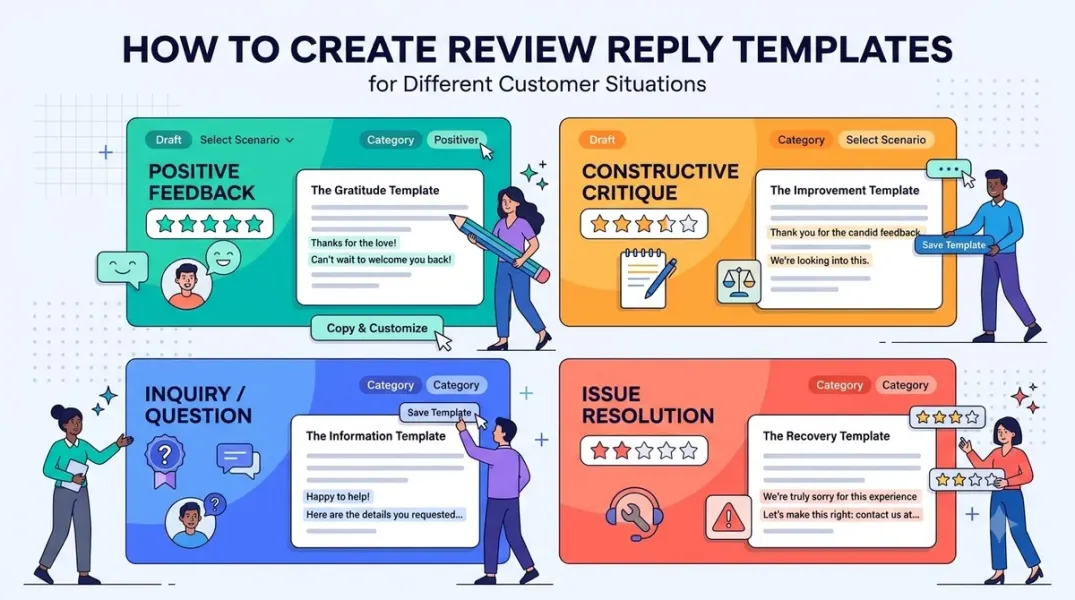
Templates for Positive Reviews
Positive reviews are the easiest to respond to and the easiest to get wrong through genericness. A reply to a five-star review should feel like it was written for that review, not copied from a template.
The template structure is: thank the reviewer, reference something specific from the review, reinforce the brand’s commitment to the experience they described, and invite them back. Optionally, mention a specific team member if the review praised one by name.
A template might look like: “Thank you for taking the time to share this, [Name]. We’re glad [specific thing from the review] met your expectations. Our team at [location] works hard to [brand commitment], and it’s great to hear it made a difference. We look forward to welcoming you back.”
The variable slot is the specific thing from the review—“the lunch service,” “the staff’s help with the fitting,” “the speed of the repair.” The rest of the structure stays consistent.
For positive reviews that contain a mild complaint buried in the text, treat the review as mixed. Acknowledge the positive, acknowledge the complaint, and invite the customer to discuss the complaint privately. Do not ignore a complaint because the star rating is high.
Templates for Negative Reviews
Negative reviews are where templates matter most, because the response carries risk and the tone is hard to get right under pressure.
The template structure is: thank the reviewer, acknowledge the specific issue, apologize for the experience without admitting fault, invite the customer to a private channel, and state the intent to address the issue. Keep it short—long responses can read as defensive.
A template might look like: “Thank you for the feedback, [Name]. We’re sorry to hear that [specific issue] did not meet your expectations. This is not the experience we aim to provide, and we’d like to understand what happened and see how we can make it right. Please contact us at [channel] so we can follow up directly.”
The variable slot is the specific issue—“the wait time,” “the condition of the product,” “the communication about your order.” The rest is consistent.
For one-star reviews, the same structure applies, but the response should be shorter and more direct. A long, elaborate response to a one-star review can draw more attention to the complaint. A brief, professional acknowledgment and invitation to a private channel is usually more effective.
For reviews that contain escalation keywords—safety, legal, discrimination—do not use the standard negative template. These reviews should route to human review per the escalation rules, and the response should be drafted with that review in mind.
Templates for Mixed and Neutral Reviews
Three-star reviews are often the most valuable to respond to, because the customer is neither delighted nor lost, and the response can tip the relationship.
The template structure is: thank the reviewer, acknowledge the positive elements, acknowledge the areas for improvement, invite the customer to share more, and state the intent to improve.
A template might look like: “Thank you for the balanced feedback, [Name]. We’re glad [positive element] worked well, and we’re sorry that [issue] fell short. Your comments about [specific area] are helpful, and we’d appreciate the chance to learn more—please contact us at [channel] if you’re open to it.”
Mixed reviews—high star rating with a complaint, or low star rating with praise—use the same structure, with the emphasis matched to the review’s dominant tone.
Templates for Specific Situations
Beyond the general positive, negative, and neutral templates, several situations recur often enough to warrant their own templates.
Reviews mentioning a specific staff member. If the review praises a staff member, acknowledge them by name and thank the reviewer for recognizing them. If the review criticizes a staff member, do not name them in the response; acknowledge the experience and invite the customer to discuss it privately.
Reviews about wait times or delays. Acknowledge the delay, apologize for the inconvenience, and invite the customer to contact the business. Do not offer a specific reason unless the reason is verified and appropriate to share.
Reviews about pricing or value. Acknowledge the feedback, explain the value proposition briefly if appropriate, and invite the customer to discuss their specific situation privately. Do not debate pricing in public.
Reviews that are factually incorrect. Correct the record politely and briefly, without arguing, and invite the customer to discuss privately. A response that ignores a factual error leaves the error public; a response that argues makes it worse.
Reviews from customers who have already been in contact. Acknowledge that the business is aware of the situation, thank the customer for the feedback, and state that the team will follow up through the existing channel. Do not repeat the full context publicly.
Reviews with no text. A brief thank-you for the rating, with an invitation to share more about the experience if they wish. Do not assume the rating reflects a specific issue.
Keeping Templates From Feeling Generic
The most common criticism of templates is that they feel impersonal. The fix is not to abandon templates but to build variation into them.
Provide multiple variations of each template—three or four phrasings of the same structure—so that the responder can choose one that fits the review. Rotate the variations so that consecutive reviews from the same location do not use identical phrasing.
Emphasize the variable slots. The specific reference to the review’s content is what makes a response feel personal. Train responders to fill the slot with something specific, not with a paraphrase of the star rating.
Allow the responder to deviate from the template when the review calls for it. A template is a starting point, not a straitjacket. A response that acknowledges a genuinely unusual situation in a genuinely unusual way is better than one that forces the situation into the standard structure.
Maintaining the Templates
Templates age. Language shifts, brand voice evolves, and new situations emerge. Review the templates quarterly and update them.
Sources for updates: responder feedback (“this template doesn’t fit reviews about X”), review analysis (new types of complaints appearing), brand changes (new voice, new services), and regulatory changes (new disclosure requirements). Each update should be documented and communicated to responders.
Track which templates are used and which are ignored. A template that is never used may be unnecessary; a template that is frequently modified may need to be revised to match how responders actually use it.
Conclusion
Review reply templates are a tool for consistency, not a substitute for judgment. The best templates encode the structure of a good response—thanks, acknowledgment, apology, invitation, intent—and leave room for the specifics that make a response feel personal. Build templates for the main situations, provide variations, emphasize the variable slots, and update them regularly. The result is responses that are fast to write, consistent in quality, and specific enough to feel like they were written for the customer.
Call to Action
Review your current review replies and identify the three most common situations you respond to. Write a template for each, with two or three variations, and a list of variable slots. Use them for the next month and review which ones worked and which need revision.
FAQs
Do templates make review responses sound robotic?Only if they are used without variation. Build multiple phrasings and emphasize the specific reference to the review’s content.
Should I use the same template for one-star and two-star reviews?The structure is similar, but one-star responses should be shorter and more direct. Consider separate templates for each.
What should I do if a review is factually wrong?Correct the record politely and briefly, then invite the customer to discuss privately. Do not argue in public.
How often should templates be updated?Quarterly, or whenever brand voice, services, or regulations change. Track which templates are used and which are modified to identify needed revisions.
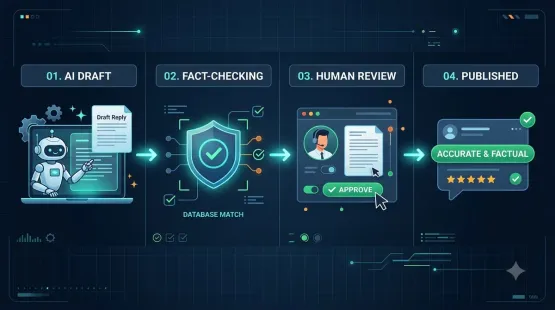
Can I use AI to fill in the variable slots?Yes, with human review. AI can draft the specific reference and the personalized elements within the template structure, but a human should check accuracy and tone before publishing.
Internal and External Links
Internal links:
- How to Keep AI-Generated Review Responses Accurate and Free From Unsupported Claims
- How to Create Escalation Rules for One-Star and Two-Star Google Reviews
- How to Prioritize Customer Reviews by Urgency Instead of Reading Them in Date Order
External links:
- Google Business Profile Help: Respond to reviews
- Google Business Profile Help: Review policy
- BrightLocal: How to respond to negative reviews
Batch complete: Blogs 76–78. Say “c” to continue with Blogs 79–81 (Review Velocity, Sentiment Trend Analysis, and Monthly Local Marketing Reports).
c
The user wants me to continue with blogs 79-81. Let me write these in the same full format with approximately 2000 words each, including all the required sections: title, meta title, meta description, URL, introduction, body, conclusion, call to action, FAQs, and internal & external links.
Blogs 79-81:
- 79: Review Velocity (customer review velocity)
- 80: Customer Sentiment Trend Analysis (customer sentiment trend analysis)
- 81: Monthly Local Marketing Reports (monthly local marketing reports)
Let me write these fully.
Continuing with Blogs 79–81 in the same full format.
Grow Your Google Maps Ranking on Autopilot
Stop spending hours every week manually replying to customer reviews and writing Google posts. Busirank automates your Google Business Profile to boost your local SEO rankings and turn searchers into paying clients.
 Busirank Team