 Busirank Team
Introduction
Most local promotion calendars are built backwards. A team brainstorms promotions, assigns dates, and publishes. The calendar reflects what the marketing team thought of, not what customers were looking for or what the business needed at that moment in the year.
The result is predictable: a promotion in a slow month that does not move revenue, a discount during peak season that gives away margin for no reason, and a cluster of campaigns in months when customers are not shopping. The calendar is busy, but it is not aligned.
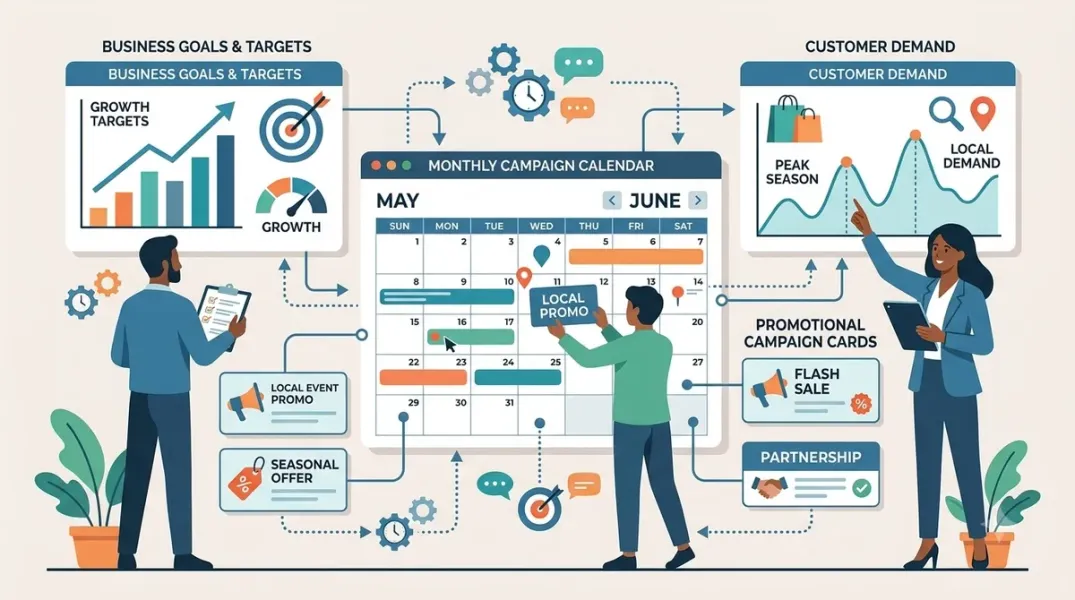
A better approach starts with two inputs—business goals and customer demand—and builds the calendar from there. This guide explains how to identify both inputs, how to map them to a twelve-month promotion calendar, and how to keep the calendar responsive as the year unfolds.
Start With Business Goals, Not Promotion Ideas
The first question in calendar planning is not “what promotions should we run?” It is “what does the business need this year, by month?”
Different months carry different needs. A retail business may need to drive foot traffic in January after a slow December, clear inventory in March before spring lines arrive, build awareness in September as customers return from summer, and maximize revenue in November and December. A service business may need to fill capacity in slower months, smooth demand in months with long waitlists, and create reasons for past customers to return.
List the business goals by month. Be specific. “Increase revenue” is not a goal that shapes a calendar; “drive 15 percent more appointments in February and March, when bookings historically drop” is. Each goal should have a metric and a target, so that the calendar can later be evaluated against it.
With the goals mapped, the calendar’s purpose becomes clearer: each promotion should serve a monthly goal. If a promotion does not serve a goal, it is a candidate for removal.
Read Customer Demand Signals
Business goals tell you what the business needs. Customer demand tells you what customers are likely to respond to. Both are necessary; a promotion that serves a business goal but ignores customer demand will fail, and one that chases demand but ignores the business goal may succeed at the wrong thing.
Demand signals come from several sources. Historical performance—past promotions, past months’ bookings, past revenue—shows when customers have responded and when they have not. Google Business Profile insights show searches, views, and calls, and their seasonality. Website and landing page traffic shows when interest rises and falls. Search trends for relevant local terms show when demand builds. Seasonal and cultural events—holidays, school terms, local festivals—shape when customers are in the market. Weather patterns, for businesses sensitive to weather, affect when customers decide.
Pull these signals into a single view by month. You are looking for months where demand naturally rises (peak season), months where it naturally falls (trough season), and months where an event or campaign can create demand (opportunity months).
The calendar should protect peak season—do not discount away margin when demand is already high—and stimulate trough season, where promotions can shift demand forward or create new reasons to visit.
Map Goals and Demand to a Twelve-Month Calendar
With both inputs in hand, build the calendar month by month. For each month, record the business goal, the demand signal, and the promotion plan.
A typical mapping looks like this. In a peak demand month, the goal might be to capture maximum revenue and margin. The promotion plan may be light—perhaps a value-add or a loyalty reward rather than a discount—and the emphasis is on visibility and conversion rather than price. In a trough month, the goal might be to drive volume, and the promotion plan may include a stronger offer to create a reason to buy. In an opportunity month, tied to a local festival or season, the goal might be awareness or trial, and the promotion plan is event-driven.
The calendar should also account for timing. Promotions published too early reach customers before they are ready to act; promotions published too late miss the decision window. For seasonal demand, schedule promotions to publish before the season’s decision window opens—for back-to-school, that may be mid-July; for holiday, early November.
Leave room in the calendar. A calendar with every month filled with a planned campaign leaves no capacity for reactive opportunities or unexpected needs. A common approach is to plan roughly 80 percent of the year and leave 20 percent open.
Aligning Promotions With Google Business Profile Mechanics
The calendar is only useful if it translates into actions on the platforms where customers see the business. Google Business Profile supports posts, offers, and events, and each has different mechanics that should shape the plan.
Update posts are for visibility and routine communication—new arrivals, seasonal greetings, behind-the-scenes content. They can be scheduled frequently and are useful for maintaining activity between bigger campaigns.
Offer posts are for promotions with terms—discounts, value-adds, package deals. They carry start and end dates, and their timing should match the promotion window. Offer posts are most effective in trough months or when demand can be shifted.
Event posts are for open days, workshops, demonstrations, and classes. They suit opportunity months tied to local events or seasonal themes and appear in event discovery surfaces.
The calendar should specify, for each month, which post types will be used and when. A month with a strong offer should have an offer post scheduled at the right time, with end dates aligned. A month with an event should have an event post scheduled two weeks ahead. A month with no campaign should still have one or two update posts to maintain activity.
The calendar should also account for the publishing workflow—approvals, asset preparation, and scheduling lead times. A promotion that requires a landing page needs to be on the calendar early enough for the page to be built.
Keeping the Calendar Responsive
A twelve-month calendar built in January is a plan, not a commitment. Customer demand shifts, business priorities change, and unexpected opportunities appear. The calendar needs a review cadence that allows it to adapt.
A monthly review is sufficient for most businesses. The review looks at the upcoming month’s plan against current demand signals and business needs, and makes adjustments. If demand is trending higher than expected, a planned discount may be softened. If demand is lower, an extra promotion may be added.
A quarterly review looks further ahead, re-evaluating the next quarter against updated signals. This is where larger changes can be made—a new campaign added, a planned one removed, or a focus shifted from one location group to another.
Record what actually happened against what was planned. At the end of each month, note the promotion, the goal, the metric, and the result. Over a year, this record becomes the most valuable input to next year’s calendar—it shows which promotions moved which metrics in which months.
Conclusion
A local promotion calendar is not a list of ideas. It is the product of two inputs—what the business needs and what customers want—mapped to the platforms where customers see the business. Build it by month, tie each promotion to a goal, protect peak season, stimulate trough season, and leave room to adapt. Review it monthly and record outcomes. The calendar that results is a working tool that improves each year, not a document that gets created and forgotten.
Call to Action
Start your next calendar by listing business goals and demand signals by month for the next twelve months. Map each month to a promotion strategy and specify which Google Business Profile post types will be used and when. Schedule a monthly review to adjust the plan against what is actually happening.
FAQs
Should I run promotions in peak season?Usually lightly. Peak season demand is already strong, so discounts give away margin without adding volume. Value-adds and loyalty rewards work better than price cuts.
How far ahead should promotions be planned?A twelve-month outline with monthly detail is a reasonable cadence. Plan roughly 80 percent of the year and leave the rest flexible.
What role does Google Business Profile play in the calendar?GBP posts, offers, and events are the primary tools for reaching local customers. The calendar should specify post types and timing for each month.
How do I know if a promotion worked?Define a metric and target for each promotion when planning it, then record the result after it runs. Over a year, this record shows which promotions worked in which months.
How often should the calendar be reviewed?Monthly for near-term adjustments, quarterly for larger changes. Review against current demand signals and business needs.
Internal and External Links
Internal links:
- How to Coordinate Offer Start and End Dates Across Multiple Business Locations
- How to Use Google Business Profile Event Posts to Promote Workshops and Open Days
- How to Create Location-Specific Google Posts Without Losing Brand Consistency
External links:
- Google Business Profile Help: Create and manage posts
- Google Trends: Explore local search demand
- Google Business Profile Help: Understand your business insights
Grow Your Google Maps Ranking on Autopilot
Stop spending hours every week manually replying to customer reviews and writing Google posts. Busirank automates your Google Business Profile to boost your local SEO rankings and turn searchers into paying clients.

 Busirank Team