 Busirank Team
Introduction
A new location opening is not a single day. It is a sequence of interdependent digital marketing tasks that must begin months before the doors open. When those tasks are compressed into the final weeks, the location opens with an empty pipeline, no local search presence, and a customer acquisition cost that stays elevated for months.
The businesses that launch successfully are not the ones with the biggest opening-day crowds. They are the ones whose digital infrastructure was built and indexed before the first customer searched for their services. Google’s own documentation confirms that a Business Profile with a future opening date begins showing in Search approximately 90 days before that date . That 90-day window is the earliest your map presence can exist. Every week you delay preparation after that window opens is a week of lost visibility.
This guide provides a structured timeline for digital marketing teams responsible for launching new business locations. It covers the tasks that must happen, when they must happen, and who owns them.
When digital marketing begins at opening rather than months prior, the consequences are predictable: thin appointment calendars, missed first-month revenue targets, and a ramp period that stretches from months into quarters . The location may eventually perform well, but the slow start creates a permanent handicap in terms of customer acquisition momentum.
The root causes are usually not market conditions. They are the absence of a patient acquisition pipeline seeded before opening day, no pre-registration mechanism, and missing conversion infrastructure like landing pages and call tracking .
A launch timeline prevents these gaps by sequencing work backward from the opening date.
The Four-Phase Launch Framework
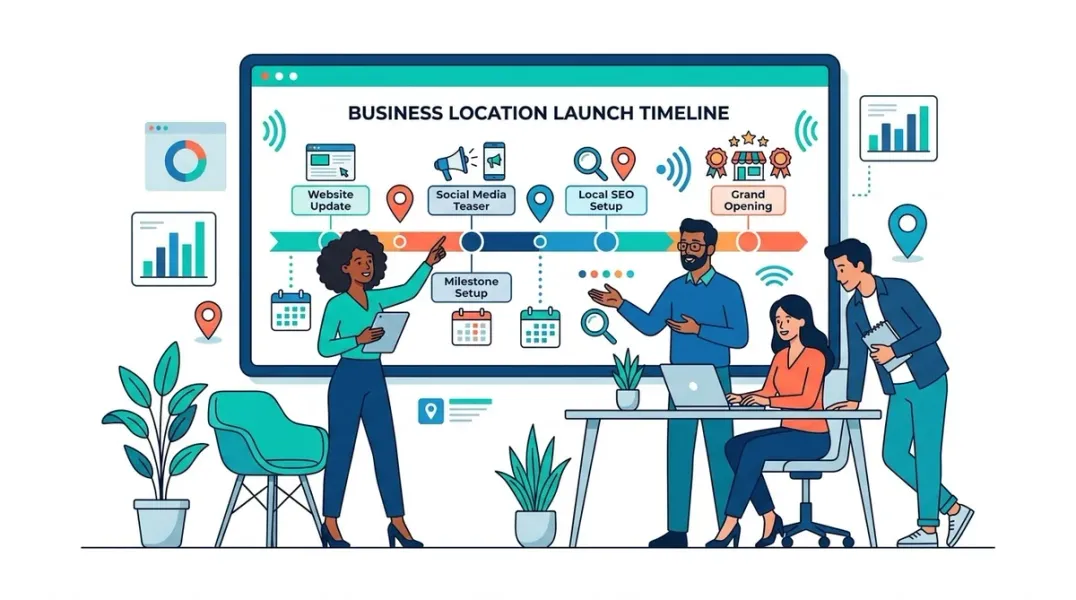
A practical digital marketing launch timeline spans approximately 90 days before opening through 60 to 90 days after. The framework below divides that period into four phases, each with distinct objectives.
Phase 1: Foundation (90–60 Days Out)
The objective in this phase is to establish the location’s digital identity and first-mover authority.
Google Business Profile setup. Claim and optimize the profile with the opening date set. According to Google, you can add a future opening date up to one year in advance, and the profile remains quiet until the 90-day window opens . Use this window to complete every field: categories, attributes, business description, and initial photos.
Location-specific web page. Build a dedicated page for the new location with local SEO elements: NAP data, local keywords, embedded map, and directions. This page becomes the primary destination for all digital campaigns.
Social media channel establishment. Create or update location-specific social profiles on the platforms most relevant to your audience. Begin posting behind-the-scenes or countdown content to build anticipation .
Local citation building. Submit the new location to major directories and data aggregators. Citations need time to propagate, so starting early ensures the location is discoverable when search volume begins .
Phase 2: Demand Generation (60–30 Days Out)
The objective in this phase is to build awareness and capture early interest before the location is fully operational.
Launch hyper-local digital advertising. Deploy Google, Meta, and programmatic campaigns targeting a tight radius around the new location. Research on outlet launches shows that a 3-kilometer radius is often the suburban sweet spot, with cost-per-visit rising significantly beyond that distance .
Deploy pre-registration or pre-booking offers. Give interested customers a way to express intent before opening. This could be a waitlist signup, a pre-booking for opening week, or a “notify me” mechanism. The goal is committed appointment holders before the doors open .
Begin email and SMS nurture sequences. Capture leads from pre-launch campaigns and nurture them with updates about the opening timeline, exclusive offers, and behind-the-scenes content.
Phase 3: Conversion Optimization (30 Days Out to Opening Day)
The objective in this phase is to ensure that demand converts into visits and bookings.
Test all booking and contact infrastructure. Call tracking numbers, online booking systems, contact forms, and chat features must be verified working. A broken conversion path during launch week is a preventable disaster.
Optimize landing pages for direct booking. Shift campaign messaging from awareness to conversion. Refine offers based on data from Phase 2. The landing page should make it as easy as possible for a user to book an appointment or claim an offer .
Pre-seed review strategy. Identify early customers or advocates who can leave reviews once the location opens. Reviews collected in opening week are worth more than the margin given away to get them, because they influence every future customer who checks social proof .
Phase 4: Opening and Ramp (Opening Day through +60 Days)
The objective in this phase is to sustain momentum and convert first visits into repeat customers.
Elevate paid search to capture local intent. As the location becomes visible on Google Maps and Search, paid search campaigns should capture all relevant local queries .
Launch reappointment or second-visit campaigns. Research on opening offers shows that next-visit vouchers produce a 34 percent second-visit rate within 60 days, compared to 9 percent for a straight opening-day discount . The goal is habit formation, not one-time crowds.
Analyze channel performance and reallocate. After 30 to 60 days of operation, review which channels are driving the highest-quality visits and adjust budget accordingly.
Deploy feedback and review sequences. Systematically request reviews from first-visit customers. Respond to all reviews promptly .
Building the Timeline Document
The launch timeline should be a living document that assigns every task to a specific owner with a due date. A simple spreadsheet or project management board works well.
Each task should include:
- Task description: What needs to be done
- Phase and due date: When it must be completed
- Owner: Who is responsible
- Dependencies: What must happen first
- Status: Not started, in progress, complete
For multi-location brands, this timeline becomes a reusable playbook. The first successful launch becomes the template for every subsequent opening .
Conclusion
A business location launch is not a marketing moment. It is a sequence of digital infrastructure tasks that must be completed in the right order at the right time. The 90-day pre-opening window is your earliest opportunity to build local search presence, and every week within that window matters. By structuring your launch timeline around foundation, demand generation, conversion optimization, and sustained ramp, you give the new location its best chance at a strong start rather than a slow climb.
The difference between a location that ramps in ten months and one that takes twenty-two is rarely the market. It is whether anyone built the pipeline before opening day .
Call to Action
Ready to launch your next location with confidence? Download our Location Launch Timeline Template to coordinate every digital marketing task from 90 days out through the first 60 days of operation. Or schedule a consultation to assess your launch readiness.
FAQs
Q: How far in advance should I create the Google Business Profile for a new location? A: You can create the profile and set a future opening date up to one year in advance. Google will begin showing the profile approximately 90 days before the opening date .
Q: What is the most critical task in the launch timeline? A: The Google Business Profile setup and location-specific web page. Everything else—ads, social, email—depends on having a destination where customers can find accurate information and take action.
Q: How should I handle opening-day offers to build repeat customers? A: Avoid deep one-day discounts. Use offers that require a second visit to redeem, such as a voucher valid for the next visit. This produces significantly higher return rates than straight discounts .
Q: Who should own the launch timeline? A: For multi-location brands, a central marketing operations lead should own the timeline, with local or regional managers responsible for location-specific tasks. For single locations, the marketing owner or agency partner manages it.
Q: What should we do in the first 60 days after opening? A: Focus on capturing local search intent with paid search, launching second-visit campaigns, analyzing channel performance, and systematically requesting reviews from first-visit customers .
Internal & External Links
Internal Links
- How to Manage Digital Marketing Tasks During a Temporary Business Relocation
- How to Build a Master Location Database for Local Marketing Teams
- How to Create a Local Marketing Operations Manual for Distributed Teams
External Sources
- Google Business Profile: Add or Edit Your Opening Date https://support.google.com/business/answer/9176340
- Google Search Central: Establish Your Business Details https://developers.google.com/search/docs/appearance/establish-business-details
- BrightLocal Citation Tracker https://www.brightlocal.com/local-seo-tools/auditing/citation-tracker/
Grow Your Google Maps Ranking on Autopilot
Stop spending hours every week manually replying to customer reviews and writing Google posts. Busirank automates your Google Business Profile to boost your local SEO rankings and turn searchers into paying clients.

 Busirank Team
