 Busirank Team
Introduction
For twenty years, the standard local marketing playbook was simple: rank on Google, drive traffic to your website, and measure success by the number of visitors. That playbook is now broken. A growing majority of Google searches end without a single click to any website—a phenomenon known as zero-click search.
For local businesses, this shift is both a threat and an opportunity. The threat is obvious: less website traffic means fewer opportunities to convert visitors on your own terms. The opportunity is less obvious but more important: for local searches, the point of conversion has moved off the website and onto the search result itself—into the local pack, the business profile, and AI-generated answers.
This guide explains what zero-click search is, why it hits local businesses differently than other types of businesses, and how to adapt your strategy so you can still capture calls, bookings, and customers—even when people never visit your site.
1. What Is Zero-Click Search?
A zero-click search happens when a user finds what they need directly on the search engine results page (SERP) and never clicks through to an external website. Google answers the query itself—or provides enough information for the user to act—without sending them anywhere else.
Common zero-click features include:
- AI Overviews: AI-generated summaries at the top of results, often citing multiple sources.
- Featured snippets: Direct answer boxes pulled from a webpage.
- Knowledge panels: Structured business or entity information.
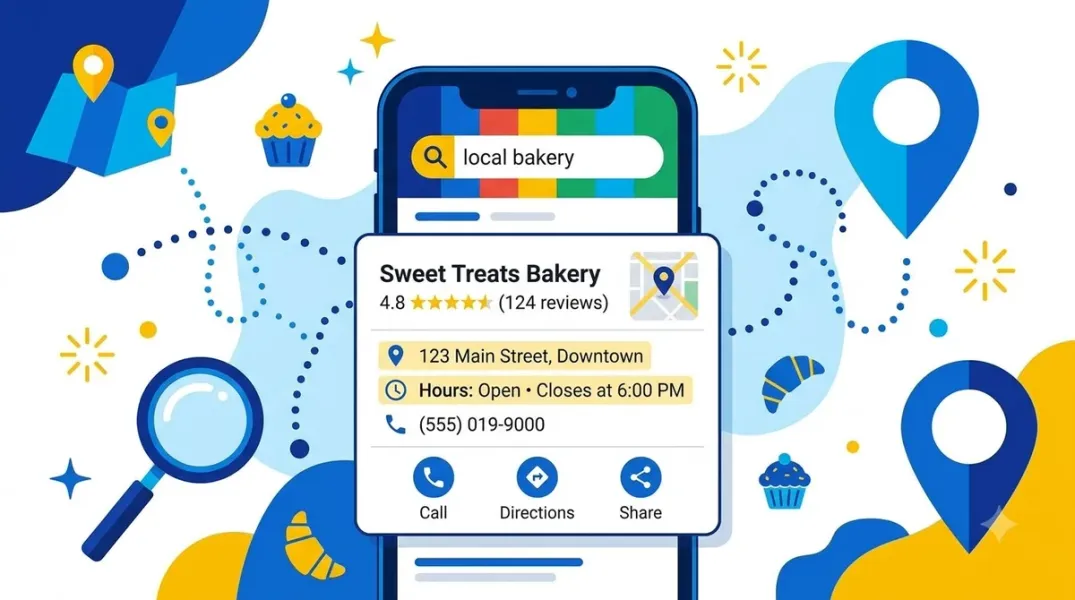
- Local Pack: The map-based results showing three local businesses with hours, reviews, phone numbers, and directions.
- People Also Ask: Expandable question-and-answer boxes.
This is not a bug in Google’s system. It is Google’s strategy. The company wants users to stay on Google, and with the expansion of AI Overviews, the trend is accelerating.
2. The Zero-Click Numbers Are Stark
The data on zero-click behavior has shifted rapidly.
- 68% of US Google searches ended without a click in the first four months of 2026, up from about 60% in 2024.
- 58.5% of all Google searches ended without a click in 2025, according to Semrush.
- 77% of mobile searches are zero-click.
- When an AI Overview appears, the zero-click rate climbs to 83%.
- The Local Pack—the map results for “near me” searches—has a 70–85% zero-click rate.
Put simply: out of every 1,000 Google searches, only about 276 now reach the open web, down from 374 in 2024. The majority of searches resolve without a website visit.
3. Why Zero-Click Search Hits Local Businesses Differently
Zero-click search affects every industry, but it has a unique dynamic for local businesses. On one hand, local searches are highly vulnerable to zero-click behavior because the Local Pack answers the query so completely. On the other, local searches still drive real actions—calls and direction requests—even when no website is visited.
The data shows both sides:
- 46% of all Google searches carry local intent.
- Birdeye’s State of Google Business Profile 2026 report found that under half of interactions on a business profile were website visits; the remainder were direction requests and phone calls—actions completed without a site ever loading.
- Research from Ahrefs found that only 7.9% of local searches trigger an AI Overview, meaning local intent searches still drive clicks at much higher rates than informational queries.
The key insight is this: for local businesses, zero-click does not mean zero-value. The person still has the need. The impression is simply formed somewhere other than your homepage—on your Google Business Profile, in your reviews, or in the Local Pack.
4. The Point of Conversion Moved Off the Website
For local and service businesses, the business profile is no longer a signpost pointing at the website. For a meaningful share of customers, it is the storefront, the brochure, and the contact page at once.
The surfaces that close business without a click include:
- The business profile and map listing. Categories, hours, service lists, current photos, and a working call button do more commercial work than most homepages. An incomplete profile does not merely rank lower—it loses the comparison outright, because the customer is comparing what is displayed, not what is available three clicks deeper.
- Reviews and ratings. The shortlist is often decided in the review panel. Recent reviews, replies to criticism, and customer photos function as the trust layer that a website’s testimonial section no longer provides.
- Chat and click-to-message. A message thread started from a listing skips the website entirely. Whether it converts depends on response time and whether the first reply answers the question.
- AI-generated answers. When an assistant recommends a business, the description it gives is the pitch. It is assembled from profiles, reviews, directories, and third-party pages, which is why consistency across those sources now has direct commercial consequences.
5. Why the Local Pack Dominates Local Zero-Click
The Local Pack—the three-business map result for “near me” searches—is the single most important zero-click surface for local businesses. It sits at the top of the results page, exactly where zero-click behavior is most concentrated.
What the Local Pack shows without a click:
- Business name
- Star rating and review count
- Category
- Address and distance
- Hours (open/closed status)
- Phone number
- “Directions” and “Call” buttons
A customer can evaluate, compare, and contact a local business entirely within the Local Pack. If your profile is incomplete or your reviews are weak, you lose the comparison before the customer ever considers visiting your website.
6. Adapt Your Strategy: Treat Your Business Profile as Your Homepage
The first strategic shift is to stop treating your website as the primary conversion surface and start treating your Google Business Profile as the front door.
What this means in practice:
- Complete every field. Categories, services, attributes, hours, service area, and a clear business description.
- Add current photos regularly. Exterior, interior, team, and work examples. Profiles that look active build more trust.
- Enable and monitor messaging. Respond quickly. A slow response is worse than no messaging option.
- Use posts and updates. Regular posts show the business is active and give customers a reason to choose you.
- Make calling and directions one tap away. Ensure your phone number and address are clickable and accurate everywhere.
7. Win the Review Layer
Reviews are the trust layer of zero-click local search. The shortlist is often decided in the review panel, not on your website.
Review strategy for a zero-click world:
- Build review velocity. A steady flow of recent reviews matters more than a large number of old reviews.
- Respond to every review. Professional responses to negative reviews can increase trust. Ignoring reviews signals neglect.
- Ask at the right moment. Request reviews immediately after a positive service experience.
- Monitor across platforms. Google, Yelp, and industry-specific sites all feed into the trust layer.
8. Structure Your Content for Answers, Not Just Clicks
Even though fewer people click through, content still matters—because it feeds the AI answers, snippets, and panels that shape zero-click decisions.
The extract is the impression. If a snippet or an AI answer is all most people will see, then the first two sentences of a page are the page for practical purposes. Pages built to state the answer immediately, with detail below, are quoted more often and represented more accurately.
Content principles for zero-click visibility:
- Answer the question in the first two sentences. Lead with the direct answer, then provide detail.
- Use question-based headings. Structure content around the questions customers actually ask.
- Publish clear pricing ranges, service areas, and timelines. Withheld information no longer forces an enquiry—it forces a comparison with a competitor who published theirs.
- Use FAQ schema and structured data. Help search engines and AI systems understand and cite your content.
- Cover hyper-local context. Mention neighborhoods, landmarks, and local rules. AI systems use this context to verify that you are genuinely local.
9. Optimize for AI Overviews and AI Search
AI Overviews are now a major zero-click driver, and local businesses need a strategy for them.
What works for AI visibility:
- Get cited, not just ranked. 47% of AI Overview citations come from pages ranking below position #5. AI looks for the best-structured, most complete answer regardless of ranking position.
- Maintain consistency across profiles, reviews, directories, and third-party pages. AI assembles its recommendation from multiple sources. Inconsistency weakens your case.
- Use structured data (schema markup) so AI crawlers can easily read your hours, services, location, and other key details.
- Publish clear, factual, well-organized content that directly answers local questions.
10. Measure What Matters Now
If website sessions are no longer the primary proof that marketing worked, you need new metrics.
Zero-click-aware metrics for local businesses:
- Calls from Google Business Profile. Track calls as a primary conversion.
- Direction requests. A strong signal of intent to visit.
- Messages started and response time. Messaging conversions happen without a website.
- Local Pack visibility and share of local voice. Track how often you appear in the top three across your service area.
- Review velocity and rating trends. These drive the trust layer that shapes zero-click decisions.
- AI citation mentions. Monitor whether your business appears in AI-generated answers for local queries.
Fix: Shift your reporting from “website sessions” to “actions taken on search surfaces.” A phone call from your profile is a conversion, even if no website visit occurred.
11. What Not to Do
Adapting to zero-click search does not mean abandoning your website. It means rebalancing.
Avoid these mistakes:
- Abandoning your website entirely. Your site still supports trust, depth, booking, and conversion for higher-intent visitors.
- Ignoring your Google Business Profile. In a zero-click world, an incomplete profile is a competitive disadvantage.
- Chasing clicks as the only success metric. Clicks matter less than calls, bookings, and visits.
- Hiding key information to force an enquiry. In a zero-click world, hidden information usually sends the customer to a competitor who published theirs.
- Treating zero-click as purely a threat. For local businesses, zero-click surfaces are often where the highest-value actions happen.
Conclusion
Zero-click search is not a temporary trend. It is the new normal for how people find and evaluate local businesses. For local businesses, the shift is not primarily a loss of traffic—it is a relocation of the moment of decision. The decision now happens in the Local Pack, in the review panel, in the business profile, and in AI-generated answers.
The businesses that adapt fastest are the ones that stop treating a website session as proof that marketing worked and start optimizing the surfaces where customers actually decide. By treating your business profile as your homepage, winning the review layer, structuring content for answers, optimizing for AI visibility, and measuring calls and direction requests rather than sessions alone, you can turn zero-click search from a threat into a source of real local customers.
Call to Action
Is zero-click search hurting your local business? Start by auditing your Google Business Profile for completeness, your review velocity, and the clarity of your key service pages. If you want to know exactly where you are losing local customers in a zero-click world, contact us for a free zero-click visibility audit and get a practical plan to capture calls, bookings, and visits—whether or not people click.
FAQs
Q1: What is zero-click search?A: A zero-click search is a search that ends without the user clicking through to any website. Google provides the answer or enough information directly on the results page through AI Overviews, featured snippets, knowledge panels, or the Local Pack.
Q2: Does zero-click search mean local businesses should stop investing in their websites?A: No. Your website still matters for trust, depth, and higher-intent visitors. But the balance has shifted. Your Google Business Profile, reviews, and local pack visibility now carry more conversion weight than they did in the past.
Q3: What is the zero-click rate for local searches?A: The Local Pack has a 70–85% zero-click rate, meaning most people who see local results act without visiting a website—often by calling or requesting directions.
Q4: How can I track conversions if people don’t visit my website?A: Track calls, direction requests, messages, and bookings directly from your Google Business Profile. These are the actions that matter in a zero-click world. Use Google Business Profile insights and call tracking to measure them.
Q5: Do AI Overviews affect local searches?A: AI Overviews appear on fewer local searches than informational ones—Ahrefs found only about 7.9% of local searches trigger an AI Overview. However, when they do appear, they can significantly reduce clicks, so optimizing for AI citation is still worthwhile.
Grow Your Google Maps Ranking on Autopilot
Stop spending hours every week manually replying to customer reviews and writing Google posts. Busirank automates your Google Business Profile to boost your local SEO rankings and turn searchers into paying clients.
 Busirank Team