 Busirank Team
Introduction
Search engines do not see your website the way a customer does. They do not read a headline, admire a photo, or feel reassured by a five-star review. They parse code, extract facts, and try to determine whether the information they find is consistent and trustworthy. For local businesses, that gap between human experience and machine understanding is where visibility is won or lost.
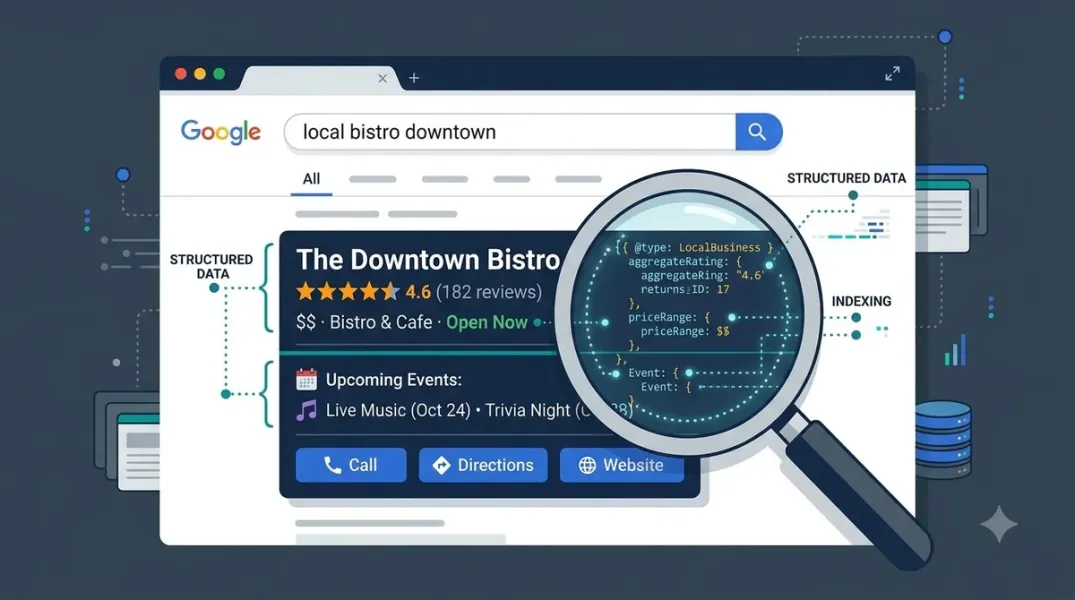
Structured data closes that gap. By adding local business schema markup to your website, you translate the details of your business—your name, location, hours, services, and reviews—into a format that search engines and AI systems can read with confidence. Google’s own documentation describes structured data as a standardized format for providing information about a page and classifying its content.
This guide explains how structured data works for local businesses, why it matters more in an AI-driven search environment, which schema types to use, how to implement them, and the common mistakes that turn a good intention into a silent liability.
1. What Structured Data Actually Does for a Local Business
Structured data is not a ranking factor in the traditional sense. John Mueller and Gary Illyes have both confirmed that schema is not a direct ranking signal. Its value is indirect but substantial: it improves how search engines understand your entity, increases eligibility for rich results, and strengthens the confidence AI systems have in reusing your information.
For local businesses, three benefits matter most.
Entity clarity. Search engines triangulate your business identity across on-page content, internal linking, Google Business Profile data, citations, reviews, and schema markup. When these signals align, Google’s confidence in your information increases. When they contradict each other, the correct information may not be pulled into search at all.
Rich results eligibility. Structured data can unlock enhanced search displays—business hours, review stars, and other visual enhancements—that can improve click-through rates. A Webstix case study cited in schema research reported a 43% CTR increase associated with rich results from structured data.
AI citation readiness. In the AI-driven search world, schema helps Google and other AI systems understand who you are, what you do, where you operate, and how confidently your information can be reused. Structured data has become a primary input for AI Overviews, Perplexity citations, and ChatGPT’s web-grounded answers.
2. Choose the Most Specific LocalBusiness Subtype
The single most important schema decision for a local business is choosing the right type. Schema.org offers dozens of specific subtypes under LocalBusiness. Using a specific subtype—not the generic LocalBusiness type—is always better because it provides more precise information about your business category and helps Google match you to relevant queries.
Common LocalBusiness subtypes by industry:
- Professional services: LegalService, AccountingService, FinancialService, InsuranceAgency
- Medical: Dentist, Physician, MedicalClinic, Optician, Pharmacy
- Home services: Plumber, Electrician, HVACBusiness, Locksmith, RoofingContractor
- Automotive: AutoRepair, AutoDealer, GasStation, AutoBodyShop
- Food: Restaurant, BarOrPub, CafeOrCoffeeShop, Bakery, FastFoodRestaurant
- Fitness and beauty: HealthClub, BeautySalon, HairSalon, DaySpa
- Real estate: RealEstateAgent, MovingCompany
Source: Locafy implementation guide
One important correction: The schema type Attorney is deprecated by Schema.org. Use LegalService combined with a Person reference for individual attorneys instead.
The rule is simple: if a more specific subtype exists that accurately describes your business, use it. Reserve the generic LocalBusiness type only when no specific subtype fits.
3. Include the Required and Recommended Properties
A schema block is only as strong as the properties it contains. Google’s documentation identifies a minimum set of required properties and a longer list of recommended properties that strengthen the signal.
Required properties (minimum):
- @type: Your specific LocalBusiness subtype name.
- name: The exact business name, matching your Google Business Profile.
- address: A PostalAddress object with streetAddress, addressLocality, addressRegion, and postalCode.
- telephone: Your primary phone number, matching your Google Business Profile and on-page NAP.
Source: Google Search Central and schema type documentation
High-value recommended properties:
- geo: GeoCoordinates with at least five decimal places for accurate location data.
- openingHoursSpecification: Verifiable hours for each day of the week.
- url: The canonical URL for the location.
- image: A URL to a primary business photo.
- priceRange: A short text range or dollar-sign indicator, under 100 characters.
- sameAs: An array of URLs to your official profiles (Google, Facebook, LinkedIn, Yelp, BBB).
- aggregateRating: Average rating and review count, only when reviews are visible on the page.
- areaServed: For service-area businesses, the cities, states, or GeoCircle you serve.
- hasMap: A URL to your Google Maps listing.
Source: Locafy and Google documentation
4. Use the sameAs Property to Connect Your Digital Identity
The sameAs property is one of the most underused and most valuable properties in local business schema. It tells search engines that your website entity is the same entity as your profiles on Facebook, LinkedIn, Yelp, BBB, and other platforms.
This creates explicit entity connections that reinforce the trust signals from your citation network. In an AI-driven search environment, where systems cross-reference dozens of sources to determine confidence, sameAs helps resolve ambiguity and strengthens your case for citation.
What to include in sameAs:
- Your Google Business Profile URL.
- Social media profiles (Facebook, Instagram, LinkedIn, X).
- Major directory listings (Yelp, BBB, industry-specific directories).
- Any other official profiles that represent the same business entity.
5. Implement with JSON-LD and Place It Correctly
JSON-LD is the format Google recommends for structured data and the format that large language models process most easily. It is placed inside a
Where to place schema across your site:
- Homepage: Full LocalBusiness schema with all applicable properties.
- Contact page: LocalBusiness schema emphasizing address, phone, hours, and map.
- About page: Organization schema with founding date, team, and credentials.
- Individual service pages: Service schema linked to the parent LocalBusiness entity.
- Location pages (multi-location): A separate LocalBusiness schema block for each branch with its own address, phone, hours, and geo data.
Source: Locafy schema placement guide
A minimal JSON-LD example for a local restaurant:
json
{
“@context”: “https://schema.org”,
“@type”: “Restaurant”,
“name”: “Dave’s Steak House”,
“image”: [
“https://example.com/photos/1x1/photo.jpg”,
“https://example.com/photos/4x3/photo.jpg”
],
“address”: {
“@type”: “PostalAddress”,
“streetAddress”: “148 W 51st St”,
“addressLocality”: “New York”,
“addressRegion”: “NY”,
“postalCode”: “10019”,
“addressCountry”: “US”
},
“telephone”: “+1-212-555-0100”,
“url”: “https://example.com”,
“openingHoursSpecification”: {
“@type”: “OpeningHoursSpecification”,
“dayOfWeek”: [“Monday”, “Tuesday”, “Wednesday”, “Thursday”, “Friday”],
“opens”: “17:00”,
“closes”: “23:00”
}
}
This structure follows the pattern shown in Google’s own LocalBusiness documentation.
6. Avoid the Mistakes That Invalidate Your Markup
Structured data errors are not always loud. Many schema problems are silent—the markup is technically valid JSON, but it contradicts other signals and gets discounted or ignored.
Critical mistakes that undermine schema:
- Name mismatch. “Clinica Dental Sonrisa” on the website but “SONRISA DENTAL S.L.” in the JSON-LD. Names must be identical across schema, GBP, and on-page content.
- Generic type when a specific subtype exists. Using Organization or Thing when Dentist or LegalService would be accurate.
- Missing @id. Without a unique identifier, other pages cannot reference your entity, weakening internal linking and entity coherence.
- Partial address. Omitting postal code or country creates incomplete data that reduces confidence.
- Relative URLs. Always use absolute URLs with https://.
- Schema that contradicts on-page content or GBP. When structured data contradicts visible content, Google Business Profile data, citations, or reviews, Google does not reconcile the difference—it discounts the markup and often ignores the information altogether.
- Marking up third-party reviews as your own. Google strictly prohibits using Review schema for reviews collected on third-party platforms like Yelp or Google Maps. Only first-party reviews, collected directly by your site and clearly visible to the user, can be marked up.
- False positives. Marking a business as a medical provider without credentials, applying Person schema to non-professionals, or using Product schema for services are particularly damaging because AI models are conservative when confidence is low—they simply will not reuse or cite the information.
7. Validate and Monitor Your Structured Data
Deploying schema is not the final step. Validation and ongoing monitoring are essential.
Validation workflow:
- Use the Rich Results Test to check for critical errors and eligibility for rich results.
- Fix non-critical issues where possible, as they can improve the quality of your structured data even if they do not block rich results.
- Deploy a few pages first and use the URL Inspection tool to see how Google renders the page.
- Ask Google to recrawl once the pages look correct.
- Submit a sitemap to keep Google informed of future changes.
Ongoing monitoring: Re-validate schema after site updates, theme changes, or plugin installations. Structured data can break silently when templates are modified. For multi-location businesses, validate each location page individually.
8. Apply Schema Across Multiple Locations
Multi-location businesses need a more deliberate approach. Google rewards specificity, and the best practice is to have a dedicated location page for each branch, with its own LocalBusiness schema block.
Multi-location schema checklist:
- Each location page has its own LocalBusiness subtype block.
- Each block includes a unique @id, address, telephone, geo, and openingHoursSpecification.
- The parent organization is referenced on each location page using Organization schema.
- sameAs includes the GBP URL for that specific location, not just the main brand profile.
- Service pages are linked to the parent LocalBusiness entity using Service schema.
A single schema block for the whole business is not enough when each location has different hours, a different address, and different reviews. Each branch is its own local entity, and schema should reflect that.
9. Understand How Schema Supports AI Search Visibility
Schema does not guarantee that AI systems will cite or recommend your business. It is a supporting signal, not a direct lever. But in an environment where AI systems are conservative and avoid uncertainty, schema plays a specific and valuable role: it reduces confusion and reinforces your business as a stable, trustworthy local entity across traditional search, local packs, AI Overviews, and external AI platforms.
How AI platforms use structured data:
- To determine whether two references describe the same business.
- To assess whether information is current.
- To judge whether a source is authoritative.
Source: Search Engine Land
While external AI platforms do not necessarily parse schema the same way Google does, structured data contributes to clearer entity representation across the web. The practical takeaway is that schema is one layer of a broader entity strategy. It works best when combined with accurate Google Business Profile data, consistent citations, strong reviews, and clear on-page content.
10. Prioritize the Schema That Matters Most
Not all schema types carry equal weight for local businesses. If you are starting from scratch or rebuilding a fragmented implementation, prioritize in this order.
Priority schema for local businesses:
- LocalBusiness (specific subtype) on the homepage and every location page. This is the foundation.
- sameAs and geo on the primary LocalBusiness block. These strengthen entity verification.
- Service schema on individual service pages. This defines what you offer and where.
- FAQPage schema on genuine Q&A content. This supports AI citation and search intent clarification.
- Review and AggregateRating schema only for first-party reviews visible on the page. This reinforces quality signals where permitted.
- BreadcrumbList schema sitewide. This clarifies site structure and topical hierarchy.
Source: Locafy and LinkedIn schema guidance
For most small local businesses, a well-implemented LocalBusiness block with sameAs, geo, and hours on the homepage and contact page is the highest-leverage starting point. Add Service and FAQ schema as content allows.
Conclusion
Structured data is not a technical box to tick. It is the language your website uses to tell search engines and AI systems what your business is, where it operates, and whether its information can be trusted. For local businesses, that clarity is a competitive advantage.
By choosing the most specific LocalBusiness subtype, including required and recommended properties, connecting your identity with sameAs, implementing with JSON-LD, avoiding contradictions, and validating your work, you can turn local business schema markup into a foundation for local visibility that supports both traditional search and AI-driven discovery.
Schema will not fix a weak business profile or an inconsistent citation network. But when the signals align, it makes every other local marketing effort easier to trust—and easier for search engines to act on.
Call to Action
Want to know if your structured data is helping or hurting your local visibility? Start by validating your homepage with Google’s Rich Results Test and checking for name, address, and hours inconsistencies between your schema and your Google Business Profile. If you want a structured review of your local schema implementation, contact us for a free schema audit and get a clear, prioritized plan for fixing gaps and strengthening your entity signals.
FAQs
Q1: Does schema markup directly improve local rankings?A: No. Schema is not a direct ranking factor. It improves entity understanding, rich result eligibility, and AI citation readiness, which indirectly support visibility.
Q2: What is the most important schema type for a local business?A: A specific LocalBusiness subtype on your homepage and each location page. Use the most specific subtype available—Dentist rather than LocalBusiness, Plumber rather than HomeAndConstructionBusiness.
Q3: Can I mark up reviews from Google or Yelp on my website?A: No. Google prohibits marking up third-party reviews as your own. Only first-party reviews collected directly by your site and visible on the page can be marked up with Review schema.
Q4: What happens if my schema contradicts my Google Business Profile?A: Google discounts the markup and often ignores the information altogether. When structured data conflicts with on-page content, GBP data, citations, or reviews, the correct information may not be pulled into search results.
Q5: Do I need separate schema for each business location?A: Yes. Each location should have its own LocalBusiness schema block with a unique address, phone, hours, geo, and @id. A single block for the whole business does not reflect the reality of multi-location operations.
Grow Your Google Maps Ranking on Autopilot
Stop spending hours every week manually replying to customer reviews and writing Google posts. Busirank automates your Google Business Profile to boost your local SEO rankings and turn searchers into paying clients.

 Busirank Team