 Busirank Team
Introduction
The buying decision sounds simple. You need better review management, so you buy a review tool. But the moment you start comparing options, the all-in-one local SEO platform appears with a compelling pitch: rank tracking, citations, Google Business Profile management, and reviews in one dashboard, often for less than the sum of the separate tools. The suite looks like the smarter purchase.
Sometimes it is. Often it is not. The honest answer to “which is better” is “it depends which job is actually broken” . A tool that does five things adequately is often worse than one that does one thing well, especially when the suite’s review features are the weakest part of the bundle. Conversely, buying a standalone review tool when the real problem is citations or rank tracking is a waste of a subscription.
This guide gives you a decision framework, the pricing reality for both categories in 2026, and the specific situations where each option wins.
The Core Trade-Off: Depth vs. Breadth
A standalone review tool is built around one job: requesting, monitoring, and responding to reviews across platforms. Birdeye is the category leader for review monitoring and requests, and its capability score for review management (92) is the highest in a 2026 benchmark, even though its overall score (76) trails the all-in-one platforms because it does less of everything else. That is the point of a specialist: it goes deeper on the one job you are buying it for.
An all-in-one local SEO platform bundles reviews with rank tracking, citation audits, Google Business Profile management, and white-label reporting. BrightLocal scores 90 out of 100 on the same benchmark, leading on citation management (95), local rank tracking (92), and review management (90)—a strong all-rounder that is genuinely competitive on reviews, not just adequate. Semrush Local scores 85 and leads on integrations (90), making it the better fit for teams already inside the Semrush ecosystem.
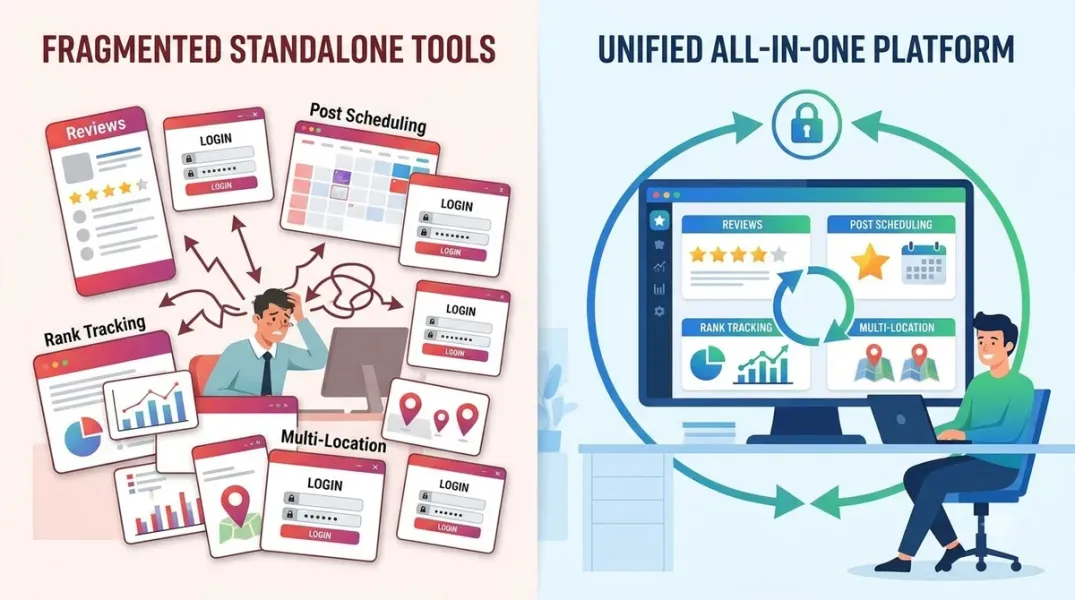
The trade-off is real. The specialist wins on review depth. The suite wins on consolidation and per-tool economics—but only if you actually need the other tools.
When the Standalone Review Tool Wins
When reviews are the only broken thing. If your rankings are stable, your citations are clean, and your Google Business Profile is complete, buying a suite means paying for tools you will not use. A focused review platform closes the gap without the bundle premium.
When review volume and response speed are the bottleneck. Standalone tools invest more in review workflows: AI drafting, tiered approval, multi-platform monitoring, and request automation. Birdeye’s review-management depth is the reason it remains the default recommendation for reputation at scale, even against suites that bundle reviews as one feature among many.
When the budget is tight and the job is narrow. A single-location business with a review problem does not need a $250/month suite. The minimum viable spend is the narrowest tool that fixes the specific failure.
The trade-off is that you will eventually need the other tools, and the integrations between separate specialists are rarely seamless.
When the All-in-One Platform Wins
When you need three or more of the bundled jobs. If you need rank tracking, citations, and reviews, the suite is usually cheaper than three subscriptions. BrightLocal’s Grow tier at 59/month on some pricing pages) bundles reviews with rank tracking and citation monitoring, while the lower Track tier at $41/month omits reviews entirely. The bundle only makes sense if you need what the tier includes.
When you report to clients or manage multiple locations. White-label reporting is the suite’s strongest argument. BrightLocal’s white-label dashboards turn rankings, listings, and reviews into a single client-ready story—a capability that standalone review tools often charge extra for or handle less cleanly. Yext is the enterprise standard for multi-location listing sync across 200+ publishers, with pricing quoted by contract.
When you want one login and one invoice. The operational cost of five separate tools is not the subscription—it is the context-switching, the reconciliation, and the training. A suite reduces the number of places a task can stall.
The Pricing Reality in 2026
The numbers matter because the suite premium is often smaller than expected, and the specialist premium is often larger.
All-in-one platforms are priced per location per month. BrightLocal starts at 54–$65** for tiers that include reviews and listing sync. Semrush Local starts at **$30/month per location on Base, billed annually, and $60/month on Pro. Yext is custom-quoted and positioned at enterprise scale.
Standalone review platforms are priced higher per location because the review workflow is the whole product. Birdeye ranges from $299 to $449/month, and Podium from $399 to $599/month, depending on tier and contract length. These are not comparable to a $41/month BrightLocal tier in the same way—they are doing different jobs at different depths.
The buying rule that follows is not “which is cheaper” but “which bundle matches the jobs I actually need.” A $41/month suite is cheap if you need two of its three jobs and expensive if you need one. A $299/month specialist is expensive if a $65/month suite tier covers the review work adequately, and cheap if it replaces a full-time hire.
The Decision Framework
Answer four questions before comparing features.
-
How many of the bundled jobs are actually broken? One job: buy the specialist. Two or more: price the suite tier that covers them.
-
Is review depth a competitive requirement or a hygiene factor? For healthcare, hospitality, and multi-location service brands, review workflow depth—AI drafting, tiered approval, escalation—is a requirement. For a business that just needs replies to go out on time, a suite tier is sufficient.
-
Do you report to clients? If yes, white-label reporting is a feature you will use monthly, and the suite’s value rises.
-
What is the cost of one more login? For a solo operator, the context-switching cost is real. For a team with an ops manager, it is manageable. The suite’s consolidation benefit scales with team size and location count.
The Hybrid Option Worth Considering
The binary is false. Many teams run a suite for the foundation and a specialist for the gap. BrightLocal for rank tracking and citations, Birdeye for review depth, and Google’s free tools for the profile baseline is a legitimate stack. The 2026 tooling market is built for this: the question is not which single tool does everything, but which combination closes the specific gaps without duplicating what you already pay for.
Conclusion
Choosing between a standalone review tool and an all-in-one local SEO platform is not a question of which category is better. It is a question of how many jobs are broken and how deep the review work needs to go. The specialist wins on review depth and focus. The suite wins on consolidation, white-label reporting, and per-job economics—provided you need the jobs it bundles.
The evidence is clear enough to guide the decision. Birdeye leads on review management capability (92) but trails overall (76) because it does less of everything else. BrightLocal leads overall (90) and is genuinely strong on reviews (90), making it the default all-in-one for agencies and multi-location teams. Semrush Local is the right suite if you already live inside Semrush. And Yext is the enterprise listing layer, not a review tool.
The mistake to avoid is buying the suite because it looks complete, or buying the specialist because it looks serious. Buy the tool that fixes the job that is actually costing you customers.
Call to Action
Write down the one job that is most broken before you open a pricing page. If it is reviews only, start with a specialist or the review tier of a suite you already own. If it is two or more jobs, price the suite tier that covers them and compare it against the specialist plus the tools you would still need to buy. Run a 14-day trial on the shortlisted option—BrightLocal offers one with no card—and test it against your own data rather than the demo. The right choice is the one that closes the gap with the fewest subscriptions you will actually use.
FAQs
What is the difference between a standalone review tool and an all-in-one local SEO platform?A standalone review tool focuses on requesting, monitoring, and responding to reviews across platforms—Birdeye is the category leader for depth. An all-in-one platform bundles reviews with rank tracking, citations, Google Business Profile management, and reporting—BrightLocal and Semrush Local are the leading options. The specialist goes deeper on reviews; the suite covers more jobs at a lower per-job cost.
Which is better for a small business?It depends on how many jobs are broken. If reviews are the only gap, a standalone tool or the review tier of a suite is sufficient. If rank tracking and citations are also gaps, an all-in-one platform like BrightLocal at 65/month per location is usually cheaper than separate subscriptions.
How much do standalone review tools cost in 2026?Birdeye ranges from $299 to $449/month, and Podium from $399 to $599/month, depending on tier and contract length. These are priced higher than suite tiers because the review workflow is the entire product.
How much do all-in-one local SEO platforms cost?BrightLocal starts at 54–$65** for tiers that include reviews and listing sync. Semrush Local starts at **$30/month per location on Base (annual) and $60/month on Pro. Yext is custom-quoted for enterprise multi-location.
Which all-in-one platform is best for agencies?BrightLocal is the strongest all-in-one for agencies and multi-location teams, with rank tracking, citation audits, reviews, and white-label reporting in one place. It scores 90/100 on a 2026 capability benchmark, leading on citation management (95), rank tracking (92), and review management (90).
Can I combine a standalone review tool with an all-in-one platform?Yes, and many teams do. The common stack is a suite for rank tracking and citations (BrightLocal) plus a specialist for review depth (Birdeye), with Google’s free Business Profile tools for the baseline. The key is to avoid duplicating a job you already pay for.
What is the biggest mistake when choosing between the two?Buying the suite because it looks complete, or the specialist because it looks serious, without identifying the job that is actually broken. The honest answer to “which is best” is “it depends which job is actually broken” .
Internal & External Links
Internal links (to other posts in this series):
- How Restaurants Can Coordinate Google Reviews and Promotional Posts From One Platform (previous post)
- What to Look for When Evaluating Google Business Profile Automation Software (next in series)
- Best Google Business Profile Management Software for Small Businesses in 2026
- How to Create White-Label Local SEO Reports for Your Agency Clients
- How to Choose the Right Call-to-Action for Google Business Profile Posts
External links (sources referenced in this article):
- Local SEO Citation Builder — Best Local SEO Tools (2026): Picked by the Job They Do: https://localseocitationbuilder.com/blog/best-local-seo-tools
- Sprites — Local SEO Tools: 8 Options Compared by Category: https://www.sprites.ai/blog/local-seo-tools
- Codivox — Best Local SEO Tools in 2026 (Compared by Use Case): https://codivox.com/blog/best-local-seo-tools/
- Benchline Reports — Local SEO Software: Public Capability Benchmark: https://benchlinereports.com/reports/local-seo-software-public-capability-benchmark
- Marketing LTB — 10 Best Local SEO Tools in 2026: https://marketingltb.com/blog/tools/best-local-seo-tools/
- CostBench — Podium vs Birdeye Pricing (2026): https://costbench.com/software/review-management/podium/
What to Look for When Evaluating Google Business Profile Automation Software
Grow Your Google Maps Ranking on Autopilot
Stop spending hours every week manually replying to customer reviews and writing Google posts. Busirank automates your Google Business Profile to boost your local SEO rankings and turn searchers into paying clients.
 Busirank Team