 Busirank Team
Introduction
Every local business owner has asked some version of the same question: “Which marketing is actually working?” You run ads, send emails, post on social media, appear in local search, and take phone calls. Revenue comes in. But tracing that revenue back to the activity that caused it is harder than it looks.
This is the problem of marketing attribution. For small businesses, the challenge is especially sharp. You do not have the data volume, the analytics team, or the budget for enterprise-grade modeling. And the default tools most platforms provide—last-click attribution—are not just imperfect. They are often actively misleading, systematically undervaluing the channels that build awareness and overvaluing the ones that capture demand that already existed.
This guide explains how to create a marketing attribution model that works for a small business. You will learn why common models fail, which approaches fit limited resources, how to account for phone calls and in-store visits, and how to make attribution decisions with directional accuracy rather than false precision.
1. Understand Why Last-Click Attribution Misleads Small Businesses
Most analytics platforms default to last-click attribution, which gives 100% of the credit for a conversion to the final touchpoint before purchase. A customer sees your brand on social media, reads a blog post, clicks a Google ad the following month, and finally converts through a direct visit—and the entire conversion is credited to “direct.”
This does not just misrepresent reality. It misdirects budget. Channels that tend to appear early in the customer journey—social, content, display—are systematically undervalued, while channels that capture existing demand—search, direct—are systematically overvalued.
Platform-reported conversions compound the problem. Each ad platform counts its own contribution as a conversion, which results in duplication. Multiple platforms and touchpoints contribute to the same sale, and their contributions should be measured holistically to prevent over-counting.
The waste is measurable. NP Digital’s attribution audit across hundreds of clients found that small businesses waste 19.4% of ad spend due to poor attribution—the highest rate of any company size, driven by limited data and tooling.
2. Accept That Perfect Attribution Is Impossible—and Aim for Directional Accuracy
Customers move between phones, laptops, tablets, social apps, email, search engines, and offline conversations before buying. Privacy regulations, browser restrictions, and platform data policies limit how much of that journey any single tool can observe. Contemporary research indicates that perfect attribution is impossible.
For small businesses, the practical goal is not perfect credit assignment. It is directional accuracy: knowing which channels consistently contribute to revenue, which are wasting spend, and how the mix is trending. A model that helps you make a better budget decision is more valuable than a model that looks precise but cannot be trusted.
3. Choose the Right Attribution Model for Your Business
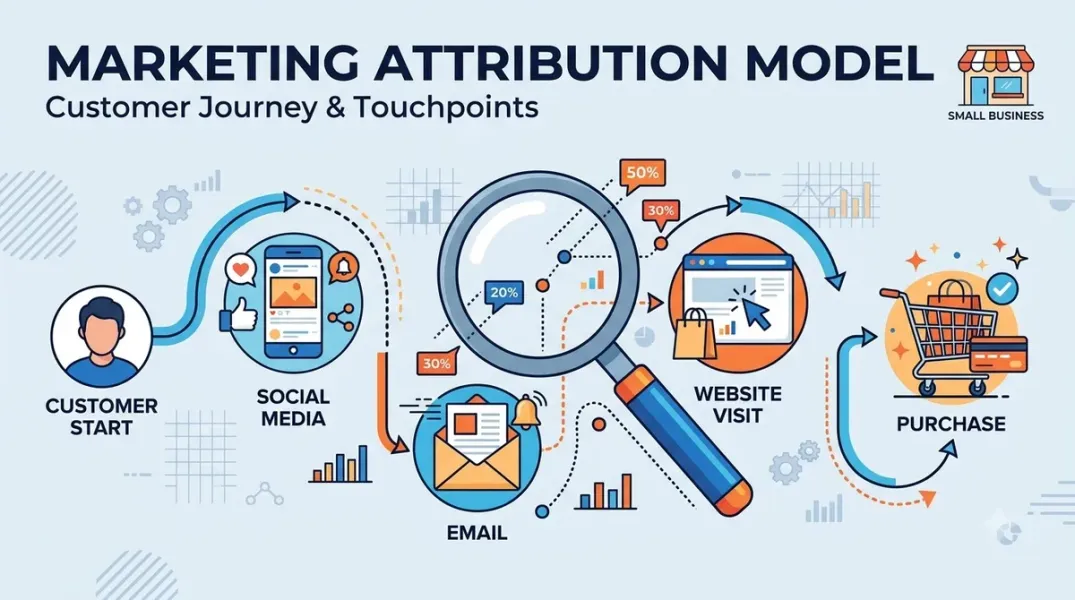
Attribution models are lenses for viewing the same customer journey. Each assigns credit differently, and each has a use case. For small businesses, a small number of models cover most needs.
First-touch attribution gives 100% of the credit to the first interaction. It is useful for understanding which channels drive awareness and discovery.
Last-touch attribution gives 100% to the final interaction before purchase. It identifies which channel closes the deal, but it is a poor basis for budget decisions on its own.
Linear attribution splits credit evenly across every touchpoint. It gives a balanced view of awareness and conversion activities and works when customers take a long, consistent path to purchase.
Time-decay attribution gives more credit to touchpoints closer to the conversion, while still acknowledging earlier interactions. It is useful when the path is long and the most recent touches are most influential.
Position-based (U-shaped) attribution gives most credit to the first and last touches, with the remainder distributed across the middle. It suits businesses that care about both discovery and closing.
A practical recommendation for many local businesses is to avoid relying on any single-touch model. Use a multi-touch view—linear, time-decay, or position-based—for budget planning, and use first-touch and last-touch as diagnostic lenses to understand awareness and closing separately.
4. Use a Three-Method Approach Built for Limited Resources
The most practical attribution strategy for a small business combines three methods. None is perfect on its own, but together they provide a reliable picture.
Method 1: Blended metrics. Rather than trying to attribute each conversion to a specific channel, track overall cost per acquisition (CPA) and customer acquisition cost (CAC) at the business level. Then look at channel-level performance as a proportion of the whole. If overall CPA is healthy and improving, the mix is working—even if you cannot pinpoint exactly which impression drove which sale.
Method 2: Incrementality testing. The simplest form is geographic holdout testing: run a campaign in one region and not another, then compare results. If the campaign region shows a measurable uplift in conversions that the holdout region does not, the campaign is working. This is less precise than individual-level attribution but far more reliable.
Method 3: Ask your customers. A “How did you hear about us?” field on your enquiry form or checkout page is crude but surprisingly useful. It captures the touchpoint the customer remembers—which, while incomplete, often identifies the most influential moment in their journey.
5. Focus on the Metrics That Actually Indicate Growth
Attribution is a means to an end. The end is knowing whether marketing is growing the business. A small set of revenue-focused metrics provides a sufficient picture for most local businesses.
Total customer acquisition cost (CAC): Total marketing spend divided by total new customers. This is the foundational efficiency metric.
Payback period: How long it takes for a new customer to generate enough revenue to cover their acquisition cost. A short payback period gives you more flexibility to invest in growth.
Retention rate: What proportion of customers return or remain active. Retention directly affects lifetime value and the return on acquisition spend.
Marketing efficiency ratio (MER): Revenue generated per dollar of marketing spend. This business-level metric shows whether the overall mix is producing profitable growth.
Track these monthly. If they are improving, your marketing is working. If they are deteriorating, something needs to change. You do not need a multi-touch model to identify the trend—you need consistent measurement and honest assessment.
6. Account for Phone Calls, Which Most Models Miss
For local businesses, phone calls are often the primary conversion—and the biggest attribution blind spot. Industry-wide, roughly a third of marketing-driven revenue cannot be confidently tied back to the channel that produced it, and phone calls are the black box.
Call tracking closes this gap. Dynamic number insertion ties each call to the exact page, campaign, and channel that produced it. The call is then scored, transcribed, and tied to the job record so the campaign attribution remains intact through the full lifecycle—estimate, booked job, invoice, and revenue.
The impact can be substantial. In a case study with moving franchise You Move Me, connecting call tracking to the CRM moved attribution accuracy from roughly 65% to 98%, enabling the team to stop funding channels that did not book jobs and double down on those that did.
For any local business where the phone is a primary conversion path, call tracking is not optional. Without it, a meaningful share of your marketing spend is invisible.
7. Measure Store Visits and Offline Conversions
For businesses with physical locations, the most valuable conversion happens offline. Store visit attribution measures whether an ad exposure caused a customer to visit a physical location, bridging the gap between digital impressions and real-world foot traffic.
The measurement process works by identifying users exposed to an ad, matching them to a panel of mobile devices with location history, observing whether they subsequently visited a relevant location, and comparing their visit rate against a control group that was not exposed. The difference is the incremental lift—visits that would not have happened without the advertising.
For local businesses, this matters because a click is not a customer. A store visit is. If your marketing drives awareness that leads to foot traffic, measuring only online clicks will systematically understate your marketing’s value.
8. Centralize Your Data to Avoid Double Counting
Attribution requires that different channels feed into a shared customer profile. When data sources are fragmented, you may double-count revenue and allocate spend to the wrong channel.
What to centralize:
- Website form submissions.
- Phone calls and call outcomes.
- Email and SMS engagement.
- Point-of-sale and booking data.
- Ad platform conversion data.
Use a CRM or a connected analytics setup to bring these sources together. GA4 is a practical option for many small businesses because it uses Google signals and first-party data to model customer journeys across platforms and channels, comparing the paths of customers who convert with those who do not to attribute contribution to each channel.
The goal is not a perfect single source of truth. It is a shared customer record that reduces duplication and makes channel-level performance comparable.
9. Set a Sophistication Threshold
More sophisticated attribution is not always better. It has a cost—in tools, time, and complexity—and that cost only pays off above a certain scale.
A useful rule of thumb: if your marketing budget is below roughly $10,000–£10,000 per month across multiple channels, the cost and complexity of advanced attribution typically exceed the value of the marginal insight it provides. Keep it simple, measure consistently, and make decisions based on trends rather than individual data points.
If your budget exceeds that threshold, or if you operate in a sector with long and complex sales cycles, investing in a dedicated analytics platform or a custom measurement framework may be worthwhile.
10. Audit Your Attribution Quarterly
Customer journeys change. New channels appear, old ones decline, and seasonality shifts behavior. An attribution model that was accurate six months ago may be misleading today.
Quarterly audit checklist:
- Are the channels you are crediting still the ones driving revenue?
- Has your cost per acquisition or marketing efficiency ratio shifted?
- Are there new touchpoints missing from your model?
- Do your blended metrics and platform-reported numbers tell the same story?
- Have you run an incrementality test recently?
- Are your call tracking and offline conversion data complete?
NP Digital recommends auditing attribution quarterly because customer journeys change and models must adapt. Tie the results directly to budget decisions: allocate spend to channels proven to influence conversions, not channels that simply claim credit for them.
Conclusion
Marketing attribution for small businesses is not about achieving perfect precision. It is about making better budget decisions with the data you can realistically collect. Last-click attribution will mislead you. Platform-reported conversions will double-count. But a pragmatic combination of blended metrics, incrementality testing, customer feedback, call tracking, and offline measurement can give you a trustworthy picture of what is working.
Start with the metrics that matter—CAC, payback period, retention, and marketing efficiency ratio. Close the phone and store-visit gaps that most models miss. Centralize your data enough to avoid double counting. And audit your model quarterly so it keeps pace with how your customers actually behave.
Call to Action
Ready to stop guessing which marketing is working? Start by auditing your current attribution setup for last-click bias, then add call tracking and a simple “How did you hear about us?” field to capture the touchpoints your analytics miss. If you want help building a practical attribution model for your local business, contact us for a free attribution audit and get a clear plan for measuring what actually drives revenue.
FAQs
Q1: What is a marketing attribution model?A: It is a framework for assigning credit for a conversion—such as a sale, booking, or call—to the marketing touchpoints that contributed to it. Different models (first-touch, last-touch, linear, time-decay) assign credit differently.
Q2: Why is last-click attribution a problem for small businesses?A: Last-click gives all credit to the final touchpoint, undervaluing channels that build awareness and overvaluing channels that capture existing demand. It systematically misdirects budget.
Q3: Do I need expensive software to do marketing attribution?A: No. For many small businesses, a combination of blended metrics, geographic holdout tests, a customer survey field, call tracking, and a CRM provides enough directional accuracy. Advanced platforms only pay off above a certain budget threshold.
Q4: How do I attribute phone calls to marketing channels?A: Use call tracking with dynamic number insertion. Each call is tied to the page, campaign, and channel that produced it, and can be followed through to booked revenue.
Q5: How often should I audit my attribution model?A: Quarterly is a practical rhythm. Customer journeys change, new channels emerge, and seasonality shifts behavior. An annual audit is too infrequent to catch problems before they affect budget decisions.
Grow Your Google Maps Ranking on Autopilot
Stop spending hours every week manually replying to customer reviews and writing Google posts. Busirank automates your Google Business Profile to boost your local SEO rankings and turn searchers into paying clients.

 Busirank Team