 Busirank Team
Introduction
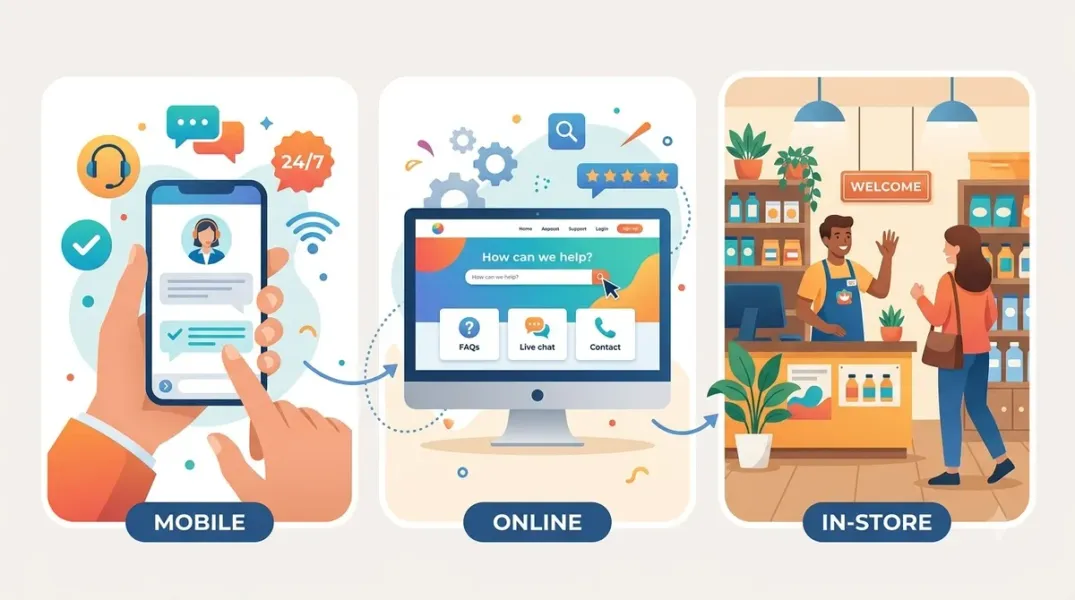
A local customer does not experience your business as “channels.” They experience it as a single relationship. They see your Google Business Profile, call your number, browse your website, message you on social media, walk into your store, and receive a follow-up email. To them, it is all one business.
But inside many small businesses, those channels operate as separate worlds. The person answering the phone does not know what the customer submitted through the website form. The in-store team cannot see the email thread. A message sent on social media sits unanswered because no one owns that inbox. Each handoff creates friction, and the customer feels it immediately.
This is the omnichannel customer experience gap. It is not a technology problem first. It is a consistency problem. And for local businesses, it is one of the most direct paths to lost revenue—and one of the most fixable.
This guide explains how to improve customer experience across phone, website, and in-store visits. You will learn why omnichannel matters for small businesses, where the most common friction points hide, and how to connect your channels without an enterprise budget.
1. Understand What Omnichannel Actually Means—and What It Does Not
Omnichannel is not the same as multichannel. Multichannel means offering multiple ways for customers to reach you—phone, website, email, social, in-store—but each channel operates independently. Omnichannel means those channels are interconnected, so the customer experiences one continuous, consistent relationship regardless of where they interact.
IBM defines omnichannel customer experience as a customer’s ability to interact with a business seamlessly across multiple channels and touchpoints, receiving a unified and consistent experience regardless of platform or device. The critical difference is integration: in an omnichannel model, the customer journey—not the individual channel—is the unit of management.
For a small business, this has a practical meaning: the customer should not have to repeat themselves. The person who answers the phone should know what the customer submitted online. The in-store team should know about the appointment booked by text. A message on any channel should be visible to whoever can resolve it.
2. The Perception Gap: Businesses Think They Are Better Than They Are
The most consistent finding in omnichannel research is that businesses overestimate their own performance. Across nearly every channel, small businesses rate their customer experience far higher than customers do.
A 2026 Moneypenny survey of 2,000 SMBs and 2,000 consumers found perception gaps as high as 32 percentage points. For social media, 64% of SMBs said it drives conversion, but only 32% of consumers felt it met expectations. Web forms showed the same gap: 64% versus 32%. AI receptionists: 56% versus 26%. Chatbots: 54% versus 26%.
The phone channel showed a smaller but still meaningful gap: 89% of SMBs said the phone was effective at converting inquiries, while 69% of consumers agreed. Phone had a 16-point perception gap overall.
The broader pattern is similar across markets. In the U.S., 65% of consumers say their favorite brand delivers a seamless experience, but 78% of businesses believe they offer one—a 13-point gap. And 74% of consumers are frustrated by disorganized interactions that force them to repeat information or switch between teams.
Fix: Before improving anything, assume the gap exists in your business. The most useful starting point is not a new tool—it is an honest audit of what the customer actually experiences across each channel.
3. Map the Customer Journey and Quantify Friction
You cannot fix friction you have not identified. Before investing in tools, map the actual journey a local customer takes from first contact to completed service.
A practical mapping exercise:
- List every touchpoint: Google Business Profile, website, phone, text, social media, email, in-store visit, booking system, follow-up.
- Walk the journey yourself as a customer would. Call your own number. Submit your own form. Send a message on social. Visit the store.
- Note where you have to repeat information, where you wait, or where the experience feels inconsistent.
- Identify the top three friction points that cost the most time or cause the most abandonment.
RingCentral’s retail CX framework recommends quantifying friction before fixing it—tracking repeat contact rates, escalation frequency, and sentiment scores by journey stage to understand which touchpoints create the most frustration.
Fix: Start with one high-value journey—such as “inquiry to booked appointment” or “website visit to in-store purchase”—and map it end to end. Most friction will appear at handoff points between channels.
4. Unify Customer Data So Context Travels Across Channels
The root cause of most omnichannel friction is fragmented data. When phone, website, and in-store systems do not share a customer record, every interaction starts from zero.
The numbers are stark. A 2026 State of Digital Customer Communication Survey found that only 11% of companies had full integration across their messaging platforms and their CRM or core business systems. The remaining 89% were operating with partial to no integration, struggling with fragmentation.
For small businesses, fragmentation often looks like WhatsApp on personal numbers, email in individual inboxes, SMS on separate platforms, and phone calls in a system that was never designed to connect the dots. The result is no shared history, no continuity, and no visibility for the customer on the other side.
What unified data enables:
- A single customer profile that combines website form submissions, phone calls, in-store purchases, and messages.
- Context at every touchpoint, so the customer does not have to repeat their name, issue, or history.
- Personalization based on past interactions across channels.
Fix: Start with a simple CRM that connects your website forms and phone inquiries. Integrate point-of-sale data where possible. Even a basic unified record—name, contact information, interaction history, and preferences—eliminates most repetition friction.
5. Deliver Consistency in Service Protocols and Response Times
Customers expect the same standard of service regardless of channel. If your website promises a two-hour response, your phone team and in-store staff must deliver the same speed.
Where consistency matters most:
- Response time. The Moneypenny survey found that 72% of consumers say they are likely to choose the business that responds first. Speed of response ranked higher than brand trust when consumers considered loyalty.
- Tone and accuracy. The same question should get the same answer whether it is asked by phone, chat, or in person.
- Next steps. If a customer books online, the confirmation, reminder, and follow-up should follow the same pattern regardless of how the booking was made.
- After-hours coverage. 24% of consumers said they would prefer early evening support between 5 p.m. and 9 p.m., and after-hours availability made 37% feel more reassured and 32% more likely to choose or stick with a business.
Fix: Write down your service standards—response time targets, greeting, escalation process, and follow-up timing. Apply them uniformly across phone, website, and in-store. Train every customer-facing team member on the same standards.
6. Equip Your Team With Unified Customer Context
Your team cannot deliver a consistent experience if they cannot see the customer’s history. Frontline staff—whether on the phone, at a desk, or on the sales floor—need access to the same customer information.
What staff need at their fingertips:
- Previous purchases, bookings, or service history.
- Open inquiries or unresolved issues.
- Communication preferences and consent status.
- Notes from prior conversations across channels.
RingCentral’s framework emphasizes mobile-first platforms that deliver real-time customer history, inventory data, and communication tools directly where the work happens—on the sales floor and at service desks. Unified context eliminates mid-conversation system toggling and reduces the “let me check on that” moments that frustrate customers.
Fix: Give frontline staff a single view of the customer. If a full CRM is not feasible yet, start with a shared notes system that every team member can access and update after each interaction.
7. Connect Physical and Digital Touchpoints
For local businesses, the most valuable omnichannel improvements often happen at the boundary between digital and physical. Customers research online and buy in-store, or discover in-store and complete online.
Practical connections to build:
- Buy Online, Pickup In-Store (BOPIS): Allows customers to order online and collect at your location, merging digital convenience with physical immediacy.
- QR codes and smart packaging: Bridge offline materials to online information, reviews, or reordering.
- In-store tablets or mobile tools: Help staff look up product availability, reviews, or place online orders from within the store.
- Click-and-collect and returns across channels: Reduce friction for customers who want flexibility in how they receive or return purchases.
Fix: Choose one physical-digital connection that fits your business—BOPIS, QR-based reordering, or in-store access to online inventory—and implement it well before adding more.
8. Treat the Phone as a First-Class Channel
The phone is still one of the highest-converting channels for local businesses, but it is also one of the most neglected in omnichannel planning. 89% of SMBs say the phone is effective at converting inquiries—more than any other channel.
Phone-specific improvements:
- Answer faster. 33% of businesses and 17% of consumers think a response should come within seconds; 36% of businesses and 41% of consumers say within minutes.
- Use call tracking to attribute calls to the channel or campaign that drove them, and to review what happened on each call.
- Connect call data to the customer record so the next interaction—whether in-store or online—has context.
- Cover after-hours demand. Early evening support (5–9 p.m.) meets a meaningful share of customer preference.
Fix: Review your missed-call rate and average speed to answer. Even small improvements in phone responsiveness can recover revenue that is currently leaking silently.
9. Build Continuous Feedback Loops
Omnichannel improvement is not a one-time project. Customer expectations shift, and new friction points emerge as channels change.
Feedback practices that work:
- Ask after every interaction—post-call, post-visit, post-purchase—with a short, channel-appropriate survey.
- Monitor reviews and messages across platforms for recurring complaints.
- Track repeat contact rates as a signal that the first interaction did not resolve the issue.
- Close the loop with customers who report a problem, and with your team so they know what changed.
Fix: Set a monthly rhythm for reviewing feedback across channels. Identify one friction point to fix each month, and measure whether the fix reduced repeat contacts or improved satisfaction.
10. Start Incrementally—Do Not Attempt Everything at Once
A full omnichannel transformation is overwhelming for a small business. The practical approach is incremental: fix one slice at a time, build on the foundation, and expand as capability grows.
A sensible sequence for most local businesses:
- Unify your contact points—website forms, phone, and email into one record.
- Standardize response times across those channels.
- Add SMS or messaging for reminders and confirmations.
- Connect point-of-sale data so in-store interactions update the customer record.
- Add BOPIS or another physical-digital connection if relevant to your business.
- Introduce automation for routine confirmations and follow-ups.
The ITEdgeNews analysis makes the same point: while a full omnichannel transformation from day one will overwhelm the average small business, an incremental approach—one slice at a time—is entirely possible and allows businesses to manage both spend and strategic growth simultaneously.
Conclusion
Improving customer experience across phone, website, and in-store visits is not about buying an enterprise platform. It is about removing the friction that appears when channels operate as separate businesses. The perception gap is real: most small businesses believe they are delivering a better experience than their customers actually receive. Closing that gap starts with mapping the journey, unifying customer data, standardizing service, and connecting the physical and digital touchpoints your customers already use.
For local businesses, the advantage is proximity. You can build the kind of personal, responsive relationships that larger competitors struggle to replicate. But that advantage only pays off when the customer experiences one business—not five disconnected ones.
Call to Action
Ready to close the omnichannel gap in your business? Start by calling your own phone number, submitting your own website form, and visiting your own store as a customer would. Note every point where you have to repeat yourself or wait. If you want a structured review of your phone, website, and in-store handoffs, contact us for a free omnichannel customer experience audit and get a practical plan for connecting your channels without overhauling everything at once.
FAQs
Q1: What is omnichannel customer experience for a small business?A: It means a customer can interact with your business across phone, website, messaging, and in-store visits and receive a consistent, connected experience—without repeating information or encountering disconnected service.
Q2: How is omnichannel different from multichannel?A: Multichannel offers multiple independent channels. Omnichannel integrates those channels so customer data and context travel across them, creating one continuous experience rather than separate ones.
Q3: Do I need expensive software to improve omnichannel experience?A: No. Start with a simple CRM that connects website forms and phone inquiries, standardize response times, and ensure staff can see interaction history. Add tools incrementally as the basics work.
Q4: Why does the phone still matter in an omnichannel strategy?A: The phone remains one of the highest-converting channels for local businesses. 89% of SMBs say it is effective at converting inquiries, and speed of response strongly influences which business customers choose.
Q5: What is the first step to improving omnichannel experience?A: Map the customer journey and identify friction points—especially handoffs between channels where customers have to repeat information. Fix one high-value journey before expanding to others.
Grow Your Google Maps Ranking on Autopilot
Stop spending hours every week manually replying to customer reviews and writing Google posts. Busirank automates your Google Business Profile to boost your local SEO rankings and turn searchers into paying clients.
 Busirank Team