 Busirank Team
Introduction
A monthly local SEO report for a single-location business has one job: prove that the investment is generating customers. Yet most reports fail at this basic task. They are packed with impressions, keyword counts, and technical details that do not connect to revenue. The business owner skims page one, files the report, and quietly wonders what they are paying for .
The difference between a report that builds trust and one that gets ignored comes down to focus. For a single-location business, there is no need for multi-location comparison charts or franchise-level rollups. The report should answer three questions: What changed this month? Why did it change? What happens next ?
This guide covers exactly what a monthly local SEO report should include for a single-location business—the metrics that matter, how to frame them for a business owner, and how to connect local search activity to actual revenue.
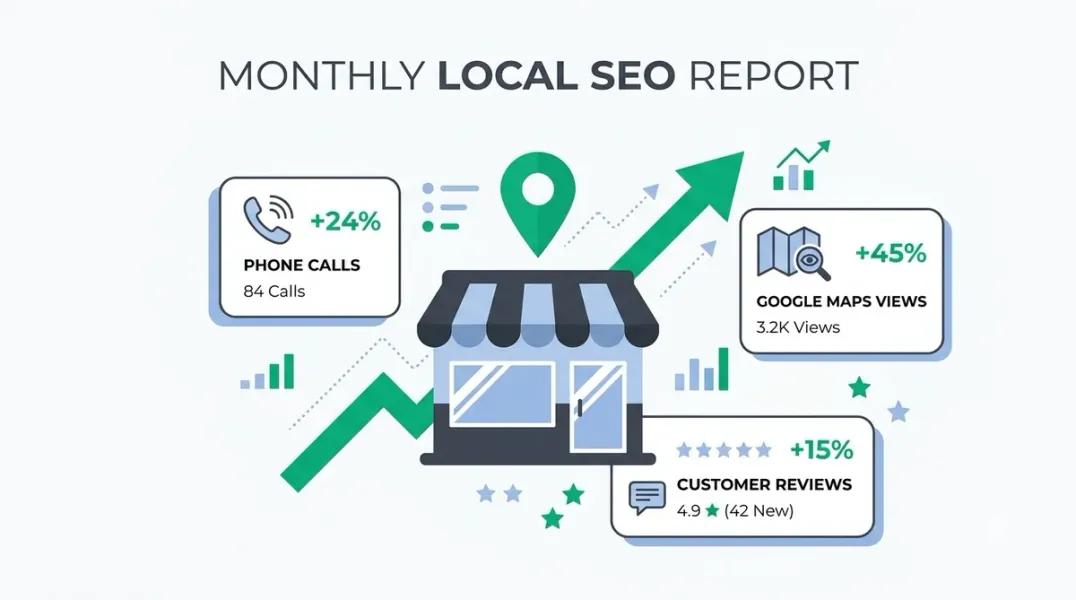
For a single-location business, the metrics that carry the report are the ones with an obvious line to the business . Clients do not experience impressions. They experience the phone ringing, or not ringing.
Lead with calls from the Google Business Profile. This is the closest thing to a direct enquiry count. When someone taps the call button on your profile, they are expressing immediate buying intent. Lead every report with this number .
Direction requests come second. For any business with a physical location, direction requests are the clearest signal that someone is taking concrete action toward a visit. “People set off to visit” is unarguable .
Website clicks from the profile show how many people went to look more carefully. This connects the profile to the website and whatever conversion tracking exists there .
Review count and rating matter because clients check these themselves. Better that the movement comes from you first. Show new reviews, current average rating, and response rate .
Search Console queries explain the other numbers. The useful cut is branded versus non-branded. Branded traffic reflects existing demand. Non-branded traffic shows your ability to capture new prospects .
Cutting the Vanity Numbers
Every metric in a single-location report should survive one question: what would we do differently if this changed? Most do not .
Profile views and impressions move with seasonality, interface changes, and chance. They are useful as context in a sentence, but misleading as a headline .
Raw keyword position lists are especially problematic for local businesses. Local pack results vary by the searcher’s exact location, so a reported position is one point on a map. Presenting it as fact invites an argument you cannot win when the client checks from home .
Task lists as achievements—“updated 14 attributes,” “built 8 citations”—are inputs, not outcomes. Keep an activity section, but do not present it as results .
Cutting these feels uncomfortable because volume feels like value. It is not. Every metric you include is one you may have to defend when it moves the wrong way.
Structuring the Monthly Report
A single-location report should be short enough to read in one sitting and structured so the most important information comes first .
Page 1: The Executive Summary. Lead with leads and revenue. “Leads: 45 to 89 (+97%). Revenue: $67K to $124K (+85%).” Business metrics in plain language, no jargon .
Page 2: Lead Generation Breakdown. Show calls, form submissions, direction requests, and messages. Break down by source where possible. “Phone calls: 67 (+45%). Form submissions: 22 (+83%). Total leads: 134. Qualified leads: 89” .
Page 3: Review Performance. New reviews this month, current rating, response rate, and the trend over time. Reviews influence both rankings and buying decisions .
Page 4: What We Did This Month. Client-friendly language. “Added 2 service pages, generated 14 new reviews, published 4 blog posts.” Not “Implemented schema markup for enhanced SERP features” .
Page 5: Next Month Plan. Clear action items with business rationale. “Reach 200 total reviews. Rank top 3 for [keyword]. Launch [new service] pages” .
Connecting Local SEO to Revenue
The ultimate test of a report is whether it answers: how much revenue did this generate ?
The formula is straightforward: Leads × Conversion Rate × Average Customer Value = Attributed Revenue .
For example: if your GBP generates 40 calls and 15 form submissions per month (55 leads), and you convert 25% of leads with an average value of $500, your local SEO program generates approximately $6,875 per month. If your investment is $1,500 per month, that is a 4.6x ROI .
Apply conservative attribution. Attributing 70% of incremental leads to local SEO is a defensible middle ground that prevents overclaiming while still demonstrating value .
Accounting for Seasonality
Never compare December to November without acknowledging seasonality. A single month’s figure means almost nothing alone .
Show each metric against the previous period and, where you have the history, the same month last year. A client running a garden center already knows February is quiet. Not acknowledging it makes the report look naive .
If a decline occurs, raise it yourself in the first paragraph. Do not bury it on page nine and let the client discover it. Declines usually fall into a few buckets: seasonal, local and specific (a competitor opened), reputation (a run of poor reviews), or self-inflicted (hours were wrong). Name it. Clients forgive an owned mistake far more readily than a vague one .
Reporting Frequency and Format
Monthly reporting is the standard. Weekly is too granular and creates anxiety over normal fluctuations. Quarterly is too infrequent—by the time you spot a problem, you have lost three months of potential performance .
Create two versions: a one-page executive summary for the decision-maker and a detailed appendix for anyone who wants the full data. Most business owners will only read the summary. Sending both shows thoroughness without overwhelming .
Conclusion
A monthly local SEO report for a single-location business does not need to be comprehensive. It needs to be clear. Lead with the phone calls and direction requests that signal real customer intent. Show review trends. Explain what you did and what comes next.
Connect the numbers to revenue using the simple formula: leads × conversion rate × average customer value. Cut the vanity metrics that do not drive decisions. Account for seasonality. Raise bad months yourself.
The businesses that master this reporting approach build trust, retain clients longer, and justify their value with numbers that owners actually understand.
Call to Action
Ready to build reports that prove your local SEO value? Start by restructuring your next monthly report to lead with calls, direction requests, and review trends. Then add the revenue calculation.
Download our Single-Location Local SEO Report Template for a proven structure that connects metrics to business outcomes. Or contact our local SEO team to audit your current reporting and identify what to keep, what to cut, and what to add.
FAQs
What is the most important metric in a local SEO report?
Phone calls from the Google Business Profile. It is the closest thing to a direct enquiry count and signals immediate buying intent. Lead every report with this number .
Should I include keyword rankings in a single-location report?
Show only the 3-5 priority keywords that drive revenue. Present them as position movement, not absolute position. Local results vary by the searcher’s location, so a single reported position can be misleading .
How do I calculate ROI for a single-location business?
Use the formula: Leads × Conversion Rate × Average Customer Value = Attributed Revenue. Compare attributed revenue to monthly investment. A 4.6x ROI is achievable with 55 leads at 25% conversion and $500 average value against a $1,500 investment .
What should I do if the report shows a decline?
Raise it yourself in the first paragraph. Explain the likely cause—seasonal, local, reputation-related, or self-inflicted. Clients forgive an owned mistake far more readily than a vague one buried on page nine .
How often should I send local SEO reports?
Monthly is the standard. Weekly is too granular and creates unnecessary anxiety over normal fluctuations. Quarterly is too infrequent to catch problems early .
Internal & External Links
Internal Links
- How to Connect Local SEO Metrics With Actual Sales (Topic 71)
- Local SEO Attribution: How to Know Which Searches Generate Customers (Topic 72)
- How to Create a Local SEO Dashboard for Business Owners (Topic 73)
- Which Google Maps Metrics Should Agencies Report to Clients Every Month? (Topic 74)
External Sources
- Google Business Profile Help: Understand your Business Profile performance: https://support.google.com/business/answer/9918094
- Locafy: Local SEO Reporting—What to Track and How to Show ROI: https://locafy.com/blog/local-seo-reporting
- AgencyAnalytics: How to Create Effective Local SEO Reports: https://agencyanalytics.com/blog/local-seo-reports
- Google Business Profile APIs: Metric Reference: https://developers.google.com/my-business/reference/rest/v4/Metric
Grow Your Google Maps Ranking on Autopilot
Stop spending hours every week manually replying to customer reviews and writing Google posts. Busirank automates your Google Business Profile to boost your local SEO rankings and turn searchers into paying clients.

 Busirank Team
