 Busirank Team
Introduction
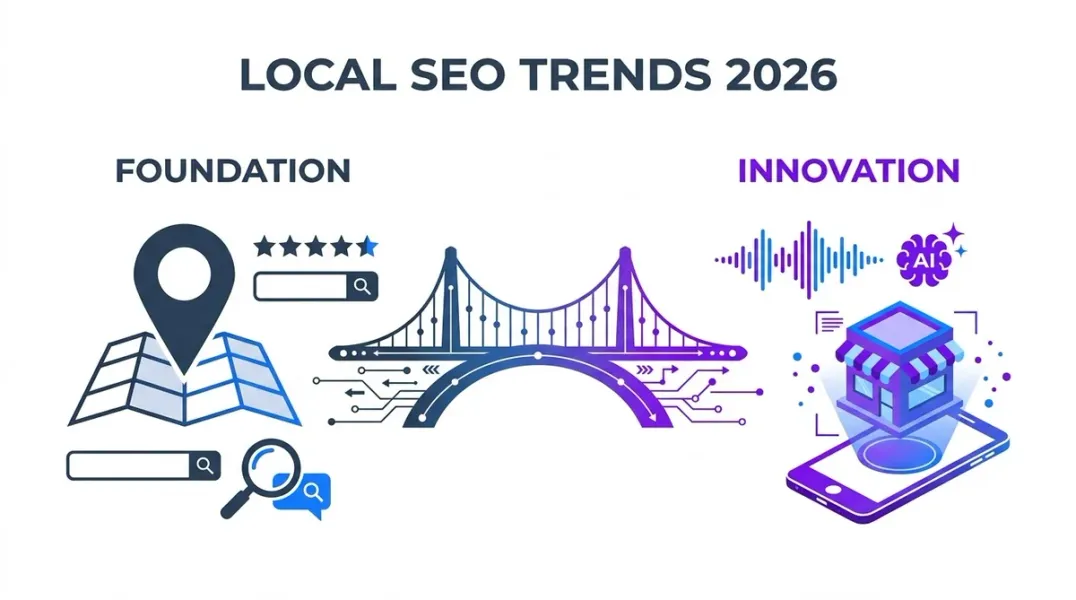
Local SEO in 2026 looks different from even two years ago. AI-powered search experiences now appear in a significant share of queries. Voice assistants and conversational tools are reshaping how customers phrase their needs. Review signals carry more weight than ever. Yet the fundamentals—Google Business Profile optimization, citation consistency, and review management—remain the foundation of local visibility.
The landscape is shifting in measurable ways. Google AI Overviews now appear in roughly 30 to 50 percent of US searches, often pushing traditional results down the page . In Locafy’s analysis, Google’s AI surfaces cite local-SEO brands more than ChatGPT and Copilot combined . Meanwhile, use of conversational search tools like ChatGPT for local recommendations jumped from 6% to 45% in a single year .
This guide breaks down what is actually changing in local SEO, what remains constant, and how to position your business for visibility across both traditional and AI-driven search experiences.
AI is not replacing local SEO. It is changing where and how local results appear.
Google AI Overviews now answer a meaningful share of local queries, often citing local businesses directly in the generated response. Informational queries like “how long does an eye exam take near me” trigger AI Overviews 92% of the time . This means the informational layer above the Map Pack is increasingly AI-generated.
Conversational assistants are also entering the local discovery flow. Customers ask ChatGPT, Gemini, and Perplexity for recommendations—“best coffee shop in Austin” or “who can fix a burst pipe near me tonight”—and these tools generate answers from publicly available data, reviews, and structured content.
The implication: local visibility now requires being present and accurate across multiple surfaces. Your Google Business Profile remains critical, but so do structured data, consistent citations, and review content across platforms. AI systems synthesize information from all of these sources when forming recommendations.
Why Review Signals Are More Important Than Ever
Reviews have grown as a ranking factor every year for the past five years, and that trend continues in 2026 . But the nature of review influence is evolving.
A study of negative e-reviews on Google Maps found that review credibility has a significant effect on purchase intention, while the quality and volume of negative reviews exhibited limited or non-significant effects . What matters is not just how many reviews you have, but how trustworthy and believable they are.
Another study examining Google Maps ratings and reviews on purchasing decisions found that both rating and review significantly and positively affect decisions, with rating being the most dominant variable . This confirms what practitioners have observed: the star rating is the first filter, and review content is the second.
The actionable trend: review velocity, response rate, and content quality matter more than raw volume. A steady stream of recent, detailed reviews with owner responses outperforms a stale pile of generic five-star ratings.
Voice Search and Conversational Queries
Voice search is no longer a futuristic novelty. It is a fundamental shift in how customers find local businesses. Approximately 72% of voice searches are phrased as questions, and they are significantly longer than typed queries.
People now ask full questions like “who can fix a burst pipe near me tonight” instead of “plumber Nashville” . This conversational nature means your optimization must mirror how people actually talk. Service descriptions, business descriptions, and Q&A content should reflect the language customers use when speaking.
The connection to local SEO is direct: voice assistants pull from Google Business Profile data, structured content, and review signals when answering local queries. A complete profile with accurate hours, services, and location data is more likely to be the spoken answer.
The Growing Weight of Behavioral Signals
Behavioral signals—how users interact with your listing—are a growing factor in local rankings. These include click-through rate from search results, mobile clicks-to-call, direction requests, and dwell time .
A study of automotive Google Business Profiles across India found that website clicks never crossed 4% in any category. Instead, direction requests dominated: at auto repair shops, 80.5% of all customer actions were direction requests. For used car dealers it was 75.6%, and for tyre shops 69%. Two-wheeler dealers were the exception, with 52.1% of actions being calls .
The lesson: not all engagement is equal, and the mix varies by category. For brick-and-mortar businesses, direction requests are often the strongest signal of intent. For mobile services, calls and website clicks matter more. Tracking the right behavioral signals for your category is essential.
What Stays the Same: The Fundamentals
Despite all the changes, the core of local SEO remains remarkably stable.
Google Business Profile remains the foundation. GBP signals account for approximately 32% of local ranking weight . Primary category selection, profile completeness, posting activity, photo quantity, and Q&A engagement all influence visibility.
Citations still matter for verification. While citation weight has declined slightly, NAP consistency across authoritative directories remains a foundational signal . Inconsistent citations actively hurt rankings by creating confusion about your business identity.
Reviews are a ranking and conversion factor. Review quantity, velocity, diversity, average rating, keyword content, and owner response rate all contribute to prominence signals .
On-page location relevance still counts. Location keywords in title tags, city and service landing pages with unique content, LocalBusiness schema markup, and mobile performance all influence local rankings .
Local links carry outsized weight. A link from your city’s newspaper or chamber of commerce is worth more than links from generic national directories .
Emerging Trends to Watch
Several developments are shaping the next phase of local SEO.
Entity optimization for AI. As AI search grows, new ranking factors are emerging around entity authority. Google, ChatGPT, and Perplexity evaluate whether your business is a recognized entity with consistent, corroborated information across the web .
Geo-grid rank tracking. Local rank tracking is shifting from single-position reporting to geographic grids that show visibility across neighborhoods and zip codes. This reflects how local search actually works—rankings vary by the searcher’s exact location.
Behavioral signal optimization. Encouraging direction requests, clicks-to-call, and other engagement actions is becoming a deliberate tactic. For example, having employees use Google Maps to navigate to the business each morning signals to Google that the location is active and worth showing .
AI-generated review summaries. Google now generates review summaries for many businesses. These summaries pull from review content and shape how potential customers perceive the business before they read individual reviews.
What This Means for Local Businesses
The 2026 local SEO landscape rewards businesses that do three things well:
Be complete and consistent. Every profile, every citation, every piece of structured data should tell the same story. AI systems synthesize information, and inconsistencies create doubt.
Be active and recent. Fresh reviews, regular GBP posts, updated photos, and prompt review responses signal that the business is alive and engaged.
Be relevant and specific. Generic content does not rank. Specific services, specific locations, and specific answers to customer questions—these are what earn visibility in both traditional and AI-driven search.
Conclusion
Local SEO in 2026 is both more complex and more straightforward than ever. The surfaces are multiplying—Map Pack, AI Overviews, voice assistants, conversational search—but the signals that earn visibility remain consistent. Complete profiles, consistent citations, steady reviews, relevant content, and active engagement.
The businesses that adapt will be those that treat local SEO as an ongoing discipline, not a one-time project. They will monitor their profile data, respond to reviews promptly, keep citations clean, and create content that answers real customer questions. They will understand that AI is not a replacement for these fundamentals—it is a new lens through which they are evaluated.
The fundamentals work. They always have. The difference in 2026 is that more systems are reading the signals, and the bar for consistency is higher.
Call to Action
Ready to future-proof your local SEO? Start by auditing your Google Business Profile for completeness. Check your NAP consistency across citations. Review your review velocity and response rate.
Download our Local SEO Trends 2026 Checklist to ensure your business is positioned for visibility across traditional and AI-driven search. Or contact our local SEO team to build a strategy tailored to your market and category.
FAQs
Is local SEO still relevant in 2026?
Yes, more than ever. 46% of all Google searches have local intent, and 78% of local mobile searches result in an offline purchase within 24 hours . The surfaces are changing, but the demand for local discovery is growing.
How is AI changing local SEO?
AI Overviews now answer many local queries, and conversational assistants are increasingly used for local recommendations. This means businesses need complete, consistent, and structured data across multiple platforms—not just a well-optimized Google Business Profile .
What is the most important local ranking factor in 2026?
Google Business Profile signals account for approximately 32% of local ranking weight, making GBP optimization the highest-leverage activity . Review signals (16%) and on-page signals (13%) follow.
Do citations still matter for local SEO?
Citations have declined in weight but remain a foundational signal. NAP consistency across authoritative directories helps verify your business identity to search engines and AI systems .
How do I optimize for voice search and AI assistants?
Use conversational language in your GBP description and Q&A. Answer common questions directly. Build structured data. Maintain consistent reviews across platforms. These signals feed the systems that power voice and AI search .
Internal & External Links
Internal Links
- How to Optimize Google Business Profile for Voice Search (Topic 61)
- How Google Maps Reviews Influence Customer Buying Decisions (Topic 62)
- Local SEO: The Complete Guide (Topic 76)
- How to Monitor Competitor Google Reviews and Find Market Opportunities (Topic 66)
External Sources
- Locafy: Local SEO Guide for 2026: https://www.locafy.com/blog/local-seo-guide
- Locafy: Local SEO Ranking Factors 2026: https://www.locafy.com/blog/local-seo-ranking-factors
- Search Engine Journal: How To Connect AI Search Visibility To Local Leads: https://www.searchenginejournal.com/how-to-connect-ai-search-visibility-to-local-leads/588096/
- Zenodo: Map Pack Ranking Factors 2026: https://zenodo.org/records/22144087
Grow Your Google Maps Ranking on Autopilot
Stop spending hours every week manually replying to customer reviews and writing Google posts. Busirank automates your Google Business Profile to boost your local SEO rankings and turn searchers into paying clients.

 Busirank Team
