 Busirank Team
Introduction
You rank number one for your main keyword. But do you know how much of your actual local market you are winning? Rankings alone can be misleading. You might appear at the top of the results from your office, yet be invisible just a few miles away where a large share of your potential customers live.
This is where local search share of voice (often called Share of Local Voice, or SoLV) comes in. It measures the percentage of your geographic market where your business appears in the most valuable search results—the Google local pack. It answers the question that matters most: for the searches that drive real customers, how often are you the one they see?
This guide explains what local search share of voice is, why it is one of the most revenue-connected metrics in local SEO, and exactly how to measure and improve it for your business.
1. What Is Local Search Share of Voice (SoLV)?
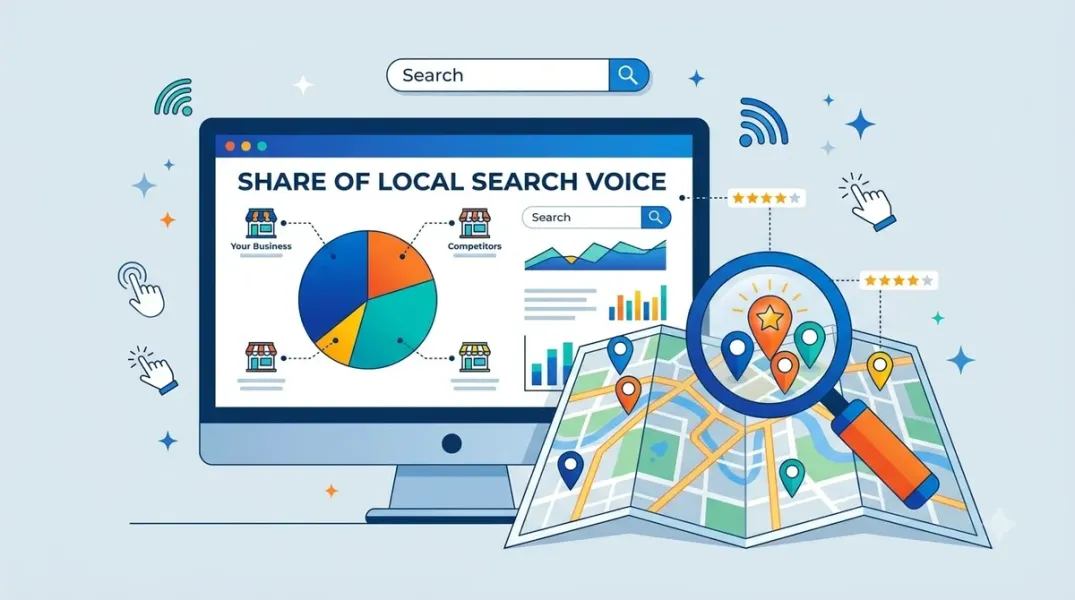
Local search share of voice is the percentage of local search visibility a business captures in its geographic market compared to competitors. It measures how often your business appears in the local pack (the top three map results), Google Maps, and local organic results for a defined set of local keywords.
If five businesses compete for 100 local keywords and you appear in the local pack for 35 of them, your share of local voice is approximately 35%. Your competitors showing up for 25, 20, 15, and 5 keywords hold the remaining 65%.
SoLV is different from a traditional keyword ranking. A ranking tells you where you appear from a single location. SoLV tells you how consistently you appear in the top three results across your entire service area, from many different search locations.
2. Why Share of Local Voice Matters More Than Rankings
Average rank can hide critical information. Two businesses might have the same average rank, but one could be first across 70% of its area and missing from the rest, while the other is fourth everywhere. The first leads in a large part of its market. The second appears everywhere but is never first.
The top three positions in the local pack capture the overwhelming majority of clicks. Position one captures roughly 25–35% of clicks, position two around 15–20%, and position three about 10–15%. Positions four through seven share only the remaining 20–30%. If you are not in the top three across a given area, you are effectively invisible to most searchers there.
SoLV measures the geographic coverage where you are actually capturing leads. It answers: What percentage of my market am I winning? This is why SoLV is directly connected to business outcomes like calls, leads, and revenue.
3. The Compounding Effect of Local Voice
Unlike paid advertising that stops the moment your budget runs out, a growing share of local voice is self-reinforcing. More local pack appearances drive more clicks. More clicks drive more reviews. More reviews improve local ranking signals. Each gain builds on the previous one, which is why the gap between the leader and the laggard widens every month without intervention.
Businesses that dominate local packs track SoLV monthly and treat every competitor gain as a signal to act. Ignoring it allows competitors to quietly expand their visibility into your service area.
4. How to Measure Local Search Share of Voice
Measuring SoLV requires moving beyond a single location check and using geo-grid data across your target keywords and service area.
Step 1: Define Your Market and Keyword Set
Select 20–50 local queries your target customers actually search. Combine service keywords with location modifiers—for example, “plumber Austin,” “emergency plumber near me,” or “water heater repair [neighbourhood].” Pick the two or three discovery keywords that genuinely describe what you sell, and run a geo-grid for each to establish a baseline.
Step 2: Run Geo-Grid Scans
A geo-grid checks the same search from evenly spaced points around a business pin. Common grids are 7×7 (49 points) or 9×9 (81 points). Each point produces a mobile Google Maps results list, and you record whether your business appears in the top three.
This is essential because a search from your office checks only one point. A location-based grid shows how your visibility actually spreads across the entire service area.
Step 3: Calculate Your Share of Local Voice
The formula is straightforward:
SoLV = (Grid points where your business ranks 1–3) ÷ (Total grid points) × 100
On a 7×7 grid (49 points), if your business ranks in the top three at 22 of those points, your SoLV is 44.9%. A SoLV of 70% means you are in the top three for 70% of the searches across your service area. A SoLV of 15% means you are only capturing top-three visibility in 15% of your market.
Step 4: Track Month Over Month
A single snapshot is meaningless. Monthly tracking reveals whether your visibility is growing or shrinking, and whether a competitor is gaining ground.
5. Tools for Measuring Local Share of Voice
Several tools specialize in local rank tracking and SoLV calculation.
- Local Falcon: A dedicated geo-grid rank tracker that calculates SoLV based on top-three appearances across a grid. It is widely used for local SEO audits and competitive benchmarking.
- BrightLocal: Offers a Local Search Grid feature that shows your share of voice in your local neighborhood and benchmarks you against top competitors.
- Semrush Map Rank Tracker: Measures local SEO share of voice in map results alongside traditional position tracking.
- AccuRanker: Provides Share of Voice using either a static click-through rate model (where rank one is treated as roughly 31.2% of clicks) or a dynamic machine-learning model that accounts for SERP layout, ads, and search intent.
Beyond map grids, SoLV is also appearing in AI search visibility tools. BrightLocal’s Local AI Visibility metrics include a share of voice that measures your share of all business mentions in AI answers compared to competitors. A low share of voice, even with a decent mention rate, usually means you are being mentioned, but your competitors are being mentioned more.
6. What Counts as a “Good” Share of Local Voice?
There is no universal target. SoLV depends on how crowded your area and category are. A 30% local share for a plumber in a big city with hundreds of competitors means something different from 30% for a dentist in a small town. The benchmark that matters most is your own history: measure the same way each time and watch the trend.
That said, industry benchmarks provide useful context for competitive markets:
- Dominant: SoLV 60%+
- Strong: SoLV 40–60%
- Competitive: SoLV 25–40%
- Struggling: SoLV below 25%
In moderate competition, strong performance shifts to 50–70%, and in low-competition markets, 80%+ is achievable for well-optimized businesses.
Research has connected SoLV directly to lead volume. Businesses that double their SoLV typically see proportional increases in Google Business Profile-driven leads.
7. How to Improve Your Share of Local Voice
SoLV improvement requires converting positions four through seven into positions one through three across the grid. This is harder than it sounds, and improvement gets harder as you climb. Moving from 20% to 40% is more achievable than moving from 60% to 80%.
A realistic improvement trajectory:
- 20% to 30%: 2–3 months with active optimization
- 30% to 50%: 4–6 months
- 50% to 70%: 6–12 months
What moves SoLV:
- Review velocity and count (the strongest signal)
- Google Business Profile completeness improvements
- Citation consistency cleanup
- Local link building
- Category and attribute optimization
Best practices include establishing your baseline before optimizing, publishing 15+ Google Business Profile posts monthly, building a review generation system, creating local landing pages for each target area, and monitoring competitor share monthly.
8. Use SoLV in Reporting to Connect SEO to Revenue
SoLV resonates with business owners and clients better than abstract rank metrics because it maps to intuitive business language.
Instead of saying: “Your average rank improved from 5.2 to 4.1,” say: “You are now visible in the top three for 45% of searches in your service area, up from 28%. That is a 61% increase in geographic market coverage.”
People understand market coverage. They understand “45% of people searching in your area see you in the top three.” This connects directly to revenue in a way that average position cannot.
You can also break SoLV down by geographic zone—for example, by quadrant—to see which parts of your service area are strong and which need attention.
Conclusion
Local search share of voice is one of the clearest competitive benchmarks in local SEO. It moves beyond a single ranking to show how much of your actual geographic market you are winning in the local pack—the results that capture the majority of local clicks and calls.
By defining your keyword set, running geo-grid scans, calculating your SoLV, tracking it monthly, and focusing on the factors that move it—reviews, profile completeness, citations, and local content—you can turn a vague sense of “we’re doing okay” into a precise, revenue-connected measure of local visibility.
Call to Action
Want to know your true share of local search voice? Run a geo-grid baseline for your top service keywords and see exactly where you appear in the top three—and where competitors are taking your market. If you want help measuring and improving your SoLV, contact us for a free local visibility audit and get a clear plan to expand your coverage.
FAQs
Q1: What is local search share of voice (SoLV)?A: SoLV is the percentage of your geographic market where your business appears in the local pack top three for a defined set of keywords, measured across many search locations using a geo-grid.
Q2: How is SoLV different from a keyword ranking?A: A ranking shows where you appear from one location. SoLV shows how consistently you appear in the top three across your entire service area, which is a much better indicator of real visibility and lead capture.
Q3: What is a good SoLV percentage?A: It depends on competition. In highly competitive markets, 40–60% is strong and 60%+ is dominant. The most important benchmark is your own trend over time.
Q4: How do I measure SoLV if I don’t have an expensive tool?A: Dedicated tools like Local Falcon and BrightLocal are the most practical way to run geo-grids. A manual approach is possible but time-consuming and less accurate.
Q5: How long does it take to improve SoLV?A: A realistic trajectory is 2–3 months to move from 20% to 30%, 4–6 months to reach 50%, and 6–12 months to reach 70%. Improvement gets harder as you climb.
Grow Your Google Maps Ranking on Autopilot
Stop spending hours every week manually replying to customer reviews and writing Google posts. Busirank automates your Google Business Profile to boost your local SEO rankings and turn searchers into paying clients.

 Busirank Team