 Busirank Team
Introduction
Most local marketing decisions are made on instinct. A business owner tries a new offer, changes the website headline, or boosts a social post—and then judges the result by gut feeling. “That seemed to work” or “I don’t think that did anything” becomes the basis for the next decision, and the cycle repeats.
The problem is not effort. It is measurement. Without a structured experiment, you cannot tell whether a result came from your change or from the season, the weather, a competitor’s promotion, or pure chance. You end up repeating what feels good and abandoning what actually works.
Local marketing experiments solve this. They replace guesswork with a disciplined process: form a clear hypothesis, design a fair test, measure the outcome against a control, and decide what to do next based on evidence. This guide explains how to run experiments that produce trustworthy answers—without a data science team or an enterprise budget.
1. Understand What Makes a Marketing Experiment Different From a Campaign
A campaign is designed to produce results. An experiment is designed to produce learning. These are not the same thing.
When you launch a campaign, you want it to succeed. When you run an experiment, you want to know whether a specific change caused a specific outcome. That requires a level of discipline most campaigns do not have: a clear hypothesis, a controlled comparison, and a decision rule set in advance.
A true experiment has four components:
- A hypothesis: A specific, testable prediction about what will happen and why.
- A treatment: The change you are testing.
- A control: A group or period that does not receive the change, used for comparison.
- A measurement plan: Defined metrics, a defined time period, and a threshold for deciding whether the result is meaningful.
If any of these are missing, you are running a campaign, not an experiment—and you will not be able to trust the conclusion.
2. Start With a Hypothesis That Can Be Proven Wrong
A good experiment starts with a hypothesis that is specific enough to be disproven. Vague goals like “improve our local marketing” cannot be tested.
A strong hypothesis follows a simple structure:
Because [observation], we believe that [change] will result in [expected outcome], measured by [metric].
Weak hypothesis: “A new landing page will improve conversions.”
Strong hypothesis: “Because our contact form has five fields and mobile users abandon at a high rate, we believe reducing the form to three fields will increase mobile form submissions by at least 15% over four weeks, measured by form completion rate.”
The strong version names the observation, the change, the expected outcome, the metric, and the timeframe. You will know at the end whether you were right or wrong.
3. Choose Experiments That Fit Your Local Business
Not every experiment requires a website redesign or a big budget. Some of the most valuable local marketing experiments are small and fast.
High-value experiments for local businesses:
- Calls to action: “Call now” vs. “Get a free quote” vs. “Book online.”
- Form length: Five fields vs. three fields on mobile.
- Google Business Profile photos: Professional interior photos vs. team photos, measured by calls and direction requests.
- Review request timing: Immediately after service vs. 24 hours later.
- Local landing page headlines: Location-specific headline vs. service-focused headline.
- Offer structure: Percentage discount vs. dollar-off vs. free add-on.
- Follow-up cadence: Two-touch sequence vs. four-touch sequence.
- Ad copy: Neighborhood-specific messaging vs. general service messaging.
- Response time: Same-hour callback vs. next-day callback, measured by lead conversion.
Start with experiments tied to your most important conversion—calls, form submissions, bookings, or direction requests.
4. Design a Fair Test With a Control
The control is what separates an experiment from a guess. It is the comparison group or period that does not receive the change.
Common control designs for local businesses:
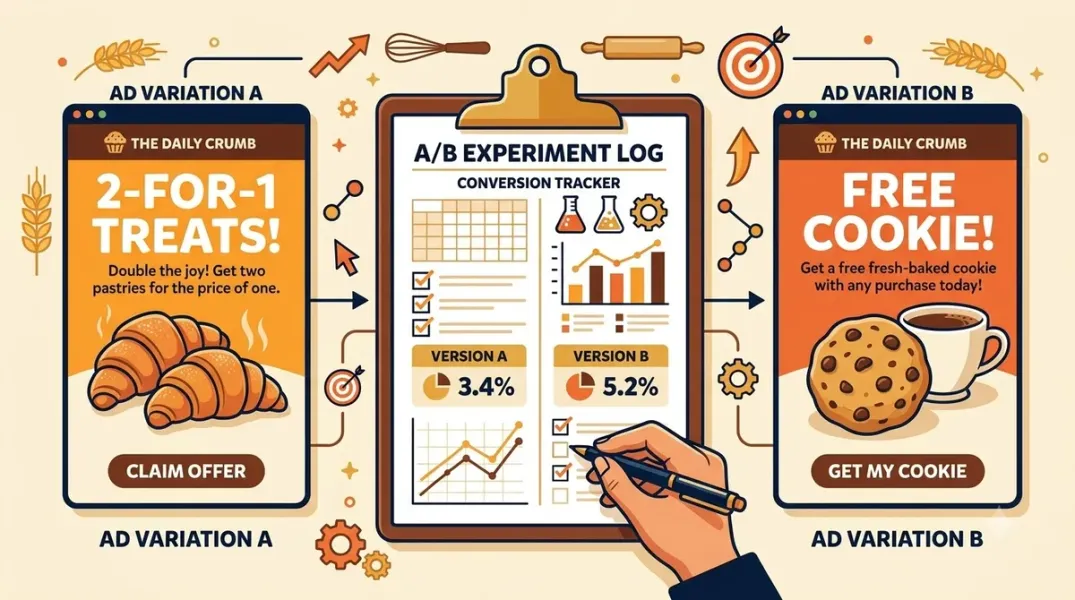
- A/B test (split test): Two versions of a page, ad, or email shown to different visitors at the same time. This is the cleanest design because it controls for seasonality and external events.
- Before-and-after test: Compare performance before and after the change. Simpler, but weaker—seasonality, weather, or a competitor’s promotion can distort the result.
- Holdout test: A segment of your audience does not receive the change while the rest does. Useful for email and SMS campaigns.
- Geo test: Run the change in one service area and compare it to a similar area that does not receive it. Useful for local ad campaigns.
Fix: Whenever possible, use a simultaneous A/B test. It is the most reliable way to isolate the effect of your change. If you cannot split traffic, use a before-and-after design but extend the period long enough to average out normal fluctuations.
5. Define Your Metrics Before You Launch
Deciding how you will measure success after the experiment ends is a recipe for rationalization. Define the metric and the decision rule before the test begins.
Metrics to define in advance:
- Primary metric: The one number that determines success (e.g., mobile form completion rate).
- Secondary metrics: Supporting metrics that explain the result (e.g., page load time, scroll depth, time on page).
- Guardrail metrics: Metrics that must not get worse (e.g., total form submissions, call volume, revenue per lead).
Fix: Write down the primary metric, the baseline value, the target improvement, and the decision rule. For example: “If mobile form completion rate increases by 10% or more with no drop in total submissions, we will roll out the change.”
6. Run the Test Long Enough to Be Meaningful
Short experiments produce noisy results. Local marketing is affected by day of week, weather, local events, and seasonality. A test that runs for three days is unlikely to produce a trustworthy answer.
Practical timing guidance:
- Minimum one to two weeks for most website and local ad tests.
- Four weeks or more for seasonal services, where demand fluctuates significantly.
- At least one full business cycle—include weekdays and weekends, and avoid running a test only during an unusual week.
- Stop at a pre-defined date, not when the result looks good.
Fix: Choose the test duration before you launch, based on your normal traffic volume. If you do not get enough traffic for statistical significance in four weeks, either run a longer test or test a change with a larger expected effect.
7. Aim for Enough Traffic to Detect a Real Difference
Statistical significance tells you whether an observed difference is likely real or just random variation. But you need enough traffic for the test to detect a meaningful effect.
The trade-offs to understand:
- Small traffic sites need larger effects or longer test periods to detect a change.
- Big effects are easier to detect. A 30% improvement needs far less traffic than a 3% improvement.
- You can roughly estimate sample size with a free A/B testing calculator before you launch. Enter your baseline conversion rate and the minimum effect you want to detect.
Fix: Before launching, estimate the traffic required. If your site does not get enough traffic, focus on changes likely to produce a larger effect—like a new offer or a redesigned form—rather than micro-optimizations.
8. Avoid Confounds and Testing Bias
A confound is anything that changes at the same time as your treatment and could explain the result. Confounds are the most common reason local marketing experiments produce misleading conclusions.
Common confounds to control for:
- Seasonality: Running a summer offer test in July and concluding the offer worked when demand was already rising.
- Simultaneous changes: Launching a new ad campaign while also testing a landing page.
- Local events: A festival or school holiday that changes foot traffic.
- Competitor activity: A competitor’s promotion or price change during the test.
- Tracking gaps: A call tracking number that only appears on one version of the page.
Fix: Change one thing at a time. Note any external events during the test period. If a major confound occurs, extend the test or re-run it.
9. Analyze Results Carefully
When the test ends, resist the urge to declare victory or failure immediately. Look at the full picture.
Analysis checklist:
- Compare the primary metric between control and treatment.
- Check the secondary and guardrail metrics for unintended effects.
- Look at the trend over the test period, not just the final number. Was the effect consistent or driven by a single spike?
- Assess statistical significance where your volume allows.
- Consider segment differences. A change that helps desktop users may hurt mobile users. For local businesses, mobile results often matter more.
- Review any confounds that occurred during the test.
Fix: Report results in plain language. “Reducing the form from five fields to three increased mobile form completions by 22%, while total submissions held steady. We are rolling it out.”
10. Decide What to Do Next
An experiment ends with a decision, not a report. Each result should lead to one of four outcomes:
- Adopt: The change worked. Roll it out to all relevant pages or campaigns.
- Iterate: The change showed promise but did not fully succeed. Test a variation.
- Abandon: The change did not work. Document what you learned and move on.
- Re-test: The result was inconclusive because of low volume or a confound. Run it again with a better design.
Fix: Document every experiment in a simple log: hypothesis, dates, traffic, result, decision, and what to test next. Over time, this log becomes a valuable knowledge base for your local marketing.
11. Use the Tools That Make Experiments Practical
You do not need an enterprise platform to run useful experiments. Several accessible tools cover the essentials.
Website and landing page testing:
- Google Optimize alternatives: Google Optimize was retired, but platforms like VWO, Optimizely, and AB Tasty offer A/B testing.
- Unbounce and Instapage support landing page tests natively.
- WordPress plugins: Several A/B testing plugins can test headlines, forms, and CTAs on small business sites.
Ad testing:
- Google Ads experiments let you test campaign changes on a portion of traffic against a control.
- Meta Ads testing features allow split testing of creatives, audiences, and placements.
Measurement:
- GA4 experiments and event-based conversion tracking.
- Call tracking with separate numbers per variant.
- CRM fields to track lead source and variant.
Fix: Start with the tools you already have. A GA4 event plus a simple CRM field can support many useful experiments before you invest in new software.
12. Build a Culture of Experimentation
The biggest benefit of experiments is not any single result. It is the habit of asking “How would we know?” before making a marketing decision.
Ways to build the habit:
- Run one experiment per month on your highest-value conversion.
- Share results with your team in plain language.
- Celebrate good tests, even when the result is negative—a negative result saves money.
- Keep a running list of hypotheses to test next.
- Review your experiment log quarterly and look for patterns.
Fix: Start with one experiment tied directly to revenue—like a form change or a new offer—and use the result to build momentum for the next one.
Conclusion
Local marketing experiments turn opinion into evidence. By forming a specific hypothesis, designing a fair test with a control, defining metrics in advance, running the test long enough, avoiding confounds, and making a clear decision at the end, you can learn what actually works for your local customers—and stop spending time on what does not.
You do not need perfect data to make better decisions. You need a disciplined process, a willingness to be wrong, and the patience to let a test finish before declaring a winner.
Call to Action
Ready to stop guessing and start testing? Pick one conversion that matters—your contact form, your call button, or your booking page—and design your first experiment this month. If you want help setting up a fair test, choosing the right metrics, and analyzing the results with confidence, contact us for a free experimentation planning session and get a clear roadmap for your first local marketing experiment.
FAQs
Q1: What is a local marketing experiment?A: It is a structured test of a specific marketing change—like a new call to action or a shorter form—designed to measure whether the change caused a specific outcome compared to a control.
Q2: How long should a local marketing experiment run?A: Most website and ad tests should run at least one to two weeks, and four weeks or more for seasonal services. Run for a pre-defined period rather than stopping when the result looks good.
Q3: Do I need a lot of website traffic to run an experiment?A: You need enough traffic to detect a meaningful effect. If your site has low traffic, test changes likely to produce larger effects—such as a new offer or a redesigned form—and run the test longer.
Q4: What is a control group, and why does it matter?A: The control is the group or period that does not receive the change. It provides the comparison needed to determine whether the change actually caused the result rather than seasonality or external events.
Q5: What should I do if my experiment result is inconclusive?A: Check for confounds such as seasonality, simultaneous changes, or insufficient traffic. Then re-run the test with a longer period, a cleaner design, or a change expected to produce a larger effect.
Grow Your Google Maps Ranking on Autopilot
Stop spending hours every week manually replying to customer reviews and writing Google posts. Busirank automates your Google Business Profile to boost your local SEO rankings and turn searchers into paying clients.

 Busirank Team