 Busirank Team
Introduction
Most local businesses make marketing decisions based on intuition or “best practices.” They try a new Google Post format, adjust their profile description, or change their primary photo, then move on without ever knowing whether the change actually worked.
This is expensive. Without a structured way to test campaign ideas, you cannot tell whether your rankings improved because of your changes or because a competitor closed. You cannot know whether your new call-to-action drove more bookings or whether it was just a busy month.
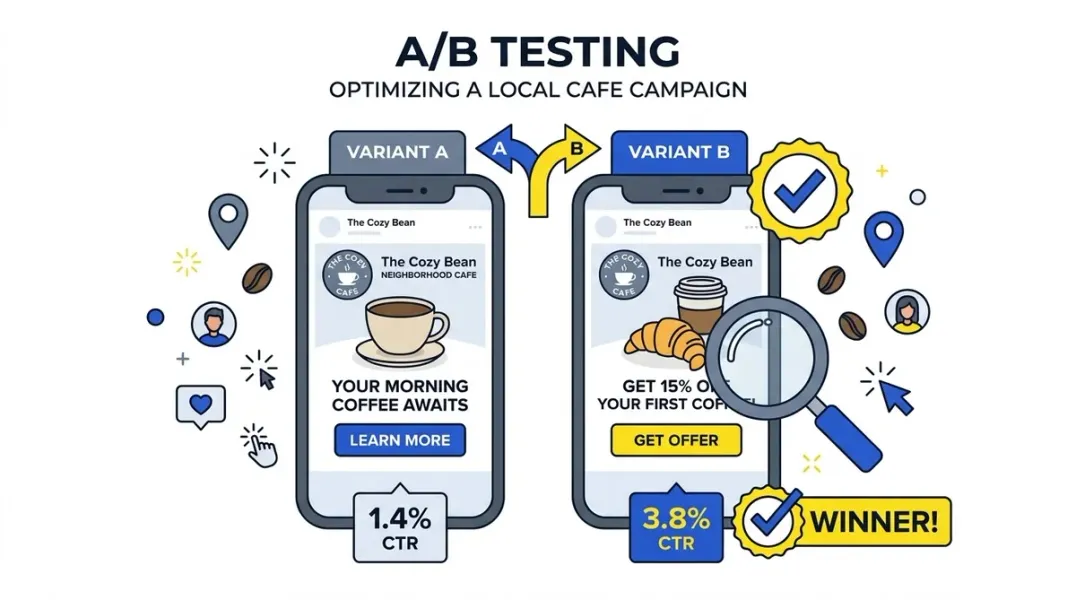
A local marketing experiment framework fixes this. It replaces guesswork with evidence. You form a hypothesis, run a controlled test, measure the outcome against a baseline, and roll out what works. This guide covers how to build that framework for local marketing campaigns, from defining your metrics to running tests and documenting results.
The challenge is that local search is volatile. Rankings fluctuate. Seasonality affects traffic. Competitors make changes. Without a controlled experiment, you cannot isolate the effect of your own actions .
A structured framework solves this by establishing a baseline, changing one variable at a time, and measuring the outcome against a comparable period.
Step 1: Define What You Are Trying to Improve Before you test anything, decide which metric matters. Local marketing experiments typically target one of these outcomes:
- Phone calls from your Google Business Profile
- Direction requests from Maps
- Website clicks from your profile
- Booking clicks through your appointment link
- Form submissions from local landing pages
- Review volume or review response rate
Pick one primary metric per experiment. Testing multiple outcomes at once makes results impossible to interpret .
Step 2: Form a Specific Hypothesis A hypothesis is not “let’s see if this works.” It is a specific, falsifiable prediction.
A weak hypothesis says: “Changing our photos will improve engagement.”
A strong hypothesis says: “Replacing our storefront photo with a team photo will increase direction requests by at least 10% over two weeks.”
The hypothesis includes the variable, the expected outcome, and the timeframe. This precision is what makes results interpretable .
Step 3: Choose One Variable to Test The cardinal rule of experimentation is testing one variable at a time. If you change your description, photos, and posting frequency simultaneously, you cannot know which change drove the result .
Elements Worth Testing on Google Business Profile
- Business description: Benefits-focused vs. feature-focused
- Primary photo: Storefront vs. product vs. team vs. action shot
- Call-to-action: “Call now” vs. “Book online” vs. “Visit us”
- Post frequency: Weekly vs. three times per week
- Post content type: Offers vs. educational vs. behind-the-scenes
- Review response time: Immediate vs. within 24 hours
Elements Worth Testing on Local Landing Pages
- Headline format: “[Service] in [City]” vs. “[Benefit] for [Audience]”
- Local content placement: Top of page vs. bottom
- Form placement: Above the fold vs. after testimonials
Step 4: Establish a Baseline You cannot measure improvement without a starting point. Before you change anything, record your current performance for the metric you are testing.
How Long to Baseline Run your baseline for the same length as your planned test. If you plan a two-week test, capture two weeks of baseline data. This accounts for normal weekly fluctuations .
What to Record Record the raw numbers and the rate. For example, if your profile got 500 views and 25 direction requests, your direction request rate is 5%. Tracking rates rather than raw numbers normalizes for changes in exposure .
Step 5: Run the Test for a Sufficient Duration Local marketing experiments need time to produce meaningful data. Short tests produce noisy results.
Minimum Duration Run each test for at least two to four weeks. This covers at least two full weekly cycles and reduces the chance that a single unusual day skews the result .
Consider Seasonality If your business has seasonal patterns, avoid testing during transition periods. A restaurant testing menu photos in December will get different results than the same test in July .
Account for External Factors Note any concurrent changes: a Google algorithm update, a local event, a competitor opening or closing. These do not invalidate the test, but they affect interpretation.
Step 6: Analyze Results Against the Baseline When the test period ends, compare the test period’s performance to the baseline.
What “Significant” Means A 5% difference over two weeks with 20 data points is not significant. A 15% difference with 200 data points is more likely to be real. For local businesses with low traffic, statistical significance is difficult to achieve. Focus on consistent directional improvement rather than p-values .
Check the Rate, Not Just the Count If your profile views increased 20% and your direction requests increased 20%, your rate stayed flat. The change in requests may be driven by more exposure, not by your variable. Compare rates to isolate the effect of your change .
Step 7: Roll Out Winners and Document Losers The point of experimentation is to build a playbook of proven tactics.
Roll Out Winners If a variant outperforms the baseline by a meaningful margin, adopt it permanently. Document what you changed, when you changed it, and what the measured impact was.
Document Losers Failed experiments are not wasted experiments. They tell you what does not work for your audience. Record the hypothesis, the test conditions, and the outcome. This prevents you from retesting the same idea later .
Build a Testing Journal Keep a simple log of every experiment: date, variable tested, hypothesis, duration, result, and decision. Over time, this journal becomes your local marketing playbook .
Conclusion
A local marketing experiment framework turns guesswork into evidence. Define the metric, form a hypothesis, change one variable, establish a baseline, run the test long enough to matter, analyze the rate rather than the count, and document everything. The businesses that do this build a compounding advantage: they know what works for their specific audience, their specific market, and their specific profile.
Call to Action
Ready to stop guessing and start testing? Build your first local marketing experiment this week using the framework in this guide. If you need help designing and running experiments for your local business, contact our local SEO team for a free consultation.
FAQs
1. How long should a local marketing experiment run?
At least two to four weeks. This covers multiple weekly cycles and reduces the chance that a single unusual day skews results .
2. Can I test multiple variables at once?
No. Test one variable at a time. If you change multiple things simultaneously, you cannot determine which change caused the result .
3. What should I test first on my Google Business Profile?
Start with high-impact, low-effort changes: primary photo, business description format, or call-to-action wording .
4. How do I know if a result is significant?
For low-traffic local businesses, statistical significance is hard to achieve. Focus on consistent directional improvement over the baseline rather than p-values.
5. What if my test fails?
Document the hypothesis, conditions, and outcome. Failed experiments tell you what does not work for your audience and prevent you from retesting the same idea later .
6. Should I test during seasonal peaks or slow periods?
Avoid testing during transition periods. Seasonality can confound results. Run tests during stable periods to isolate the effect of your variable .
Internal & External Links
- Internal Link: [How to Measure Appointment Conversion Rates From Local Search Traffic] (Topic #132)
- Internal Link: [How to Build a Lead Qualification Process for Customers Coming From Google Maps] (Topic #133)
- Internal Link: [Google Business Profile Booking Links: How to Help Customers Schedule Appointments] (Topic #117)
- External Link: Google Business Profile Help: Tips for Improving Your Local Ranking (official Google local search guidance)
- External Link: Asclique: Local SEO A/B Testing (industry guide for local experimentation)
Grow Your Google Maps Ranking on Autopilot
Stop spending hours every week manually replying to customer reviews and writing Google posts. Busirank automates your Google Business Profile to boost your local SEO rankings and turn searchers into paying clients.

 Busirank Team
