 Busirank Team
Introduction
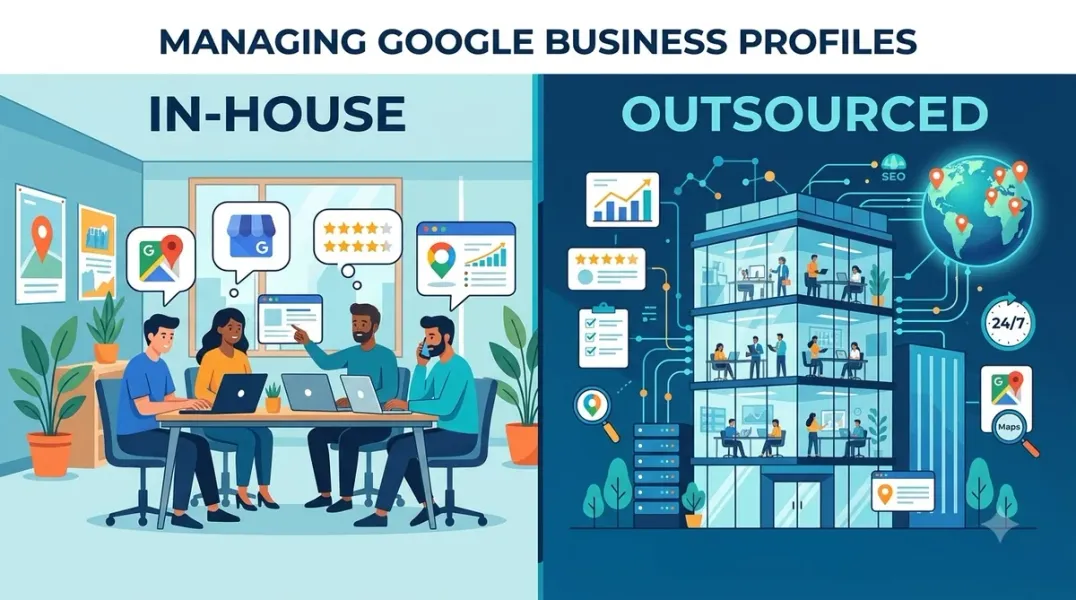
The “build or buy” question comes up for almost every local business eventually: should we manage our Google Business Profiles ourselves, or should we pay someone else to do it?
The intuitive answer is that in-house is cheaper. No monthly agency fee, no vendor markup, just an employee handling it “on the side.” But that intuition has a blind spot: it ignores the real cost of employee time, the cost of mistakes, and the opportunity cost of pulling staff away from revenue-generating work.
A single-location business spending 30 minutes a week on GBP maintenance is genuinely fine doing it themselves. A 20-location chain where internal staff “handle it on the side” can easily consume 100+ hours a week—the equivalent of two to three full-time roles—on work that should be done by specialists.
Outsourcing looks more expensive until you do the math on what you’re actually buying: expertise, scale, risk avoidance, and time.
This guide provides a realistic cost framework for making the decision with evidence rather than intuition.
In-house GBP management usually means “a marketing generalist handles it alongside their other responsibilities.” The real cost has four layers.
Layer 1: Time investment. A properly maintained single-location GBP requires roughly 5.5 hours per week for basic upkeep. That includes competitor spam monitoring (1.5 hours), review management (2 hours), content and posting (1 hour), and edit monitoring (1 hour). For five locations, that’s 27.5 hours per week—more than half a full-time role—spent on repetitive maintenance rather than growth strategy.
Layer 2: Learning curve. Setting up an optimized GBP takes most of a working day for someone who knows what they’re doing. For someone learning as they go, it takes considerably longer. That front-loaded learning cost doesn’t repeat, but it’s real.
Layer 3: Tail risk. Suspensions, duplicate listings, bad merges, and mishandled address changes can consume days and, in the worst case, take a profile and its review history offline. A suspension appeal handled without experience has a significantly lower success rate.
Layer 4: Opportunity cost. The employee’s time has an alternative value. If a marketing manager’s loaded hourly cost is $50 and they spend 20 hours a week on GBP maintenance, that’s
Realistic Outsourcing Cost Ranges
Outsourcing costs vary enormously based on scope, location count, and market competition. Here are the real ranges based on published 2026 pricing.
Automated tool tier:
This is software, not service. GBPPromote offers 42 tools at $5.33 per location per month** . LocalClarity runs **
Single-location managed service:
This is the tier where a real strategist is involved. Locafy’s 2026 pricing guide states that quality local SEO for a single location in a moderately competitive market costs between $750 and $2,000 per month. Below $500/month, you’re getting automated or templated services that produce marginal results .
This tier includes: fully optimized GBP with weekly posts, 2–4 pieces of locally relevant content per month, citation building across 30+ directories, review monitoring and response guidance, rank tracking, and detailed monthly reporting.
Multi-location managed service:
Multi-location pricing typically uses a base fee plus per-location increments. The per-location cost drops as location count rises.
India’s Mediaverse Digital publishes a clear scaling curve: ₹15,000/month for one location, ₹30,000 for up to three locations (₹10,000 per location), and ₹60,000 for up to ten locations (₹6,000 per location), with ₹5,000/month for each location beyond ten .
A Five-Location Cost Comparison
Assume five locations in a moderately competitive market. Here’s how the three models compare annually.
Model A: In-House (part-time internal management)
| Cost Item | Annual Estimate |
|---|---|
| Employee time (27.5 hrs/wk × $25/hr) | $35,750 |
| Tool subscriptions (5 × $20/mo) | $1,200 |
| Training/learning (one-time, 40 hrs) | $1,000 |
| Total | ~$37,950 |
This excludes recruitment costs, turnover risk, and the value of work the employee isn’t doing.
Model B: Full Outsourcing
| Cost Item | Annual Estimate |
|---|---|
| Base fee (5 locations × $250/location/mo) | $15,000 |
| Possible add-ons (extra content, photos) | $3,000 |
| Total | ~$18,000 |
Model C: Hybrid (tools + partial outsourcing)
| Cost Item | Annual Estimate |
|---|---|
| Automation platform (5 × $20/mo) | $1,200 |
| Internal staff for review replies (5 hrs/wk) | $6,500 |
| Outsourced complex tasks (suspensions, citations) | $2,000 |
| Total | ~$9,700 |
In this scenario, the hybrid model is the most cost-effective, but it requires an internal person who can handle daily review responses and knows when to escalate complex issues.
When DIY Genuinely Works
DIY isn’t always wrong. These conditions make it the rational choice:
- Single location, single clear category. No service-area complexity, no multiple brands, no shared premises.
- Inattentive competition. Look at the three listings above you. If their photos are years old and half their reviews have no reply, consistency alone will move you.
- Daily customer contact. If you speak to customers as the job finishes, asking for reviews is natural rather than a campaign.
- Someone who will actually do it. This is the real qualifier. DIY that lapses after six weeks is worse than not starting, because a quiet profile looks exactly like a business winding down .
When Outsourcing Is Necessary
Certain situations flip the math, and most are structural rather than a matter of effort:
- Something is broken. Suspension, reinstatement, duplicates, bad merges, wrong address. The strongest case for paying someone, because the process is unintuitive and expensive to get wrong twice .
- Multiple locations or complex service areas. Decisions about boundaries, categories, and profiles competing with each other need experience.
- A change of name, address, or ownership. Handled badly, these lose reviews and rankings.
- A genuinely contested market. If the businesses above you are clearly being managed by someone, effort alone won’t close the gap.
- Your hourly value exceeds the fee. If your time is worth $100+/hour and a specialist charges $50/hour, the trade is straightforward .
Pricing Red Flags to Watch For
Guaranteed rankings. No provider can guarantee specific Map Pack positions .
One-time setup fees with no ongoing service. SEO is an ongoing process, not a one-time project .
Long-term contracts with no performance benchmarks. A confident provider earns renewals through results .
Vague deliverables. “Optimization” and “management” mean nothing without specifics. Ask for a sample weekly activity list: how many posts, how many photos, how fast reviews are answered, what reports you’ll receive.
Only automated reports with no analysis. You’re paying for expertise, not software output .
Conclusion
The in-house vs. outsourced comparison isn’t about which is cheaper on paper. It’s about which fits your scale, competition, and internal capacity.
Single location, weak competition, someone who will actually do it—DIY is rational. Your cost is under an hour a week, and the benefit is control and responsiveness.
Multiple locations, contested market, or something already broken—outsourcing usually pays for itself. You’re buying expertise, scale efficiency, and risk avoidance.
The most pragmatic answer is often hybrid: automation for NAP consistency and basic posting, internal staff for review replies and daily maintenance, and on-demand outsourcing for complex problems. In the five-location scenario above, that model cost roughly half of full outsourcing.
Don’t be swayed by “DIY saves money” or “agencies are experts.” Put the hidden time cost, tool cost, learning curve, and tail risk on the table. The numbers will tell you what to do.
Call to Action
Evaluating in-house vs. outsourced management? Download our GBP Management Cost Calculator—enter your location count, internal hourly rate, and market competition level to generate annual cost estimates for all three models and see your break-even point.
FAQs
Q: How much time does in-house GBP management actually take? Basic maintenance runs about 5.5 hours per week per location: competitor monitoring (1.5 hrs), review management (2 hrs), content posting (1 hr), and edit monitoring (1 hr). Setup adds roughly a full working day.
Q: What’s a reasonable monthly fee for agency management of a single location? In a moderately competitive market,
Q: What does multi-location outsourcing cost per location? Roughly
Q: Can tools replace an agency? Tools handle NAP consistency and basic posting, but they don’t include strategy, content creation, or human judgment on review replies. A
Q: When should I switch from DIY to outsourcing? When any of these occur: managing more than 3–5 locations, hitting a suspension or duplicate listing issue, facing clearly managed competitors, or when your internal hourly value exceeds the outsourcing cost.
Internal & External Links
Internal Links
- [Google Business Profile Management Costs: What Determines the Monthly Price?]
- [How to Evaluate Google Business Profile Management Software Before Switching Tools]
- [How to Audit Google Business Profile User Permissions Across Your Organization]
External Sources
- Locafy: Local SEO Pricing: How Much Does Local SEO Cost in 2026?
- Ampli5 Pulse: GMB Expert vs DIY: When to Hire a GBP Specialist
- The Mediaverse: Local SEO Cost India 2026
Grow Your Google Maps Ranking on Autopilot
Stop spending hours every week manually replying to customer reviews and writing Google posts. Busirank automates your Google Business Profile to boost your local SEO rankings and turn searchers into paying clients.

 Busirank Team
