 Busirank Team
Introduction
A four-star review is not a satisfied customer. It is a customer who was happy enough to leave four stars and annoyed enough to mention that the wait was forty minutes, the parking was impossible, or the front desk never called back. The star rating says “fine.” The text says “fix this.” Most businesses read the first and miss the second.
That gap is where AI review sentiment analysis earns its place. A sentiment score tells you whether customers are positive or negative. Aspect-based analysis tells you what they are positive or negative about—the specific, fixable parts of the experience that are driving the score up or down. MetricsCart puts the distinction cleanly: sentiment analysis tells a brand that reviews turned negative last month; AI review analysis indicates that the new packaging is causing leaks, that the complaints are concentrated on one channel, and that the issue started three weeks after a specific shipment .
This guide is about using that capability to find customer pain points—not to admire a dashboard, but to identify the recurring problems worth fixing. It covers how aspect-based analysis works, what the 2026 tools actually do, what real sentiment data reveals about local service categories, and where the models still fall short.
Sentiment Analysis vs. AI Review Analysis: The Difference That Matters
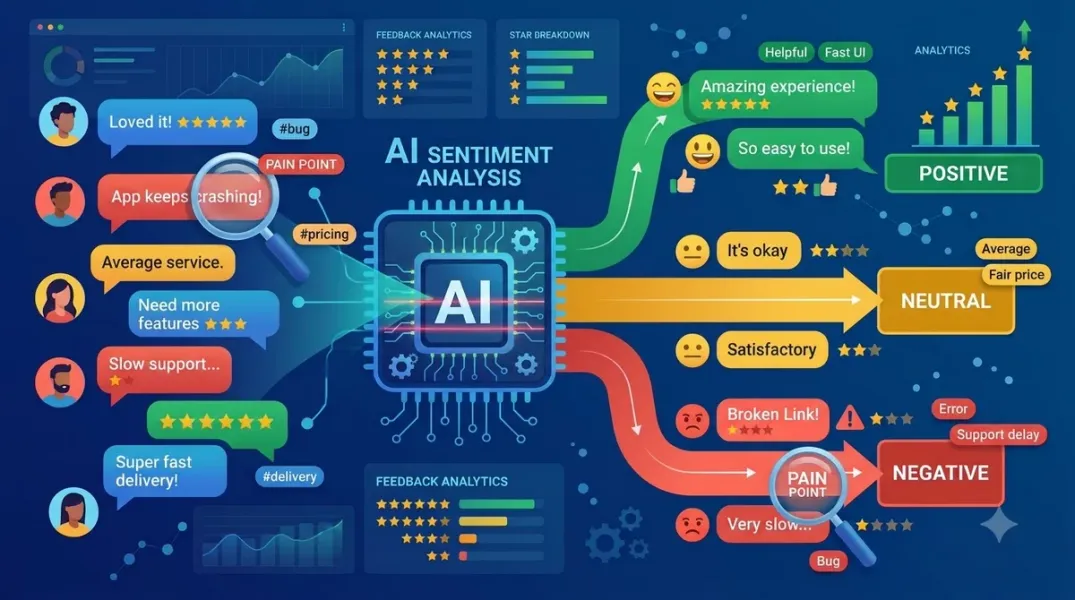
The two terms get used interchangeably, and that is a mistake. Sentiment analysis is a scoring exercise: each review or sentence is labelled positive, negative, or neutral. AI review analysis is an extraction exercise: it identifies what the review is about, groups those topics into themes, and attaches sentiment to each one .
The difference is visible in a single review. A four-star review that says “The formula works well, and my skin looks better after three weeks, but the pump broke on day two” carries positive sentiment about the product and negative sentiment about the packaging. A basic sentiment score collapses that into “mostly positive.” Aspect-based scoring splits product, packaging, and service signals within a single mixed review .
For pain-point discovery, the second approach is the one that produces action. A rating tells you something is wrong; topic extraction tells you what .
How Aspect-Based Analysis Turns Reviews into Pain Points
The research on this is more mature than the tool marketing suggests. A 2026 study from Incheon National University outlines a four-stage model that is worth understanding because it describes what good analysis should do .
Stage 1 — Collect and clean. Reviews are gathered from the platforms where customers actually write them and tagged for analysis.
Stage 2 — Extract aspects and actions. Natural language processing pulls out the service aspect (performance, payment, staff, wait time) and the specific customer action associated with it. The study’s example is instructive: in “The app keeps crashing,” the aspect “performance issue” is vague, but the action “crash” is specific—and its urgency increases if “crash” appears frequently across reviews .
Stage 3 — Score sentiment at the aspect level. Each sentence gets a sentiment score, and those scores are averaged per aspect to produce an aspect-level sentiment score. This is the step that separates a topic list from a pain-point ranking.
Stage 4 — Rank by relevance and emotional intensity. Aspect-action pairs are ordered by how often they appear and how strongly customers feel about them, producing a prioritised list of improvement areas .
That ranking is the deliverable. The output is not “customers mention parking.” It is “parking is the second most emotionally intense complaint theme this quarter, concentrated at two of your six locations.”
What Sentiment Data Actually Reveals (and Why It Surprises People)
The value of this analysis is that it contradicts assumptions. A 2026 report analysing 46,656 Google Business Profile reviews across 60 North Atlanta businesses in six service categories found that communication was the primary improvement area for 40% of the businesses studied, with pricing transparency the second most common gap .
That is not a list of product failures. It is a list of process failures—the things that happen between the service and the customer. And the category-level differences are revealing: plumbing ranked highest with a 4.72-star average and 87% positive sentiment, while HVAC ranked lowest, dragged down by two high-volume businesses with 40–50% negative sentiment rates . A group-wide average would have hidden both the star performer and the two outliers. Per-aspect analysis surfaced them.
The pattern repeats in other sectors. An analysis of U.S. car dealership reviews found communication issues mentioned in 42% of negative Google reviews, against a 15% year-over-year drop in total review volume . Alchemer’s 2026 quick-service restaurant data shows customer service mentions up 17% year over year with sentiment down 1.5%, and food quality mentions up 11% with sentiment down 3.4%—mention volume rising while sentiment falls, which is exactly the signal a star-rating average cannot show .
The consistent finding is that the most common pain points are operational and communicative, not product-related. Wait times, callback failures, pricing clarity, parking, and staff interaction dominate. Those are fixable, and they are invisible in a rating.
The Tools That Do This in 2026
The tool landscape splits into browser extensions, API actors, and full reputation platforms. The right choice depends on whether you need a one-off audit, a repeatable workflow, or a dashboard inside a broader platform.
Browser extensions for quick audits. The GBP Reviews Sentiment Analyzer (Chrome, updated February 2026) analyses reviews on any live Google Business Profile with sentiment detection, semantic topic clusters grouped into themes like “Customer Service,” “Value & Pricing,” and “Results & Outcomes,” and a content-opportunities section that turns review language into marketing ideas . It also filters out owner responses so they do not skew the dataset, and exports a multi-sheet Excel file with five tabs including topic clusters and keywords . The limitation is the analysis window: it covers roughly the past 60 days, which is enough for an audit and not enough for a trend line .
API actors for repeatable, scaled analysis. Apify’s Google Maps Review Intelligence scrapes reviews and runs AI analysis in a single run, producing sentiment scores with a 0–100 confidence score, a complaint taxonomy (service quality, wait time, pricing, cleanliness), topic clusters, and competitor delta comparison across two or more locations . A separate Pain Point Analyzer is built specifically around recurring complaints and actionable business opportunities, priced from $2.00 per 1,000 reviews analysed . For teams that want to compare their own locations against competitors, the competitor-delta feature is the differentiator—it shows who wins on sentiment and which complaint categories each side owns.
Platforms for ongoing monitoring. Miivo’s Customer Insights tool (launched July 2026) monitors sentiment across Google Reviews, Instagram, and Reddit, surfacing data-driven recommendations and pairing them with on-brand, AI-predrafted replies . Alchemer sorts every comment by theme, sentiment, and location automatically, so location managers spot problems in real time rather than weeks later—the company reports QSR brands using it raised their combined response rate from 16% to 77% . Enterpret and Chattermill operate in the broader customer-feedback intelligence category, with AI-driven taxonomy, multi-source aggregation, and sentiment analysis aimed at product and CX teams rather than local marketing .
Academic and low-cost pipelines. For teams with technical capacity, the research-grade approach is viable. A 2026 study documented a replicable low-cost pipeline using SerpApi to collect reviews and VADER to classify sentiment, with results of 85% positive, 4% neutral, and 11% negative on the corpus analysed . VADER is rule-based and interpretable, which is an advantage for simple positive/negative classification and a limitation for nuanced or mixed sentiment .
The Limits You Need to Know Before You Trust the Output
Sentiment models are useful and imperfect, and the 2026 research is unusually candid about where they fail.
Fine-grained emotion is still hard. A zero-shot evaluation of LLMs on fine-grained emotion taxonomies found the best performer, Gemini, reaching 39.9% accuracy and a macro-F1 of 0.363, with GPT-5.4 and Claude close behind but not materially better . That is not a solved problem, and it means a tool that claims to detect subtle emotional nuance should be treated with scepticism.
Humans and models disagree on sentiment itself. A 2026 study evaluating inter-rater reliability found that nobody truly agrees on sentiment—human raters, bespoke tools, and LLMs all struggle with social media text, and domain-specific fine-tuning remains crucial for reliable results . The practical implication is that a generic model applied to your review corpus without tuning will produce systematic errors, and you should validate a sample against your own reading before acting on a ranking.
Rule-based tools oversimplify. VADER, the accessible low-cost option, is a rule-based method that may oversimplify complex emotional tones or mixed sentiments . It is a reasonable first pass and a poor final word on a review that says “great food, terrible service, would come back for the fries.”
Language and local idiom are persistent failure points. The pharmacy study that used automated sentiment and aspect extraction acknowledged that local expressions, idioms, and context-specific meanings were not accurately captured by existing lexicons and algorithms . If your customers write in a dialect, a second language, or heavy sarcasm, validate the output before you build a strategy on it.
Domain drift and prompt sensitivity affect LLM-based tools. The 2026 literature identifies domain drift, cultural bias, and model variability as open challenges, with a model variability problem arising from stochastic inference and prompt sensitivity . The same review can score differently on different runs. For trend analysis, that noise matters.
The operating rule is therefore validate, then act. Read a random sample of 30–50 reviews and compare your own labelling to the tool’s. If the agreement is high on the themes you care about, use the ranking. If it is not, the tool is a starting point for reading, not a replacement for it.
A Practical Workflow for Pain-Point Discovery
The workflow that produces usable findings in a single sitting:
Step 1 — Pull 60–90 days of reviews from your own locations and two competitors, using a scraper or an extension with an export function.
Step 2 — Run aspect-based analysis, not just sentiment scoring. You want topic clusters and a complaint taxonomy, not a single positive/negative number.
Step 3 — Rank by frequency and emotional intensity. A theme mentioned twice with fury and a theme mentioned forty times with mild irritation are different problems. The aspect-action ranking is what tells them apart.
Step 4 — Segment by location and by time. A complaint concentrated at one branch is an operational issue; the same complaint across six branches is a systemic one. A complaint that started three weeks ago is a regression, not a chronic condition .
Step 5 — Validate the top three themes against your own reading. Read the actual reviews behind the ranking. If the theme holds up, it is real.
Step 6 — Assign an owner and a fix. The output of sentiment analysis is not a report; it is a task list. “Communication” as a theme is unactionable. “Callback failures on service requests, concentrated at Locations 3 and 5, 22 mentions in 60 days” is a ticket someone can close.
Conclusion
AI review sentiment analysis is most valuable not when it tells you your rating went down, but when it tells you which specific, fixable part of the customer experience is dragging it down—and which location, which channel, and which recent change are involved.
The research and the tooling have converged on aspect-based analysis as the method that produces that answer. It splits mixed reviews, attaches sentiment to topics rather than to the whole review, and ranks pain points by frequency and emotional intensity. The 2026 data from 46,656 reviews shows what it finds in practice: communication and pricing transparency top the list, not product failures, and the category-level spread between a 4.72-star plumber and an HVAC cluster with 40–50% negative sentiment is invisible in any group average.
The limits are real—fine-grained emotion detection is far from solved, models disagree with humans and with each other, and language and idiom still trip automated extraction. The response is not to skip the analysis. It is to validate a sample before you act, and use the ranking to direct human attention rather than replace it.
Call to Action
Run a one-hour pain-point audit this week. Export 60–90 days of reviews for your top location and one competitor, and run them through a tool with aspect-based clustering—the GBP Reviews Sentiment Analyzer for a quick pass, or an Apify pain-point actor if you want a repeatable pipeline. Read the top three complaint themes behind the scores, and check whether they are concentrated at one location or spread across all of them. Pick the one theme with the highest frequency and emotional intensity, assign it to a named owner, and write down the operational change that would make it disappear from next quarter’s reviews. That is the difference between a sentiment dashboard and a sentiment strategy.
FAQs
What is the difference between sentiment analysis and aspect-based sentiment analysis?Sentiment analysis scores a review as positive, negative, or neutral. Aspect-based sentiment analysis identifies what the review is about—product, packaging, service, wait time—and assigns sentiment to each aspect separately. The second approach is what allows you to find specific pain points inside mixed reviews, rather than collapsing a four-star review with a buried complaint into “mostly positive” .
Can AI sentiment analysis find customer pain points from Google reviews?Yes, and the research shows it works best when it ranks themes by frequency and emotional intensity rather than just scoring positivity. The Incheon National University model extracts aspect-action pairs, scores sentiment at the aspect level, and ranks improvement areas by relevance and emotional intensity . The 2026 North Atlanta report applied this to 46,656 reviews and identified communication as the primary improvement area for 40% of businesses .
What are the most common pain points found in local service reviews?The 2026 data points consistently to operational and communicative issues, not product failures. Communication was the top improvement area in the North Atlanta study, pricing transparency was second, and a U.S. dealership analysis found communication issues in 42% of negative reviews . Alchemer’s QSR data shows customer service and food quality mentions rising while sentiment falls—mention volume up, sentiment down .
What tools can analyse Google review sentiment in 2026?Browser extensions like the GBP Reviews Sentiment Analyzer provide quick topic-clustered audits with Excel export . API tools on Apify offer sentiment scoring, complaint taxonomies, and competitor comparison, priced from around 10 per 1,000 reviews . Platforms like Miivo and Alchemer provide ongoing monitoring with theme and location sorting .
How accurate is AI sentiment analysis?It depends on the task. Fine-grained emotion detection is still weak—a 2026 zero-shot evaluation found the best model at 39.9% accuracy on fine-grained emotion taxonomies . Research also finds that humans, bespoke tools, and LLMs do not fully agree on sentiment, and that domain-specific fine-tuning is crucial . For theme-level pain-point discovery, accuracy is higher, but you should validate a sample against your own reading before acting on a ranking.
What are the limitations of review sentiment analysis?Known limitations include rule-based tools oversimplifying mixed sentiment , language and local idiom not being captured accurately , domain drift and model variability in LLM-based analysis , and hallucination and domain adaptation challenges in aspect-based analysis . The practical rule is to validate a sample before building a strategy on the output.
Can sentiment analysis compare my business to competitors?Yes. Tools like Google Maps Review Intelligence and Pain Point Analyzer support competitor delta comparison, showing which location wins on sentiment, response rate, and complaint categories, and which gaps are worth closing . This is one of the highest-value uses of the analysis because it turns an internal health check into a competitive positioning exercise.
Internal & External Links
Internal links (to other posts in this series):
- How to Choose the Right Call-to-Action for Google Business Profile Posts (previous post)
- How to Identify Repeated Customer Complaints Across Multiple Store Locations (next in series)
- How to Automate Google Review Responses Without Losing Your Brand Voice
- How to Build a Google Review Monitoring Workflow for Busy Teams
- How to Compare Local Marketing Performance Across Different Business Branches
- How to Audit Your Team’s Review Responses for Quality and Consistency
External links (sources referenced in this article):
- GBP Reviews Sentiment Analyzer (Chrome Web Store): https://chromewebstore.google.com/detail/gbp-reviews-sentiment-ana/meipembigpibdonkklhnjfobajfogcmh
- Google Maps Review Intelligence (Apify): https://apify.com/bitdoze/google-maps-review-intelligence
- Google Maps Reviews Scraper & Pain Point Analyzer (Apify): https://apify.com/egeusta/google-maps-review-pain-point-miner
- Miivo Launches Low Cost, Fully Automated AI Customer Insights Tool (Nasdaq, July 2026): https://www.nasdaq.com/press-release/miivo-launches-low-cost-fully-automated-ai-customer-insights-tool-small-medium-size
- Alchemer — How Alchemer Turns Guest Feedback into Revenue for Quick Service Restaurant Brands: http://www.alchemer.com/resources/e-guide/quick-service-restaurant-roi-report/
- The 2026 North Atlanta GBP Sentiment Report (Zenodo, June 2026): https://zenodo.org/records/21002355
- Incheon National University — Research turns customer reviews into actionable guidance (EurekAlert, May 2026): https://www.eurekalert.org/news-releases/1128629
- Exploring Customer Insights Through Online Review Analytics (ScienceDirect, 2026): https://www.sciencedirect.com/org/science/article/pii/S1947963826000079
- MetricsCart — AI Review Analysis: How AI Reads Customer Reviews Across Every Retailer (2026): https://metricscart.com/insights/ai-review-analysis/
- Dealership Guy — Dealership communication issues mentioned in 42% of negative Google reviews (July 2026): https://news.dealershipguy.com
- Large language models for aspect-based sentiment analysis in e-commerce: A review (ScienceDirect, July 2026): https://www.sciencedirect.com
- Reframing sentiment analysis in the LLM Era (Artificial Intelligence Review, August 2026): https://link.springer.com
- Quantifying the Affective Gap: Zero-Shot Evaluation of LLMs on Fine-Grained Emotion Taxonomies (IEEE, September 2026): https://ieeexplore.ieee.org
- Nobody Truly Agrees on Sentiment: Humans, Bespoke Tools, and LLMs Struggle with Social Media Texts (arXiv, October 2026): https://browse-export.arxiv.org
- Listening at Scale: A Replicable, Low-Cost Pipeline for Collecting and Analyzing Google Business Reviews with SerpApi and VADER (2026): https://saeb.feaa.uaic.ro
How to Identify Repeated Customer Complaints Across Multiple Store Locations
Grow Your Google Maps Ranking on Autopilot
Stop spending hours every week manually replying to customer reviews and writing Google posts. Busirank automates your Google Business Profile to boost your local SEO rankings and turn searchers into paying clients.
 Busirank Team